-
-
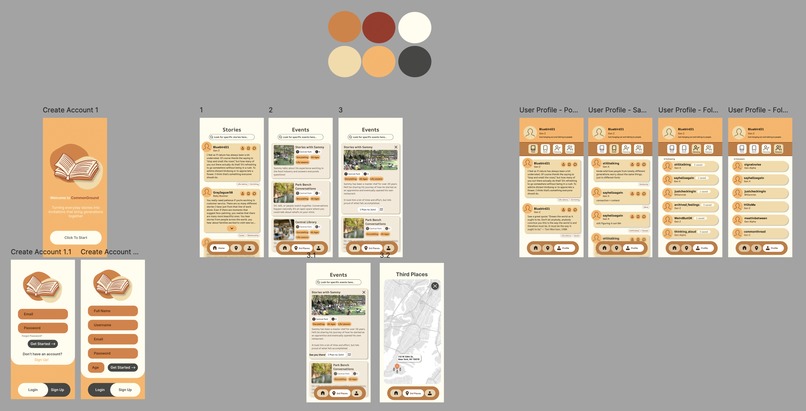
high fidelity
-
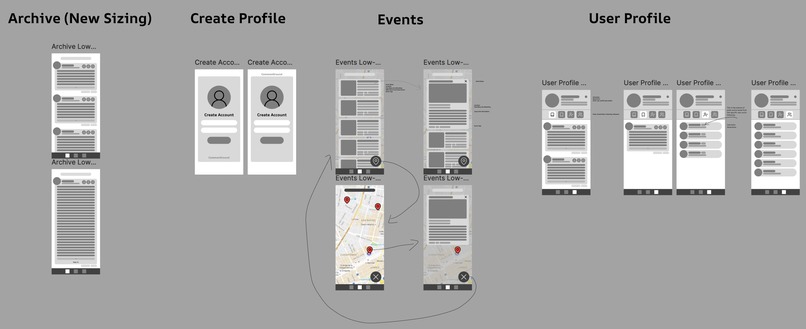
low fidelity
-
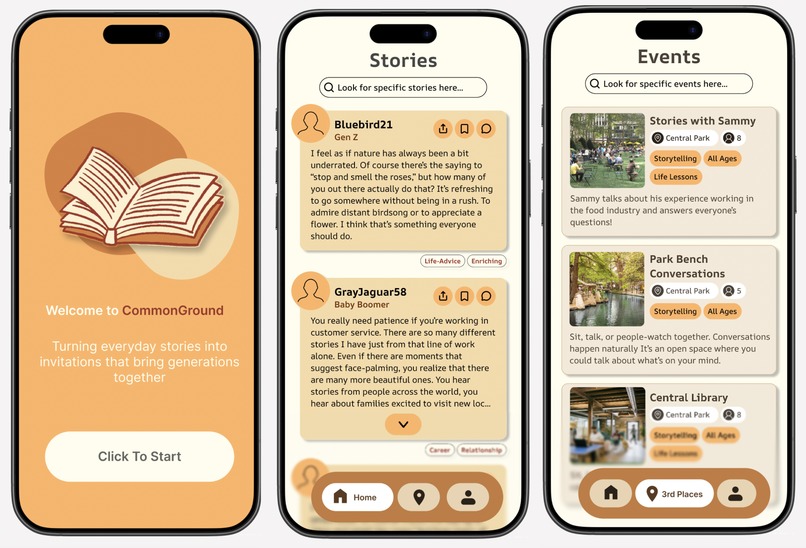
demo on phone
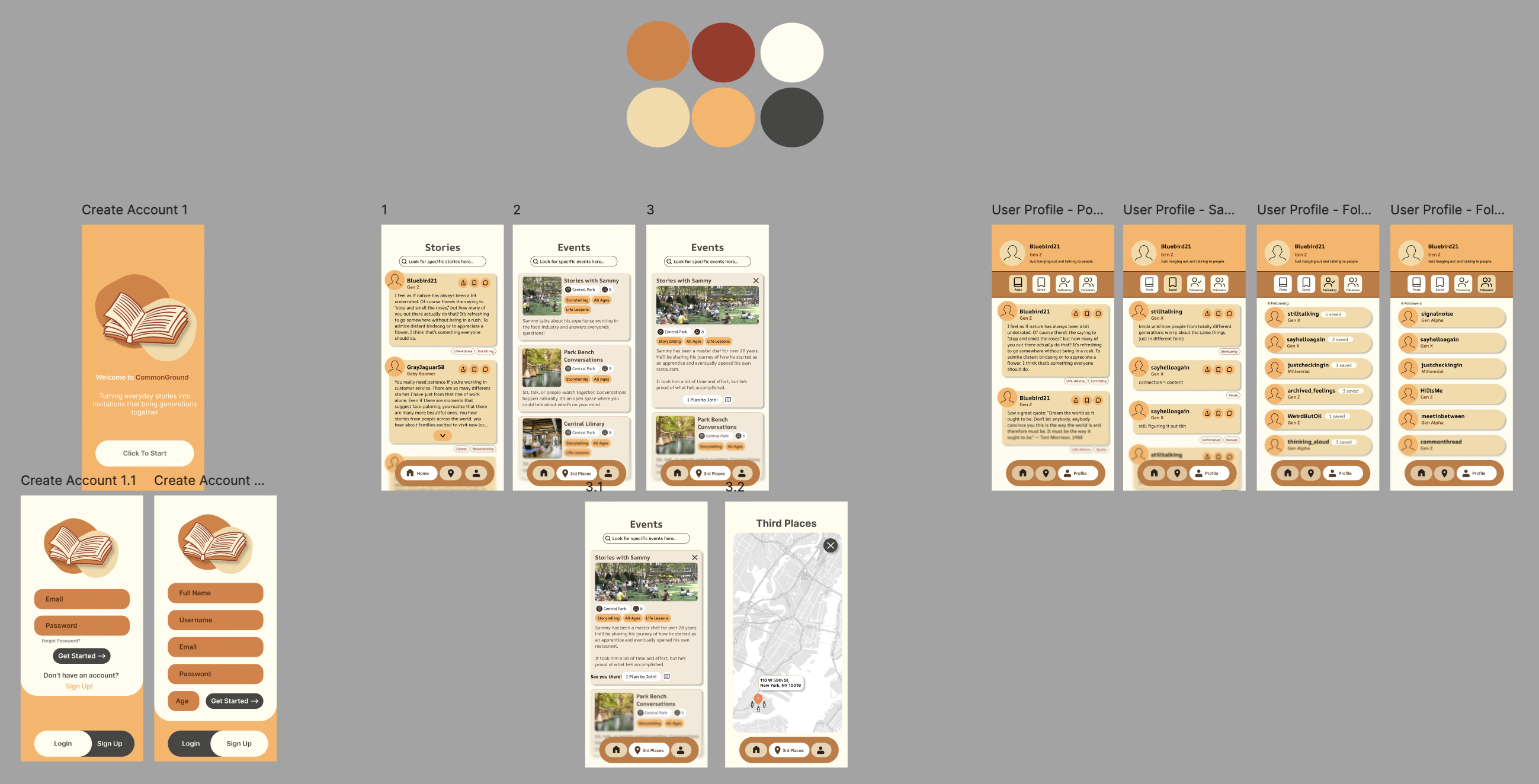
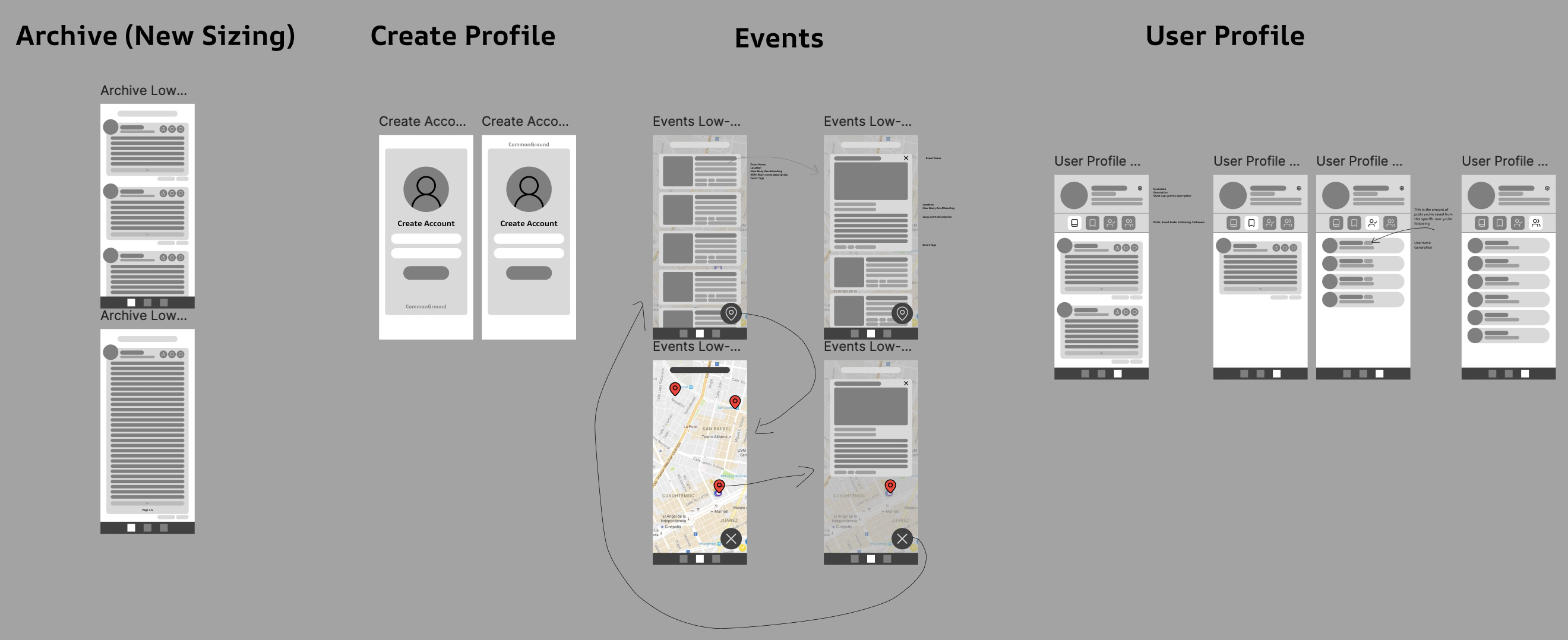
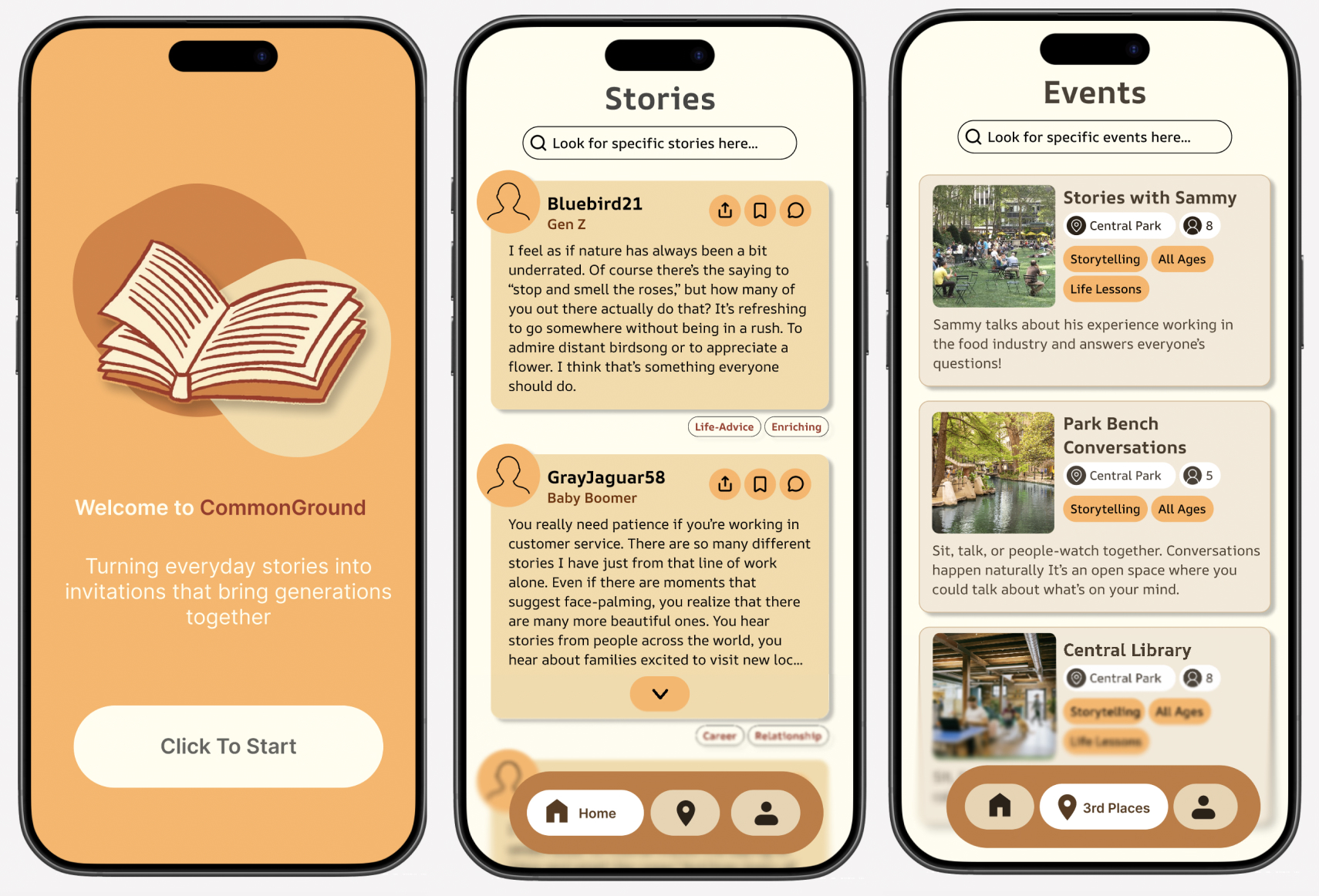
Playable prototype: Link
A Video Demo: https://www.youtube.com/watch?v=HAdBpKr7DS8
Describe your project [150 Word Limit]: We noticed that meaningful connection has become harder to come by. Many traditional “third spaces” now require spending money – cafés, events, even casual meetups often come with an $8 latte attached. Outside of work, school, or home, it’s difficult to find low-pressure places to connect with others in everyday life. CommonGround is our idea of a response to that gap. It’s part storytelling archive, part bridge to real-world connection. People can share personal stories or lessons they’ve picked up, without the likes, upvotes, or pressure to perform like traditional social media. Stories are tagged by generation to provide context on who’s sharing their story, so that different age groups can learn from one another. If a story resonates, users can choose to connect by joining in-person gatherings in shared public spaces like parks or libraries. CommonGround turns everyday stories and spaces into invitations for connection across generations.
Describe your research process and findings. If you conducted any surveys or interviews, please include the survey form and/or interview questions here. If you conducted secondary research by pulling from online sources, please include a link to your sources. [500 Word Limit]
Survey Questions: https://forms.gle/bBSbvvCZLa75c9m69
Our research was broken down into two steps:
User interview: https://docs.google.com/document/d/1kz7wGzpeVmq0PWAxlygai2OwlnqAkuyBXJ3-PKPz1u0/edit?usp=sharing To gather perspectives from younger generations, we sent out our survey through the Rice Discord and several of our university Reddit communities. Our goal was to understand how young people (roughly 29 and under) experience relationships with older figures in their lives, such as parents, grandparents, and caregivers. Since we anticipated that it would be difficult to reach older participants through online channels, one of our team members also conducted an in-depth interview with their mom to capture an older generational perspective (35 and older). The responses we got were super insightful and showed tension from both sides. Younger participants often described conversations with older people as becoming a sort of ‘lecture’ where advice turns into long explanations or complaints, making it hard to engage openly. On the other hand, the older participant expressed hesitation around asking younger people for help. They felt pressure to always appear ‘wise’ and feared that being vulnerable or admitting uncertainty would make them seem incapable or unintelligent. Across both older and younger target groups, a shared pattern emerged: fear of judgment and fear of bothering the other person. Younger people worried about being dismissed or talked down to, while older people worried about losing authority or respect. People want intergenerational connection, but fear the emotional risk (ie: judgment, fear of looking ‘stupid).These main findings helped us identify a key core barrier preventing intergenerational connection. We intentionally chose to design a mobile application, as phones are the most accessible device across age groups and backgrounds. Despite all the ideas we have come up with, we decided to only move forward with features that were directly supported by our research. For example, one of the ideas we came up with was a ‘skill-sharing’ feature where generations could share skills and knowledge. Since there wasn’t enough research to back up this feature, we did end up dropping it.
After finding key insights + needs, features that were backed up by user research, we decided to frame our problem statement: How might we make everyday public spaces and stories feel like invitations to connect rather than barriers? We also considered edge cases revealed through our findings. Like users can enable or disable location sharing when joining a group for privacy concerns. To prevent groups from skewing too heavily toward one generation, we also implemented a soft cap so that no more than 70% of a group can belong to the same age range. These decisions were made to ensure safety, balance, and inclusivity across generations.
References: https://mindbodycounselingreno.com/blog/relationships/generation-gap/
Describe your most important design decisions. What research findings and/or user testing results led you to make these decisions? [500 Word Limit]
Several main key decisions went into our final decision They are as follows:
Designing around storytelling and empathy From the beginning, we wanted CommonGround to feel like flipping through a book in a quiet, cozy library. Our research showed that fast-paced social media often discourages empathy and deep understanding as content is quickly consumed, judged, and forgotten. Since we wanted to encourage empathy and understanding, we used a book as a visual metaphor to slow users down and encourage them to “read” into someone else’s life and perspective. Each story represents a small window into someone’s lived experience, helping users build empathy across generations. While we briefly explored a playful “cookie” theme at one point, we ultimately decided that leaning fully into storytelling better supported our goal of reflection and understanding.
Removing likes to reduce performance pressure Research and survey responses showed that people are hesitant to share openly when their stories are ranked or judged. To address this, we intentionally removed likes and upvotes from posts. This design choice helps prevent popularity-driven behavior and keeps the focus on sharing experiences rather than seeking validation. We kept comments to allow for conversation and connection, and users can follow others to curate a feed that feels personal rather than competitive.
Bookmarking meaningful stories One strong insight from our research was that users find it deeply satisfying when advice or a lesson actually helps them in real life. To support this, we introduced a bookmarking feature that allows users to save stories that resonated with them or were genuinely useful. This lets users return to advice that worked for them and it reinforces the idea that stories aren’t just content to scroll past, but resources to revisit and learn from over time.
Using tags to support intentional discovery From our research it was clear that not every story resonates with every person at the same time. Younger users especially shared that what feels useful depends on where they are in life. To support this, we introduced a simple tagging system that helps people find stories that match what they’re currently navigating. Generational tags are used as context, not as labels, and they allow users to explore different perspectives intergenerationally without creating hierarchy or division.
Encouraging connection in shared public spaces Finally, we chose to include a “third-place” style hosting for connection because our research highlighted the loss of accessible third spaces. Many users (especially younger participants) showed frustration with the fact that most spaces for connection now require spending money, such as cafés or paid events. People often feel limited to connecting only at work, school, or online. Many want to connect but don’t know where or how to initiate it without cost or pressure. By allowing users to turn stories into casual, in-person gatherings in free and shared public spaces like libraries or parks, CommonGround bridges online storytelling with real-world connection in a more accessible and inclusive way.
If applicable, describe how you utilized AI in your design process. Please explain where AI fits into your workflow, which tools you used, and the specific purpose AI served at that stage. Include a concrete example of how AI influenced a design decision. [500 Word Limit]
We used AI (ChatGPT) to synthesize our research, since we did not have enough time to map it all out on a Miro Board or Figjam. It summarized our findings and we used some of that information to guide our designs. We also used AI (ChatGPT) to generate images for the video presentation, as we didn’t have enough time to record ourselves using the app. Most of the designs we drew from inspiration of warm color palettes online, and layout was inspired from existing apps we knew (like substack and some twitter features).
Built With
- chatgpt
- figma

Log in or sign up for Devpost to join the conversation.