Inspiration
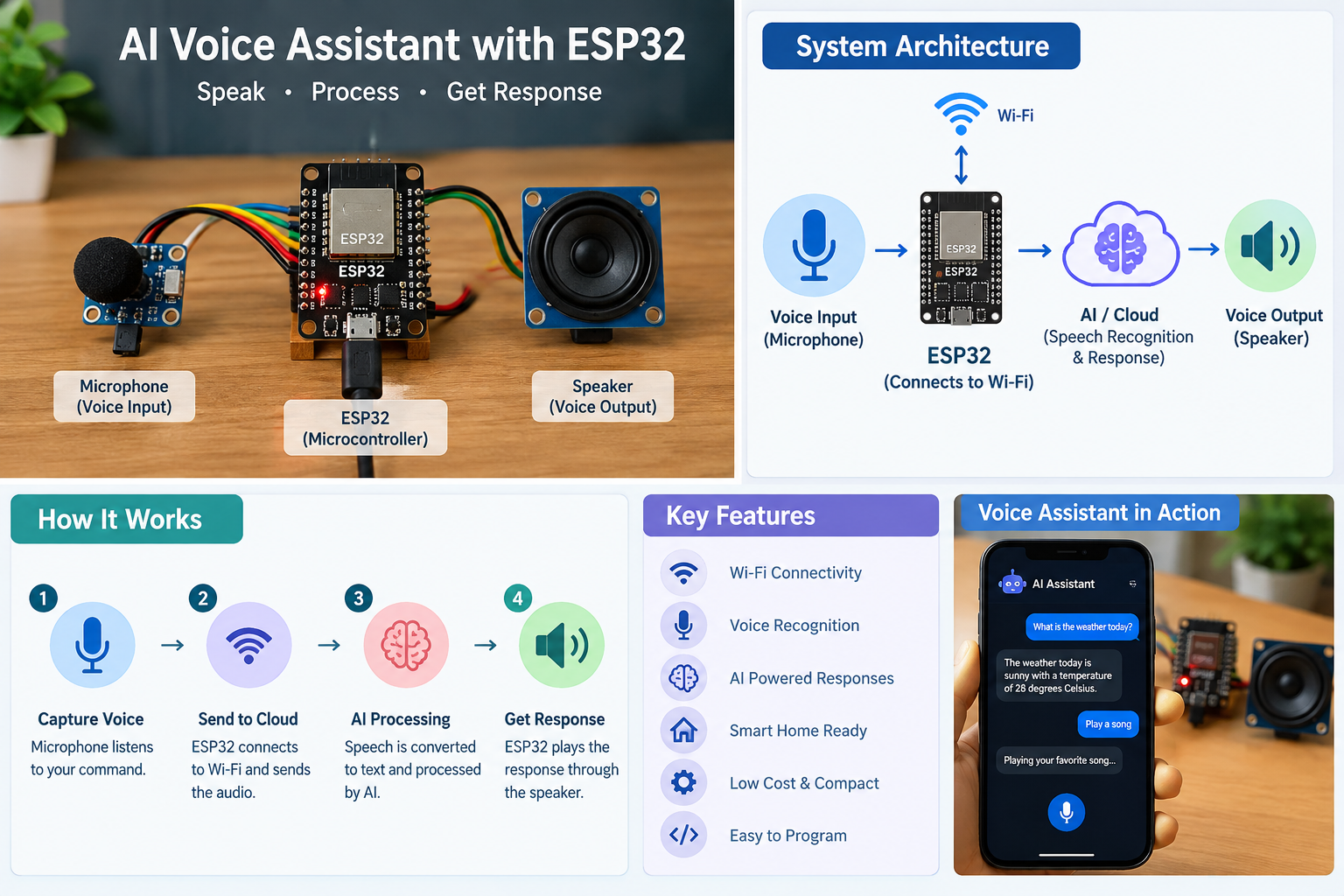
My inspiration for building an AI Voice Assistant with ESP32 was to make everyday life smarter and easier through voice-controlled technology. I wanted to combine Artificial Intelligence with embedded systems to create an affordable, interactive assistant that responds to voice commands and demonstrates the potential of smart devices in real-world applications.
What it does
How we built it
How We Built It We built an AI Voice Assistant using the ESP32 microcontroller by integrating voice input, speech recognition, AI processing, and voice output. The ESP32 connects to Wi-Fi to communicate with online services. A microphone captures voice commands, which are processed to understand the user's request. The assistant generates a response and plays it through a speaker. We combined hardware and software components.
Challenges we ran into
Challenges We Ran Into While building our AI Voice Assistant with ESP32, we faced several challenges, including connecting the ESP32 to Wi-Fi, integrating the microphone and speaker, achieving accurate speech recognition, and reducing response delays. We also had to manage limited memory and processing power on the ESP32 and troubleshoot hardware and software compatibility issues.
Accomplishments that we're proud of
Accomplishments That We’re Proud Of We successfully developed an AI Voice Assistant using the ESP32, combining embedded systems, voice interaction, and AI technology. We are proud of integrating hardware and software to create a smart assistant that can receive voice commands and provide responses. This project helped us improve our skills in microcontroller programming, IoT connectivity, and problem-solving while demonstrating the potential of affordable AI-powered smart devices.
What we learned
What We Learned While building our AI Voice Assistant with ESP32, we learned how to integrate hardware and software, program the ESP32, connect devices through Wi-Fi, and work with voice recognition and AI services. We gained practical experience in embedded systems, IoT communication, debugging, and hardware integration. We also learned the importance of teamwork, problem-solving, and continuous testing to build a reliable and user-friendly smart assistant.
What's next for I built An AI voice Assistant With ESP32
Our next goal is to improve our AI Voice Assistant with ESP32 by adding better voice recognition, faster responses, offline voice commands, and support for multiple languages. We plan to integrate smart-home control, IoT device automation, and enhanced security features. In the future, we aim to make the assistant more intelligent, affordable, energy-efficient, and useful for everyday life.
Built With
- ai
- arduinoide
- artificialintelligence
- automation
- electronics
- embeddedsystems
- esp32
- hardware
- home
- homeautomation
- innovation
- internetofthings
- iot
- machine-learning
- microcontrollers
- naturallanguageprocessing
- python
- smartdevices
- smarthome
- software
- speechprocessing
- studentproject
- voiceassistant
- voicerecognition
- wifi

Log in or sign up for Devpost to join the conversation.