Inspiration
There is a huge gap today on a almost all blockchains: Lack of proof-of-personhood protocols, and specifically a lack of any unique-human protocol. It is preventing us from doing so many things; like fair airdrops, ICOs & crowdsales. Or one-person-one-vote. Or Universal Basic Income. Or really anything else that is prone to those pesky sybil attacks.
What it does
Allows projects to query if a wallet belongs to a loyal / credible / trustworthy / unique human, according to various different criteria of “personhood”, which could range from the most strict Proof-Of-Humanity to more loosely defined criteria such as having a few proofs-of-participation (POAPs) in your wallet.
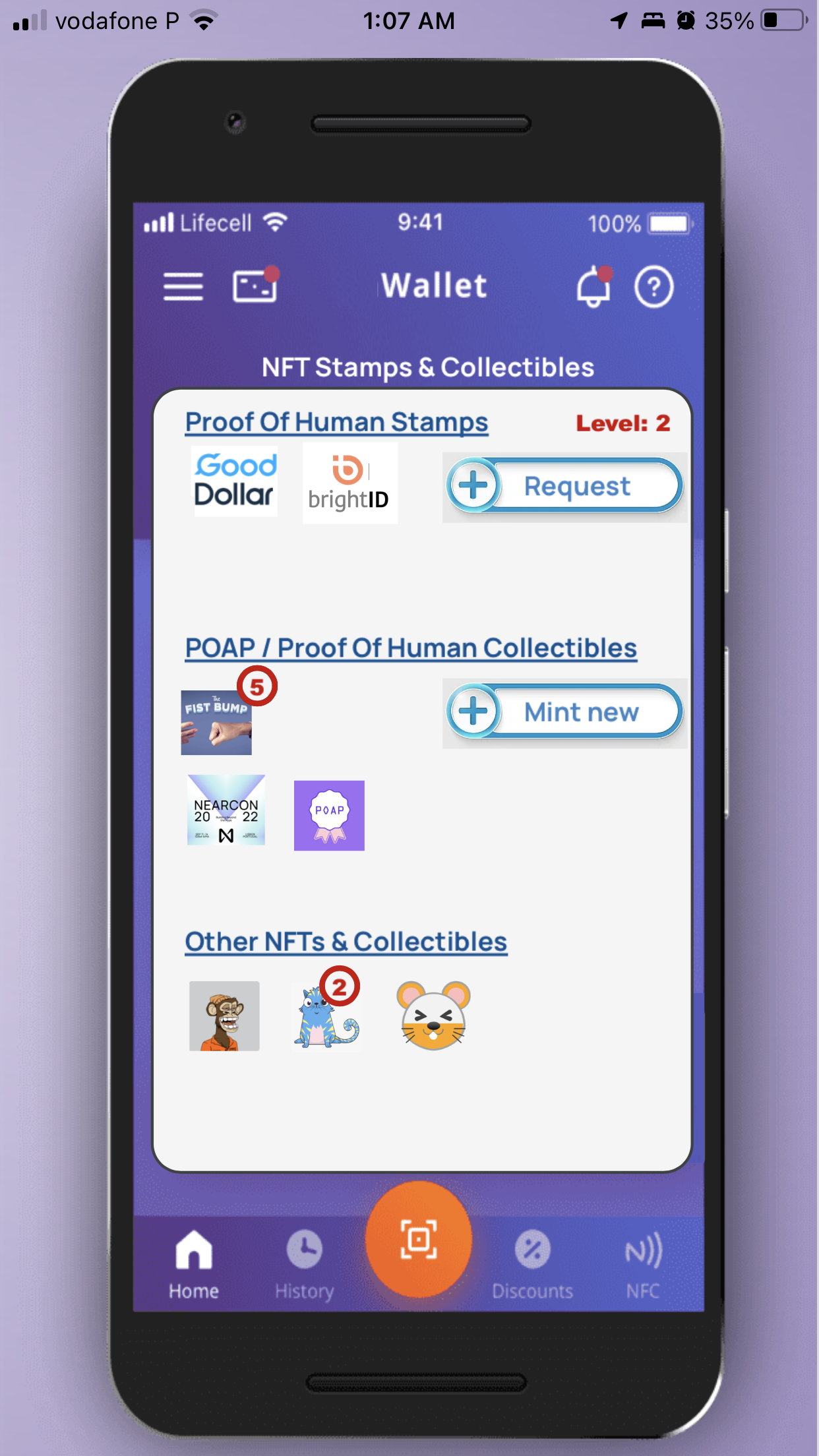
Our reimagined Non-Fungible Soulbound Token (SBT) stores “stamps” that holds and carries human credibility in some sense. Users can collect and/or request stamps from stamp providers (= SBT minters). Example: users can request that unique-human projects on other chains mint them corresponding SBTs on Near.
Then our new collection of SBTclass smart contracts can evaluate the presence of whatever collection of stamps are required by a specific project and answer queries such as “does this wallet belong to a unique human” or to a “credible human” or to a “loyal human”.
How we built it
1) Created & documented a new non-fungible Soulbound Token (SBT) standard, which we intend to submit for NEP approval 2) Created a few SBT reference implementations accordingly: the i-am-human-token and the fist-bump-token 3) Created & documented a new SBT-class smart contract standard, which provides a standardized format for querying the presence of some combination of SBT tokens that is deemed to represent personhood, which we also intend to submit for NEP approval 4) Created a HumanClass reference contract implementation accordingly 5) Created a few use-case-specific smart contracts: a UBI contract, and a Farming contract
Challenges we ran into
Challenges were mostly related to defining the problem correctly
- How to prove uniqueness?
- How to evaluate Humanness?
- How to validate that someone is still alive?
- What is credibility? Does it have a freshness to it?
- Can credibility be transferred between wallets?
- How to prevent incentives to steal credibility?
- How to enable people to recover a compromised stamp / compromised private keys?
- How to build credibility in such a way that it fits the max amount of use cases?
- Do we challenge or complement the conventional definition of an NFT?
Accomplishments that we're proud of
This was an incredibly hard, complex and multi-faceted problem to solve! Many have tried before us. But we did it!!!
What we learned
Discussion up front is important. Challenge each other’s ideas constructively. We iterated and broke solution designs several times before we found one that we couldn’t “break” any more. Building is easy if you solve the philosophical and complicated questions first.
What's next for i-am-human.app
- Publish as two new NEPs and get them accepted as standards.
- Build a dApp that can bridge credibility from other protocols (like BrightID) onto Near.
- Build a website (i-am-human.app and i-am-human.near.site) to showcase the solution and teach others how to best use it for their own purposes.
- Build out a fistbump-DAO to kickstart a NEAR-native social-graph-based unique-human protocol together with the SocialGraph project and SeshDAO
- Apply for funding to build and deliver a UBI protocol on Near, and another one on Aurora. Each blockchain should have their own UBI protocol as a combined user acquisition and user retention mechanism, as well as for poverty alleviation.
Categories we apply to:
- Future of finance – Enables better airdrops, ICOs, and crowdsales. And also UBI which will certainly be the future of finance for common folks.
- Governance – Makes DAO more useful in real world, predominantly through enabling one-person-on-vote, which has been a holy grail in crypto for a long time.
- Future of work – building job market reputation and credibility online is much easier and better with one-person-one-account. My skills as represented in my account are mine and no one else’s. (And if I get a bad review I might not be able to escape it too)
- Technical content – We have built common-good tooling free and available to use for anyone, along with standards and accompanying documentation to be approved as NEPs (?)
- Creators – We are enabling new utility on top of traditional NFTs: soul-bound, recoverable, and renewable.
Built With
- hackmd
- rust


Log in or sign up for Devpost to join the conversation.