-
-
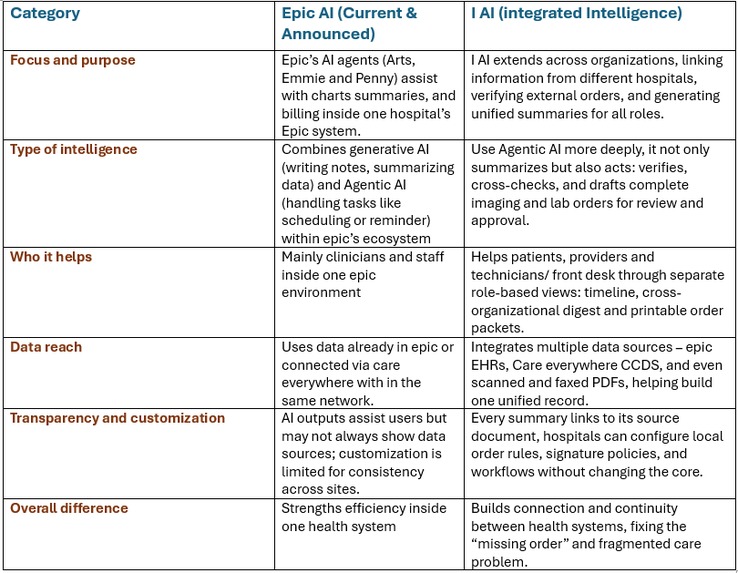
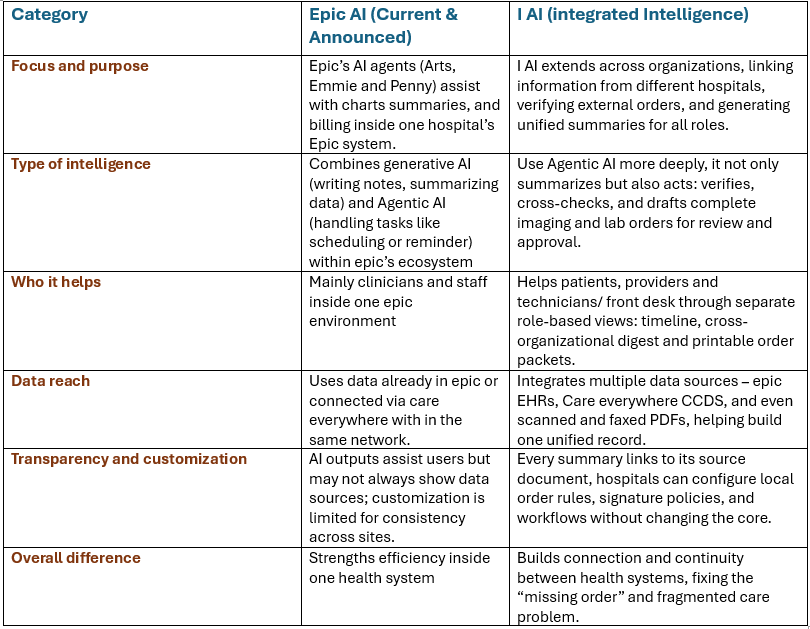
Comparison between what an AI in Epic systems can do and What I AI could be capable of.
-
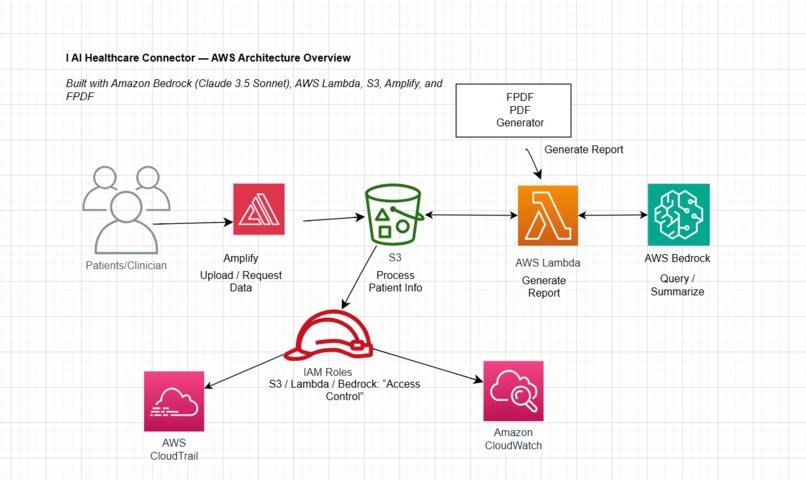
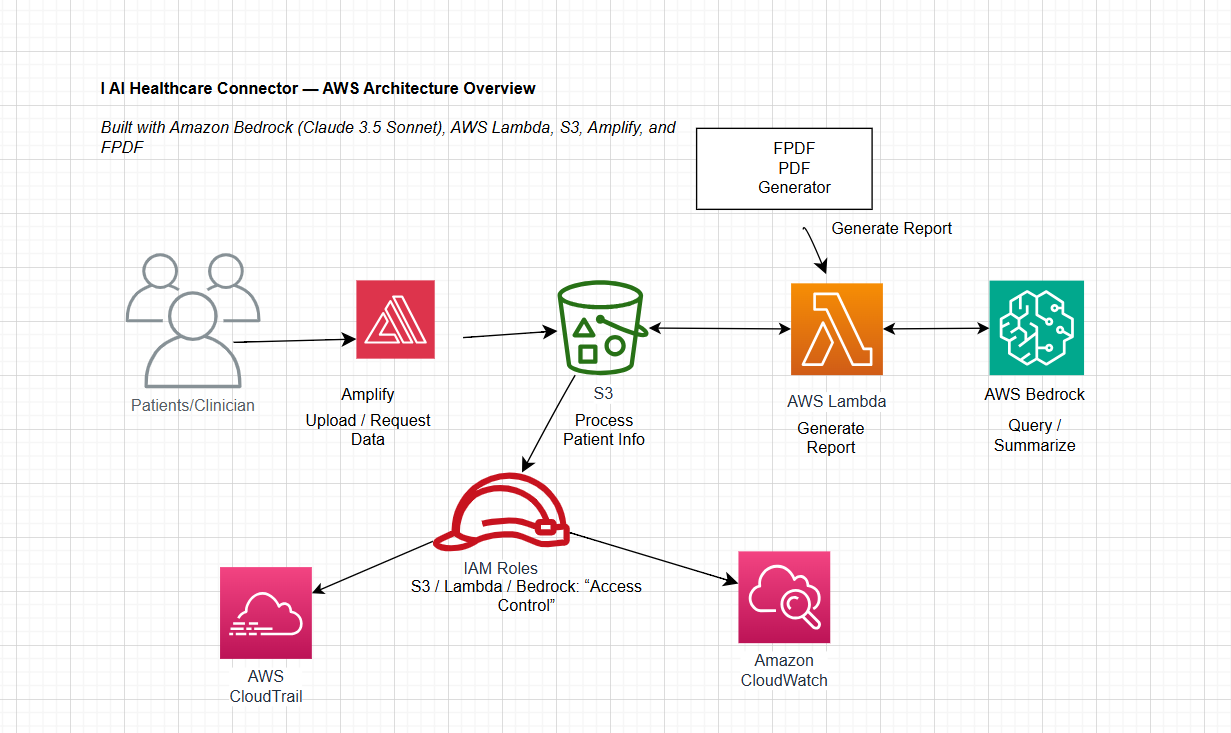
Technical Architecture
-


I AI Health — The Integrated Intelligence Healthcare Connector
Reimagining how hospitals communicate, verify, and collaborate using AWS AI.
Inspiration
Working in a hospital, I’ve witnessed firsthand how disconnected healthcare systems create daily frustration for both staff and patients.
Despite most U.S. hospitals using Epic Systems, interoperability still breaks down at the simplest tasks — sharing lab orders, imaging results, or patient summaries across organizations.
Fax machines, while HIPAA-compliant, remain the default method for cross-hospital communication. They are slow, unreliable, and prone to errors:
“We don’t have your order.”
“Your provider doesn’t practice here.”
“Do you have a paper copy?”
Meanwhile, patients struggle to manage multiple MyChart logins for different hospitals, each holding partial fragments of their medical story. Epic’s Care Everywhere helps, but the experience remains patchy — slow data updates, mismatched orders, and duplicate results.
The inspiration behind I AI Health came directly from these daily inefficiencies.
I wanted to prototype a system that could simulate the future of interoperability — one where hospitals securely connect through AI reasoning rather than fax machines, and where both patients and providers can finally see the full picture.
This project isn’t just technical; it’s personal.
It was born out of real frustration and the belief that intelligence and empathy belong together in healthcare innovation.
About I AI Health
To be best utilize I AI in its current state, it is developed to answer any health-related questions by users.
I AI (Integrated Intelligence) is a prototype that simulates agentic AI system built to explore one core question:
“What if hospitals could automatically find, verify, and summarize information and orders from other hospitals — securely, intelligently, and without faxing?”
Unlike Epic’s internal Copilot (focused on documentation and note summarization), I AI Health explores the next frontier — AI-driven cross-hospital collaboration.
It envisions an AWS-powered ecosystem where healthcare organizations remain independent yet connected through autonomous AI reasoning agents capable of:
- Understanding diverse EHR data formats (FHIR, CSV, JSON).
- Detecting missing, expired, or mismatched orders.
- Generating plain-language summaries for both patients and staff.
- Reducing administrative burden without compromising privacy.
I AI Health — From Prototype to Real Cross Hospital Integration
Vision: To transform the I AI Healthcare Connector from a proof-of-concept using synthetic S3 data into a production-ready system that securely connects to Epic and other hospital EHRs via FHIR APIs, enabling real-time reasoning, cross-organization order verification, and AI-driven care summaries.
Overview
The current I AI prototype demonstrates a working model of cross-hospital summarization using:
- AWS Bedrock Claude 3.5 Sonnet — reasoning and summarization
- AWS Lambda (Python) — backend logic
- Amazon S3 — synthetic patient storage
- AWS Amplify — chat-based web UI
To integrate with real hospital systems such as Epic, Cerner, Meditech, or Athena, the next version must connect through FHIR R4 APIs and SMART on FHIR (OAuth 2.0) authentication.
- Real EMR Data Access via FHIR and Epic App Orchard
Epic exposes open APIs through the Epic Connection Hub (App Orchard).
Developers can register apps and gain sandbox + production access.
Use Epic’s sandbox or partner hospital environments for testing.
- SMART on FHIR Authentication (OAuth 2.0)
All modern EHRs require SMART on FHIR for authorization.
How It Works
- The Amplify front end launches the SMART login page.
- The user authenticates with the hospital’s identity provider.
- The EHR redirects to your AWS Lambda OAuth callback with a
code. - Lambda exchanges that code for a Bearer token using the credentials in AWS Secrets Manager.
- Subsequent Lambda calls include:
http
Authorization: Bearer <token>
Tokens are cached briefly in AWS DynamoDB or ElastiCache and automatically refreshed when expired.
- Unified FHIR → AI Reasoning Adapter
Different EHRs represent data slightly differently.
Create a Python adapter layer that converts FHIR JSON bundles into a consistent structure (DataFrame or dict).
- Security and Compliance (HIPAA Ready)
All real implementations must meet HIPAA requirements.
AWS provides HIPAA-eligible services when configured properly.
Checklist
- Use HIPAA regions (us-east-1 or us-west-2).
- Encrypt S3 buckets with AWS KMS CMK.
- IAM Roles with least-privilege policies.
- CloudTrail + CloudWatch for auditing and alerts.
- Secrets Manager for storing client credentials.
- VPC Endpoints for private FHIR calls.
Optional: integrate AWS Comprehend Medical for entity detection and PHI masking.
- Multi-Hospital Connectivity (TEFCA / Carequality)
Once the system works with Epic, expand via national interoperability frameworks:
- Carequality – network connecting Epic, Cerner, Allscripts, etc.
- TEFCA (Trusted Exchange Framework & Common Agreement) – national interoperability standard backed by ONC.
AI agent can act as a policy-controlled “Reasoning Connector” that pulls FHIR Bundles from multiple organizations and generates secure summaries.
- Architecture Evolution
| Layer | Prototype | Production Integration |
|---|---|---|
| Data Source | S3 (Synthea CSV) | Epic FHIR API + Carequality |
| Backend | AWS Lambda (Python) | Lambda + FHIR Adapter + OAuth Handler |
| AI | Bedrock Claude 3.5 | Same, with FHIR context and role-aware prompts |
| UI | Amplify HTML chat | Amplify + SMART on FHIR Launch |
| Security | IAM + S3 | OAuth 2.0 + KMS + Audit Logs + HIPAA |
- Implementation Milestones
| Phase | Goal | Deliverables |
|---|---|---|
| Phase 1 | Connect to Epic Sandbox | OAuth 2.0 setup, FHIR data fetch Lambda |
| Phase 2 | Build FHIR Adapter | Normalize Observations, ServiceRequests |
| Phase 3 | Integrate with Bedrock | AI reasoning over FHIR Bundles |
| Phase 4 | Expand to Carequality | Multi-hospital connectivity test |
| Phase 5 | HIPAA Deployment | Full audit, KMS, logging, and IAM hardening |
Imagine I AI as a universal healthcare reasoning layer, not an EHR replacement.
Its future capabilities include:
- Autonomous Bedrock Agents — self-orchestrating FHIR retrieval + summary.
- Predictive trend analysis — detect changes across organizations.
- Conversational FHIR navigation — “Show me lab results from Hospital B last year.”
- Multi-agent care planning — provider and patient agents collaborating on treatment goals.
It can also be designed to have Role-Based Functionality
Patients
- View summaries of visits and results from multiple hospitals in one integrated dashboard.
- Get AI-generated explanations of diagnoses, lab results, and medications in everyday language.
- Download or share PDF Care Summary Packets containing upcoming appointments, order details, and prep instructions.
- Access contextual insights such as “your recent lab from Hospital B replaces a duplicate test from Hospital A.”
Providers/ clinicians
- Access a cross-hospital summary that highlights:
- What’s new since the last encounter
- Updated lab results and imaging
- Pending or expired orders
- What’s new since the last encounter
- Use Explain Anything Mode to get reasoning behind alerts or changes.
- Cross-verify orders (lab, imaging, medications) from external systems before re-entry, reducing redundancy.
Technicians and Front Desk Staff
- Automatically verify order completeness:
- Provider signature
- Diagnosis codes
- Expiration and coverage details
- Provider signature
- Generate an order : I AI will cross check and verify lab or imaging orders signed by providers and ready-to-print packets with patient instructions and codes.
- Flag missing or unsigned orders early to avoid delays or patient confusion.
With Blockchain Integrated
In a perfect world, if hospitals used blockchain as a shared verification layer, AI Healthcare Connector’s job becomes much simpler:
Instant Trust and Verification Each hospital’s data updates are automatically verified on the blockchain: no need for manual record matching or faxed confirmations. AI just checks the blockchain for data authenticity and pulls the most recent version. That means less pre-processing, fewer duplicates, and cleaner summaries.
Unified Access to Multi-Hospital Data Blockchain acts like a universal index: one patient ID across hospitals. The AI Connector no longer needs to reconcile multiple MyChart accounts or patient IDs. It can summarize all of a patient’s verified records in one pass — even if they came from different EMRs.
Built-In Consent & Permissions Patients or providers can grant AI access via smart contracts: securely, transparently, and revocably. Your AI doesn’t need to handle complex legal or policy logic; it just checks blockchain consent status before summarizing. That means AI stays compliant automatically.
Simplified Data Provenance Every lab result, note, or summary that AI processes have a blockchain timestamp and origin signature. If anyone questions a summary later, we can prove: “This summary came from verified data from Hospital A and B on this date.” which is powerful for audits, medical-legal confidence, and research traceability.
AI Can Focus on Intelligence, Not Plumbing No need to waste compute on cleaning, reconciling, or verifying data. Bedrock (Claude) can focus fully on reasoning, summarization, and prediction because data integrity is already guaranteed.
Why It Matters
- Reduces delays: Orders arrive complete, verified, and properly formatted.
- Enhances efficiency: Providers spend less time reading legacy chart notes and more time on care.
- Empowers patients: AI-generated plain-language summaries improve understanding and trust.
- Improves compliance: Every insight references its original dataset, ensuring transparency and safety.
- Demonstrates interoperability: Simulates how AWS AI and Epic’s data-sharing layer (Care Everywhere) could merge seamlessly.
How I AI Was Built
The I AI Healthcare Connector was engineered as a fully serverless AWS architecture, combining practical backend automation with an intuitive front-end experience.
Architecture Overview
Frontend (AWS Amplify)
- Lightweight chat-based web interface for patients and clinicians.
- Fully responsive design with mobile-first UI built using HTML, CSS, and Vanilla JS.
- Users can select a patient (synthetic) or ask general questions powered by AI reasoning.
- Lightweight chat-based web interface for patients and clinicians.
Backend Logic (AWS Lambda - Python)
- Core computation layer connected via Function URL.
- Fetches synthetic EMR-like CSV files from Amazon S3 (generated using Synthea).
- Cleans, parses, and transforms data with Pandas.
- Calls Amazon Bedrock Claude 3.5 Sonnet for contextual summarization and reasoning.
- Returns structured text output (role-based summaries, patient data insights, explanations).
- Core computation layer connected via Function URL.
AI Reasoning Layer (Amazon Bedrock)
- Provides multi-modal reasoning on structured and unstructured healthcare data.
- Uses system prompts to adapt answers based on user roles (patient, provider, technician).
- Generates clinically aligned summaries with empathy and context.
- Provides multi-modal reasoning on structured and unstructured healthcare data.
Storage & Security
- All data stored in Amazon S3, with IAM roles defining secure access policies.
- CloudWatch & CloudTrail monitor system performance and usage logs.
- All data stored in Amazon S3, with IAM roles defining secure access policies.
Optional PDF Generation
- Lambda integrates FPDF to produce downloadable care summaries dynamically.
- Summaries include patient metadata, care instructions, and verification codes.
- Lambda integrates FPDF to produce downloadable care summaries dynamically.
Accomplishments We’re Proud Of
- End-to-end AWS integration: Lambda, S3, Bedrock, and Amplify working together in a serverless flow.
- Contextual reasoning: The AI understands partial data, producing structured summaries even with missing fields.
- Autonomous decision-making: The agent recognizes missing patient context and switches into general Q&A mode automatically.
- Dynamic PDF generation: Built a complete pipeline for producing downloadable care summaries. Although it is not fully functional right now, we are working on it.
- Safe interoperability simulation: Demonstrated realistic cross-hospital communication using synthetic datasets only.
- Scalability: Entirely serverless design means instant scalability with minimal operational overhead.
What We Learned
- Interoperability is human-first: It’s about trust, workflow, and clarity — not just APIs.
- Reasoning models need structure: Giving Bedrock clear context (summaries, CSV metadata, role prompts) yields precise results.
- AWS simplifies orchestration: Lambda + Bedrock Runtime replaced complex middleware effortlessly.
- Resilience in design: Anticipating missing data and providing fallback logic prevents system failure.
- Explainability matters: AI outputs must be traceable and easy to understand for both clinicians and patients.
- AI and existing systems can co-exist: I AI Health enhances Epic MyChart rather than competing with it.
What’s Next for I AI Health
- Integrate Bedrock AgentCore: Enable the agent to autonomously reason across multiple tools and APIs.
- FHIR API integration: Securely access real EMR data within hospital compliance frameworks.
- Predictive analytics: Use vitals and lab trends to generate early warning insights.
- Expanded roles: Include nurses, billing, and referral coordinators in the AI’s workflow.
- UI Enhancements: Add chat memory, progress timelines, and visual summaries inside Amplify.
- Sandbox testing: Evaluate interoperability between simulated multi-Epic instances.
- Long-term vision: Create an AWS-powered intelligent agent network that connects hospitals, labs, and patients under one ethical, privacy-first ecosystem.
Challenges We Overcame
1. Bedrock Reasoning Optimization
Getting Claude 3.5 Sonnet to produce structured, clinically valid outputs required iterative prompt design and parameter tuning. Early outputs were verbose and inconsistent — we solved this through structured JSON prompts and role-conditioning.
2. Handling Missing or Incomplete Data
Synthetic Synthea datasets lacked certain vitals and imaging data. The AI had to simulate plausible responses while maintaining clinical realism.
3. Lambda Deployment Limits
Python libraries like pandas, fpdf, and boto3 exceeded AWS Lambda’s 250MB limit. We solved this by modularizing dependencies into compressed Lambda layers.
4. CORS + Amplify Configuration
The front-end initially couldn’t reach the backend due to missing CORS headers. Correcting cross-origin settings allowed Amplify and Lambda to communicate seamlessly.
5. Visualization Constraints
Without React or Vue, achieving clean, dynamic UI transitions was challenging — we built a fully responsive interface using only HTML/CSS/JS.
6. Simulating Real Interoperability
Creating believable cross-hospital scenarios using only synthetic data required careful dataset design and labeling.
7. Balancing Realism and Scope
We kept the prototype realistic enough to feel usable while showcasing innovation beyond current EHR systems.
Reflection
Through I AI Health, we learned that AI interoperability is not about replacing existing systems — it’s about extending their intelligence.
Hospitals don’t need another EMR; they need an AI layer that interprets and connects what already exists.
This project proves that AI reasoning, secure cloud storage, and structured data design can turn siloed records into coherent stories — improving both care delivery and human connection.
Conclusion
I AI Health isn’t just a demo — it’s a working vision of what the future of healthcare could be:
A world where hospitals collaborate effortlessly, patients understand their care without confusion, and AI becomes the invisible bridge connecting it all.
Built With
- apmplify
- bedrock
- kiro
- lambda
- s3


Log in or sign up for Devpost to join the conversation.