HySeer: AI-Powered Driver Drowsiness, Emotion & Stress Monitoring
💡 Inspiration
Driver fatigue and reduced attention are major road safety concerns. A driver may experience drowsiness, stress, or distraction without realizing how significantly these conditions affect their ability to drive.
I wanted to explore how computer vision and AI could help identify these visual indicators in real time. This idea led to HySeer, a driver monitoring prototype designed to analyze facial behavior, estimate fatigue, and provide insights into a driver's state.
⚙️ What it does
HySeer combines computer vision and machine learning to monitor different visual indicators:
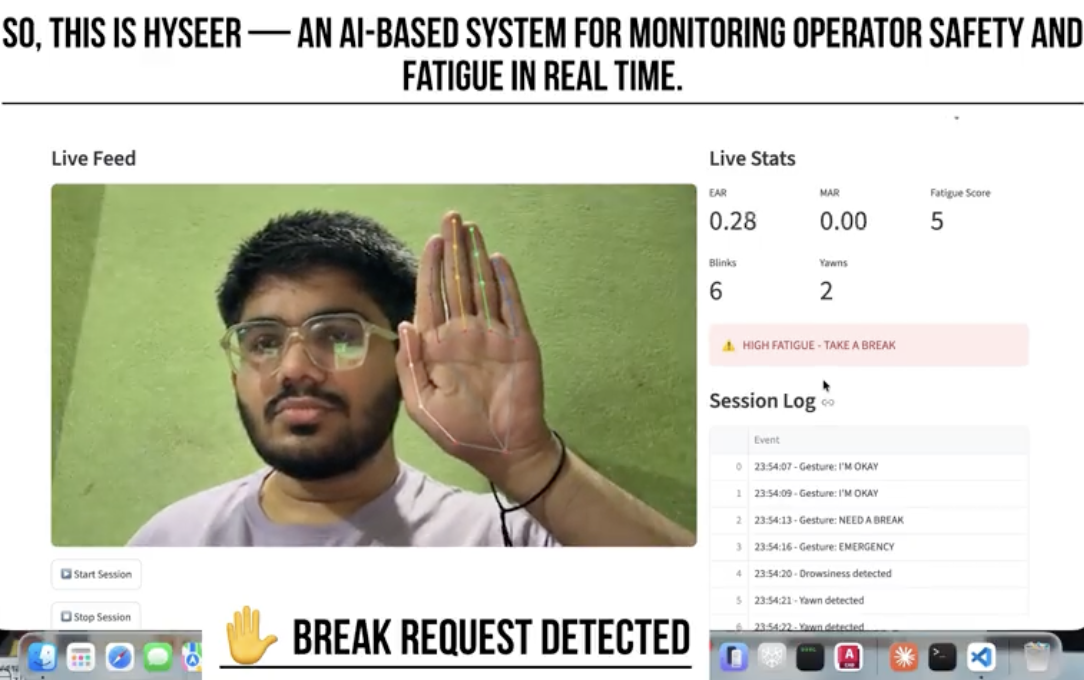
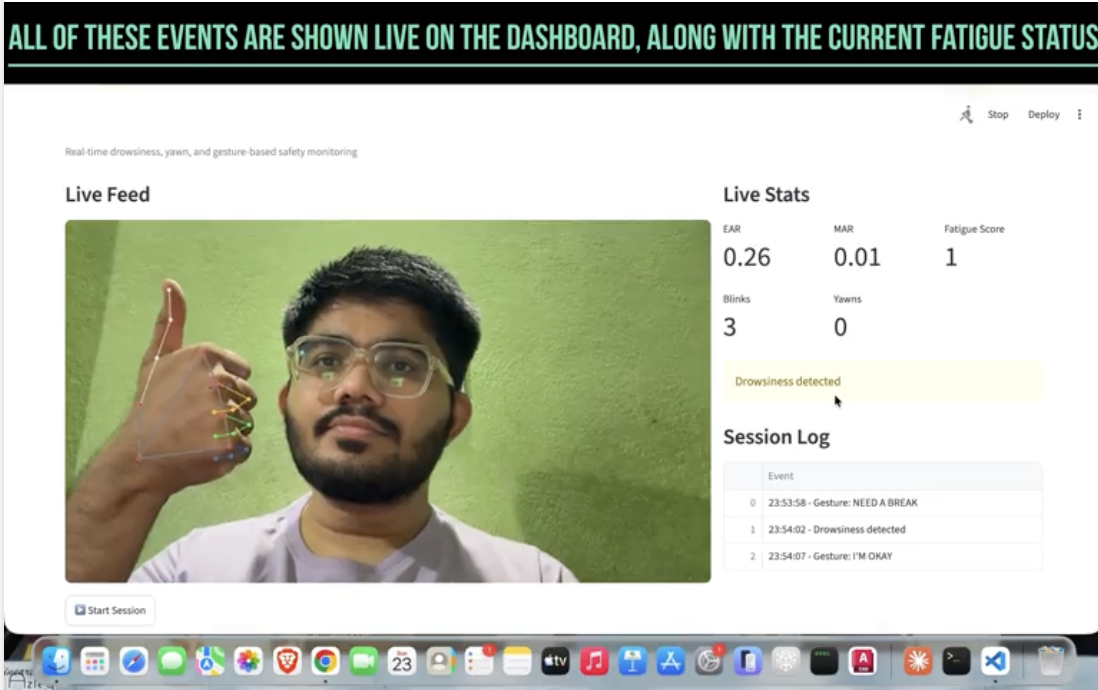
- Drowsiness detection: Uses facial landmarks and Eye Aspect Ratio (EAR) to identify prolonged eye closure and signs of fatigue.
- Yawn detection: Uses Mouth Aspect Ratio (MAR) to detect yawning patterns.
- Head-pose estimation: Analyzes head orientation to identify changes in head position.
- Emotion and stress analysis: Incorporates a CNN-based facial analysis approach to explore emotional expressions and potential stress indicators.
- Hand tracking: Uses MediaPipe Hands to support additional visual monitoring.
- Fatigue scoring: Combines detected indicators into a fatigue score.
- Dashboard and event logging: Supports real-time monitoring and recording of detected events.
🛠️ How we built it
HySeer was developed using Python, OpenCV, MediaPipe, and a CNN-based facial analysis component.
The development process involved:
- Capturing and processing video input using OpenCV.
- Detecting facial landmarks with MediaPipe Face Mesh, which provides 468 facial landmarks.
- Calculating EAR and MAR to analyze eye closure and mouth movement.
- Estimating head pose from facial landmark positions.
- Integrating facial emotion and stress analysis using a CNN-based approach.
- Combining monitoring indicators into a fatigue-scoring workflow.
- Developing dashboard and event-logging features to organize monitoring results.
🚧 Challenges we faced
One of the main challenges was translating facial landmarks into meaningful indicators of fatigue. Eye blinking, natural facial movement, and temporary changes in head position can produce misleading signals.
Another challenge was combining different monitoring techniques into a single workflow while keeping the system responsive. Integrating facial landmark detection, head-pose estimation, emotion analysis, and hand tracking required careful consideration of how each component processes visual input.
Balancing detection sensitivity with false alerts was also an important consideration in designing the fatigue-scoring approach.
📚 What we learned
Working on HySeer helped us explore practical applications of computer vision, facial landmark detection, machine learning, and real-time image processing.
It also highlighted an important engineering lesson: a working AI model is only one part of a useful system. Combining multiple detection methods, managing real-time processing, and presenting meaningful outputs are equally important.
🚀 What's next
Our future development goals include improving detection reliability across different lighting conditions, refining fatigue-scoring logic, evaluating model performance on diverse data, and exploring alert mechanisms that could make the prototype more useful in real-world driving environments.
HySeer is a prototype for exploring AI-assisted driver monitoring. It is not yet a validated safety system and should not replace driver attention or established vehicle safety features.
Built With
- artificial-intelligence
- cnn
- computer-vision
- driver-monitoring
- emotion
- face-mesh
- facial-landmark-detection
- fatigue-detection
- head-pose-estimation
- machine-learning
- mediapipe
- numpy
- opencv
- python
- real-time-image-processing

Log in or sign up for Devpost to join the conversation.