-
-
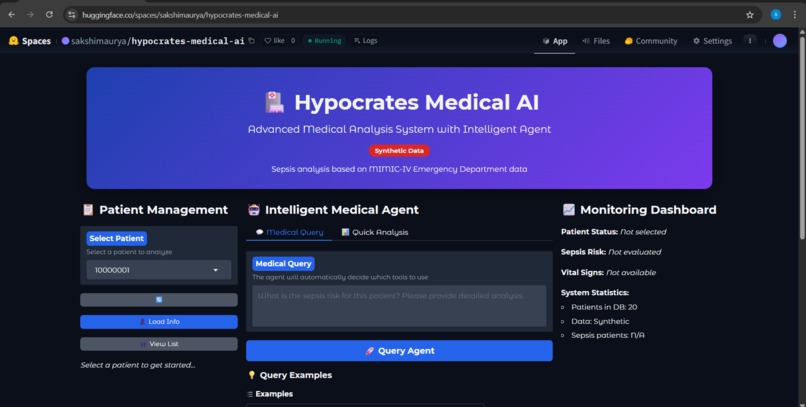
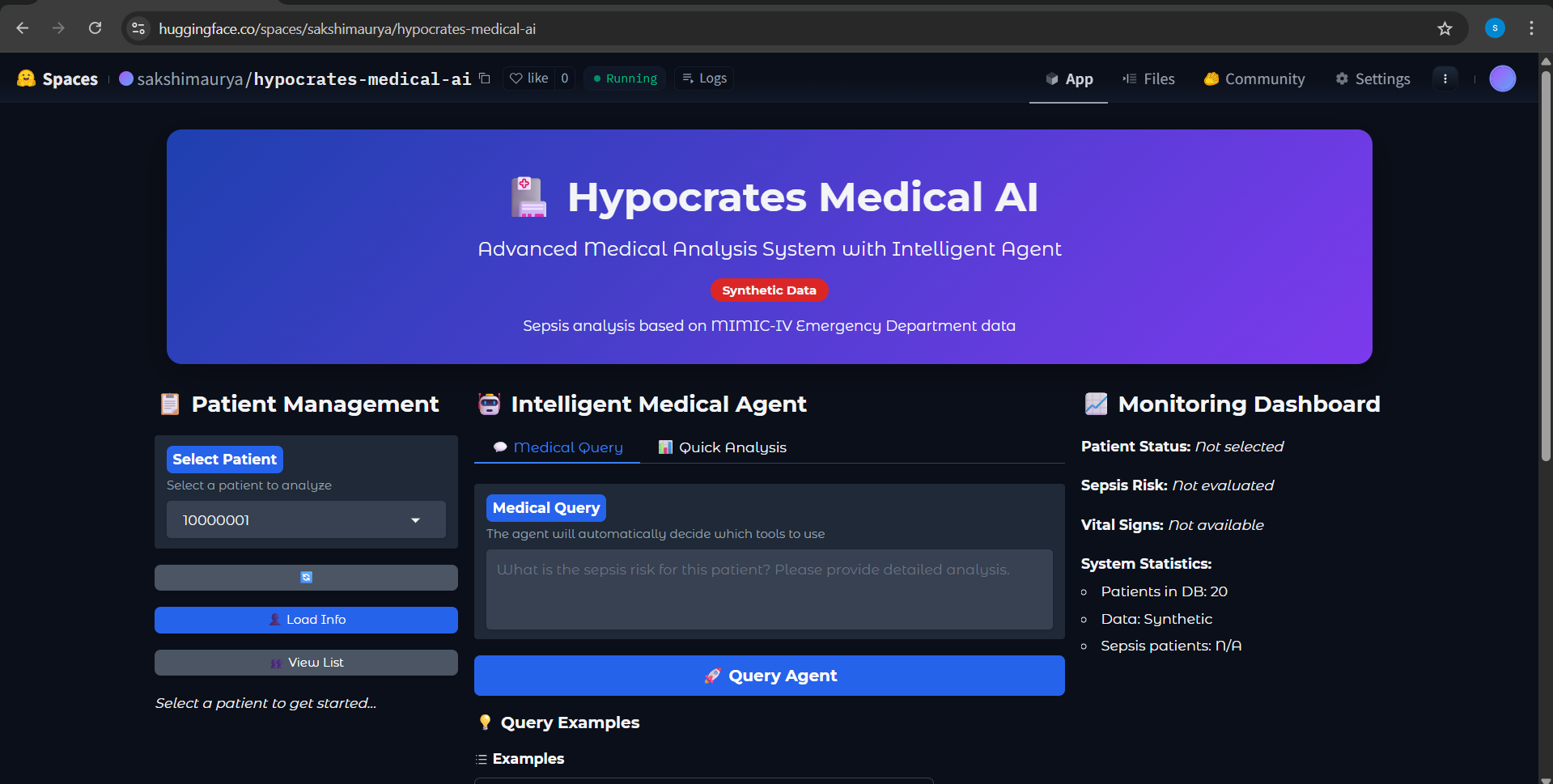
Hippocrates Medical AI is an intelligent healthcare system designed for early sepsis analysis, patient monitoring, and AI driven decision.
Inspiration
Sepsis remains one of the leading causes of preventable mortality in emergency departments, largely due to delayed recognition and fragmented clinical information. Clinicians must rapidly interpret vital signs, diagnoses, and patient context under intense time pressure. HYPOCRATES MEDICAL AI was inspired by the need for an intelligent, transparent system that can assist clinicians and researchers by organizing and interpreting emergency department data in real time, using real-world clinical datasets such as MIMIC-IV.
What it does
HYPOCRATES MEDICAL AI is an advanced medical analysis system designed to support early sepsis detection and clinical reasoning.
The system:
Assesses sepsis risk using SIRS and qSOFA-based criteria
Analyzes patient vital signs with clinical interpretation
Generates automated clinical summaries
Provides a real-time monitoring dashboard
Responds to natural-language medical queries
Automatically selects the appropriate analytical tools based on user intent
How we built it
The system was built using a modular and agent-driven architecture:
Python for medical logic and data processing
MIMIC-IV Emergency Department data for real-world clinical cases
SQLite for efficient structured querying
Rule-based clinical algorithms grounded in established sepsis criteria
Gradio for an interactive, professional medical interface
Autonomous medical agent design, enabling dynamic tool selection:
Sepsis Risk Predictor
Vital Signs Analyzer
Database Query Engine
Clinical Summary Generator
The platform supports both real MIMIC-IV data and synthetic fallback data for accessibility.
Challenges we ran into
Incomplete clinical records: Many real patients lacked sufficient vital sign data, requiring careful filtering and validation.
Clinical accuracy vs simplicity: Ensuring medical relevance while maintaining explainability.
Performance constraints: Delivering fast analysis while querying complex datasets.
Ethical considerations: Clearly positioning the system as a research and decision-support tool, not a diagnostic authority.
Deployment differences: Supporting both local execution and cloud deployment on Hugging Face Spaces.
Accomplishments that we're proud of
Successful integration of real MIMIC-IV emergency department data
Creation of an autonomous medical agent that dynamically selects analysis tools
Development of a clinically intuitive dashboard suitable for live demonstrations
Robust handling of incomplete data with graceful fallbacks
Deployment-ready architecture for Hugging Face Spaces
What we learned
Real-world medical data is noisy, incomplete, and deeply valuable
Explainability is essential for trust in medical AI systems
Intelligent agents can meaningfully assist clinical workflows when carefully scoped
UI/UX design is critical for clinical usability
Deployment and reproducibility are as important as model logic
What's next for HYPOCRATES MEDICAL AI
Future plans include:
Integration of laboratory results (e.g., lactate, WBC)
Temporal trend analysis for earlier sepsis detection
Incorporation of LLM-based clinical reasoning with explainability layers
Expansion to additional emergency conditions beyond sepsis
Support for FHIR-compatible outputs
Retrospective validation on larger patient cohorts


Log in or sign up for Devpost to join the conversation.