-
-
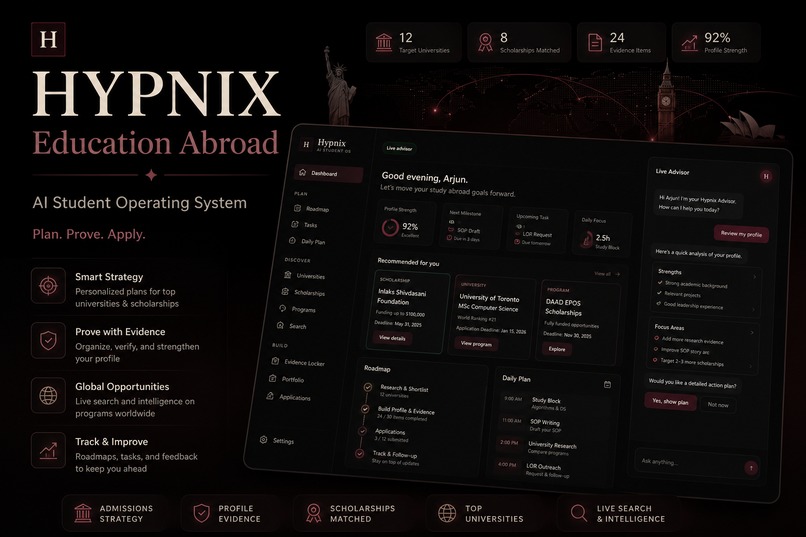
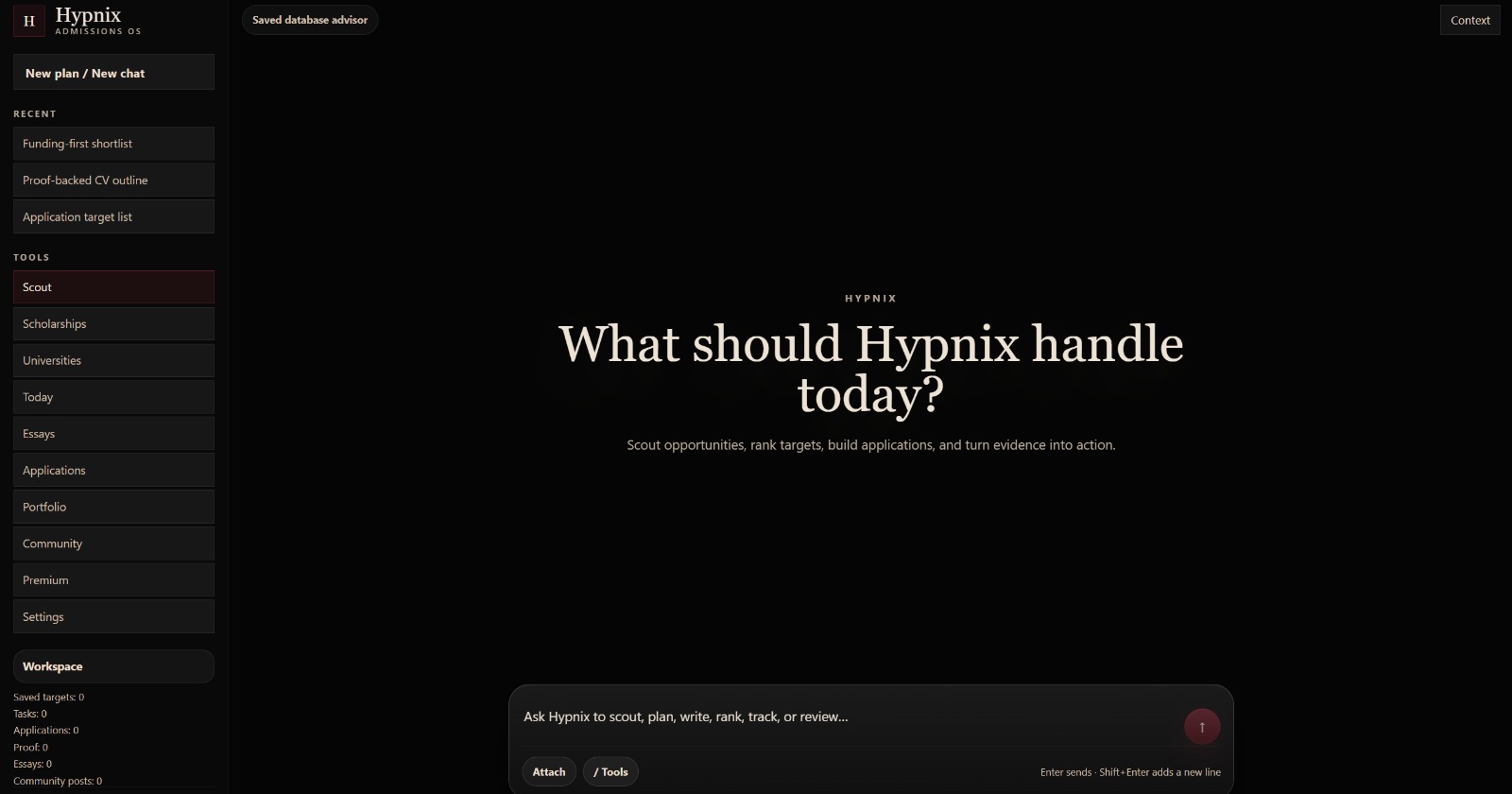
Hypnix Education Abroad: an AI student operating system connecting profile, opportunities, planning, evidence, and execution.
-
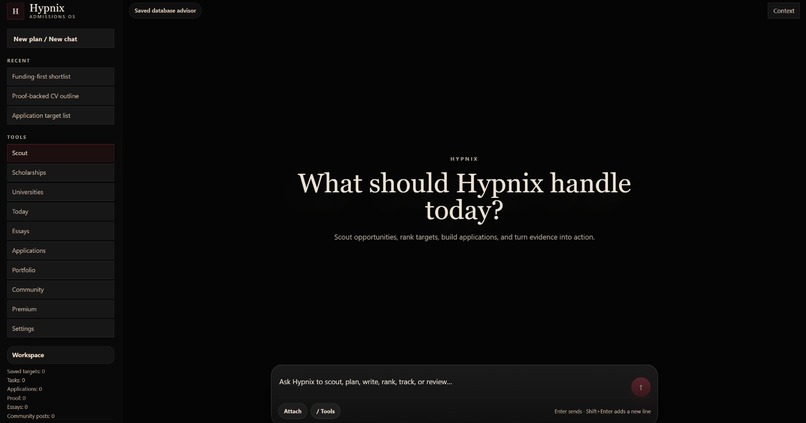
The unified Hypnix workspace, where students can scout, plan, track applications, build evidence, and manage daily actions.
-
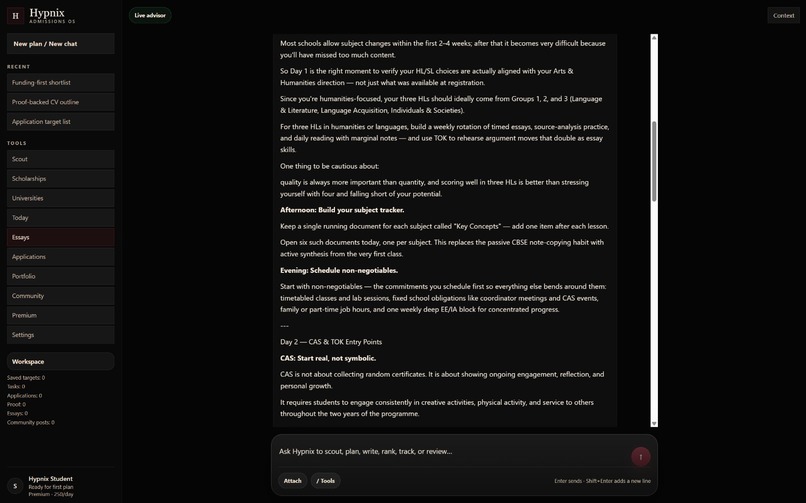
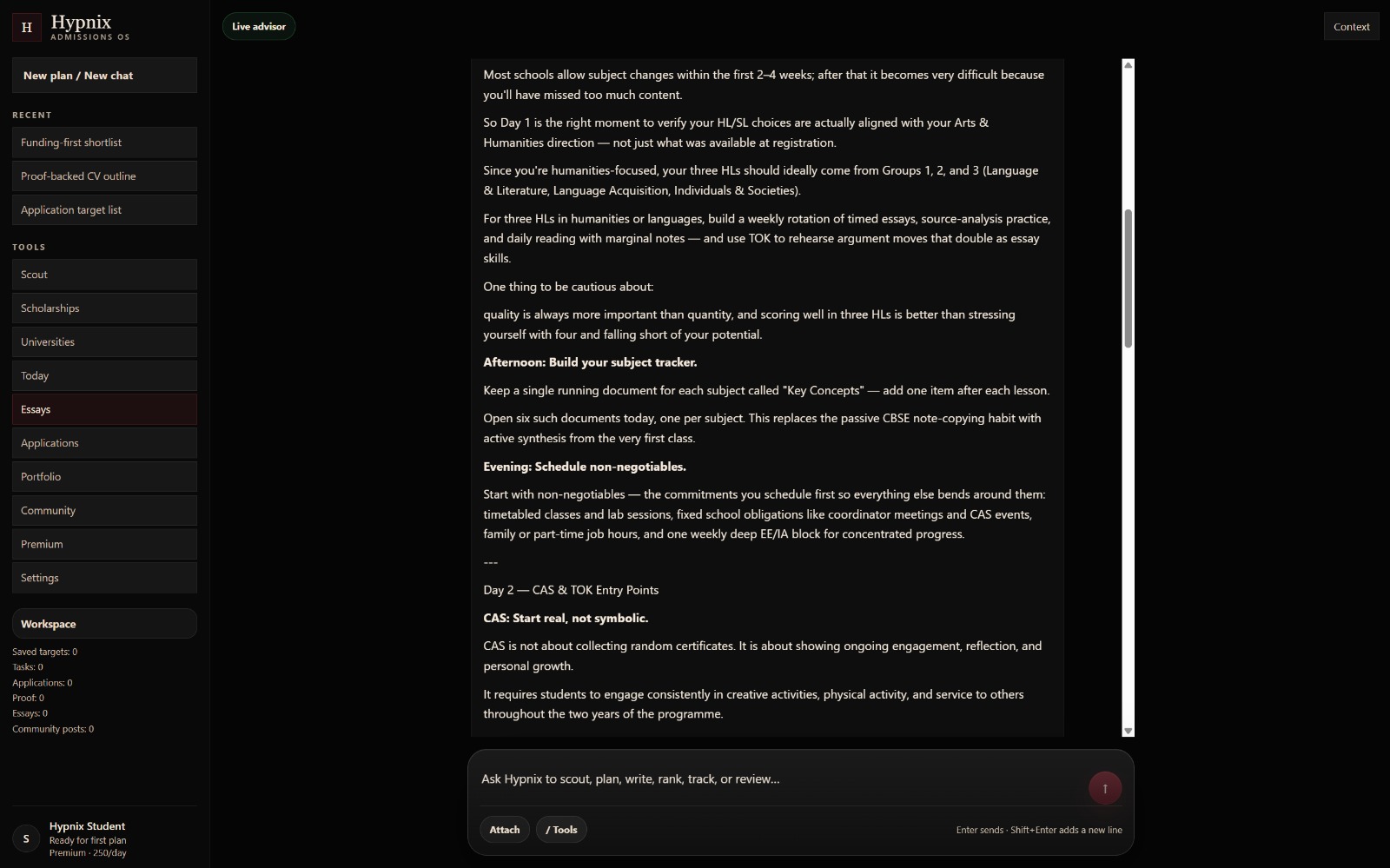
Live advisor generating a profile-aware three-day IBDP transition plan with concrete HL/SL, CAS, TOK, and study actions.
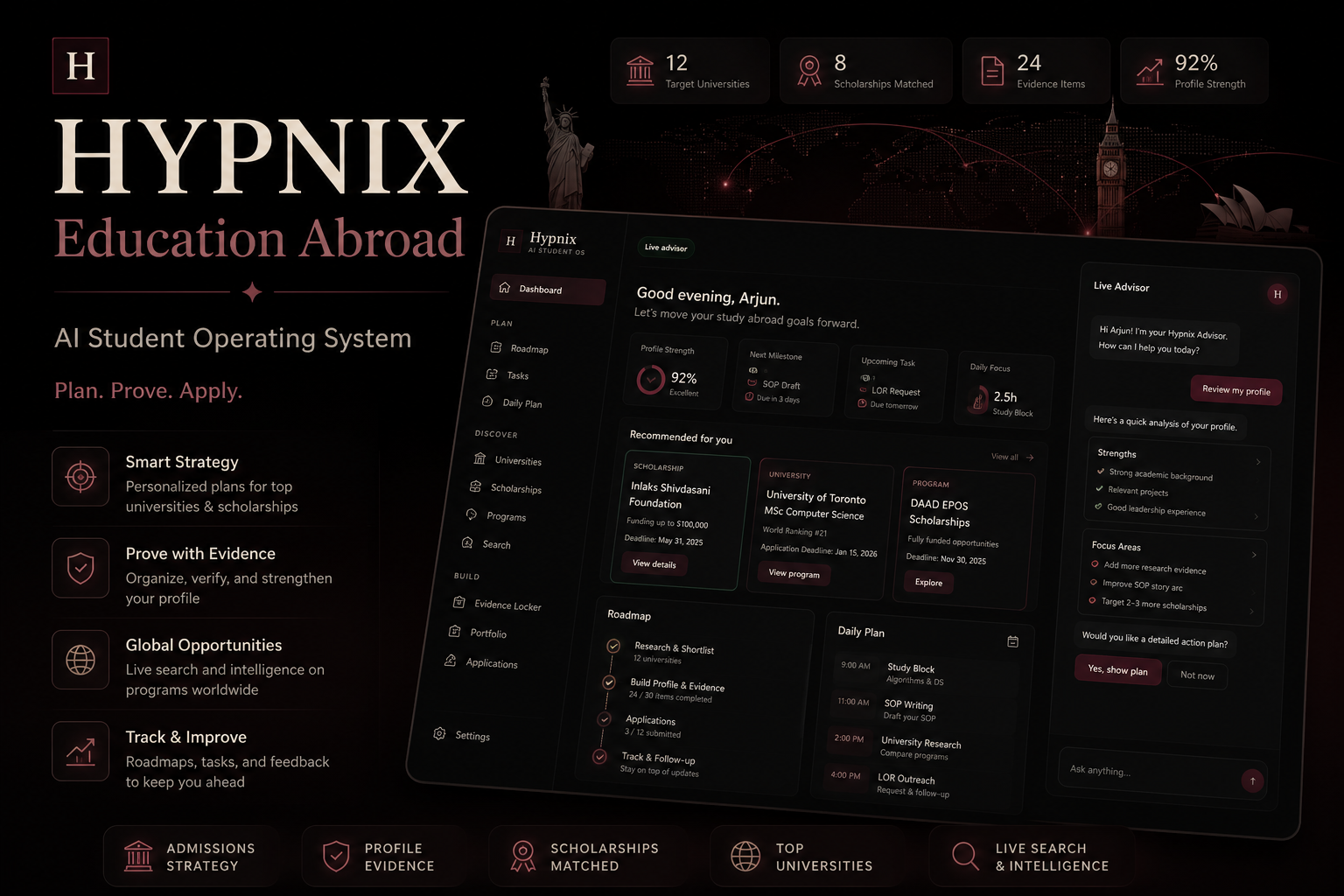
Built by Abhishek Raj, professionally known as Karma Gray, age 16. Submitted by his parent and guardian, Rajni Ranjan.
Inspiration
Admissions advice is everywhere, yet direction remains strangely scarce.
A student may have ambition, strong grades, scattered achievements, and a clear idea of the future, but still have no reliable answer to the most important question:
What should I do next?
The information exists, but it is divided across university websites, scholarship portals, competition announcements, application trackers, counsellor notes, certificates, browser tabs, and conversations that forget the student as soon as they end.
I know this problem because I am the student Hypnix was built for.
I am Abhishek Raj, professionally known as Karma Gray, a sixteen-year-old student founder from India. While publishing research, entering competitions, developing projects, and planning for international education, I found that every useful tool solved only one fragment of the journey.
A chatbot could answer a question.
A directory could list universities.
A spreadsheet could store deadlines.
None of them could hold the entire pathway together.
Hypnix began with one conviction:
Students do not merely need answers. They need a path that remembers them.
What Hypnix does
Hypnix Education Abroad is an AI student operating system for global education and admissions planning.
It is designed to connect the parts of a student journey that normally remain separate:
- student onboarding and profile creation
- achievement and evidence management
- profile-gap analysis
- current opportunity discovery
- university and scholarship research
- applications and requirements
- essay and portfolio development
- long-term roadmaps
- daily tasks and execution planning
- progress tracking and recalibration
The central distinction is simple:
ChatGPT answers a question. Hypnix manages the journey that follows the answer.
A student can ask Hypnix to find robotics competitions currently available. Hypnix performs live search, retrieves current sources, distinguishes organiser or institutional pages from weaker results, displays confidence and unresolved facts, and refuses to present an opportunity as open when the retrieved source material does not prove it.
The student profile can personalise filters such as age, geography, budget, curriculum, and academic direction, but it must not distort the current request. A law-oriented student asking about robotics should receive robotics results, not CLAT advice or debate competitions.
Hypnix can also provide profile-aware planning. For example, a student moving from CBSE into the International Baccalaureate can receive guidance that recognises the curriculum transition, identifies missing information, and structures the next academic and extracurricular decisions.
How we built it
Hypnix is a full-stack web application built with:
- Next.js
- React
- TypeScript
- Tailwind CSS
- Supabase
- PostgreSQL
- Anthropic
- SerpAPI
- OpenAI Codex
- GPT-5.6-assisted engineering
- Vercel
The codebase contains interconnected systems for authentication, student profiles, evidence, opportunity intelligence, applications, essays, roadmaps, daily execution, community, subscriptions, and advisor-style conversation.
The difficult part was not placing a language model behind a text box.
The difficult part was constructing the machinery around the model.
We had to determine:
- what the system should remember
- which stored context should be ignored
- when the current request must outrank the saved profile
- how selected opportunities should enter and leave context
- when external information should remain unverified
- how confidence and uncertainty should be displayed
- how advice should become action
- how one result should eventually alter the student’s larger plan
During OpenAI Build Week, Codex and GPT-5.6 were used to inspect, repair, test, and extend an existing multi-module codebase rather than create a temporary demonstration from scratch.
The Build Week engineering work focused particularly on:
- a shared server-side live-search architecture
- SerpAPI provider integration
- live-research intent classification
- source normalisation
- safe URL and snippet handling
- current-request precedence
- stale-context isolation
- safe configuration diagnostics
- relevance filtering
- honest no-match and provider-failure states
- production deployment and environment configuration
- automated regression testing
GPT-5.6 also helped shape the product logic itself: the distinction between a generic answer engine and a persistent student operating system, the correct order for applying context, and the safeguards required when current internet information influences educational decisions.
The hardest problem
The greatest danger in an AI product is not always an obvious error.
Sometimes it is a fluent answer built on the wrong context.
A saved opportunity may quietly enter an unrelated conversation. An old academic interest may distort a new request. A search snippet may be presented with more confidence than it deserves. A live provider may be correctly implemented on the server but never invoked because the client routes the request through an older advisor path.
These failures sound convincing, which makes them more dangerous.
We therefore established a strict context order:
- the current user message
- the current conversation
- the canonical student profile
- a deliberately selected object
- saved workspace state
The current request must win.
A saved opportunity should not become active merely because it exists. Search results should remain candidates until their eligibility, deadlines, fees, organiser identity, geography, and application requirements are confirmed.
Where information cannot be verified, Hypnix should say so.
Where no relevant current match can be established, it should return:
No sufficiently relevant current match was verified.
Where live search fails, it should fail honestly rather than invent a result.
Trust is not an additional feature in Hypnix. It is part of the architecture.
Current build status
Hypnix is an active product in development, but the submitted production build now completes its core live-search path.
An explicit chat request can trigger SerpAPI retrieval and return:
- source URLs
- retrieval timestamps
- source type
- relevance explanations
- confidence scores
- age and geography uncertainty
- deadline and fee status
- unresolved facts
- a concrete verification step
The live advisor is also operating in production and can provide profile-aware educational planning through the main Hypnix workspace.
The full product loop is not yet complete. Remaining work includes:
- deeper official-page extraction and verification
- saving live-search results as structured opportunities
- converting saved opportunities into roadmap milestones
- generating complete daily execution bundles
- stronger progress recalibration
- further interface and context refinement
We are presenting Hypnix as a genuine working product in progress, not pretending that every module has reached its final state.
Challenges we faced
Context persistence without contamination
Hypnix must remember a student over months or years, but old information must never overpower a new request.
Live discovery without blind trust
A search result is not automatically a verified opportunity. Official sources, organiser identity, eligibility, deadlines, fees, geography, and application status must remain visible and independently assessable.
Connecting server capability to the interface
Implementing a search provider was only part of the problem. The entire path from user message to intent classification, provider invocation, source filtering, synthesis, and visible response had to work reliably.
Turning advice into execution
A recommendation has limited value unless it becomes a roadmap, task, study block, evidence requirement, or application action.
Building breadth without disconnected dashboards
Hypnix contains many systems, but they must behave as one operating system rather than a collection of unrelated pages.
Engineering under severe time pressure
We encountered provider configuration problems, incomplete routing, stale context, response-length issues, authentication failures, deployment recovery, and environment-variable mismatches.
The challenge was to preserve the functioning architecture while repairing the underlying logic honestly.
Accomplishments we are proud of
Hypnix has grown beyond a concept or a thin AI wrapper.
The current codebase contains foundations for:
- persistent student profiles
- authentication and private data isolation
- evidence-backed achievement handling
- live opportunity discovery
- source-aware recommendation logic
- applications and requirement tracking
- ethical essay support
- portfolio and CV systems
- curriculum and test preparation
- roadmaps and daily execution
- advisor-style conversation
- community and entitlement infrastructure
At the latest validated development checkpoint:
- TypeScript type-checking passed
- lint completed without errors
- 419 automated tests passed
- the production Next.js build completed successfully
The production build is publicly deployed, the repository is accessible, Supabase is operational, the live advisor is enabled, and the live-search pathway is functioning.
The accomplishment that matters most, however, is the governing idea:
A student’s future cannot be reduced to a search result.
A useful education platform must understand what the student has done, recognise what remains missing, discover what may be possible, and transform possibility into action.
What we learned
We learned that an intelligent model does not automatically produce an intelligent product.
The surrounding system matters just as much:
- memory
- context
- evidence
- verification
- routing
- prioritisation
- failure handling
- interface discipline
- persistence
We learned that external search should be treated as the beginning of research, not the end of it.
We learned that a polished answer may still be useless when it arrives without relevance, timing, evidence, or a next action.
We learned that students do not need another source of noise disguised as guidance.
They need sequence.
They need clarity.
They need a system capable of saying:
- this opportunity may fit you
- this fact is verified
- this fact remains unknown
- this is the evidence you need
- this is the deadline that matters
- this is the task you should complete today
- this is how the result changes your plan
What is next
The next milestone is to complete the full Hypnix journey:
- a student completes onboarding
- the student uploads achievements and evidence
- Hypnix structures the profile and identifies gaps
- the student requests a current opportunity
- Hypnix performs live search and returns source-grounded results
- the student saves one opportunity
- Hypnix places it into the roadmap
- concrete tasks and deadlines are created
- the Today view prioritises the next actions
- the plan recalibrates when progress changes
The long-term ambition is for Hypnix to become the persistent operating layer between a student’s present profile and future education.
Not a directory.
Not a ghostwriter.
Not another window that produces text.
A system that remembers the student, examines the path ahead, and turns ambition into an ordered course of action.
That is Hypnix.
Built With
- anthropic
- api
- claude
- codex
- css
- github
- gpt-5.6
- next.js
- node.js
- openai
- postgresql
- react
- rest
- serpapi
- supabase
- tailwind
- typescript
- vercel
- zod

Log in or sign up for Devpost to join the conversation.