Hyperion
https://j0yy.github.io/hyperion/ (click on the Research button on the top right hand corner to see video explanations of what is happening!!)
TLDR
Hyperion maps the natural gravity "currents" that let spacecraft travel across the solar system on almost zero fuel.
Fuel is the tyranny of spaceflight. This is because most of a rocket is fuel to carry fuel, which is why everything beyond Earth is so expensive to reach. But there's a hidden network of low-energy pathways built into gravity itself that can carry a craft between worlds for a fraction of the fuel. They already exist and a few real missions have used them, we've just never had the compute to map more than a handful. Hyperion computes them from real physics and lets you compare the fuel-guzzling engine route vs. the near-free current route to the same destination.
Why "infinite compute": the roads exist, the physics exists, it's just extremely expensive computation to run.
Use cases:
- Cheap cargo everywhere, Moon, Mars, the asteroid belt, the moons of Jupiter/Saturn for a fraction of the fuel; this is what makes large-scale supply and settlement economically possible.
- Mission route-planning, "cheapest path from low-Earth orbit to a Europa orbit?" answered from the map.
- Opening the outer solar system to routine traffic instead of rare flagship missions.
- Placing infrastructure (fuel depots, relays, stations) at the natural gravity junctions.
Inspiration
I've loved science fiction and space travel for as long as I can remember. But the more you learn about how spaceflight actually works, the more you run into the same wall, which is fuel. The rocket equation is unforgiving, the velocity change you want costs fuel exponentially, so almost everything you launch is propellant to move a tiny bit of payload. It's the reason the solar system feels closed off. Sci-fi ships drift between worlds like it's nothing; real ones spend most of their mass just trying to leave.
So I went looking for the part of this that isn't science fiction, and found something I couldn't stop thinking about. There really is a way to travel for almost no fuel: a network of low-energy pathways that exist in the gravity between bodies, the kind of thing a few real missions (Genesis, the Hiten rescue) have actually used. The catch is that these paths hide inside the three-body problem, which is chaotic, so finding them means searching a huge, sensitive space at enormous computational cost. The physics has been understood for a long time. We just can't afford to look for most of the routes.
That's what made this premise click for me. "Infinite compute" usually invites you to invent something speculative. Here the opposite is true, there's nothing to invent. The roads are already there. The only thing standing between us and a real map of them is cycles. For once there was something genuine to optimize, with the bottleneck being purely compute, and I really wanted to see what that map looks like.
What it does
Hyperion computes those gravitational pathways for a real three-body system and lets you explore them. It builds up the whole picture step by step:
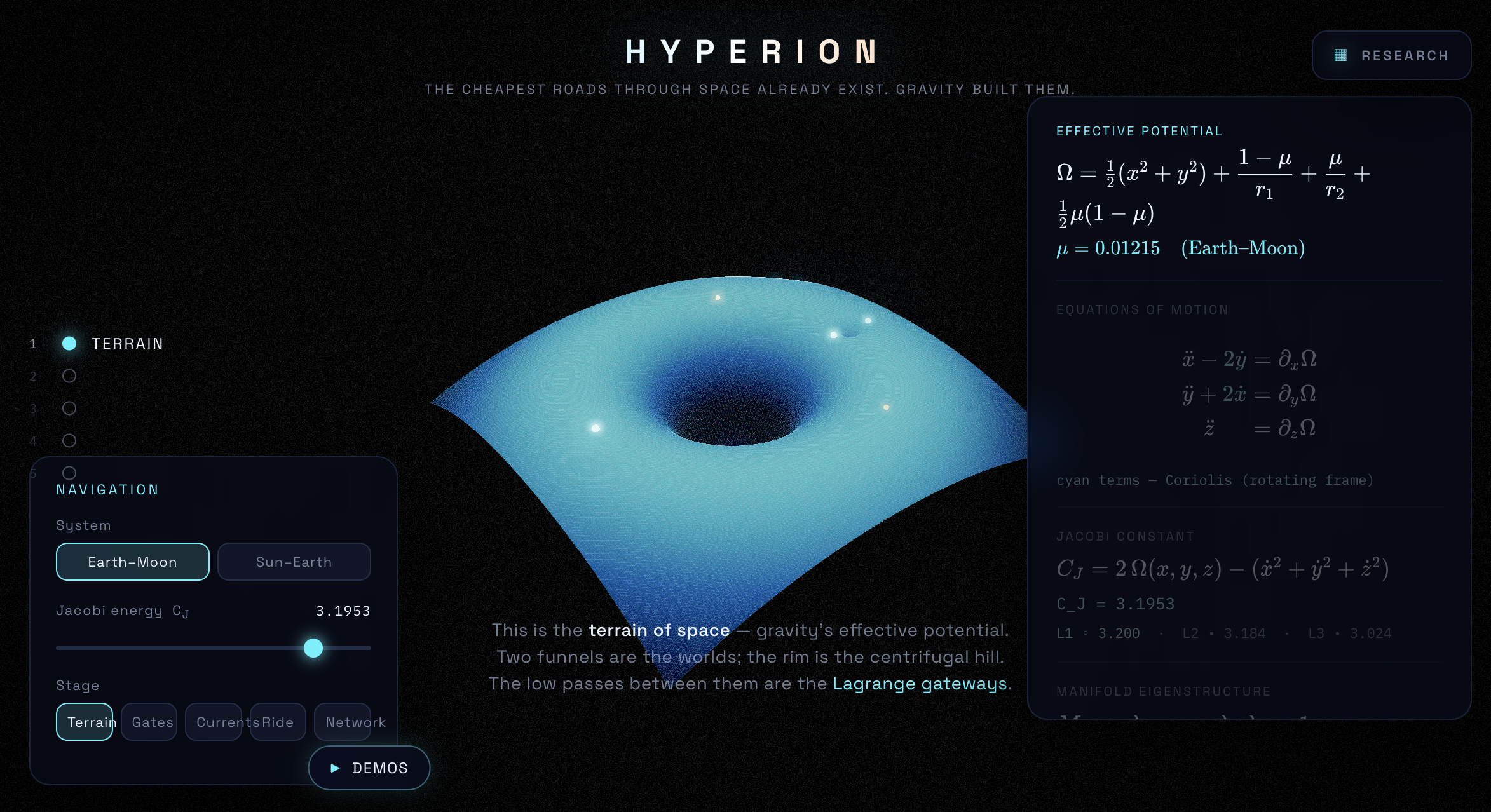
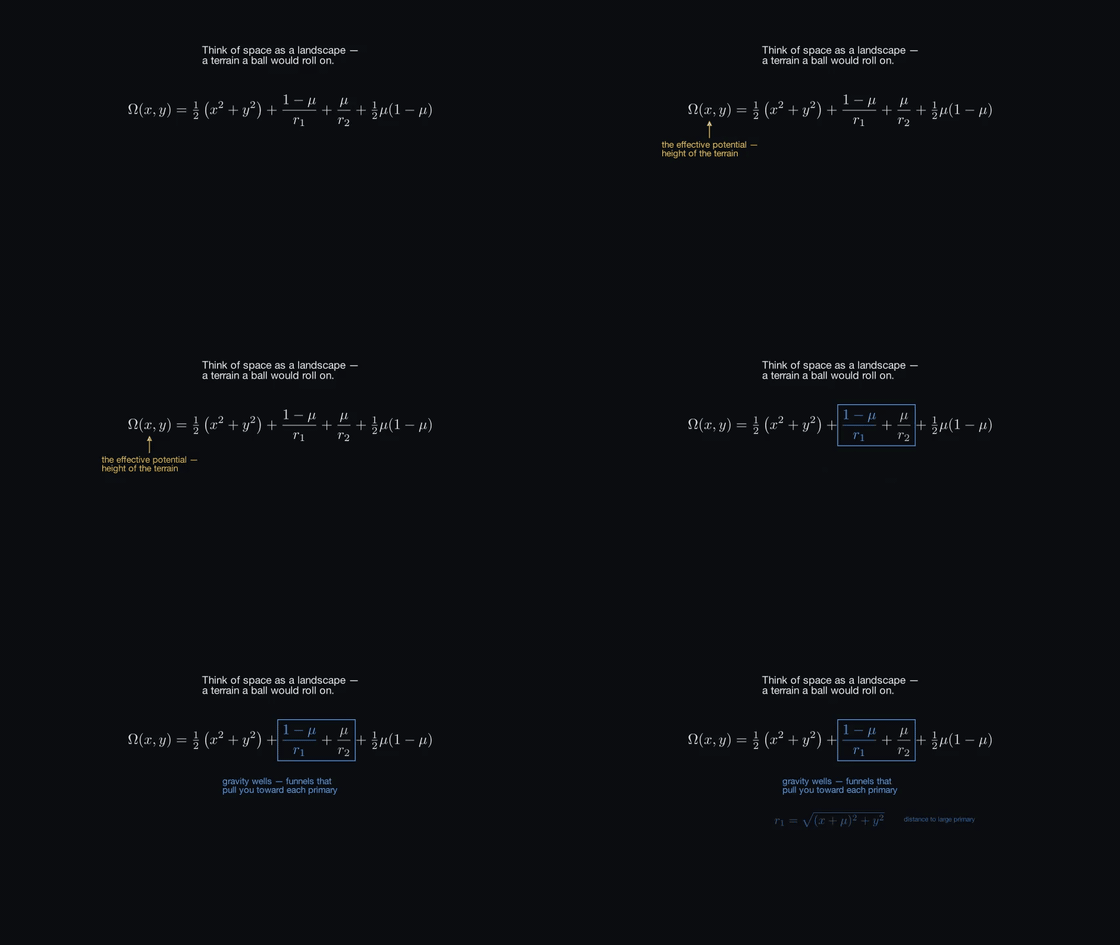
- The energy landscape of the system, the effective potential, shown as terrain you can actually see, with gravity wells and the saddle "passes" between them.
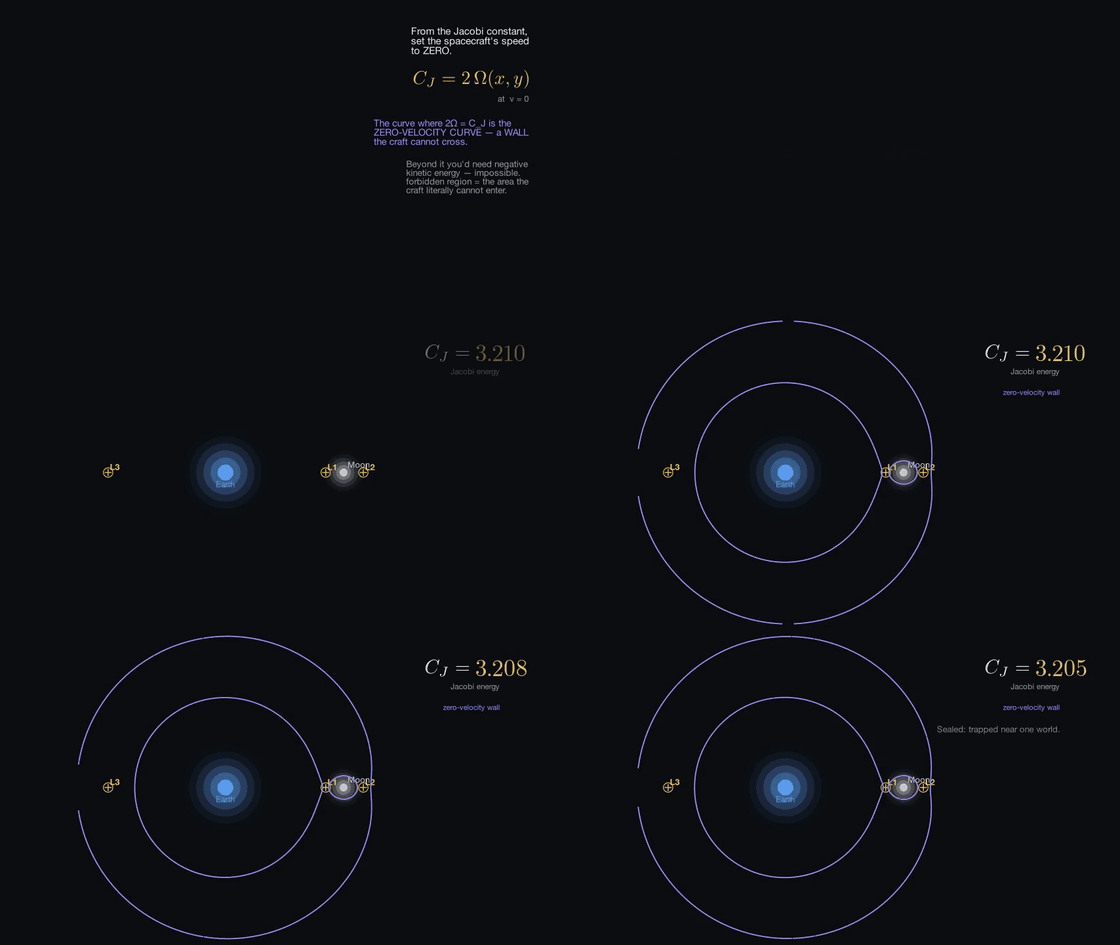
- The gates: as you change the system's energy, regions that were sealed off open up at the Lagrange points, in a specific order. There's a slider, and the equations update live as you move it.
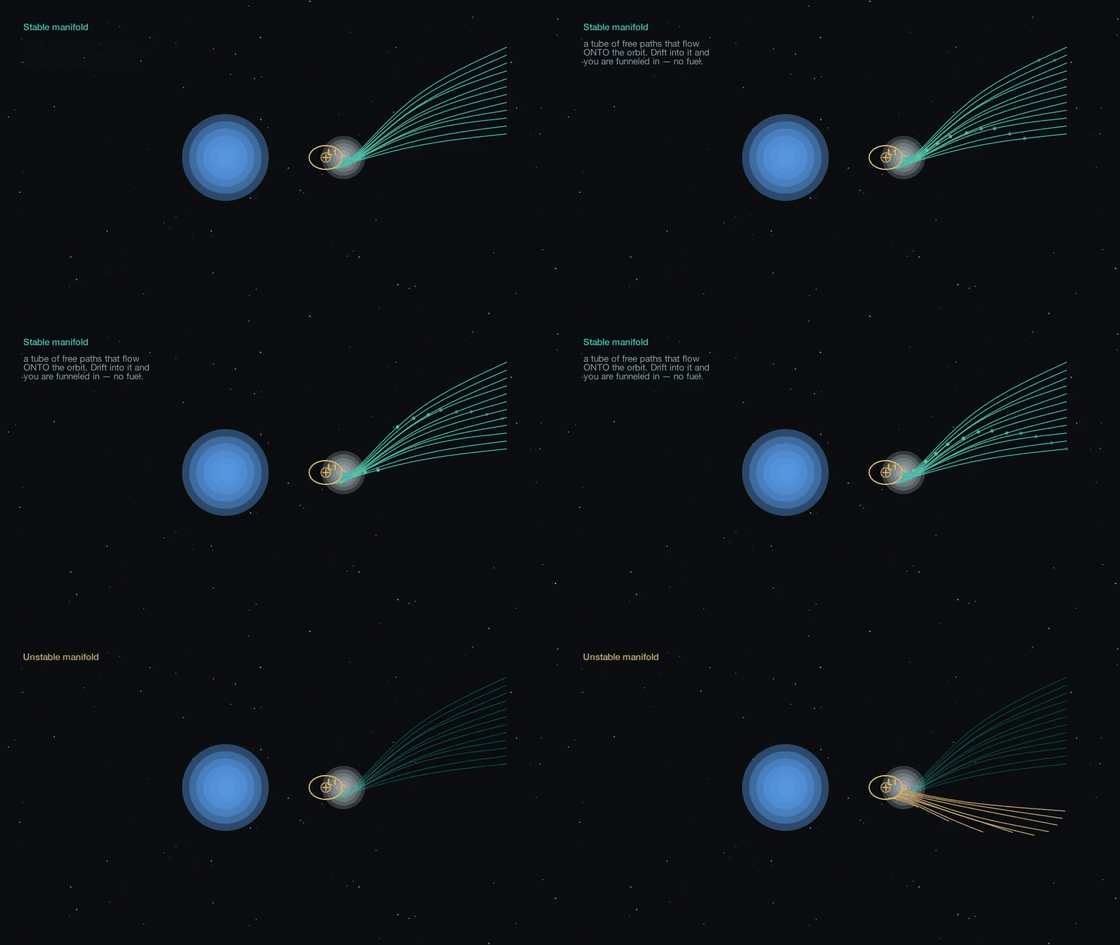
- The currents themselves, the stable and unstable manifolds spiraling out of a periodic orbit. These are the tubes a spacecraft can ride for free.
- A ride through one of them, engines off the whole time.
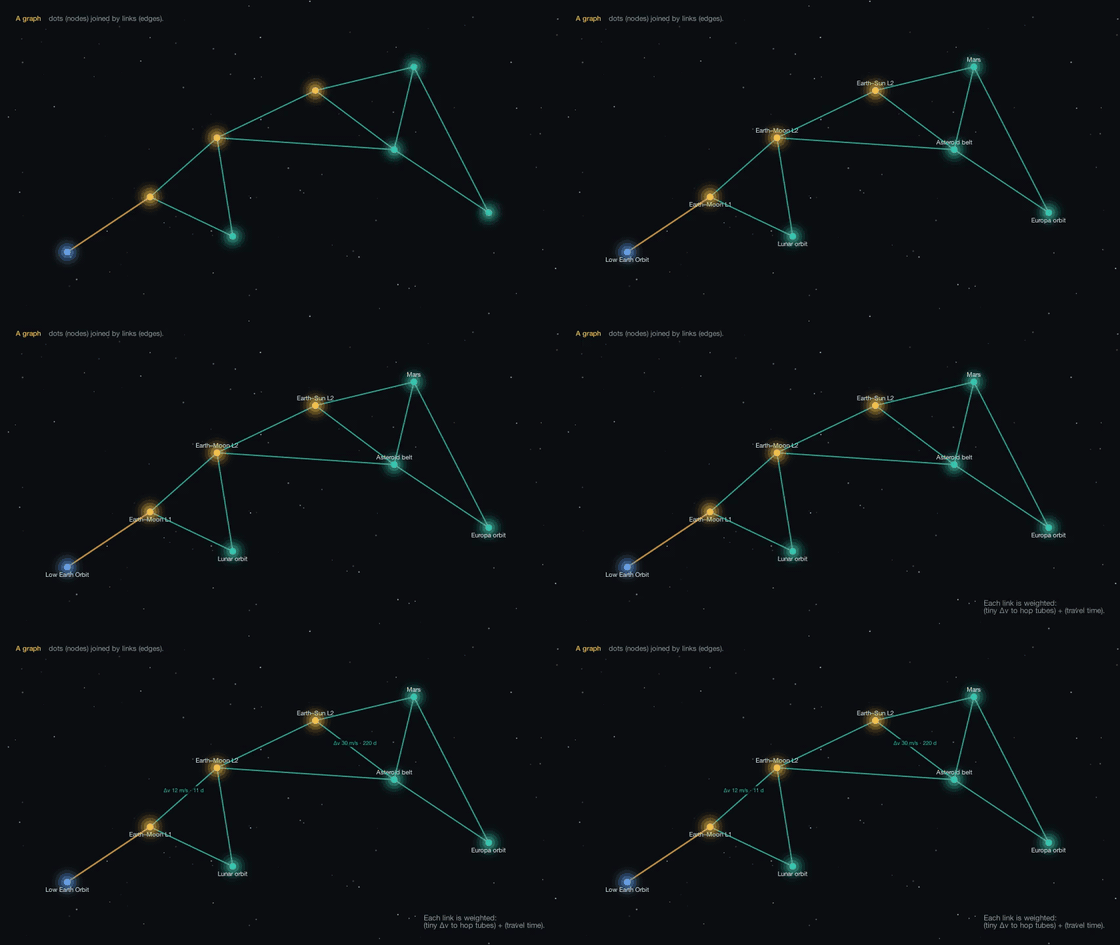
- The network you get when you connect them: orbits as stops, free transfers as the lines between them.
And the comparison I most wanted to see: a normal engine-burn route next to a manifold route to the same place, so you can see how much fuel the currents actually save.
Everything on screen is computed by the solver. None of the trajectories are drawn by hand.
How I built it
The core is a CR3BP (circular restricted three-body problem) solver in Python with NumPy and SciPy. It works up the chain: the potential, gradient, and equations of motion; the Lagrange points; the periodic orbit families, closed up with differential correction; the manifolds, found from the monodromy matrix's eigenvectors and integrated forward and backward in time; the connections between tubes via Poincaré sections; and finally a transport graph you can route across. A build step runs all of this offline and writes the geometry to JSON.
The frontend is Three.js (Vite, plain ES modules). It loads that geometry and renders the stages, with the energy-gate visualization recomputed live in the browser so the math and the picture move together. There's also a Manim animation that walks through the same ideas.
The split is deliberate: the heavy computation happens once, offline, and the interactive part stays fast. It's the same code and the same physics whether you run two systems on a laptop or imagine running every system in the solar system, only the resolution changes.
Challenges we ran into
Chaos makes everything harder than it looks. Naive trajectory shooting just diverges, so getting orbits to actually close took careful differential correction. The manifolds were the most delicate part — if the integration isn't accurate enough, the conserved energy quantity drifts and the "currents" turn into numerical noise instead of real structure, so a lot of the work was in tolerances and verification. The two systems I used (Earth–Moon and Sun–Earth) have mass ratios that differ by orders of magnitude, which broke a lot of assumptions about scaling and rendering. And the potential covers such a huge range of values that it took some care to make the terrain visible without distorting the physics.
Accomplishments that we're proud of
The biggest one is that it's real, not a mockup. The Lagrange points match known values, the orbits close to high precision, the energy quantity stays conserved along the manifolds, and the eigenvalues come out the way the theory says they should, and there are tests checking it. Every trajectory you see came out of the solver.
Beyond correctness, I'm proud that it actually makes the idea feel obvious. Watching the gates open as you drag the energy slider, or watching a craft coast through a tube with the engine off, makes something that normally lives in dense papers immediately legible. And the side-by-side of an engine route versus a current route is the image I most wanted to exist.
What we learned
A lot of this field is textbook, differential correction, monodromy eigenvectors, Poincaré sections, but turning those pieces into a pipeline that survives the chaos and produces trustworthy geometry is its own real engineering problem. I learned how much the coupling matters for understanding: the number changing as the gate opens does more to convince you than either the equation or the animation alone. And I came away with a much deeper appreciation for why this is the right kind of problem for the premise, the science is settled, and the only missing ingredient really is compute.
What's next for Hyperion
The honest next step is scale. Tile the solar system as overlapping three-body systems (each planet with the Sun, each moon with its planet), compute every orbit family across every energy level, find every connection exhaustively, and stitch them into one giant chart, the part that's genuinely intractable today and exactly what infinite compute would unlock. From there: refine the best routes under full N-body dynamics, fold in real launch windows so the map is time-aware, and turn it into something a mission designer could actually plan a trip on, "cheapest path from low Earth orbit to a moon of Jupiter," answered by the chart. That map is the thing I want to see.


Log in or sign up for Devpost to join the conversation.