-
-
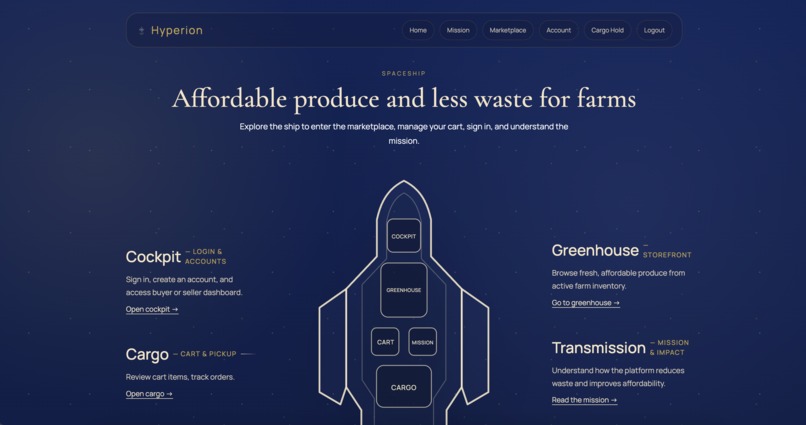
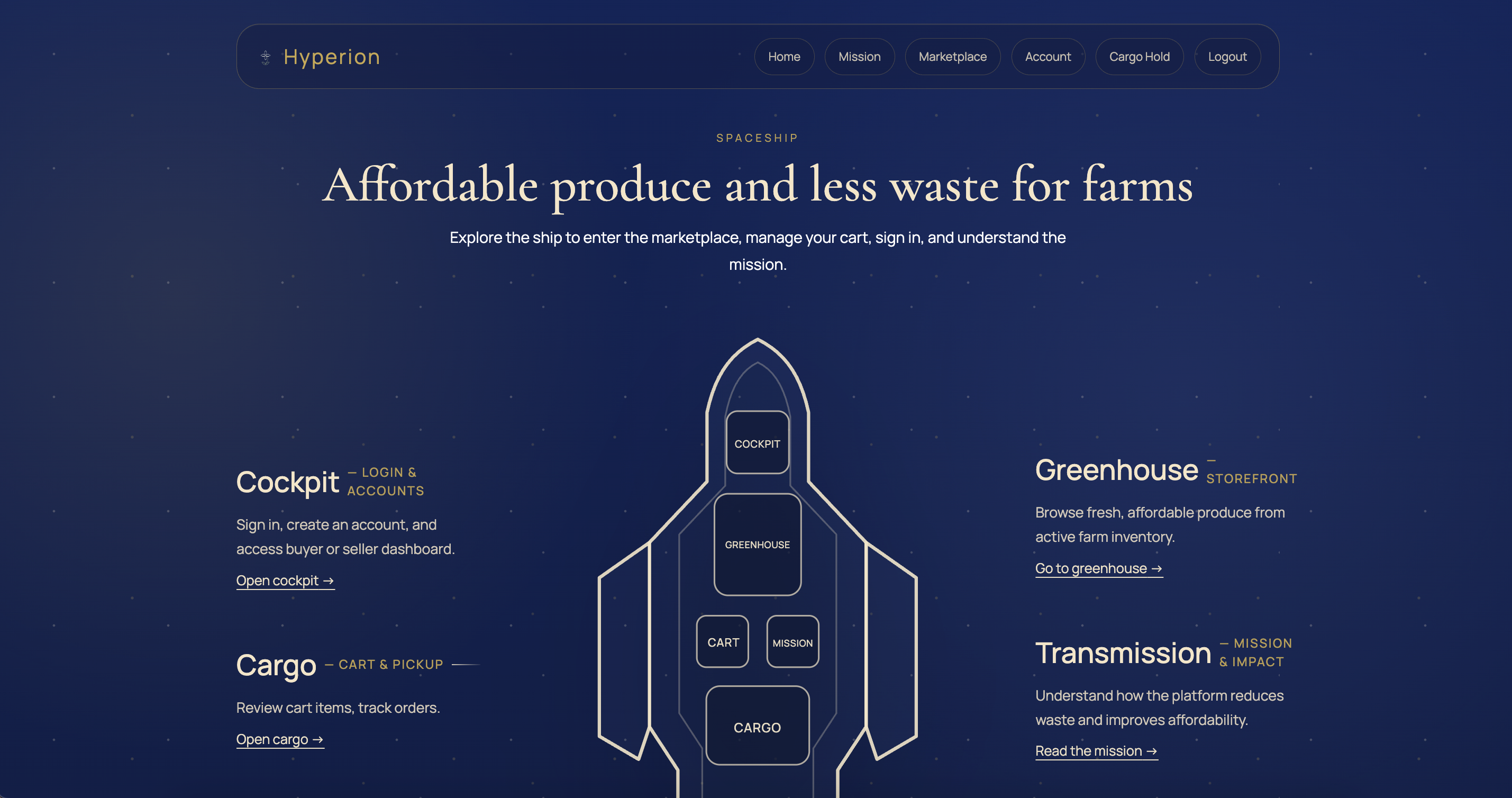
Landing Page
-
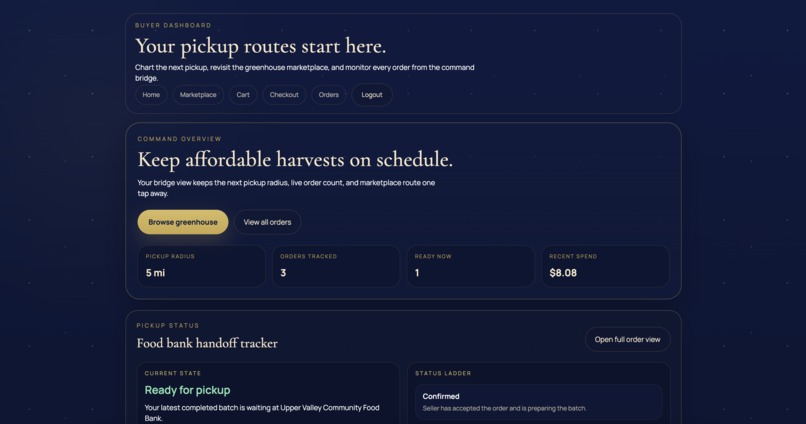
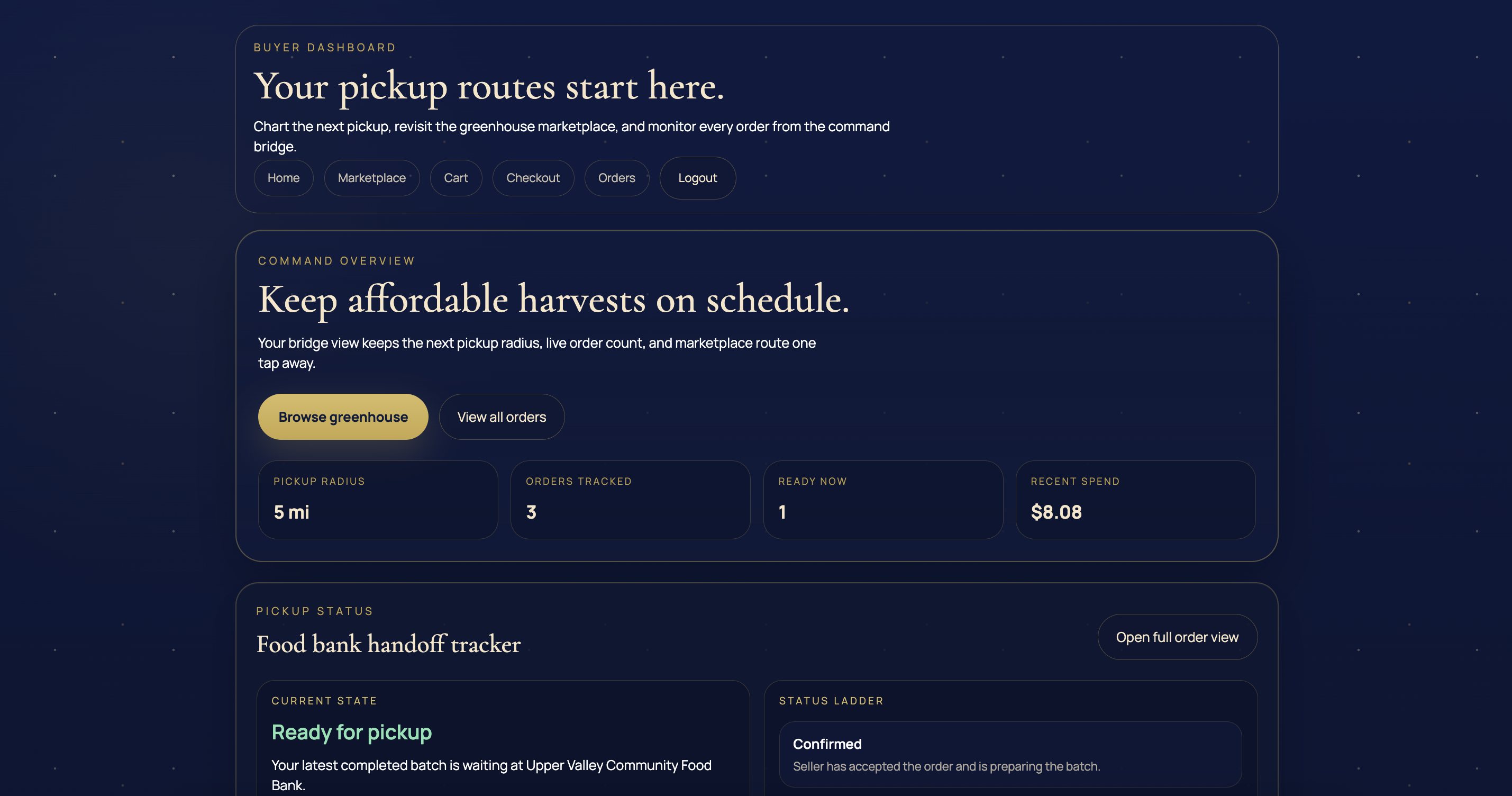
Buyer Dashboard
-
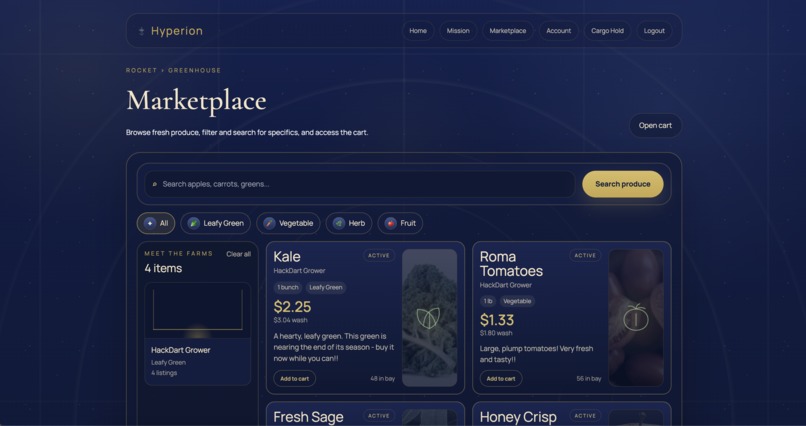
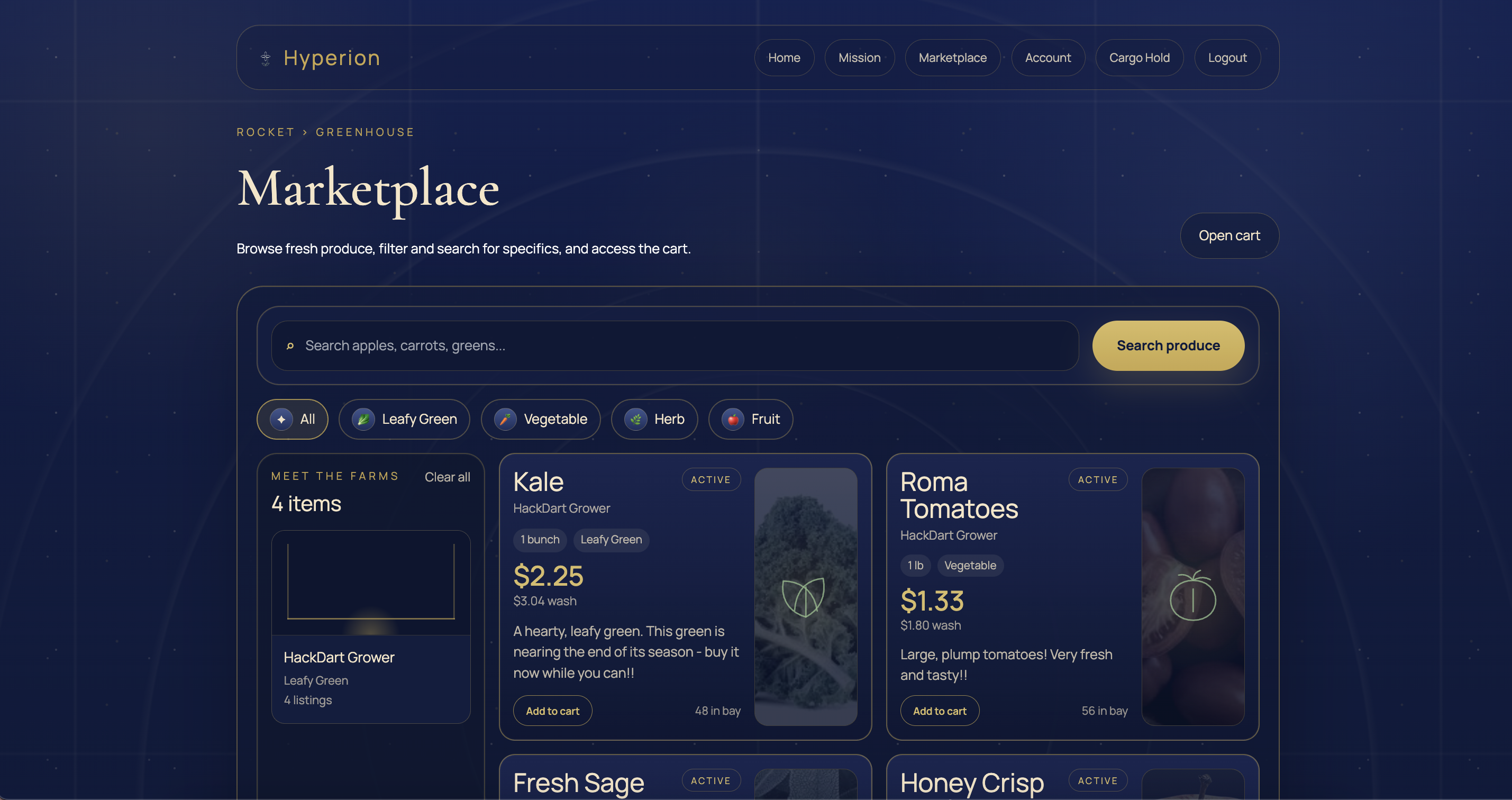
Marketplace
-
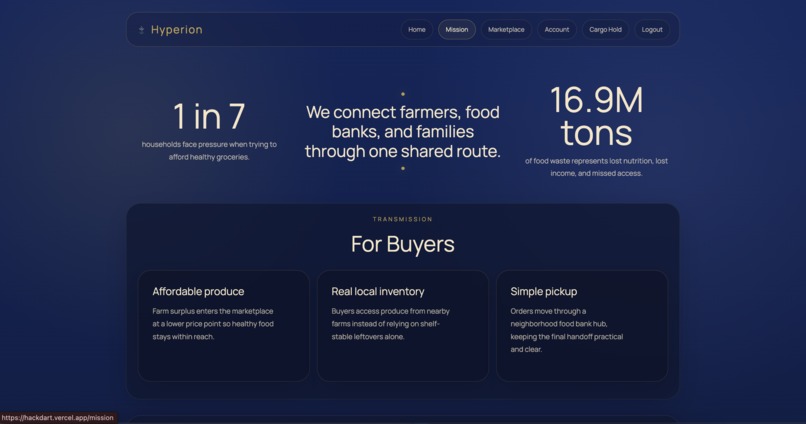
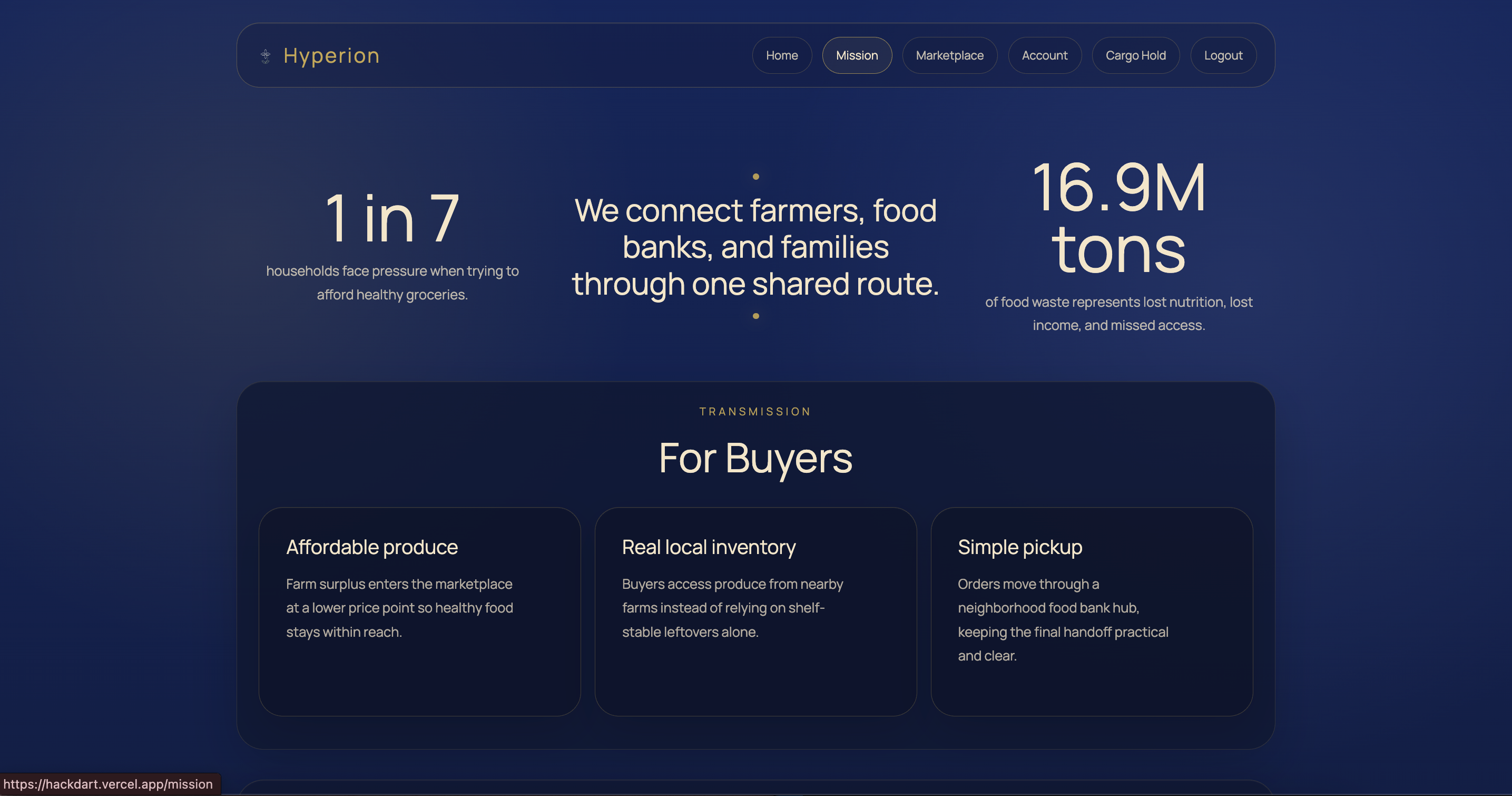
Mission Statement
Inspiration
A census report done by ReFed finds that over 240 million tons of food is wasted every year, 16.9 million of which are food surpluses created by farmers, while 18.3 million households remain food insecure. This mismatch wastes resources, drives economic loss, and exposes a major failure in food access.
What it does
Hyperion is a marketplace platform that lets individual households buy from various local farms that mark down their excess supply by 50%. The produce that is bought is then shipped in bulk to various food banks around the area, that become “pick-up” zones for customers. Farmers can now sell surplus or cosmetically imperfect produce instead of wasting it, low-income households can buy that produce at steeply reduced prices, and local food banks serve as trusted pickup hubs for distribution. By aggregating household orders into a single shipment, the system reduces delivery costs, improves efficiency for perishable food, and makes fresh produce access more practical. Unlike food banks alone, it creates a more sustainable revenue stream for farmers; unlike subsidies alone, it directly redirects surplus food; and unlike traditional marketplaces, it is designed specifically to serve food-insecure households. In doing so, the platform addresses food waste, farmer losses, and healthy food access as one connected problem.
This model combines the strengths of three existing approaches to food surplus and food insecurity: food banks, subsidy programs, and marketplace models. We found that while each model is effective, they solve only part of the problem in isolation. Food banks recover surplus at scale but depend on charitable infrastructure. Subsidies improve affordability for low-income households but do not necessarily capture wasted farm produce Marketplace models create revenue from imperfect food but are not designed specifically for food-insecure families.
Our solution innovates on these limitations by bringing all three methods together into one cohesive platform.
How we built it
- Next.js, React, and Tailwind CSS for the frontend
- Express.js for backend
- MongoDB Atlas for the database
- JWT authentication
- Nodemailer/SMTP for email
- Stripe for payments (current hackathon flow uses a simplified demo checkout path)
Challenges we ran into
Decreasing barrier to entry for low income households as much as possible: When initially brainstorming our project, we were faced with a major challenge: making the platform as accessible as possible for low-income households. Many existing solutions require high digital literacy, home delivery access, or complicated sign-up processes, all of which create barriers to participation. To reduce that barrier to entry, we designed our model around affordability, simple online ordering, and pickup through trusted local food bank hubs, making fresh produce easier to access without adding extra logistical or financial burdens.
Connecting to the backend: It was our entire team’s first time working with the backend, so there was a steep learning curve when it came to setting up the database and making API calls. We had to learn the fundamentals of what a server is, how to interact with it, and how to connect the backend with the frontend.
Asset generation: Because our team wanted to boldly match our project to the theme we had to create a lot of our assets from scratch, rather than built-in, pre-rendered AI blocks. To solve this, we decided to use combo.fun’s UI and asset creation to create most of the assets seen on screen. Thanks combo.fun!
Accomplishments that we're proud of
- Fully building a project that integrates both frontend and backend
- Designing a system that knocks out three birds with one stone: food waste for farms, lost profit for farmers, and lack of access to fresh produce to low-income households.
- Logistics: aggregating geographically close orders into one shipment and routing them through food banks
What's next for Hyperion
- Implement a refund system
- Create eligibility mechanisms for households
- Improve pickup logistics (instead of an email, completely new dashboard for food banks)
- Test with real local partners
Built With
- express.js
- jwt
- mongodbatlas
- next
- react
- smtp
- tailwind


Log in or sign up for Devpost to join the conversation.