Inspiration The inspiration for this project came from a stark reality: Hunger isn't a supply problem; it's a logistics problem.
While studying, I realized that 1/3 of all food produced is wasted, yet millions go hungry. The food exists, and the need exists, but the "bridge" connecting them is missing. I wanted to solve the data latency issue—ensuring that surplus food doesn't degrade to zero value but instead transfers utility to those in need immediately.
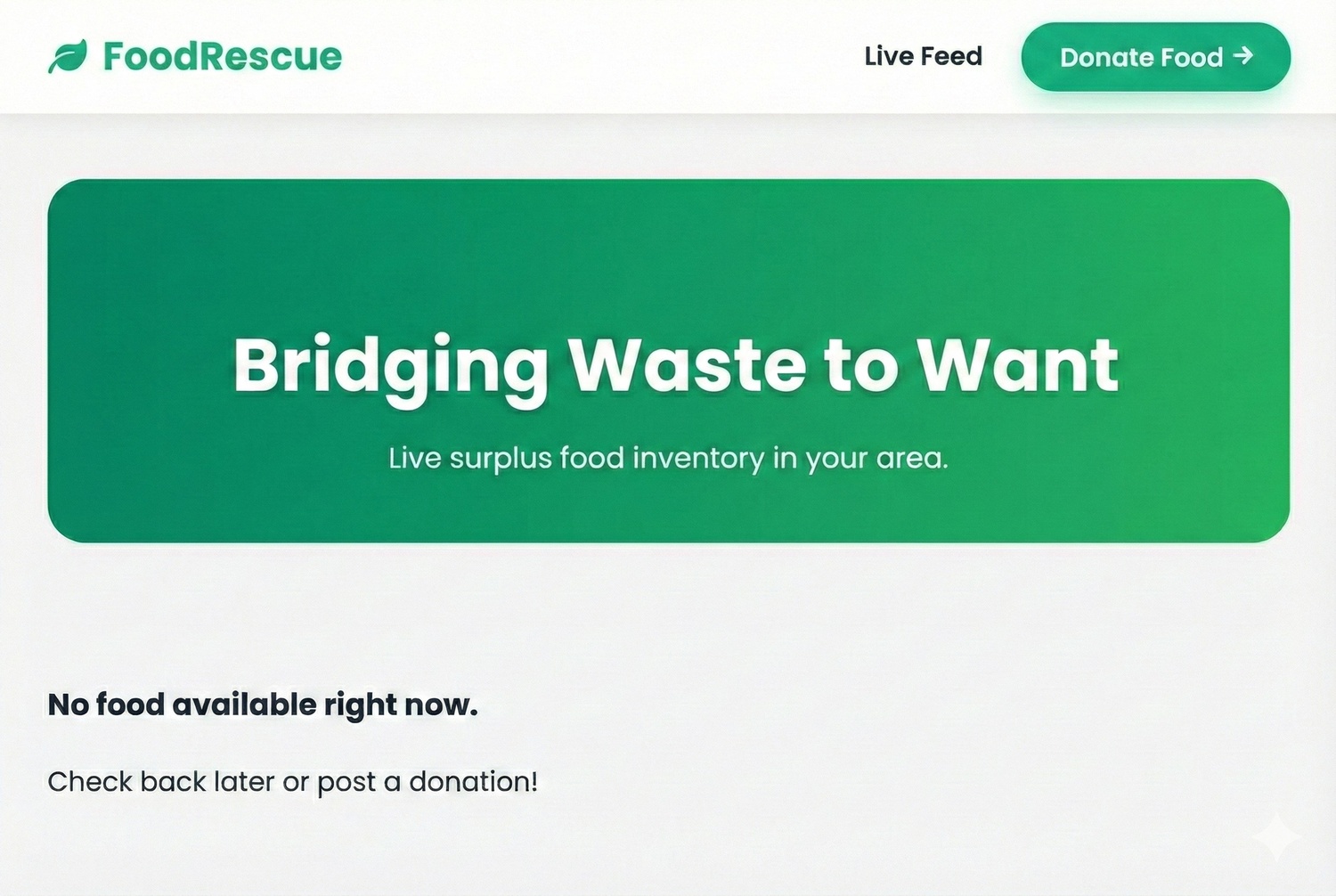
What it does The Hyper-Local Food Rescue Bridge is a real-time marketplace that connects local donors (restaurants, bakeries) with nearby shelters.
Instant Logging: Donors can post surplus food in under 30 seconds.
AI-Powered Descriptions: Users just type "leftover muffins," and the integrated Gemini 3 AI generates a standardized, appetizing description automatically.
Conflict-Free Claiming: Shelters can view live inventory and claim items instantly. The system removes claimed items in real-time to prevent double-booking.
How we built it We focused on speed and simplicity to lower the barrier to entry.Backend: Built with Python and Flask for a lightweight, fast server.AI: Integrated Google's Gemini API to handle natural language processing for item descriptions.Database: Used SQLAlchemy with SQLite (moving to PostgreSQL) to manage transactional states (Available $\rightarrow$ Claimed).Frontend: Designed with HTML5/CSS3 using a modern "Glassmorphism" aesthetic to ensure it looks trustworthy and professional on mobile devices.
Challenges we ran into Concurrency Control: The biggest technical hurdle was handling "race conditions" where two shelters might try to claim the same donation at the exact same millisecond. We implemented database session locking to handle this.
User Experience: We realized that restaurant staff are busy. Reducing the "posting" flow to just 3 inputs required aggressive optimization and reliance on AI to fill in the gaps.
Accomplishments that we're proud of Functional Prototype: Successfully building an end-to-end system where a user can post an item and another can claim it instantly.
AI Integration: effectively using a Large Language Model (Gemini) not just for chat, but for data structuring—cleaning up messy user input into clear database entries.
Social Impact Potential: Creating a tool that directly addresses SDG 2 (Zero Hunger) and SDG 12 (Responsible Consumption).
What we learned State Management: I deepened my understanding of ACID database properties and managing state in a multi-user environment.
The "Human" Element: I learned that for social good projects, the technology must be invisible. If the app is hard to use, the food goes to waste. UX is just as important as the backend logic.
What's next for Hyper-Local "Food Rescue" Bridge Geolocation: Integrating Google Maps API to sort donations by "Nearest to Me."
Push Notifications: Implementing Twilio for SMS/WhatsApp alerts so shelters know immediately when food is available.
Trust Layer: Adding verified profiles for 501(c)(3) nonprofits and food safety certifications for donors.

Log in or sign up for Devpost to join the conversation.