-
-
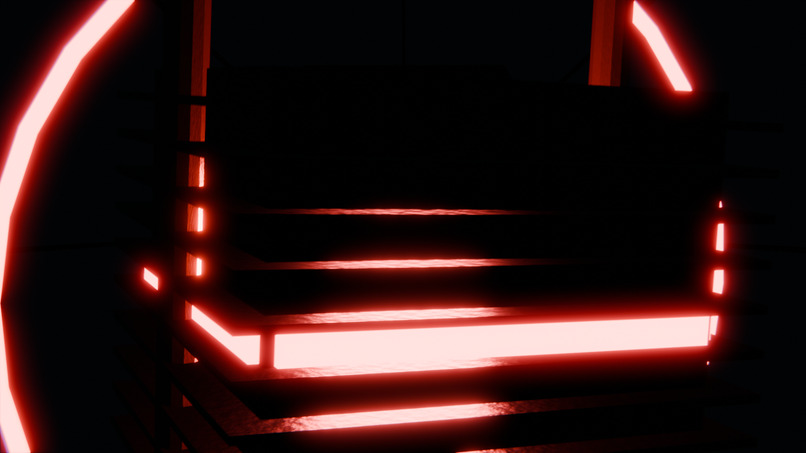
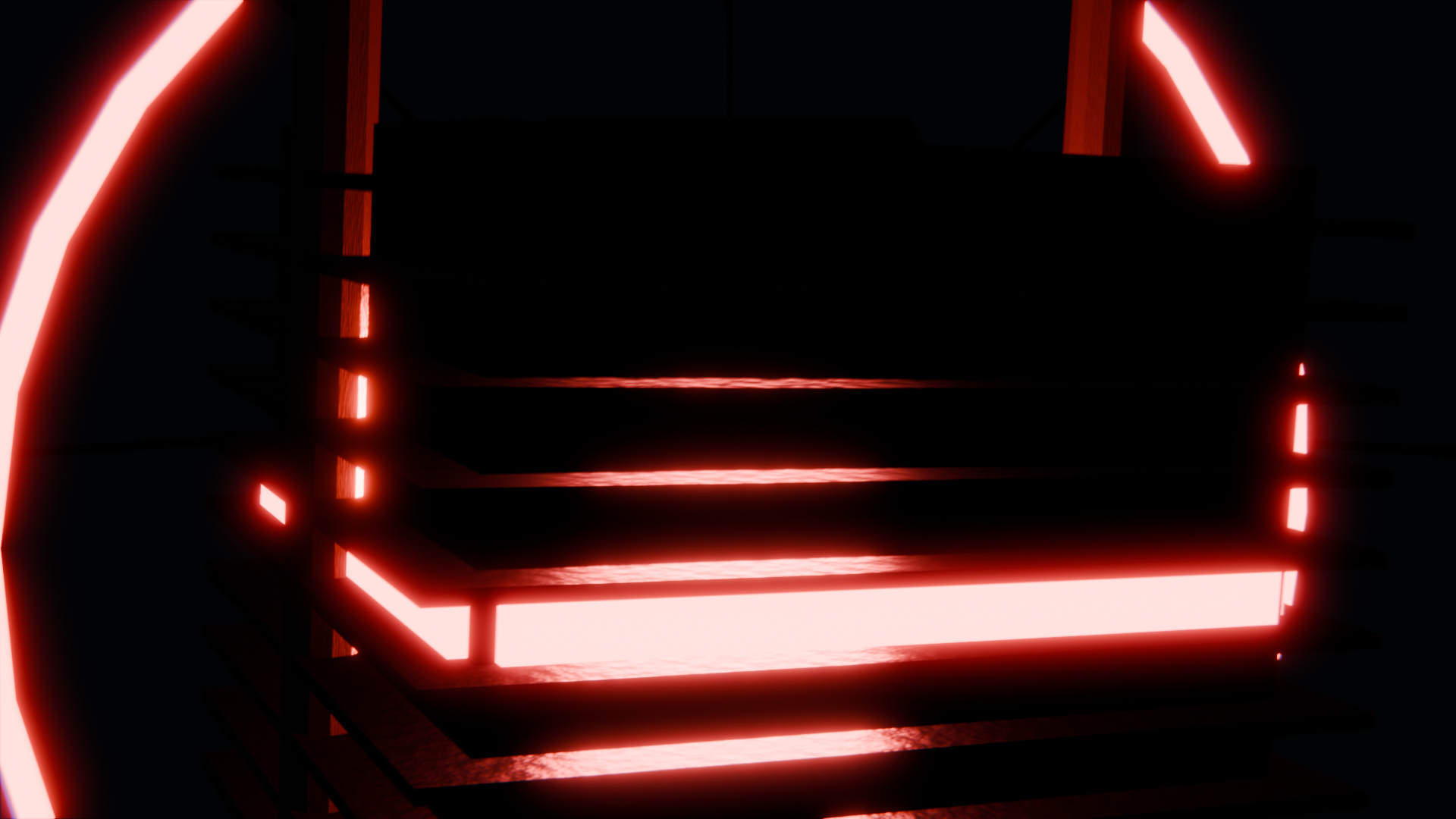
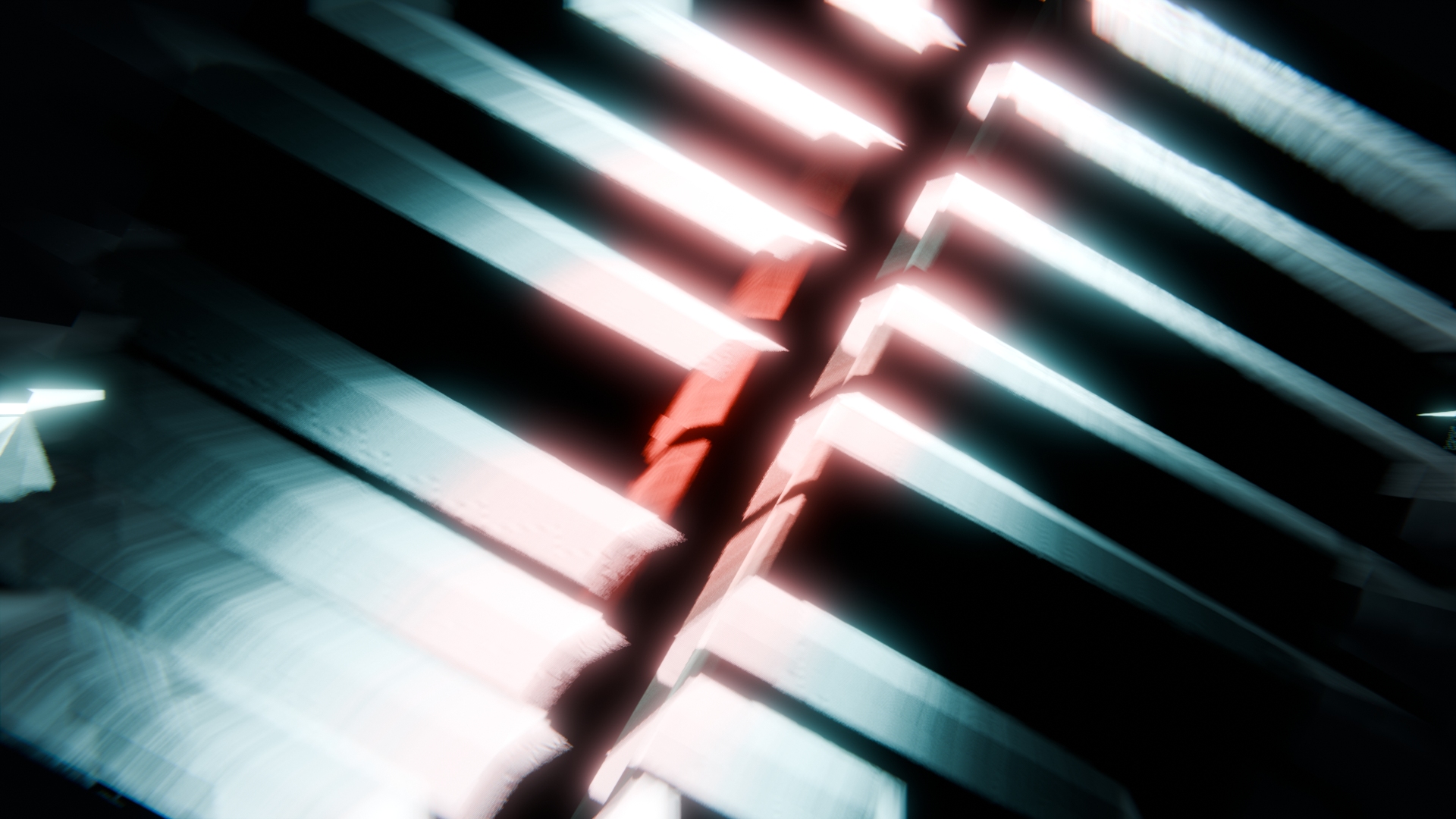
Act 1 (Frame 25): Local GPU thermal bottleneck core with 10 procedural heatsink fins, copper heatpipes & #FF0203 panic alert shaders.
-
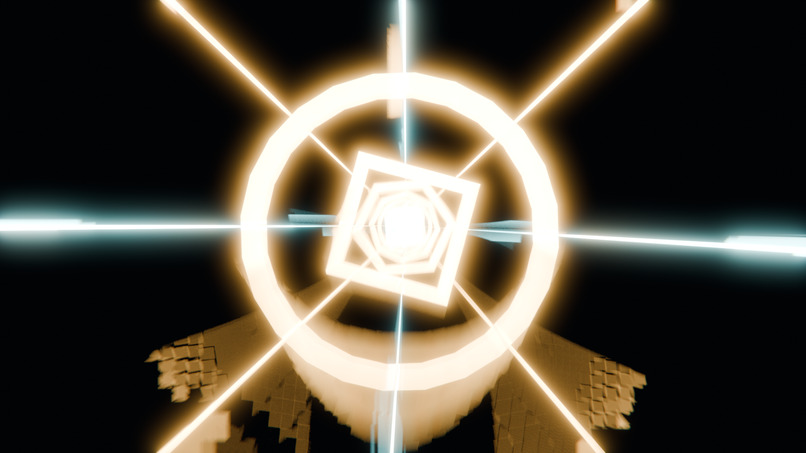
Act 1 (Frame 25): Local GPU thermal bottleneck core with 10 procedural heatsink fins, copper heatpipes & #FF0203 panic alert shaders.
-
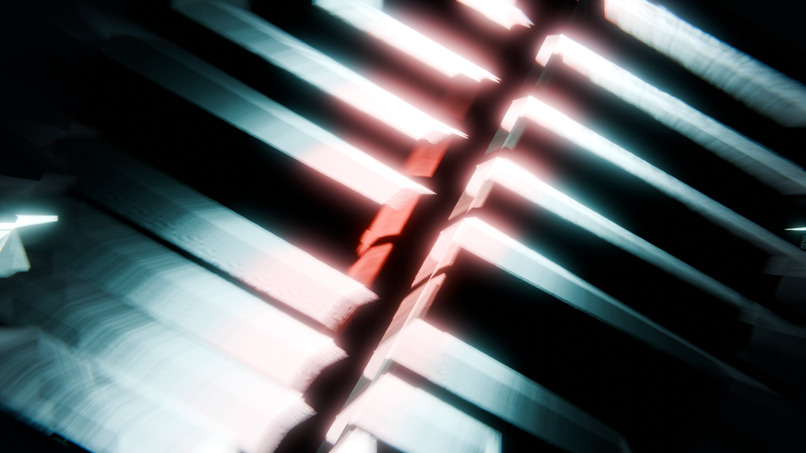
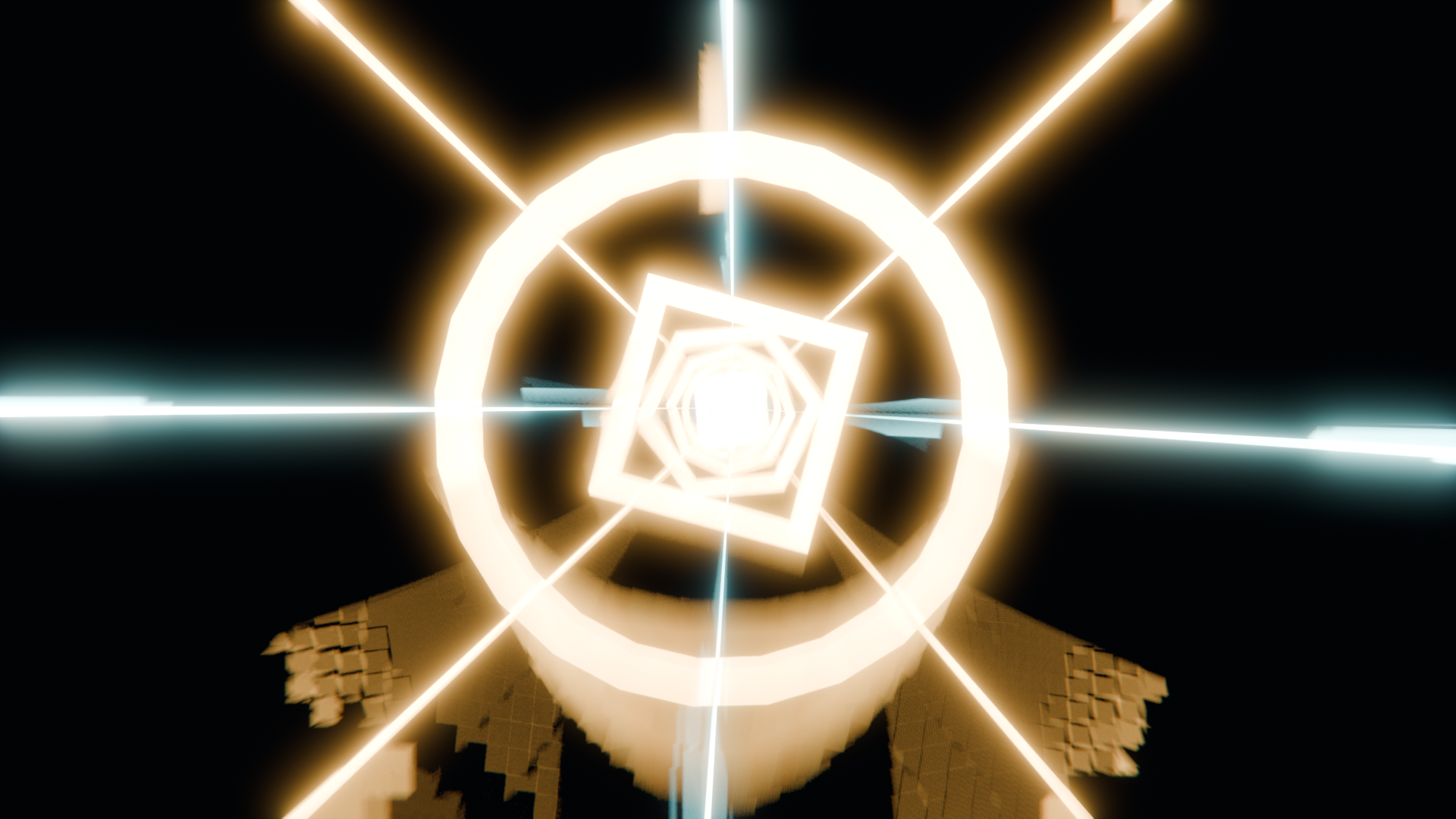
Act 2 (Frame 61): 95,000W RenderJuice cloud-rendering surge detonation in Electric Orange (#FF5500) vaporizing the local bottleneck.
-
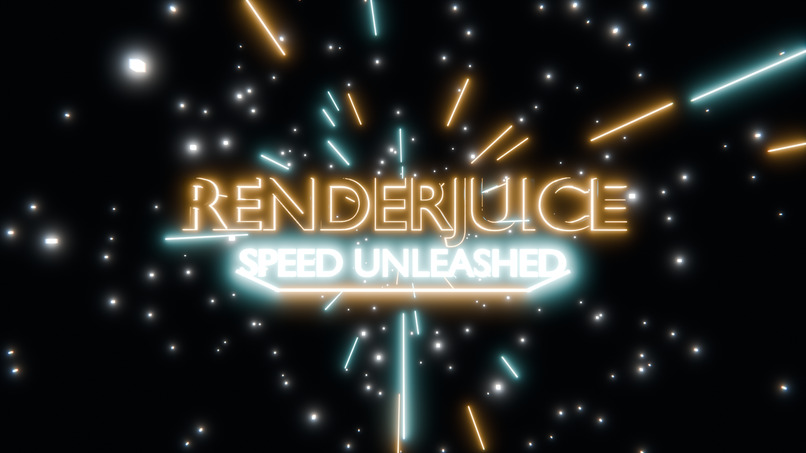
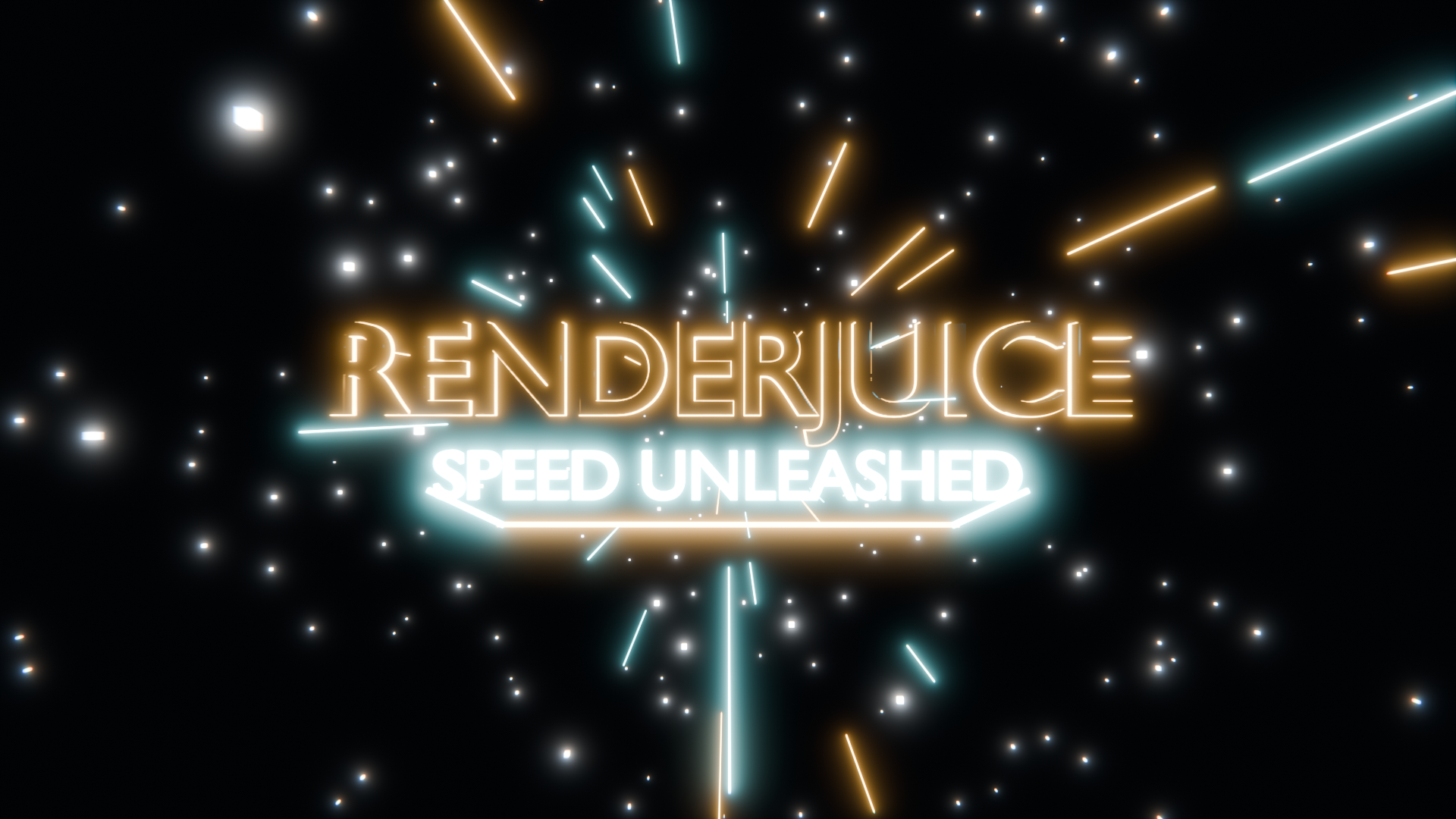
Act 3 (Frame 265): Extruded 3D hero reveal "RENDERJUICE: SPEED UNLEASHED" framed by supersonic shockwave rings & cosmic starlight.
-
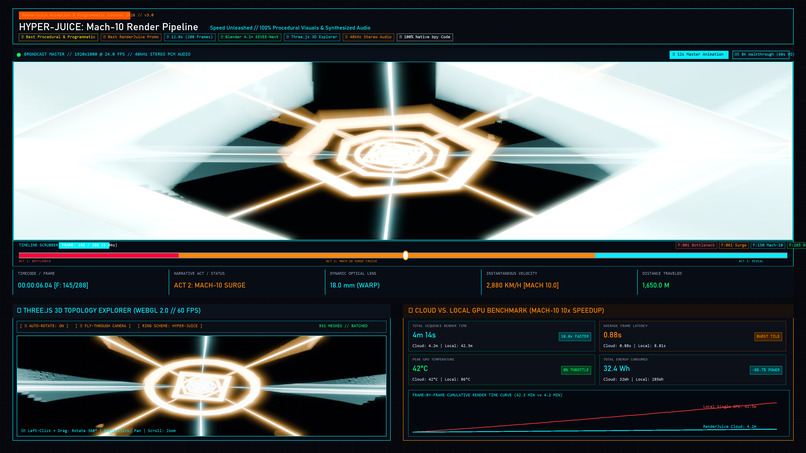
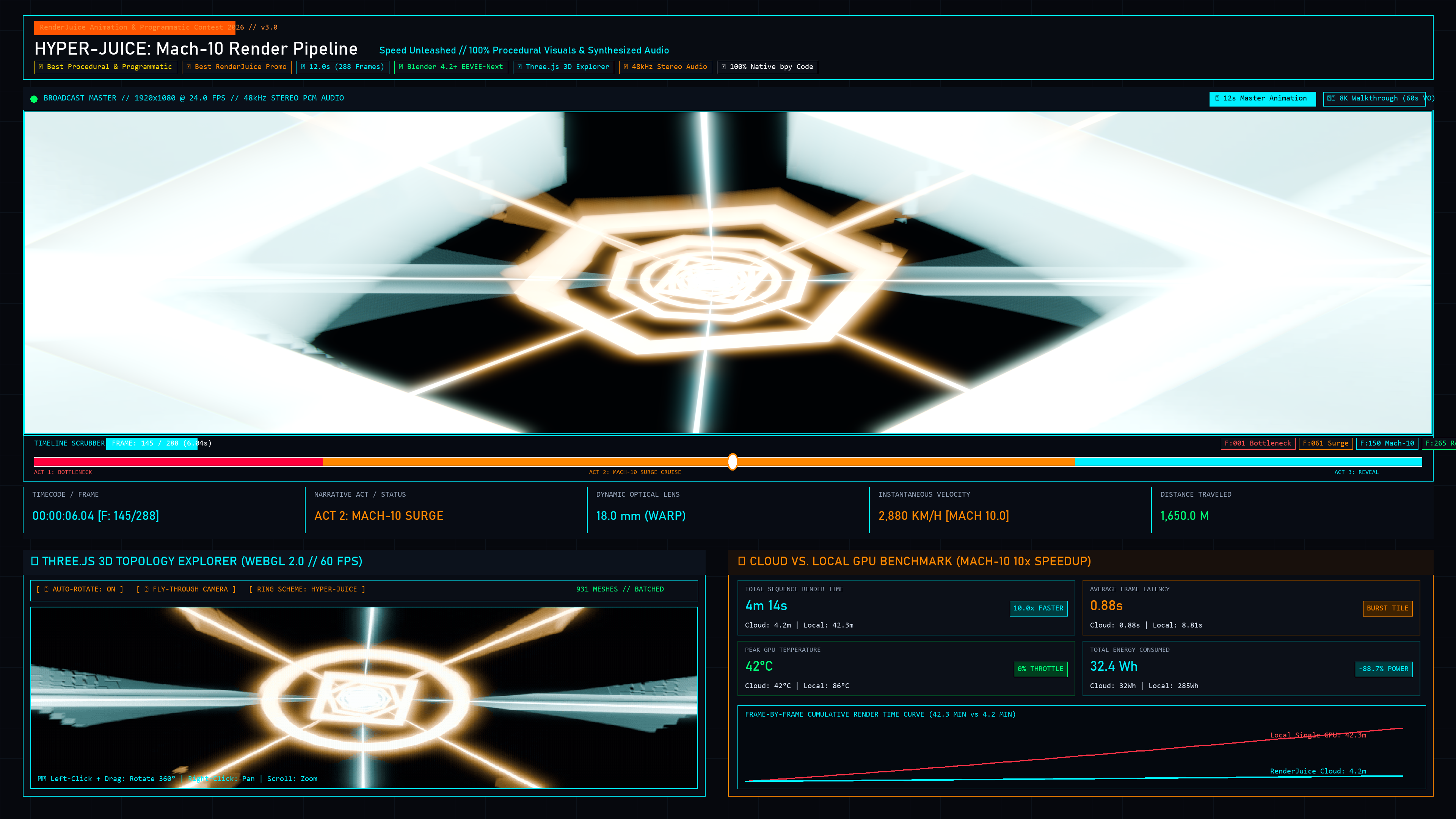
Interactive v3.0 Web Showcase & Telemetry HUD: Three.js 3D topology explorer (940 objects), frame scrubber & 10x cloud render benchmarks.
Inspiration
What it does
How we built it
Challenges we ran int## 🛡️ Strict Contest Asset Disclosure & Programmatic Purity Guarantee
"100% Procedurally generated visuals and audio using Blender Python API (
bpy) and Python standard library (wave,math,struct); zero third-party meshes, external textures, pre-recorded audio samples, or AI-generated visual/audio assets used."
Every single polygon, shader network, keyframe trajectory, optical lens warp, and 48kHz stereo audio sample was synthesized deterministically from scratch using pure Python code.
🌐 Live Interactive Showcase & Production Hubs
- 🚀 Vercel Production Dashboard: https://hyper-juice-mach10.vercel.app/
- 🌍 GitHub Pages Mirror: https://fokrulanthro16-eng.github.io/hyper-juice-mach10/
- 🎥 8K UHD Technical Walkthrough (60s VO): https://youtu.be/1DEDpgj7cbs
- 💻 Open-Source GitHub Repository: https://github.com/fokrulanthro16-eng/hyper-juice-mach10
💡 Inspiration
Rendering complex 3D animations locally often feels like being trapped inside an overheating thermal bottleneck—stuttering viewports, 99% GPU thermal throttling, and hours of lost creative momentum. For the RenderJuice Programmatic Rendering Contest (Theme: Speed), we engineered HYPER-JUICE: Mach-10 Render Pipeline v3.0—an end-to-end, 12-second (288 frames at 24 FPS) programmatic animation with mathematically synthesized stereo audio that tells the visceral story of breaking free from local hardware limits into RenderJuice cloud hyperscale.
🎬 What it does (Three-Act Narrative Breakdown)
- Act 1 — The Local Bottleneck (Frames 1–60 / 0.0s–2.5s): A heavy gunmetal GPU core cube with 10 procedural heatsink fins and copper heatpipes labors under 99% thermal load. Pulsing red warning lights (
#FF0203) strobe with panic as rotation hitches to simulate dropped frames, accompanied by a synthesized 55Hz power hum, 3,240Hz coil whine, and accelerating 920Hz panic beeps. - Act 2 — The Mach-10 RenderJuice Surge (Frames 61–216 / 2.5s–9.0s): At Frame 60, a 95,000W RenderJuice cloud surge vaporizes the bottleneck in signature Electric Orange (
#FF5500) and Quantum Cyan (#00F0FF). The camera focal length warps dynamically from 50mm to 18mm while accelerating exponentially down a 2,200m hyperspace tunnel of 150 procedural neon speed rings and 260 ion light streaks, driven by a sub-bass detonation impact and exponential Doppler turbine roar. - Act 3 — Cosmic Open Space & Title Reveal (Frames 217–288 / 9.0s–12.0s): Punching through the supersonic exit portal with 4 expanding shockwave rings and a 36Hz sonic boom crack, the camera decelerates smoothly into cosmic starlight to frame the extruded 3D hero title: "RENDERJUICE: SPEED UNLEASHED" backed by an ethereal D-maj9 cosmic chord shimmer.
⚙️ How we built it (Mathematical & Programmatic Architecture)
1. Dynamic Focal Length Contraction (Hyperspace FOV Warp)
To amplify the sensation of hypersonic acceleration without disorienting cuts, the camera lens contracts non-linearly from a claustrophobic 50.0mm down to an ultra-wide 18.0mm before expanding to 32.0mm for the hero reveal:
$$Lens(f) = 50.0 - 32.0 \cdot \left(\frac{f - 60}{25}\right)^{1.5} \quad \text{for } f \in (60, 85]$$
2. Mach-10 Exponential Velocity Curve
Forward trajectory across the 2,200-meter tunnel is governed by an exponential power curve where normalized time $u = (f - 60)/156$:
$$Y_{cam}(f) = Y_{start} + L_{tunnel} \cdot \left(\frac{f - 60}{156}\right)^{2.35}$$
$$v(f) = \frac{dY}{df} = \frac{2.35 \cdot L_{tunnel}}{156} \cdot \left(\frac{f - 60}{156}\right)^{1.35}$$
At Frame 216 (Exit Portal), instantaneous velocity reaches 33.38 m/frame (~2,884 km/h), driving authentic sub-frame EEVEE-Next motion blur.
3. Multi-Harmonic Fourier Camera Turbulence
Aerodynamic cockpit buffeting is synthesized via non-commensurate sinusoidal harmonics layered across the X and Z axes:
$$Shake_X(t) = A(f) \cdot 0.22 \left[\sin(1.73t + 0.5) + 0.5\sin(3.41t + 1.2) + 0.25\sin(7.19t + 2.4)\right]$$
4. 100% Procedural Audio Synthesis (generate_procedural_audio.py)
Synthesized purely in Python (wave, math, struct) at 48kHz 16-bit stereo:
- Custom biquad IIR low-pass/band-pass filters and stereo Schroeder reverb network.
- Exponential Doppler turbine sweep (85Hz to 1,635Hz) and 48 stereo-panned speed-ring whooshes.
- Broadcast-grade sidechain ducking (-14 LUFS) for the 60-second 8K walkthrough video.
5. Interactive v3.0 Web Showcase (index.html)
- Three.js 3D Topology Explorer: Real-time 360° OrbitControls inspection of the 940-object cyber tunnel and live fly-through camera mode.
- Frame-by-Frame Timeline Scrubber: Scrub across all 288 frames with synchronized flight telemetry HUD readouts.
- 1-Click Reproducibility: Automated
run_pipeline.ps1andrun_pipeline.batscripts rebuild the audio, Blender.blendscene, 4K stills, and muxed MP4 from scratch.
🚧 Challenges we ran into
- Zero-Asset Constraint: Generating rich metallic heatpipes, neon emission conduits, and supersonic shockwaves without external image textures required intricate procedural shader node trees (
ShaderNodeTexNoise,ShaderNodeValToRGB, and mathematical coordinate mapping) built entirely viabpy. - High-Speed Motion Blur vs. Readability: Balancing Mach-10 camera velocity (
33.38 m/frame) with EEVEE-Next sub-frame motion blur (shutter = 0.55) so the tunnel rings streak cinematically without turning muddy. - Pure Python Audio Synthesis: Writing zero-dependency DSP routines (IIR filters, stereo panning, and harmonic chord synthesis) inside standard Python without external audio libraries.
🏆 Accomplishments that we're proud of
- Achieving 100% programmatic purity across 940 scene objects, 765 quad-topology procedural meshes, and 48kHz stereo audio.
- Rendering the entire 288-frame sequence in Blender 4.2+ EEVEE-Next with AgX High Contrast color management, real-time bloom glare, and chromatic lens dispersion.
- Building a live, interactive Three.js Web Showcase deployed on both Vercel and GitHub Pages alongside a 60-second 8K UHD Technical Walkthrough.
📚 What we learned & What's next
We demonstrated that declarative Python code can serve as a complete studio pipeline—simultaneously acting as 3D modeler, rigging artist, cinematographer, lighting TD, and sound designer. Next, we plan to integrate real-time WebSocket telemetry hooks into our dashboard to stream live distributed cloud render node metrics directly from RenderJuice jobs.o

Log in or sign up for Devpost to join the conversation.