Inspiration
Growing up, sports were more than just games to us. We remember watching big moments with family and friends, cheering when an athlete won, feeling nervous during close matches, and sometimes feeling heartbroken when someone we supported lost. As kids, we did not always understand the years of training, pressure, sacrifice, injuries, and mental strength behind every performance. We only saw the final race, the final score, or the final result.
But as we got older, we started seeing sports differently.
During major events like the Olympics and Paralympics, athletes carry more than their own dreams. They carry their families, their communities, and sometimes an entire country’s hope. One moment online can make them feel celebrated, but one mistake can also bring thousands of harsh comments, jokes, and criticism. Social media makes it easy for fans to react quickly, but not always thoughtfully.
That made us think about our own behavior as fans. We realized that cheering should not only happen when athletes win. Real support matters even more when they fall short, make mistakes, or face pressure from the public.
When we scroll through social media during big sports moments, we see thousands of people liking, reposting, commenting, and reacting to athletes. But a lot of that support stays online. It becomes emojis, short comments, and temporary hype. It does not always turn into learning, encouragement, respect, or meaningful action.
That inspired us to build Hype-to-Help: Team USA Fan Impact League.
The idea came from one simple question:
What if fan hype could become real help?
We wanted to create a platform that helps fans support Team USA in a healthier and more meaningful way. Instead of only cheering louder, we wanted fans to cheer better. That means learning the story behind an athlete, discovering Paralympic sports, rewriting harmful comments into supportive ones, and turning attention into positive action.
This project is also personal because many of us grew up admiring athletes without always knowing how to support them beyond watching the game. We wanted to build something that helps fans become more than spectators. We wanted them to become respectful supporters, learners, and positive voices in the sports community.
For us, Hype-to-Help is not just a fan engagement platform. It is a way to build a better fan culture.
Because athletes do not just need support when they win.
They need support when they keep going.
What it does
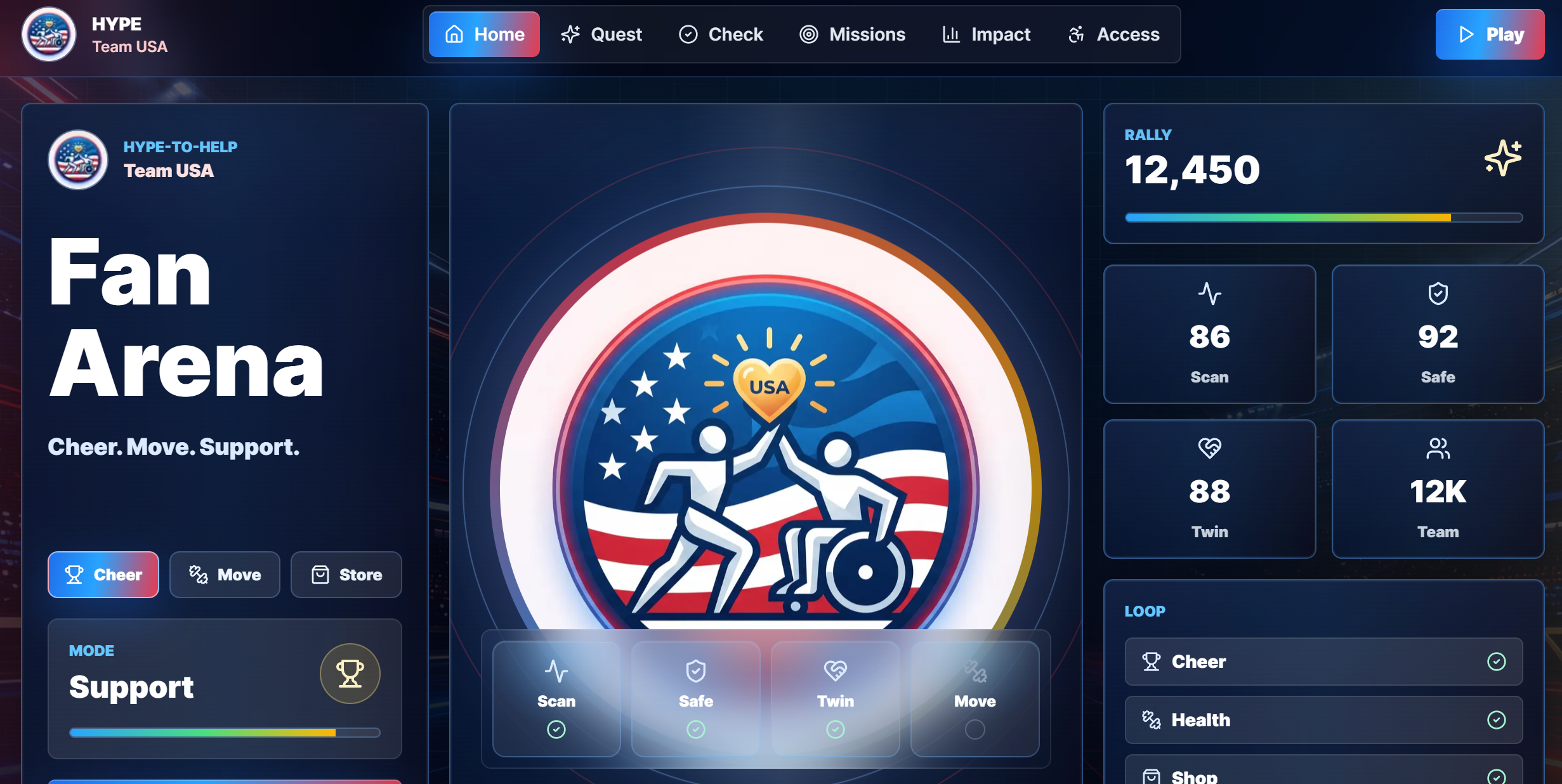
Hype-to-Help: Team USA Fan Impact League is a Gemini-powered fan engagement platform that turns Olympic and Paralympic attention into positive action.
Fans can upload or paste Olympic-related content, such as memes, headlines, social posts, athlete stories, or fan comments. Gemini analyzes the content, identifies the related Team USA topic, and generates a personalized Fan Impact Mission.
These missions help fans:
- Learn accurate context about Team USA
- Discover related Paralympic sports and athletes
- Rewrite harmful or negative comments into supportive messages
- Share inclusive fan content
- Complete Team USA support challenges
- Earn points, badges, and progress on a Fan Impact Score
The platform also includes Paralympic Twin Mode, which connects every Olympic topic with a related Paralympic sport or story. For example, if a fan is learning about swimming, the platform can also introduce Para swimming. If a fan follows basketball, the platform can introduce wheelchair basketball.
This makes Olympic and Paralympic support feel connected, equal, and unified.
How we built it
We built Hype-to-Help: Team USA Fan Impact League as a Gemini-powered fan engagement web app that turns Olympic and Paralympic fan content into positive, inclusive action.
The platform starts with a simple input flow where fans can paste a headline, social post, meme caption, athlete story, or fan comment. Gemini analyzes the content to identify the related Team USA topic, summarize the context, detect potentially harmful language, and generate a personalized Fan Impact Mission.
We organized the product around four main features:
- HypeCheck: Reviews fan comments for respectful, inclusive, and fact-aware language, then helps rewrite negative comments into supportive Team USA messages.
- Fan Impact Missions: Generates short challenges that help fans learn accurate context, cheer respectfully, discover related stories, and take positive action.
- Paralympic Twin Mode: Pairs Olympic topics with related Paralympic sports, athletes, or classification insights so Paralympic representation is built into the main experience.
- Fan Impact Score: Tracks completed missions, points, badges, and progress to make fan support feel measurable and motivating.
The frontend was designed as a clean, mission-based experience. Users can enter content, receive AI-powered analysis, complete a mission, improve a support message, and see their progress. We also planned the interface with accessibility in mind, including readable layouts, simple language, high contrast, keyboard-friendly navigation, and inclusive explanations.
Overall, we built Hype-to-Help as more than a fan app. We built it as a responsible AI system that uses Gemini to transform online attention into learning, inclusion, and meaningful Team USA support.
Challenges we ran into
One of the biggest challenges was figuring out how to turn online support into real-world impact.
It is easy for fans to comment, repost, or react to Olympic and Paralympic content. But it is much harder to build a bridge between fans and athletes in a way that feels useful, respectful, and safe.
Another challenge was making sure the platform did not become just another leaderboard or social media game. We wanted the missions to feel fun, but we also wanted them to have purpose. The goal was not to create pressure on athletes or encourage fans to compare them. The goal was to help fans learn, encourage, and support Team USA in a healthier way.
We also had to think carefully about harmful comments. Sports fans can be emotional, especially after wins and losses. A major challenge was designing HypeCheck, a feature that helps fans rewrite negative or harmful comments into supportive messages without making the experience feel judgmental.
For example, instead of saying:
"That athlete failed us."
The platform can help rewrite it as:
"Proud of the effort and dedication. Team USA support goes beyond one result."
This challenge made us realize that the project is not just about building a tool. It is about building a better fan culture.
Accomplishments that we're proud of
We are proud that this project focuses on more than just fan engagement. It focuses on responsible fan engagement.
Instead of building a platform that only rewards clicks, likes, or shares, we designed Hype-to-Help around learning, inclusion, respect, and action. We are especially proud of the Paralympic Twin Mode because it makes Paralympic representation part of the main experience instead of treating it as a separate side feature.
We are also proud of the idea behind HypeCheck. Online sports conversations can become negative very quickly, so creating a feature that helps fans pause, reflect, and rewrite their message into something supportive felt meaningful.
Another accomplishment we are proud of is the overall mission-based design. We wanted the platform to feel fun and simple, but still carry a deeper purpose. Every mission is meant to help fans become more informed, respectful, and active supporters of Team USA.
What we learned
While working on this idea, we learned that technology can do more than organize information. It can shape behavior.
We learned that fan engagement should not only be measured by views, likes, or shares. Real engagement should also ask:
- Did the fan learn something?
- Did the fan support an athlete respectfully?
- Did the fan discover a Paralympic sport they may not have known about before?
- Did the fan turn attention into positive action?
This project also helped us think more deeply about inclusion. Paralympic athletes are often treated as a separate category instead of being included in the main sports conversation. Through Paralympic Twin Mode, we learned how important it is to design inclusion into the core product experience from the beginning.
We also learned how important responsible AI is. If Gemini is helping fans rewrite comments, generate missions, or analyze content, the system has to avoid harmful assumptions. It should not rank athletes by identity, disability, body type, gender, race, or predicted performance. Instead, the AI should guide users toward accurate, respectful, and supportive fan behavior.
The biggest lesson we learned is that good technology should not replace human support. It should make it easier for people to support others in better ways.
What's next for Hype-to-Help: Team USA Fan Impact League
Next, we want to turn Hype-to-Help from a concept into a working platform with a clear demo flow.
The next step is to build the core experience where a fan can upload or paste Olympic-related content, and Gemini can generate a personalized Fan Impact Mission. We also want to develop HypeCheck so users can test and improve their comments before posting them online.
After that, we want to expand Paralympic Twin Mode by adding more Olympic-to-Paralympic sport connections, athlete stories, and simple explanations of Paralympic classifications. We also want to add a Team USA Fan Impact Score, badges, and possibly a state-based or campus-based rally map so fans can see how their support contributes to a larger community.
Long term, we imagine Hype-to-Help becoming a safe and inclusive fan movement for major sports events. The goal is to help fans move from passive support to active support.
Not just hype.
Help.
Built With
- accessibility-first
- firebase-hosting
- firestore
- gemini-api
- github
- google-ai-studio
- javascript
- react
- tailwind-css
- typescript
- ui
- vertex
- vite


Log in or sign up for Devpost to join the conversation.