Design Process and Iterations
In wanting to create an entirely self watering system, we originally had planned on creating a vertical hydroponic setup that utilized water pumps, water storage containers, and gravity to water the plants for the entirety of their growth period. It was important to us that we made a water system that required as little attention from the user as possible once the process began. Through using moisture sensors, the system is able to detect and correct moisture levels in the pots of each plant through the use of the water pumps and storage, leaving the majority of the work out of the hands of the user. It is important to note that it was inevitable that some attention would be required, as most hydroponically grown crops take at least 6 weeks, and water storage would have to be replaced. Although the hydroponic setup was something we really wanted to accomplish, mainly due to the ease of finding space for such, the cost of creating a hydroponic setup that was equally efficient on all sides as well as the actual design process seemed rather out of our reach. Therefore we switched from a hydroponic setup to a kitchen window one. Growing certain herbs, such as sage, basil, mint, and thyme all require extremely low attention from gardeners, only take a maximum of 6 weeks to grow, and compared to other plants requires significantly less water. Furthermore, the setup fits perfectly within the confines of an average kitchen window set-up, allowing just about anyone to incorporate this into their homes.
Challenges we ran into
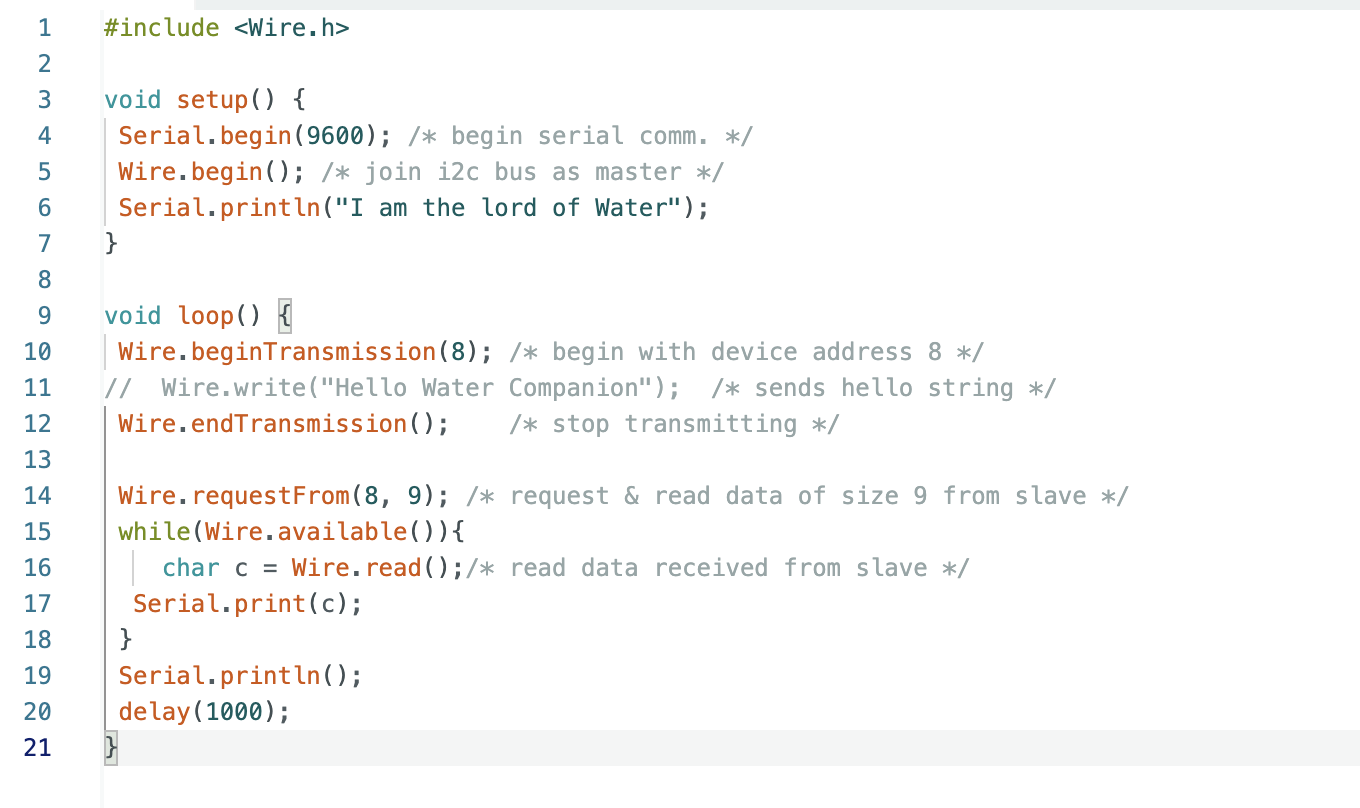
The main challenge we faced with our project came from figuring out how to wire I2C connections between two separate boards as well as figuring out the IOT/Bluetooth component of the lab. The I2C connection was used to link a master board to a slave board in order to communicate the data being read. We were able to solve this issue through research and ended up figuring out this part. However, in regards to the Bluetooth connection, we were unable to ever figure out this problem as the settings on our computer were unable to process the extensions needed for the ESP32 Feather. Therefore we were unable to fully integrate an IOT/Bluetooth component within our lab that could link to the Blynk application on the phone. All other issues were small enough to not be considered.
Technology Description (parts used, etc)
Crowtail-Smart Pump Shield:
The main (master) board used to communicate data from the sensors to the serial monitor. DC 12V Four-Way Valve:
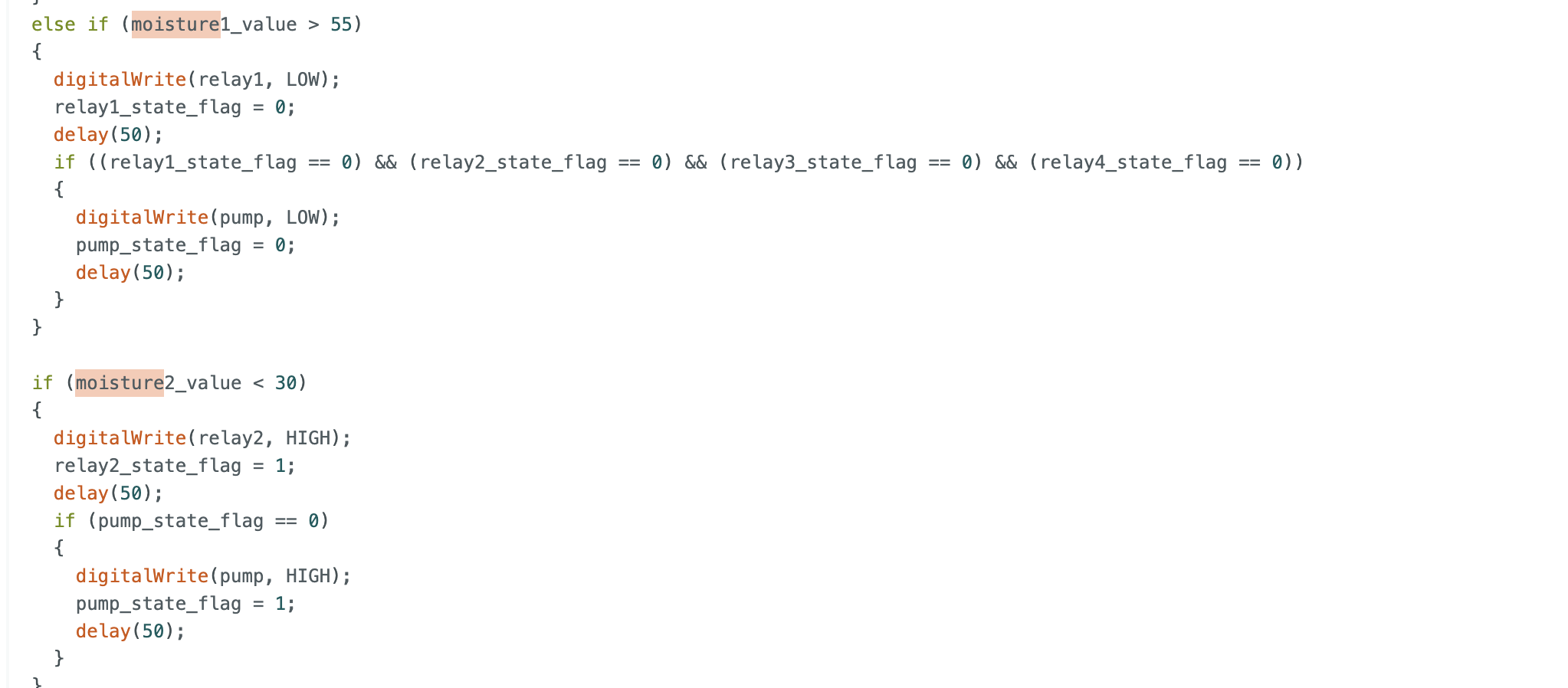
This was used in conjunction with the relays on the board to supply water to corresponding water tubes for each individual plant. The four way valve has the ability to designate water depending on which sensor communicates a need for water (based on moisture and humidity values that are specific to each plant). Therefore, not all plants are receiving water at the same time. DC 12V Adapter:
Power supply that was used to power the board and pump.
Capacitive Moisture Sensors:
Moisture sensors that were placed in the soil and communicated moisture levels with the board. These sensors were integral in creating this system as the main indicator of when to release water to each of the plants. Each moisture sensor was specifically paired with each of the plants (basil, thyme, mint, and sage) dependent on the values that were optimal for each plant's growth. Liquid Level Sensors:
Displays the water level of the water source container. Will communicate with the board when to refill water. Humidity Sensor:
Captures the humidity levels of the air around the automatic watering system, allowing the system to correct the amount of water given to each plant based on changing levels of humidity. This allows for the plant to acclimate to different environments (i.e. indoors and outdoors). Water Pump:
Pumped water from the water source, through a four way valve, and out to each of the plants via a tube.
Plastic Tube:
Connected water source, to pump, to plants. ESP32 Feather:
Responsible for making the board bluetooth capable, allowing the communication of data between sensors and board to be displayed on devices other than ones directly connected to the board (i.e. phones). This piece allows us to use the Blynk app to create an app that will display moisture levels, send watering notifications, allow you to manually water, and remind you to refill your water source via a liquid level sensor. Water Supply Container:
This houses the water supply and can be any large container.
What You Learned
One thing we learned while building our final project was the definition and workings of I2C connections. We had originally bought a board (Crowtail-Smart Pump Shield) that lacked ports needed to connect the ESP32 feather. Therefore, we used I2C connections to create a communication link between a master board (Crowtail) and slave board (Elegoo Uno R3) via the breadboard. This allows us to connect the ESP32 feather to the breadboard and the Uno R3 yet continue to use the Crowtail to continue to collect and process data. The I2C connection just allows us to “move” the data from the master board to the slave board and display it on the serial monitor of the slave. This is what would have made the bluetooth connection possible if that component would have worked. We had also learned that the I2C connection could have been directly connected to the ESP32 Feather in the end of the project, allowing us to minimize the self watering system by one component.
Next Steps
If we were to continue this project, one thing we would have preferred to do, as mentioned earlier, is convert this set up into a hydroponic system. Hydroponic systems are more cost efficient, less expensive, utilize smaller space, and can be done virtually anywhere. Using the system that we have now would greatly be better used within a hydrophobic environment as these kinds of systems require incredibly small amounts of water when compared to normal gardening methods. Furthermore, the self watering system is meant to decrease the amount of attention that is required for such a process, and with hydroponic systems using significantly less materials (super-nutrient compact soil, small insert pots, less water) it makes the most sense that the least amount of work would pair best with the least amount of setup. Although there are many things that we would like to improve, these are the ones that are most important to us... Range of System: As of now, the current system requires a vast amount of components for the entire system to work properly, consequently limiting the range of the system to about 5 feet. We would like to have built cases and wire ports that allow the overall system to both look more aesthetically pleasing and be more compact. A lot of issues arose when it came to putting things together as wires and tubes got mixed up and intertwined. Functionality of System IOT: Since this is something that we were never able to figure out due to hardware issues, being able to fix this component would greatly improve the overall project. We found it important to know when your plants are being watered, knowing when to change the water, and always being aware of what is happening to your plants when you’re away. Therefore, in order to make this a reality there would need to be changes made to increase the usability of the system from a remote environment via a bluetooth connection and application.


Log in or sign up for Devpost to join the conversation.