Inspiration:River systems are the primary vector transporting macro and microplastics into the world's oceans. Traditional water filtration plants are highly centralized, energy-dependent, and pose a severe entrapment risk to local aquatic fauna. HYDROPO was conceived as a decentralized, eco-friendly, and completely autonomous alternative to intercept and neutralize microplastics directly at the riverbank source.
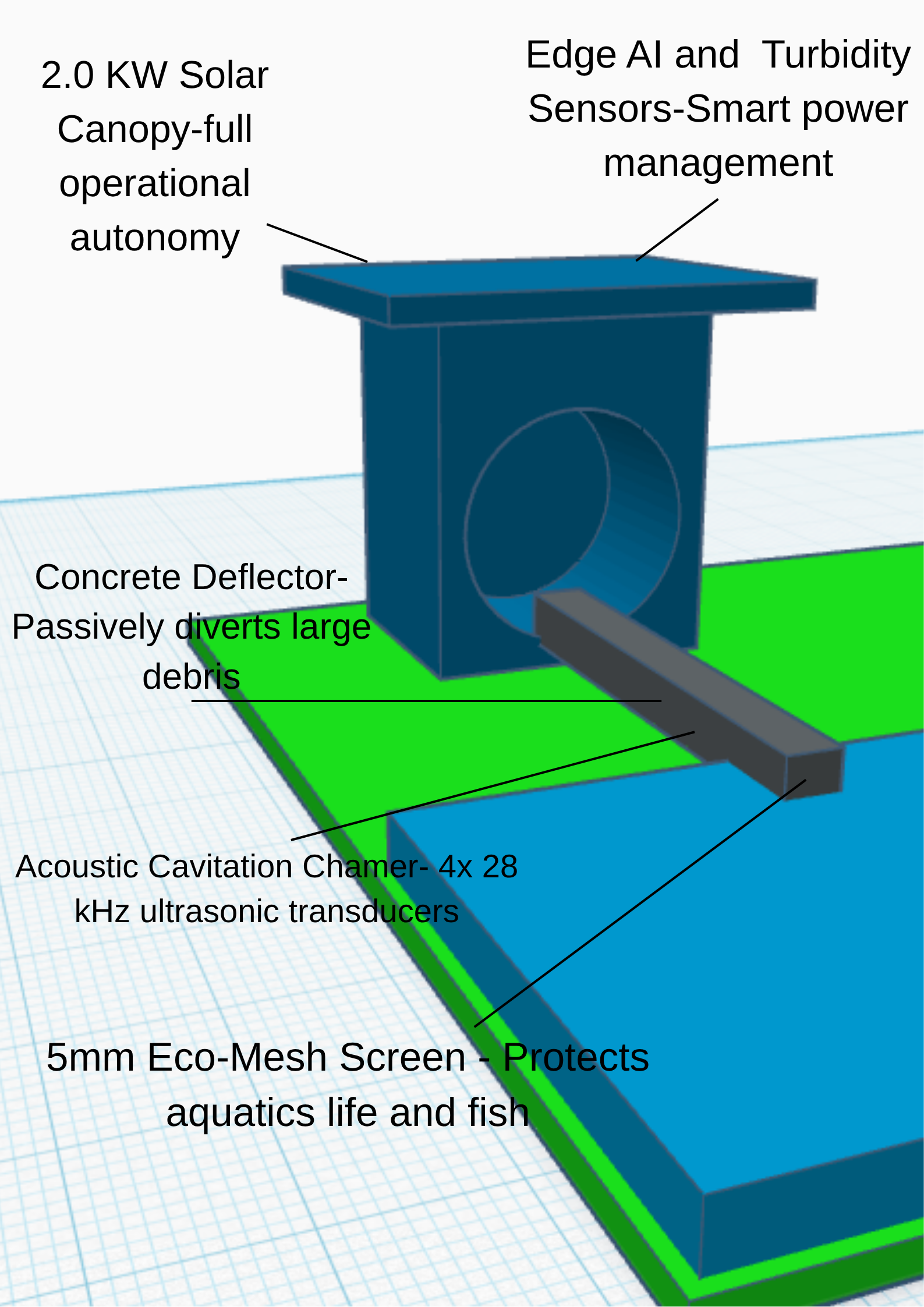
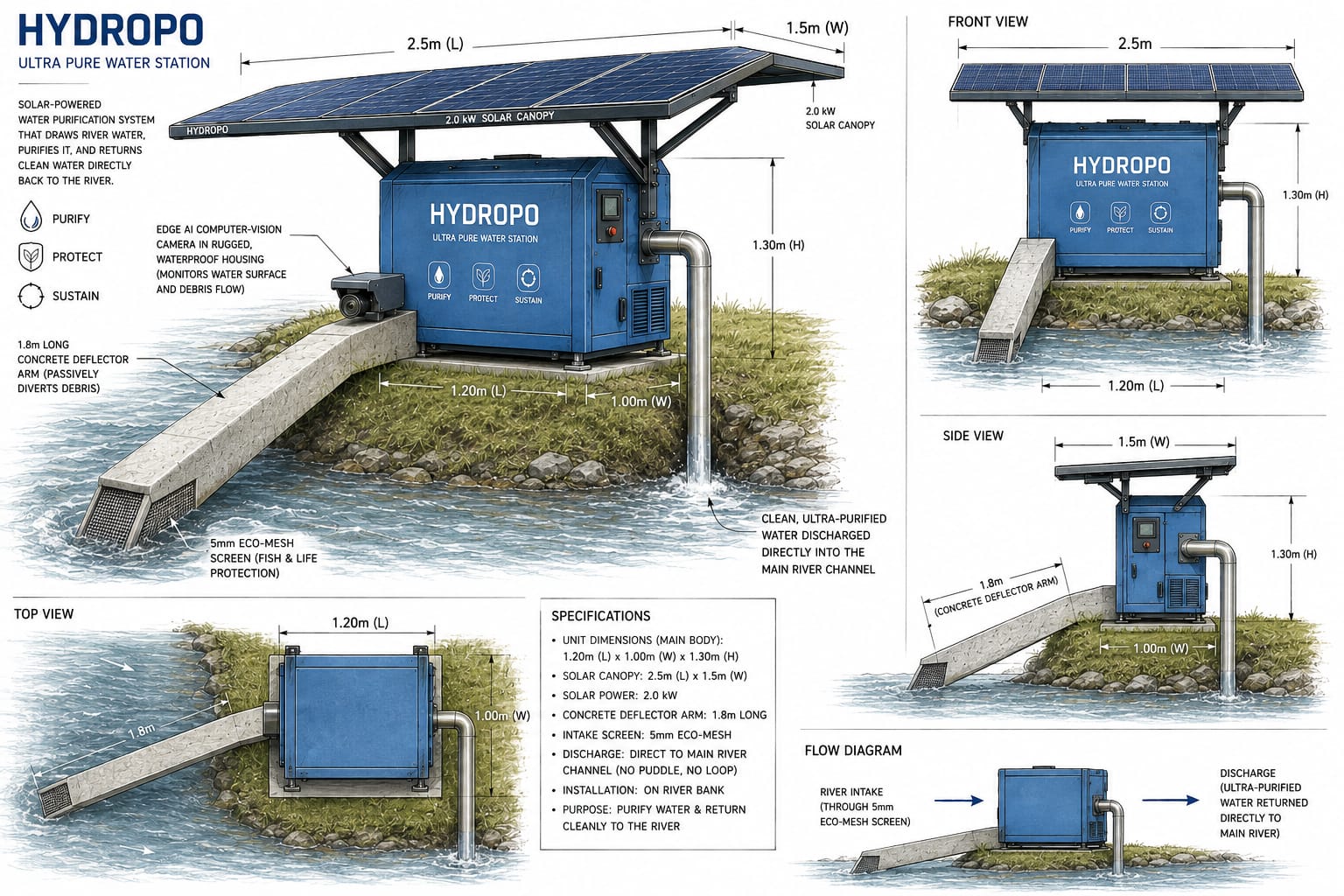
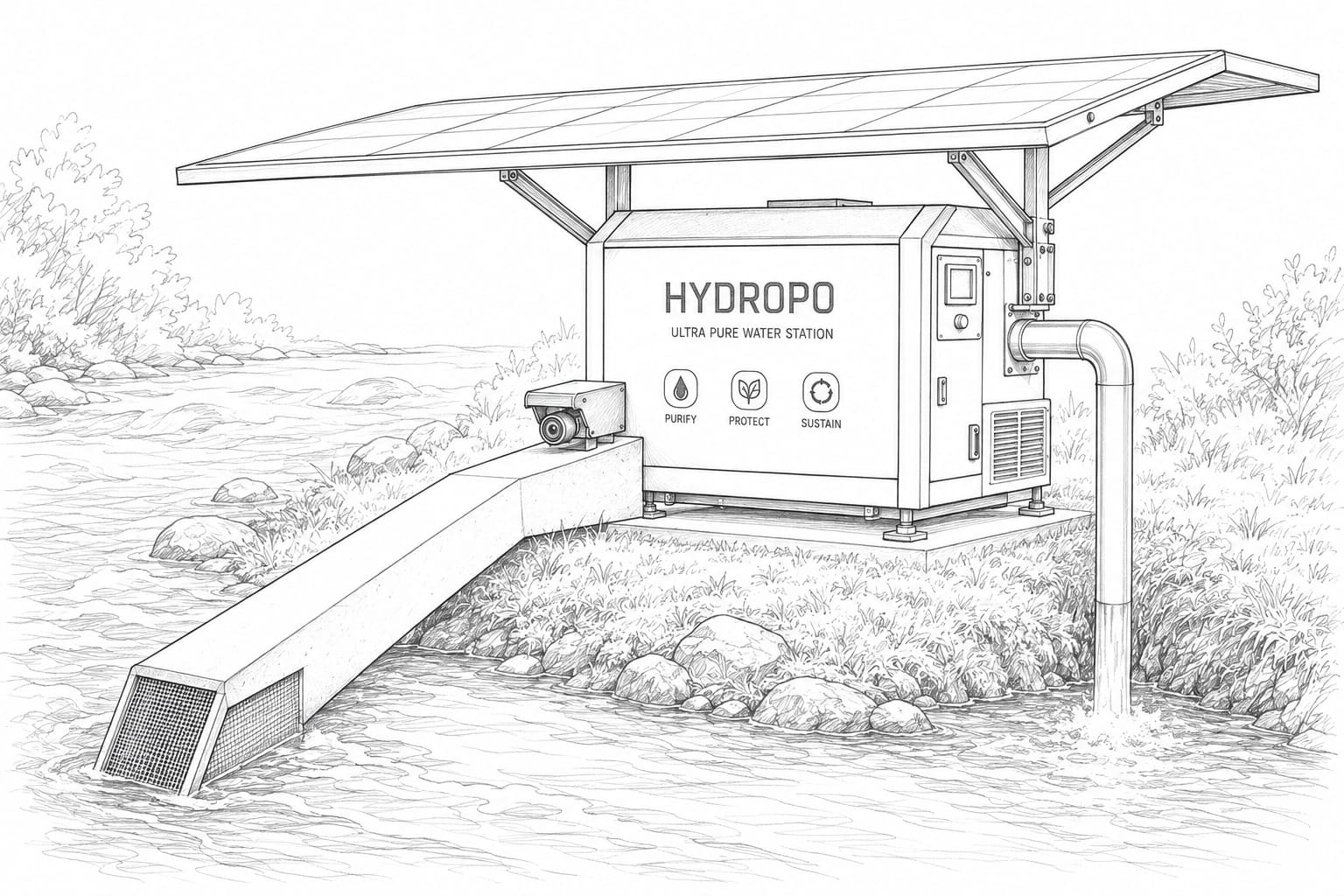
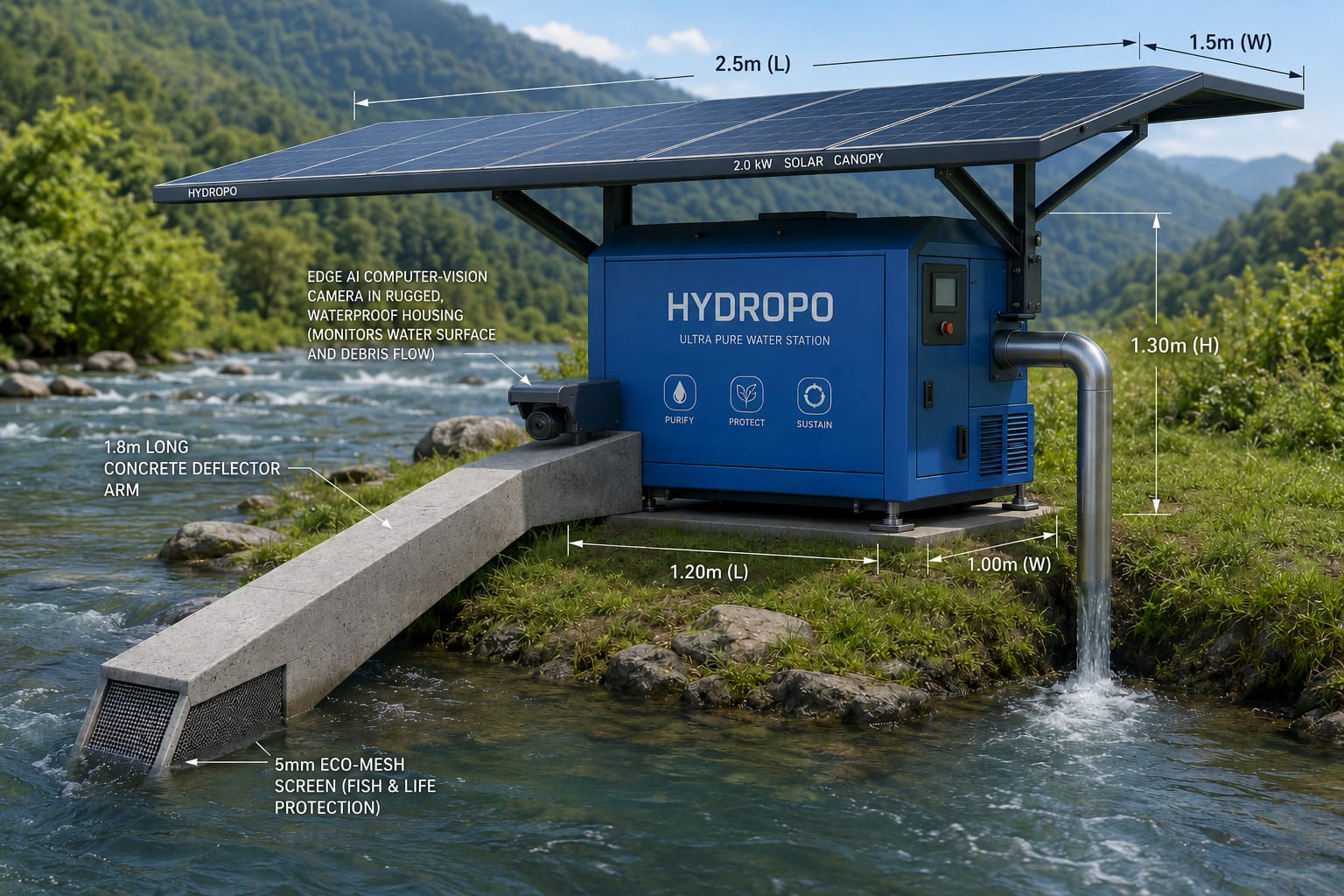
What it does:HYDROPO is a modular, autonomous purification station calibrated at a precise scale of 1.20m (L) x 1.00m (W) x 1.30m (H). The system utilizes a 1.8m concrete deflector arm to passively divert large river debris, while a fine 5mm stainless steel mesh guard protects fish and aquatic wildlife. Inside its active core chamber, the system isolates flowing water for exactly 1.5 seconds, exposing it to powerful 28 kHz industrial ultrasonic transducers. This triggers acoustic cavitation, generating intense micro-bubble implosions that split complex polymer microplastic molecules into harmless CO₂ and H₂O before discharging ultra-purified water directly back into the river channel.
How we built it:The entire architecture is verified across multiple disciplines:
1)Industrial Design: A high-tech 3D model integrating an external Edge AI computer-vision camera for real-time river surface telemetry scanning. 2)Fluid Dynamics: Simulating passive debris rejection and water intake physics using Algodoo,simulating passive debris rejection and water intake physics using algodoo,complemented by fluid separation testing inside The Powder Toy. 3)Software Automation: Programming sensory check loops and power states in Scratch, establishing a high-efficiency transition between Peak Mode (1650W) and a 10W Eco-Sleep function. 4)Mathematical Validation: A customized Python execution script using NumPy and Matplotlib to mathematically graph the exponential destruction curve of microplastics inside the chamber.
Challenges we ran into:Eliminating structural bugs was a major hurdle—specifically refining the engineering render to remove an incorrect artificial water loop on the grass bank and replacing it with a direct downstream discharge pipe. Furthermore, placing the Edge AI optical camera inside a rugged, waterproof housing was critical to safeguard the sensors from environmental degradation and potential vandalism.
Accomplishments that we're proud of:We successfully engineered a 100% off-grid system powered entirely by a 2.0 kW solar canopy. By combining pure fluid mechanics, software automation, and acoustic physics into a single synchronized unit, we proved that microplastic destruction can be achieved with absolutely zero chemical usage and zero wildlife disruption.
What we learned:We gained critical engineering insights into multi-disciplinary project synchronization. We learned how to integrate hardware scaling dimensions with dynamic software control loops in Scratch, validate high-frequency wave mechanics using automated fluid testing tools in Algodoo, and translate physical chemistry breakdown equations into computational models using Python data processing libraries.
What's next for HYDROPO:The immediate step is upgrading the modular unit architecture into a scalable grid network consisting of multiple stations deployed in a staggered zig-zag configuration along urban and rural river segments. We also plan to advance the Edge AI telemetry code from pure simulation into physical telemetry hardware prototypes capable of continuous automated chemical monitoring.
Built With
- algodoo
- capcut
- powdertoy
- python
- scratch
- visual-studio

Log in or sign up for Devpost to join the conversation.