-
-
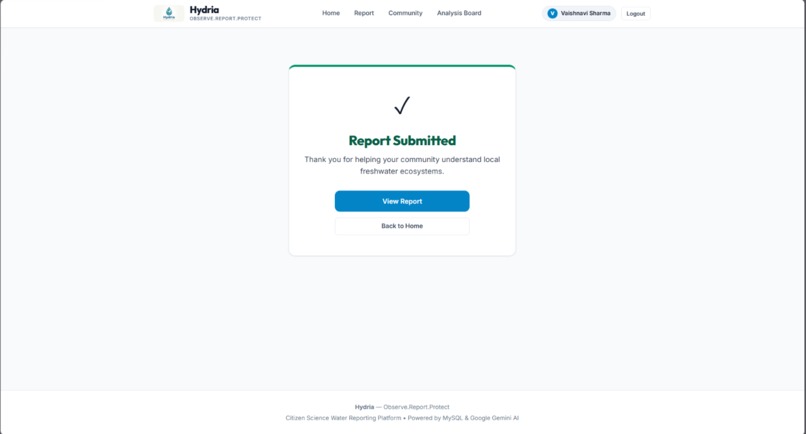
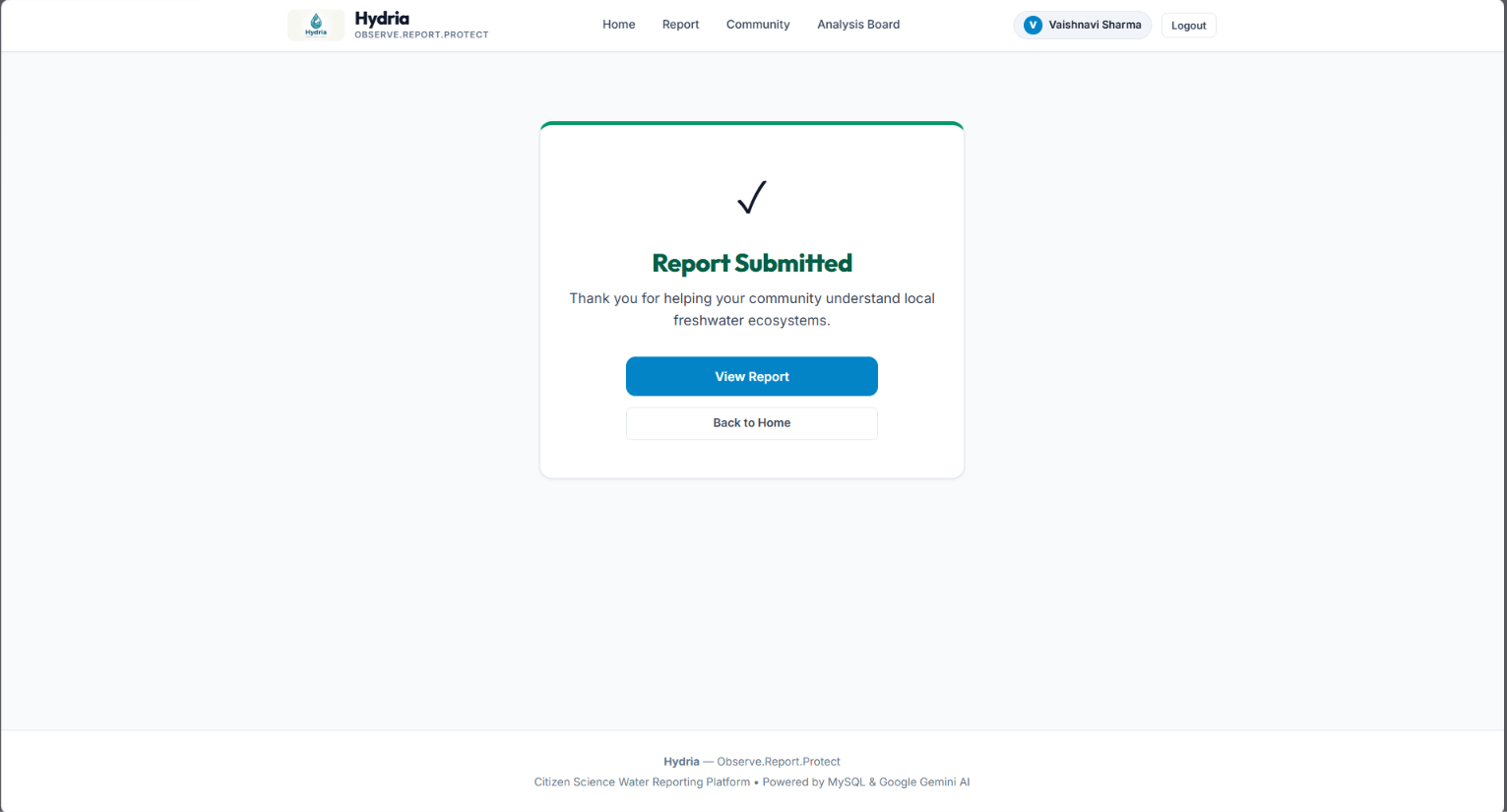
Shows the successful submission of a water-quality observation.
-
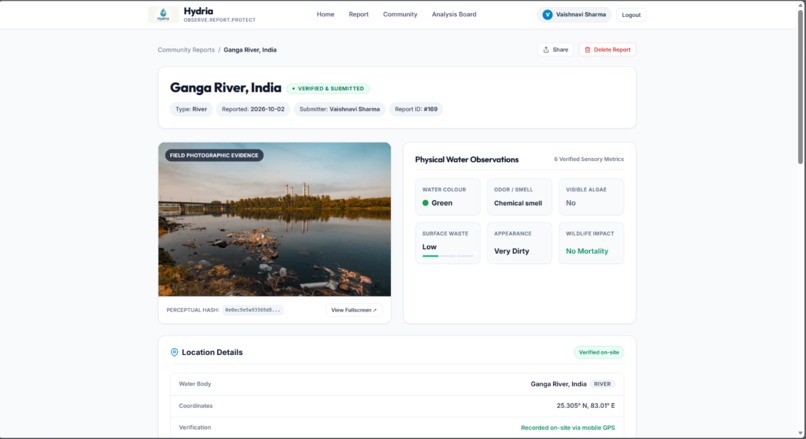
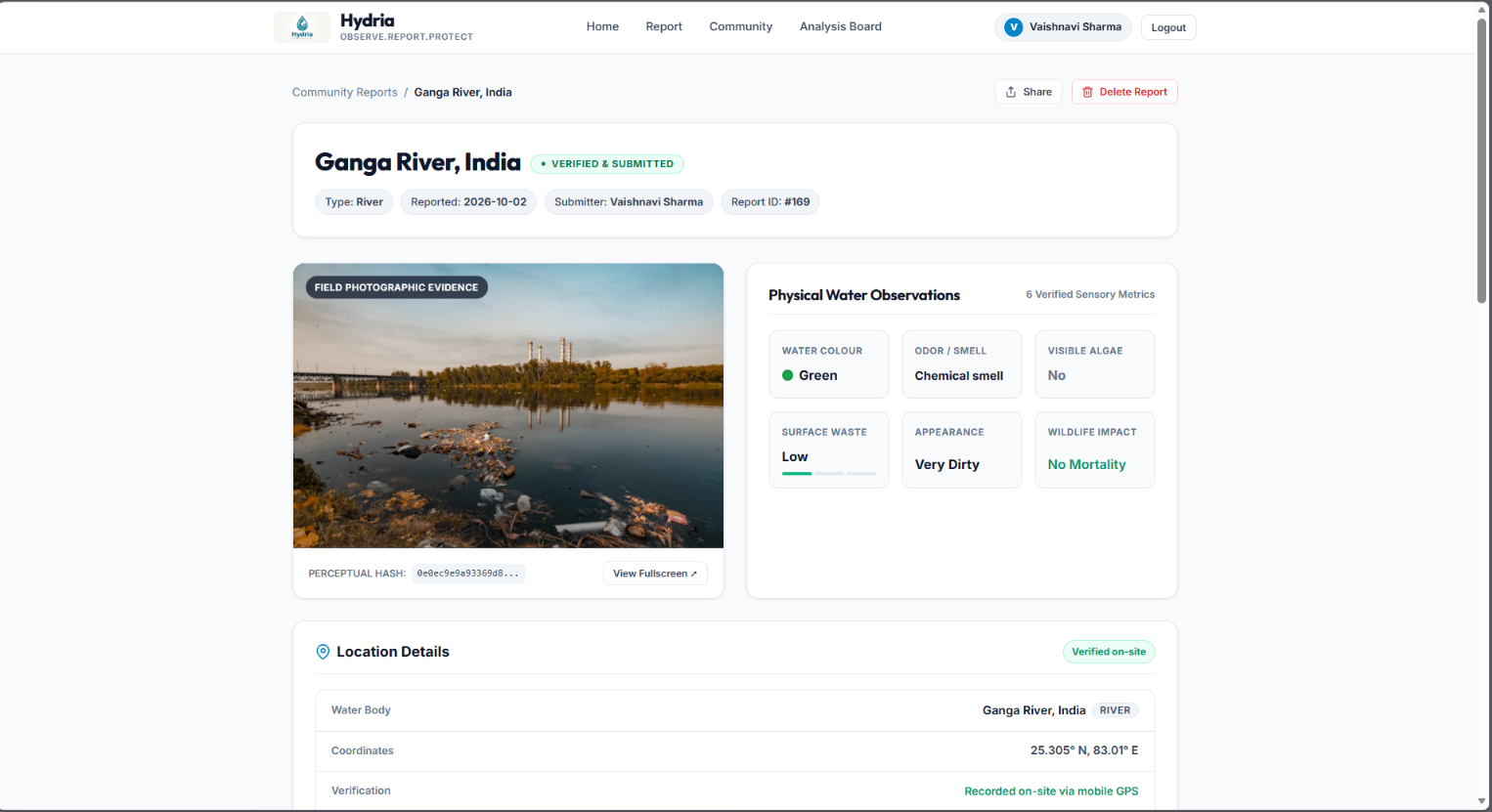
Shows the complete report with photographic evidence, sensory observations, and location verification
-
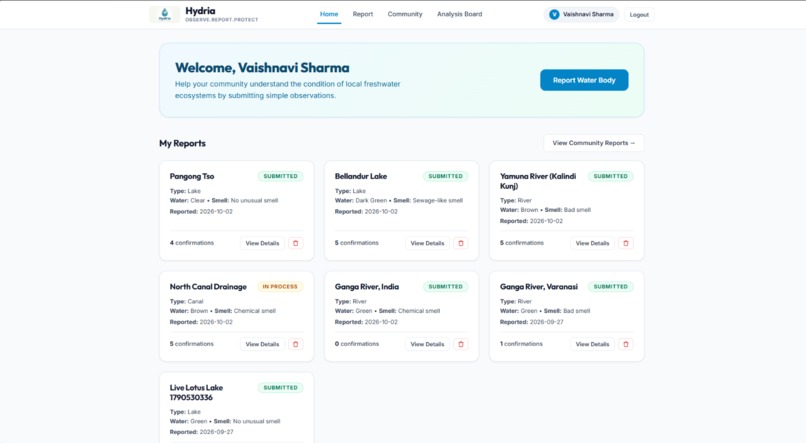
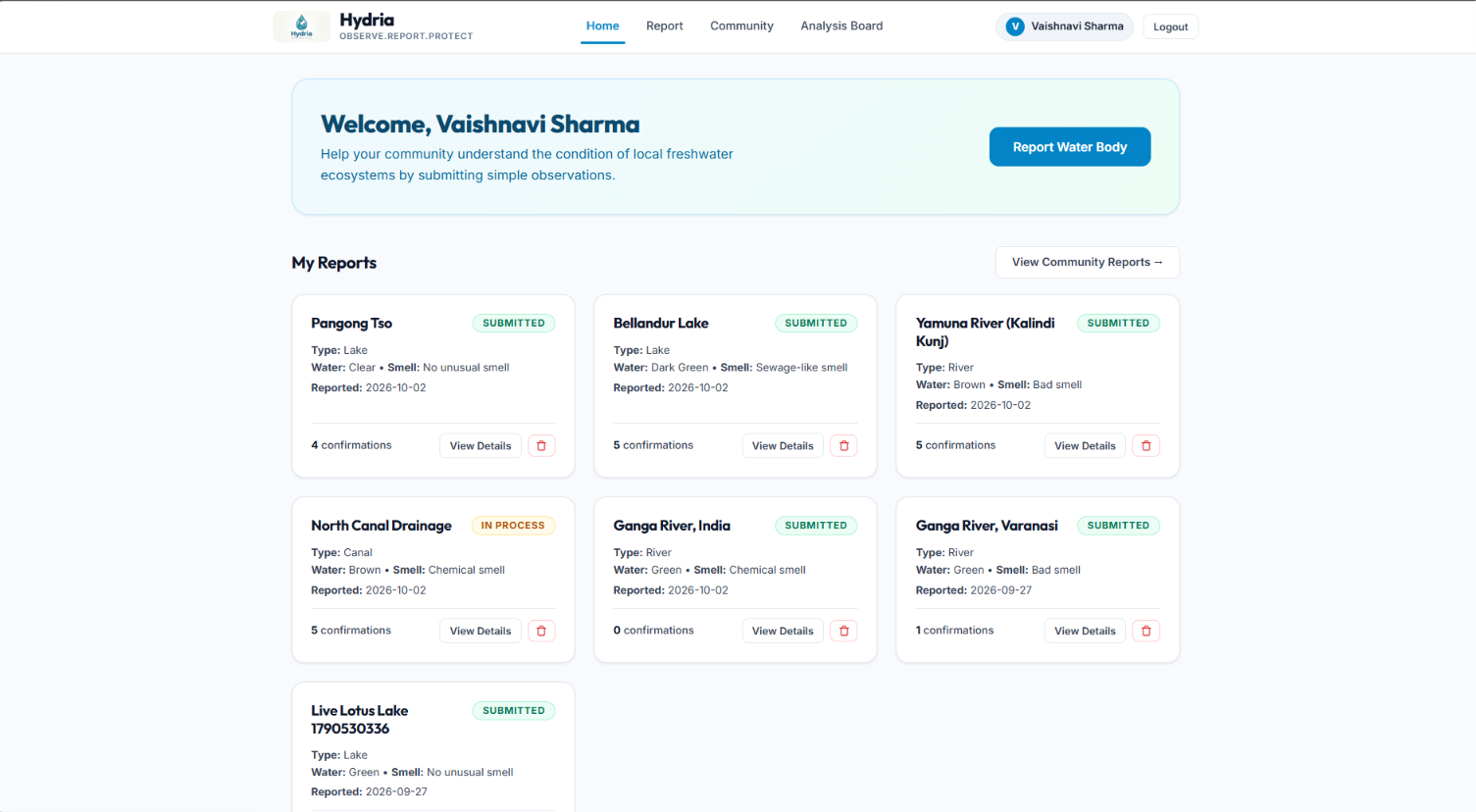
Shows the user's dashboard with personal reports, report status, and community confirmations.
-
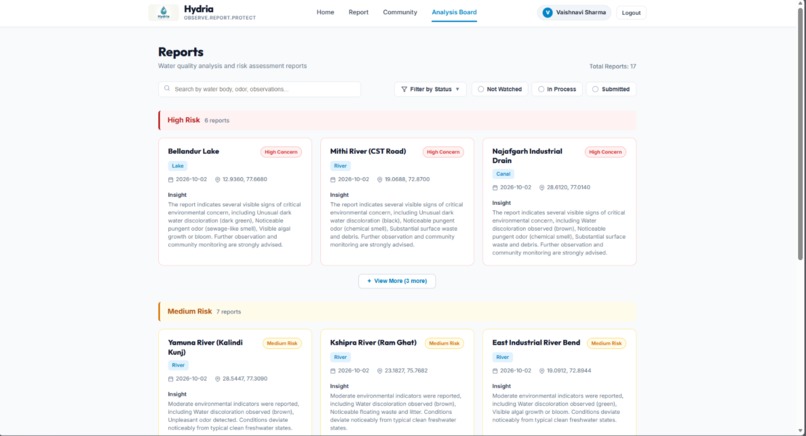
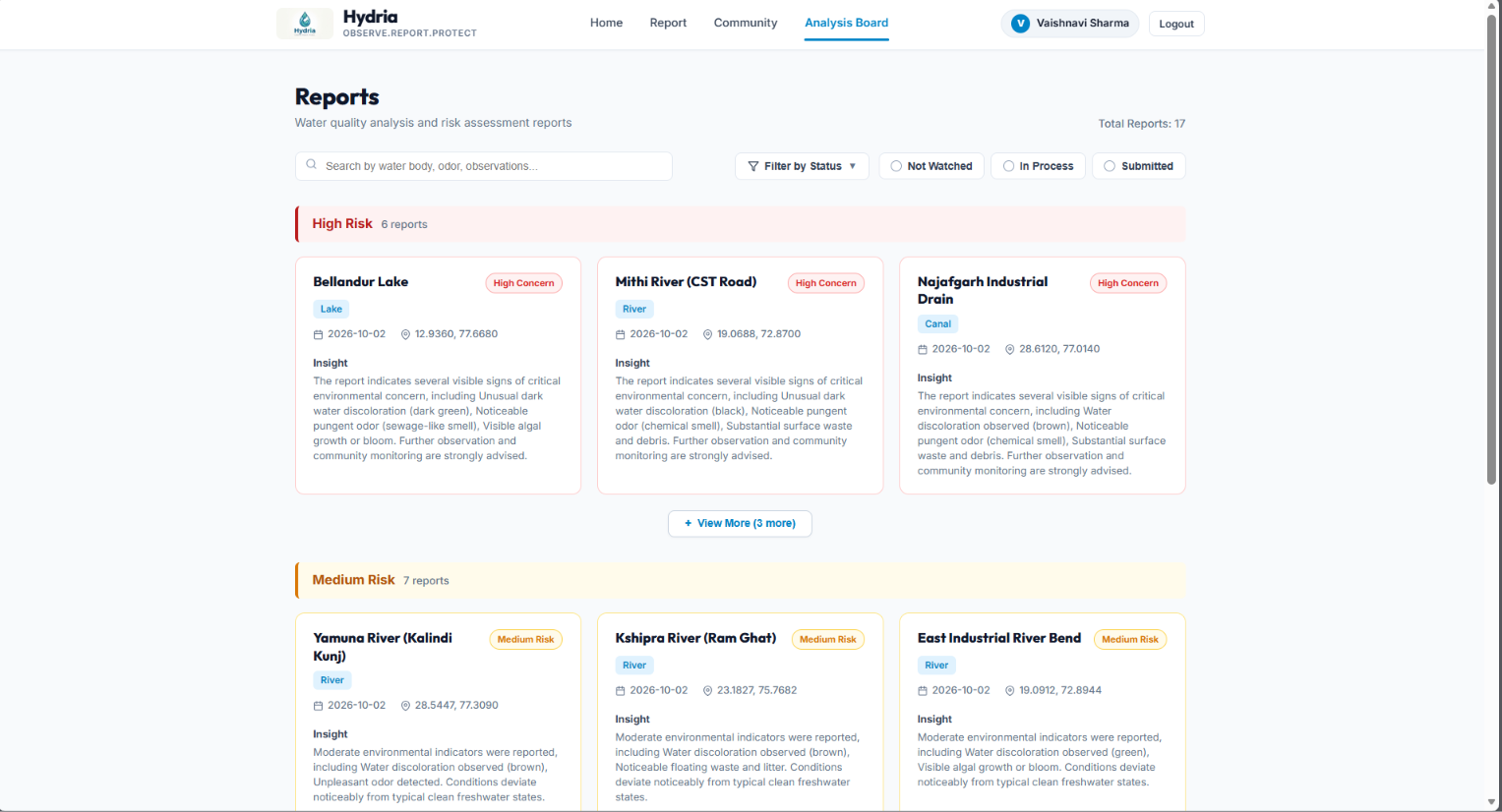
Shows categorized water-quality reports with AI-generated risk levels and environmental insights.
-
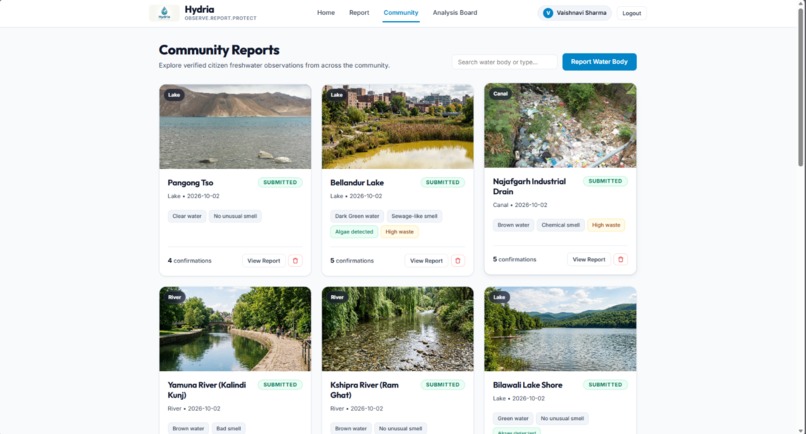
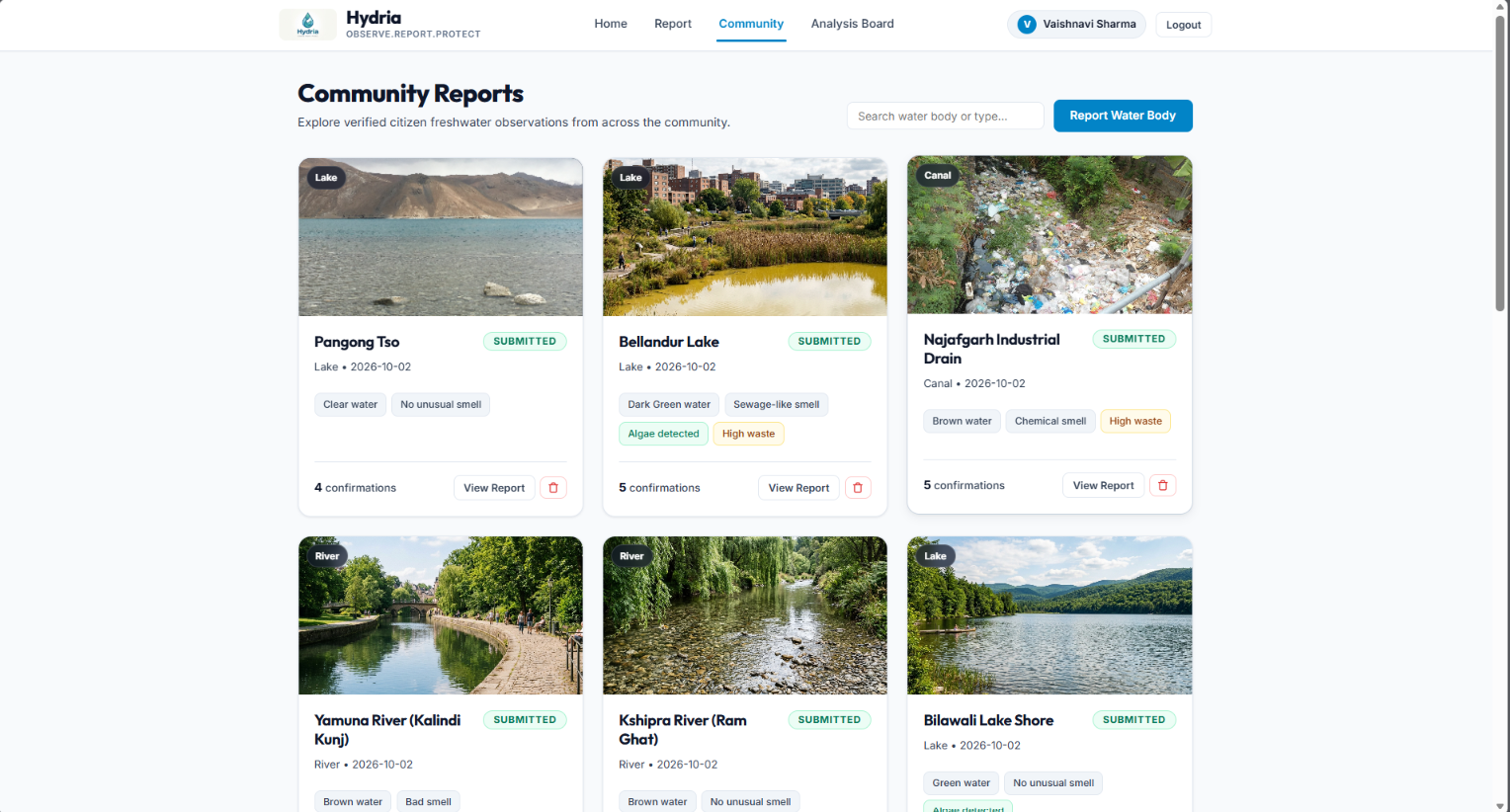
Shows the community dashboard containing submitted freshwater observations from different locations.
Inspiration
Every day, people see polluted lakes, rivers, and ponds, but most citizens do not have an easy way to report these problems or understand what they might mean. Traditional water-quality monitoring can also involve technical terms and laboratory testing that are not accessible to everyone. We were inspired to build Hydria to bridge this gap by turning simple citizen observations—such as water color, smell, algae, visible waste, and photographs—into meaningful environmental insights using AI.
What it does
Hydria is a citizen-focused water quality observation and reporting platform. Users can: • Automatically capture their location using browser geolocation. • Report observations about lakes, rivers, ponds, and other freshwater bodies. • Upload photographic evidence of the water condition. • Verify submissions and prevent duplicate or irrelevant images. • Receive AI-powered ecological analysis using Google Gemini. • Get a concern level, possible causes, health precautions, and recommended actions. • Support community verification through “I Observed This Too.” • Track reports through a visual analysis board. Hydria transforms a simple observation into a structured report that can help communities better understand potential water-quality concerns.
How we built it
We built Hydria as a full-stack web application using Python, Flask, MySQL, HTML, CSS, JavaScript, and Google Gemini 2.5 Flash. The backend is developed using Flask and Python, while MySQL 8.0+ stores users, reports, validations, votes, and AI-generated analysis. We implemented an image-validation system using perceptual hashing, image analysis, and EXIF metadata to help detect duplicate or unsuitable submissions. For AI analysis, Google Gemini 2.5 Flash processes the user's observations and available image evidence to generate ecological insights. We also created a local rule-based fallback so the system can continue providing basic analysis if the AI service is unavailable. The interface uses Jinja templates, HTML/CSS, and JavaScript for features such as location detection, image preview, report submission, and the community analysis board.
Challenges we ran into
One of our biggest challenges was maintaining the quality and reliability of citizen-generated data. Users can upload different types of images and submit similar observations, so we needed mechanisms to detect duplicates and prevent unnecessary repeated reports. Another challenge was integrating AI into a real application. We had to handle API configuration, prompts, responses, errors, and storing generated analysis in the database. We also faced challenges in connecting multiple technologies together, including Flask, MySQL, JavaScript, image processing, geolocation, and the Gemini API, while keeping the application simple for users.
Accomplishments that we're proud of
We are proud that we built Hydria as a complete working platform rather than just an AI prototype. Some of our key accomplishments include: • Integrated AI-powered ecological analysis. • Implemented automatic location detection. • Built image validation and duplicate detection. • Designed a structured MySQL database. • Added community corroboration through voting. • Created a visual report analysis board. • Added validation and duplicate-report protection. • Created automated tests for important application functionality. • Implemented an AI fallback mechanism for greater reliability. Most importantly, we created a workflow that connects: Citizen Observation → Verification → AI Analysis → Community Corroboration → Actionable Insight
What we learned
Through Hydria, we learned how to develop and connect different parts of a real-world software system. We gained practical experience with: • Full-stack web development using Flask. • Relational database design and MySQL. • REST/API integration and AI services. • Image processing and validation. • Browser geolocation. • User authentication and session management. • Data validation and duplicate prevention. • Automated testing. • Designing simple interfaces for non-technical users. We also learned that building an AI application is not only about integrating a model. Data quality, validation, database design, user experience, and fallback mechanisms are equally important.
What's next for Hydria
We want to take Hydria beyond a prototype and make it a more comprehensive environmental monitoring platform. Future improvements could include: • Interactive maps showing water-quality observations. • Integration with IoT water-quality sensors. • Integration with laboratory water-quality measurements. • Historical water-quality trends for individual locations. • Alerts for recurring or high-concern observations. • More advanced computer-vision-based pollution detection. • Support for multiple regional languages. • Collaboration with local authorities and environmental organisations. Our long-term vision is to create a platform where technology and citizen participation work together to make freshwater monitoring more accessible, transparent, and actionable.

Log in or sign up for Devpost to join the conversation.