Inspiration
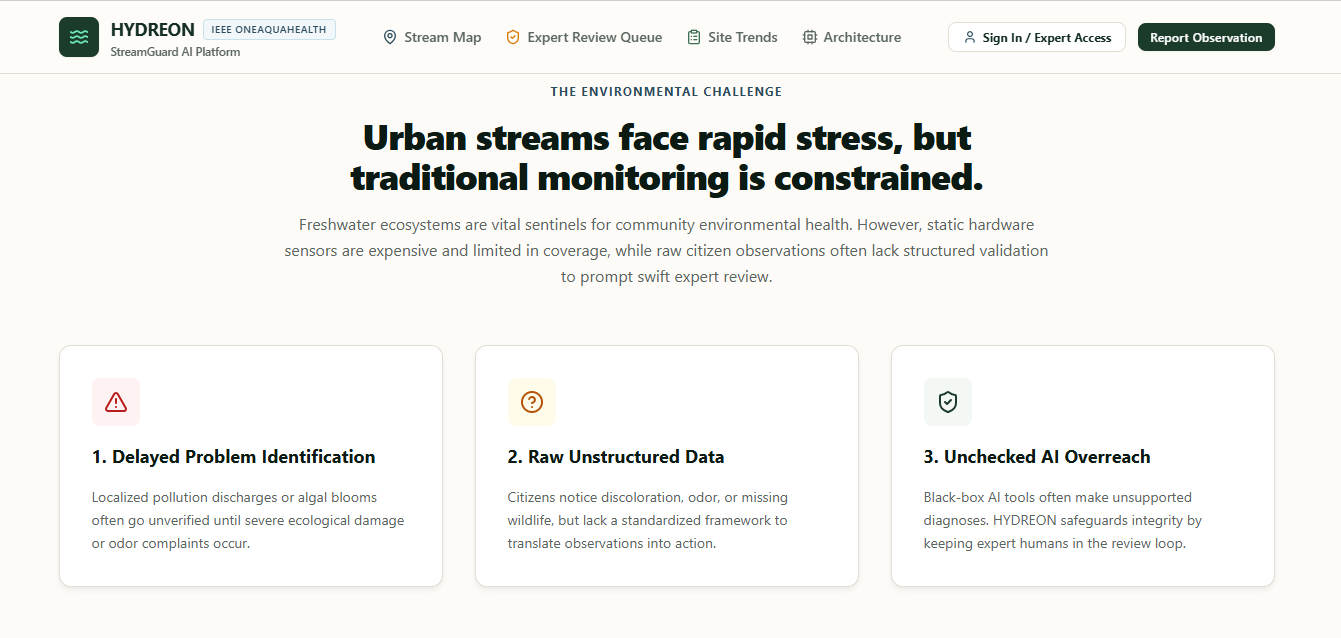
Freshwater streams and urban waterways are vital sentinels for public health and local biodiversity. However, monitoring these ecosystems presents a major operational bottleneck: traditional hardware sensor networks are expensive and limited in coverage, while raw citizen science reports often lack structured validation to trigger timely expert response.
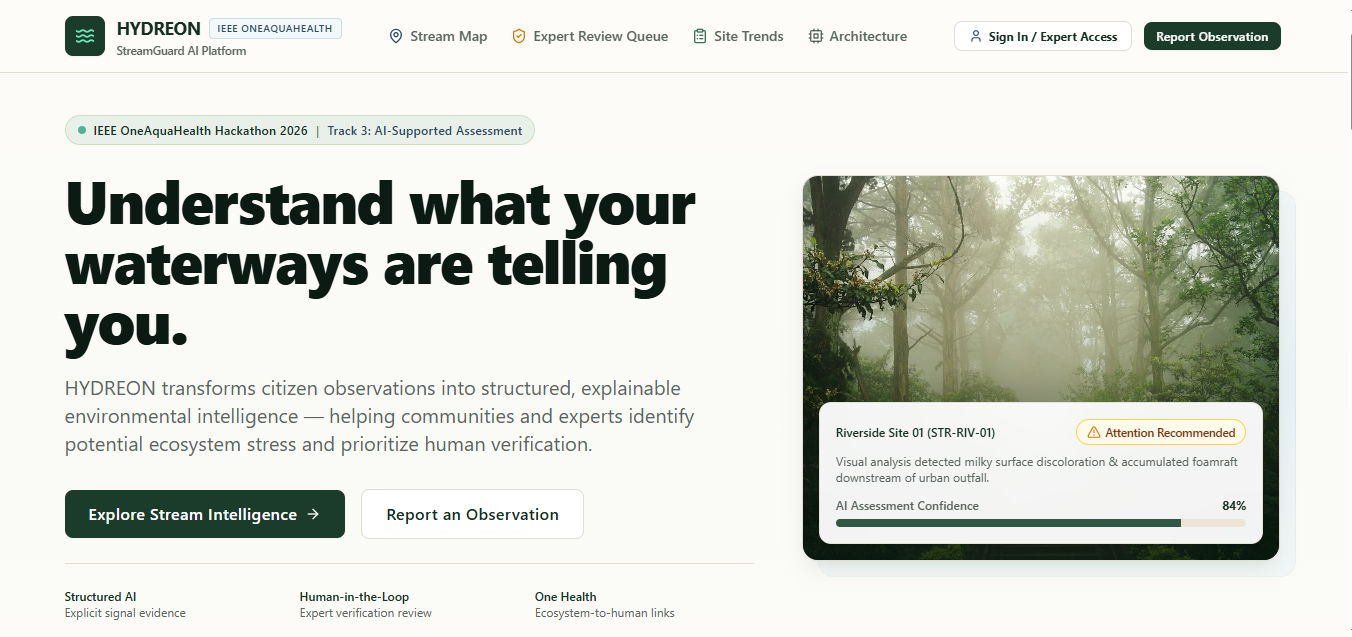
Under the OneAquaHealth framework—which connects ecosystem health, animal wellbeing, and human community health—we were inspired to create a bridge between everyday citizen observations and expert scientific review. We envisioned HYDREON StreamGuard AI as a transparent, explainable platform that empowers communities to report stream observations while giving environmental scientists structured, AI-assisted tools to prioritize field verification.
What it does
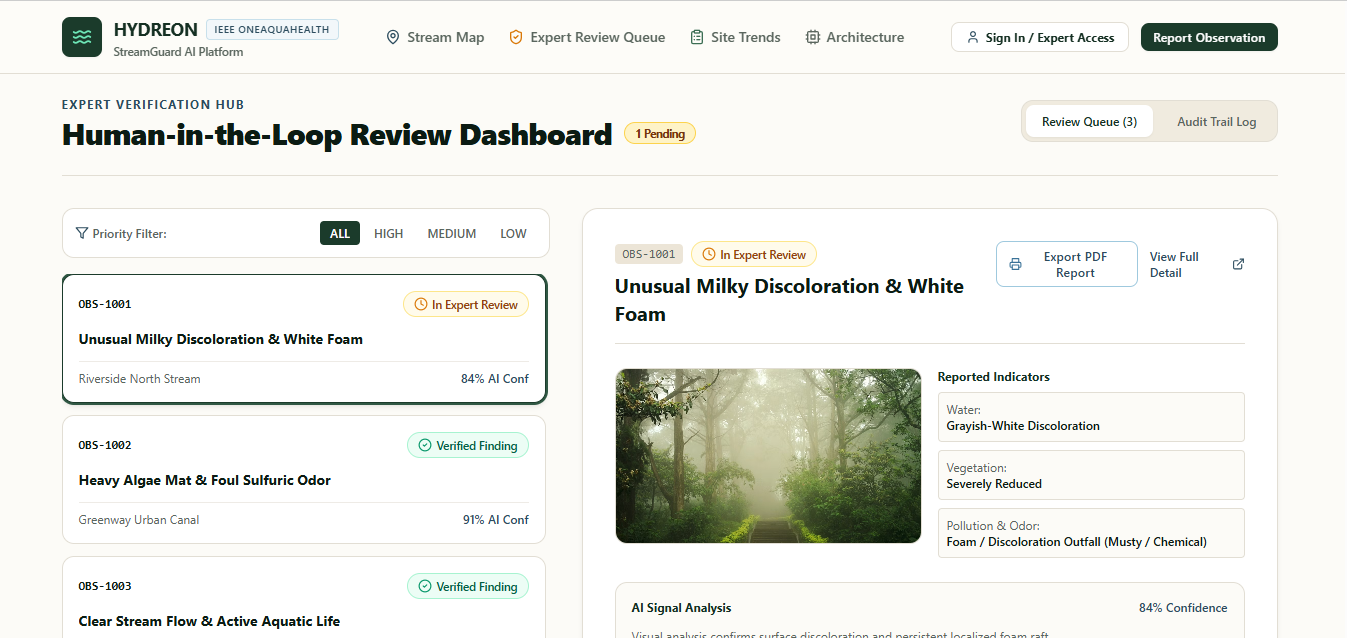
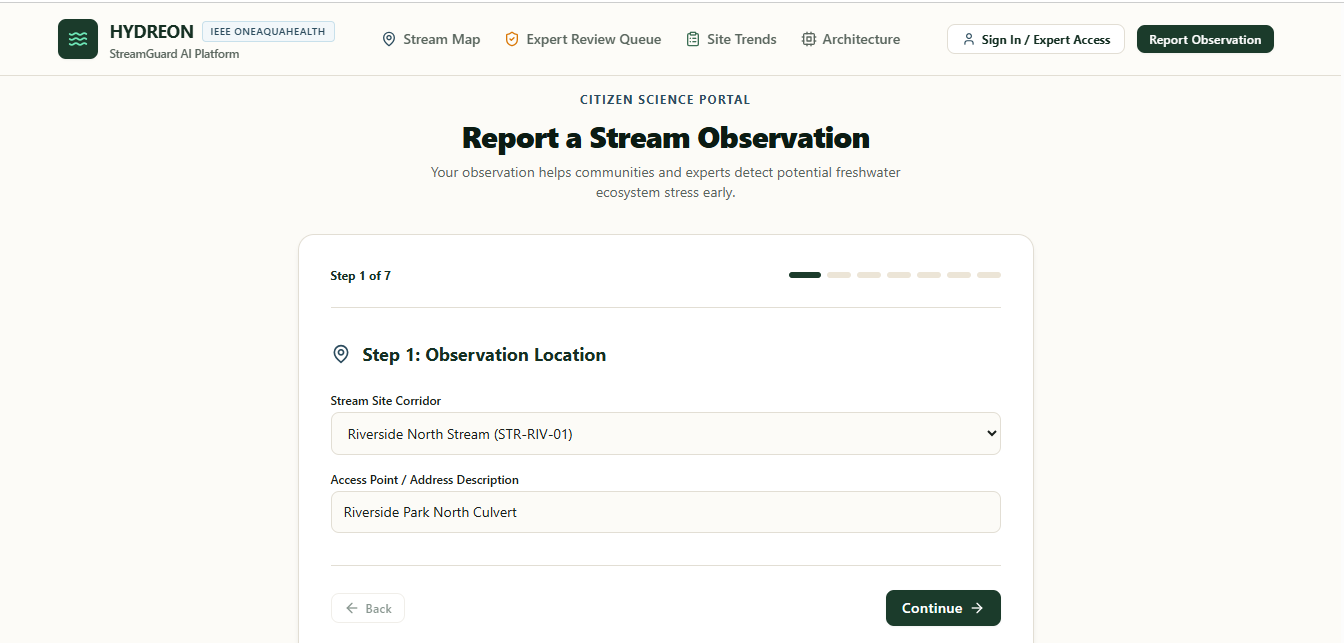
HYDREON StreamGuard AI converts qualitative citizen stream reports into structured, explainable environmental intelligence through a transparent 5-step pipeline:
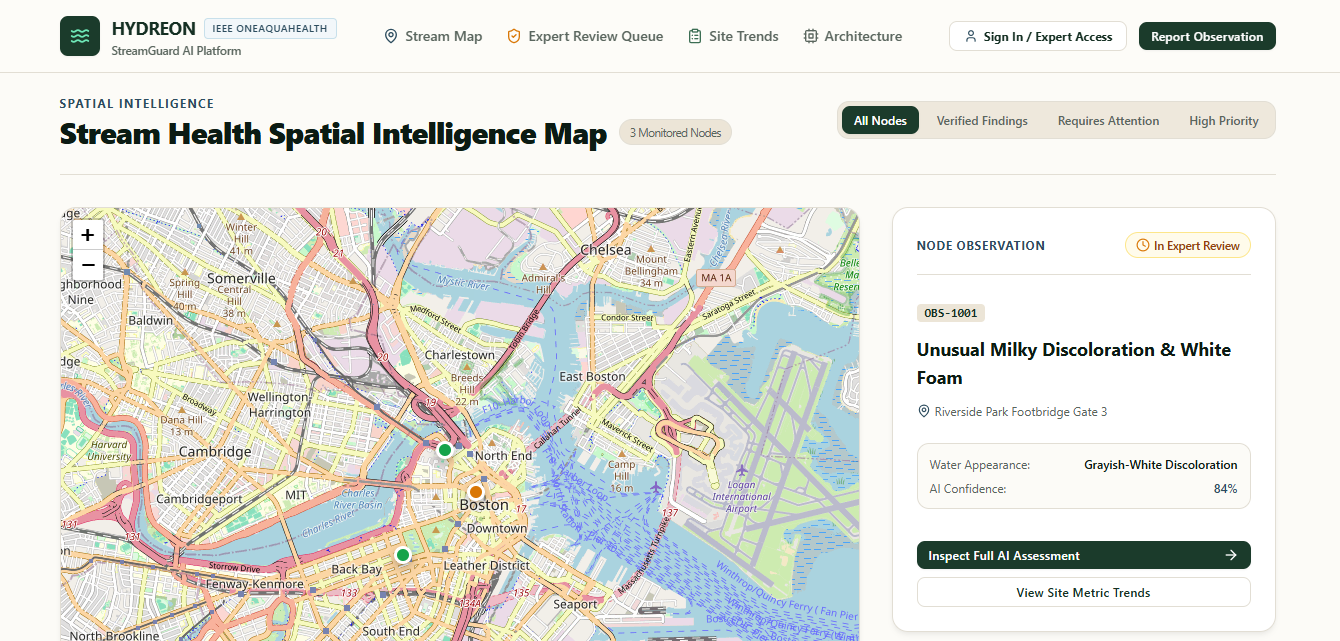
1, Observe (/observe): Citizen scientists submit stream photos alongside observed indicators such as water appearance, riparian vegetation status, biological indicators, physical pollution, and odor. 2, Analyze & Structure: A multimodal AI engine processes images and text into standardized environmental indicators using strict JSON schemas. 3, Explain: The platform generates explicit signal evidence, multimodal confidence percentages, and scientific uncertainty disclaimers rather than acting as a black-box diagnosis. 4, Review (/review): Certified environmental experts audit the review queue to confirm, adjust, or dismiss AI-flagged alerts before publication. 5, Act & Map (/map): Verified findings populate an interactive spatial intelligence map displaying site-level telemetry, trend charts, and ecosystem risk levels.
How we built it
HYDREON is built as a full-stack, enterprise-grade web application engineered for serverless scale:
Frontend: Built with Next.js 14, React 18, Tailwind CSS, Lucide Icons, Recharts for trend visualization, and React-Leaflet for interactive geospatial mapping. Backend API: Built with Express.js and TypeScript, using Zod for schema validation and Helmet for security headers. Database & ORM: Supabase PostgreSQL integrated via Prisma ORM with connection pooling for serverless execution. Multimodal AI Engine: Powered by OpenAI GPT-4o Vision with strict JSON response formatting, backed by a deterministic rule-based fallback engine for continuous uptime. Media Storage: Integrated Cloudinary API for scalable image storage and optimization. Deployment: Deployed to Vercel as a unified single-project monorepo with same-origin API routing (/api/*). Algorithmic & Scientific Safeguards (LaTeX Math) To maintain scientific integrity, HYDREON computes explainable confidence and risk metrics:
Multimodal Confidence Score: ( C_{\text{final}} = w_1 \cdot C_{\text{vision}} + w_2 \cdot C_{\text{indicator}} - \delta_{\text{uncertainty}} ) Combines visual feature confidence (( C_{\text{vision}} )) and indicator consistency (( C_{\text{indicator}} )), adjusted for missing lab parameter validations (( \delta_{\text{uncertainty}} )).
Risk Assessment Index ($\text{RAI}$): $$ \text{RAI} = \frac{\sum_{i=1}^{n} w_i \cdot S_i}{1 + \exp(-\gamma \cdot N_{\text{anomalies}})} $$ Weighs physical stress scores (( S_i )) against historical anomaly counts (( N_{\text{anomalies}} )) to prioritize urgent expert review.
Challenges we ran into
1, Preventing AI Overreach & Hallucinations:
- Challenge: Generative AI models risk diagnosing water chemical toxicity solely from a photo, which is scientifically unproven.
- Solution: We built a strict 4-tier operational boundary (Observation (\rightarrow) AI Interpretation (\rightarrow) Potential Signal (\rightarrow) Expert Verified Finding) that explicitly disclaims visual limitations and keeps humans in the verification loop. 2, Unified Monorepo Architecture on Vercel:
- Challenge: Routing Next.js SSR frontend pages and Express TypeScript API routes under a single serverless project without CORS issues.
- Solution: Engineered same-origin rewrite rules in vercel.json and wrapped Express entry points for serverless function compatibility.
Accomplishments that we're proud of
- End-to-End Production Readiness: Built a complete, fully functional platform spanning citizen reporting, AI multimodal evaluation, expert review queues, and spatial mapping for the IEEE OneAquaHealth Hackathon 2026.
- Responsible Human-in-the-Loop AI: Created a workflow that uses AI to organize data for experts rather than replacing scientific judgment.
- One Health Alignment: Successfully categorized environmental findings across Ecosystem, Aquatic Animal, Human Contact, and Community Action tiers.
What we learned
- Structured Output Is Essential for Environmental AI: Enforcing JSON schema constraints on LLM vision calls enables seamless database integration and map rendering.
- Explainability Builds Trust: Providing explicit evidence fragments and uncertainty disclaimers makes AI assessments actionable and credible for environmental managers.
- Citizen Science Needs Standardized Pipelines: Giving citizen observers clear visual choices transforms informal reports into structured scientific indicators.
What's next for HYDREON StreamGuard AI
- Offline Mobile PWA: Enable offline report drafting so citizen observers can record stream observations deep in field locations without cellular service.
- IoT Hardware Sensor Fusion: Integrate low-cost automated sensor streams (pH, dissolved oxygen, turbidity) to cross-validate citizen visual reports.
- Municipal Alert Dispatch: Build automated notification webhooks to dispatch verified alerts directly to local watershed authorities and river stewards.
- Multi-Language Support: Expand localized language support to bring community stream monitoring to global freshwater conservation initiatives.
Built With
- ai
- api
- citizen
- cloudinary
- css
- environmental
- express.js
- framer
- gpt-4o
- next.js
- node.js
- openai
- postgresql
- prisma
- react
- recharts
- rest
- supabase
- tailwind
- typescript
- vercel
- zod


Log in or sign up for Devpost to join the conversation.