-
-
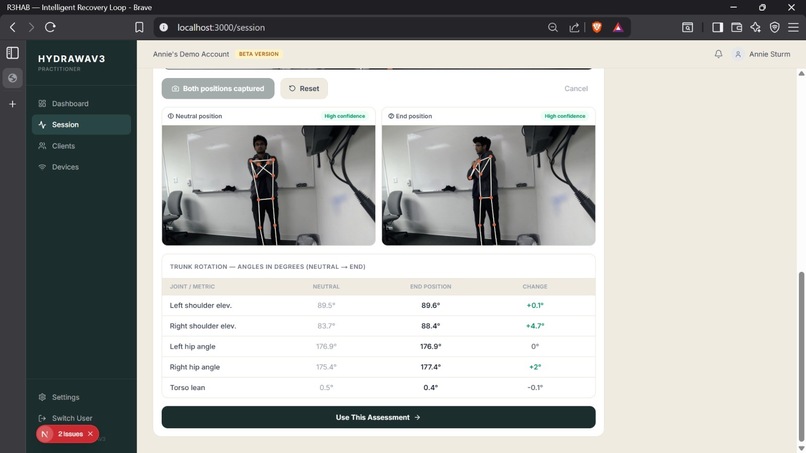
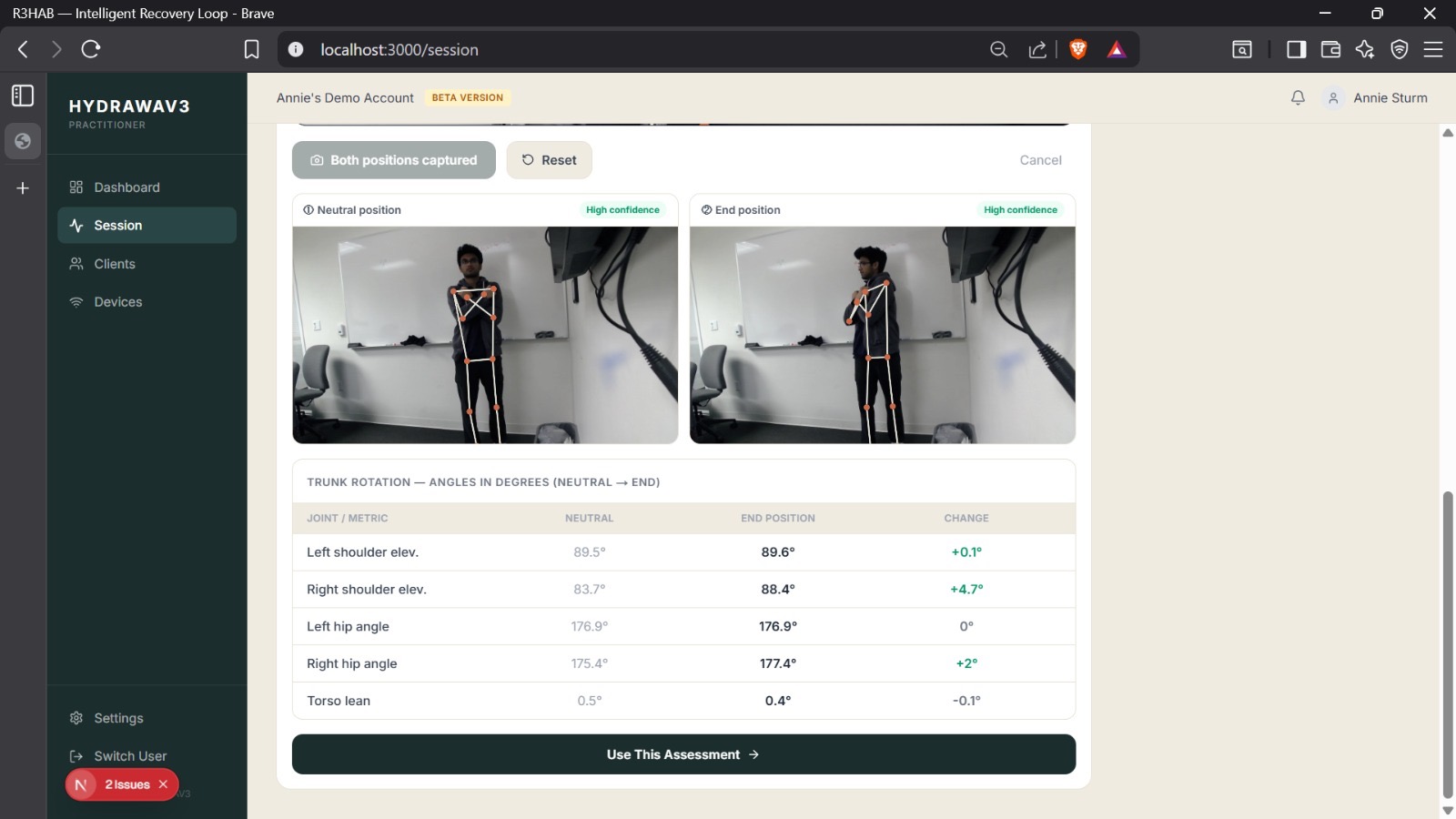
ROM analyzer
-
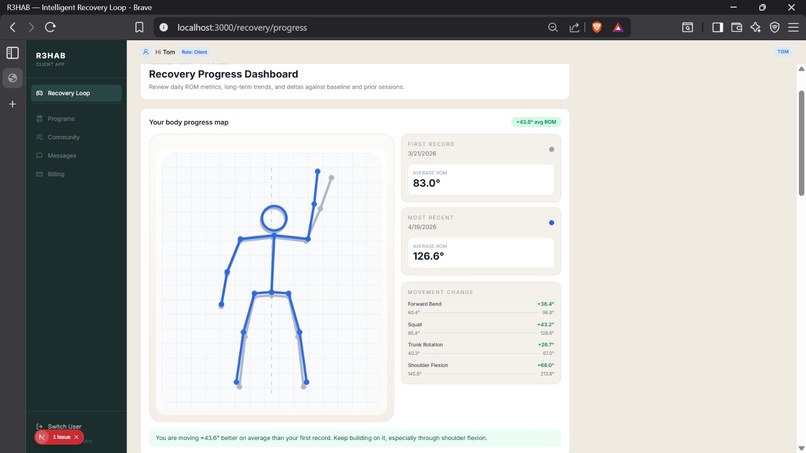
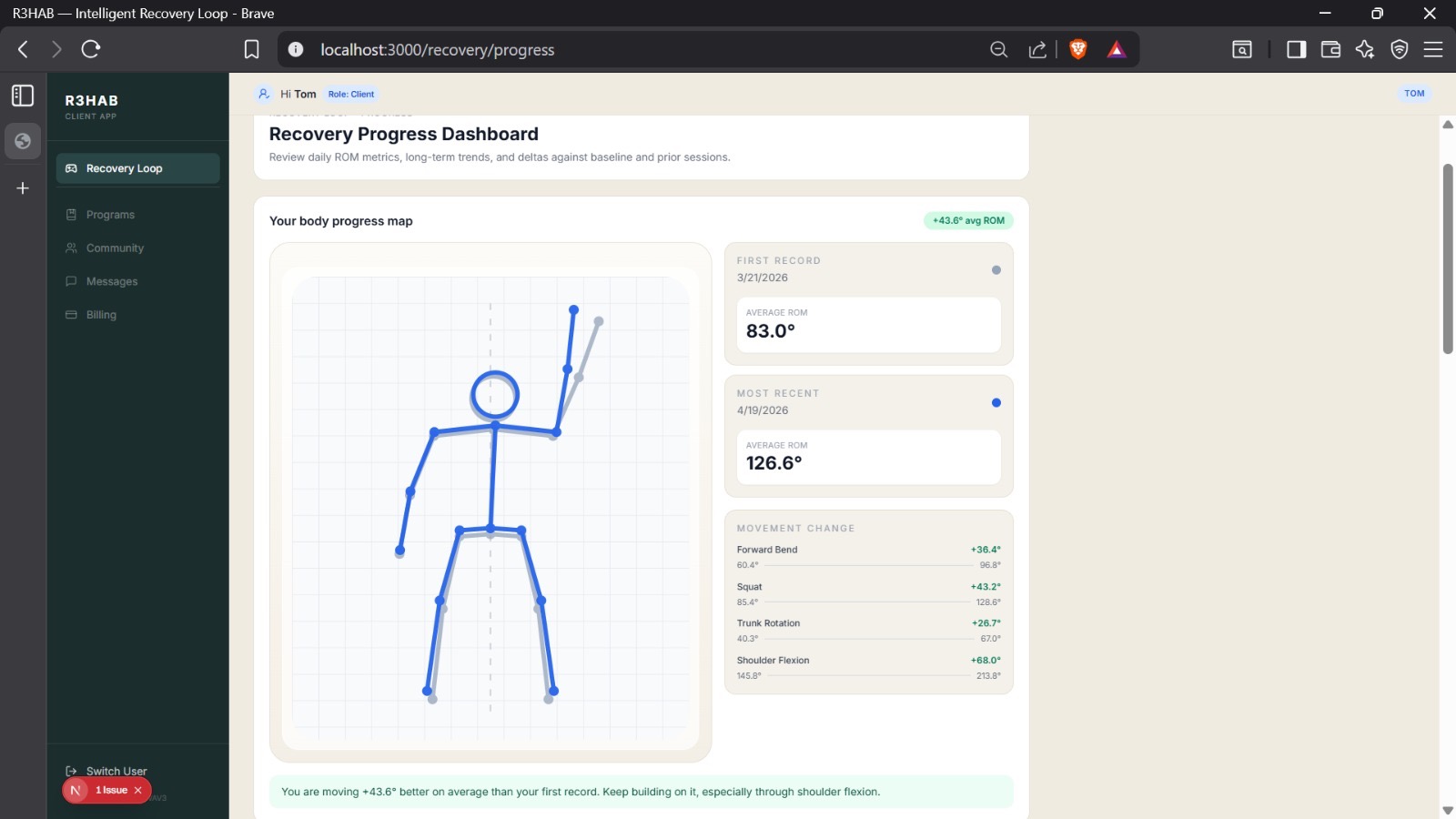
Client Dashboard
-
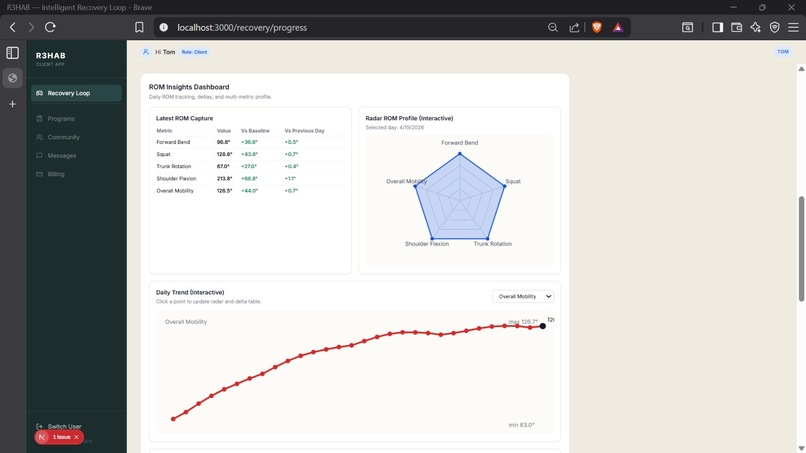
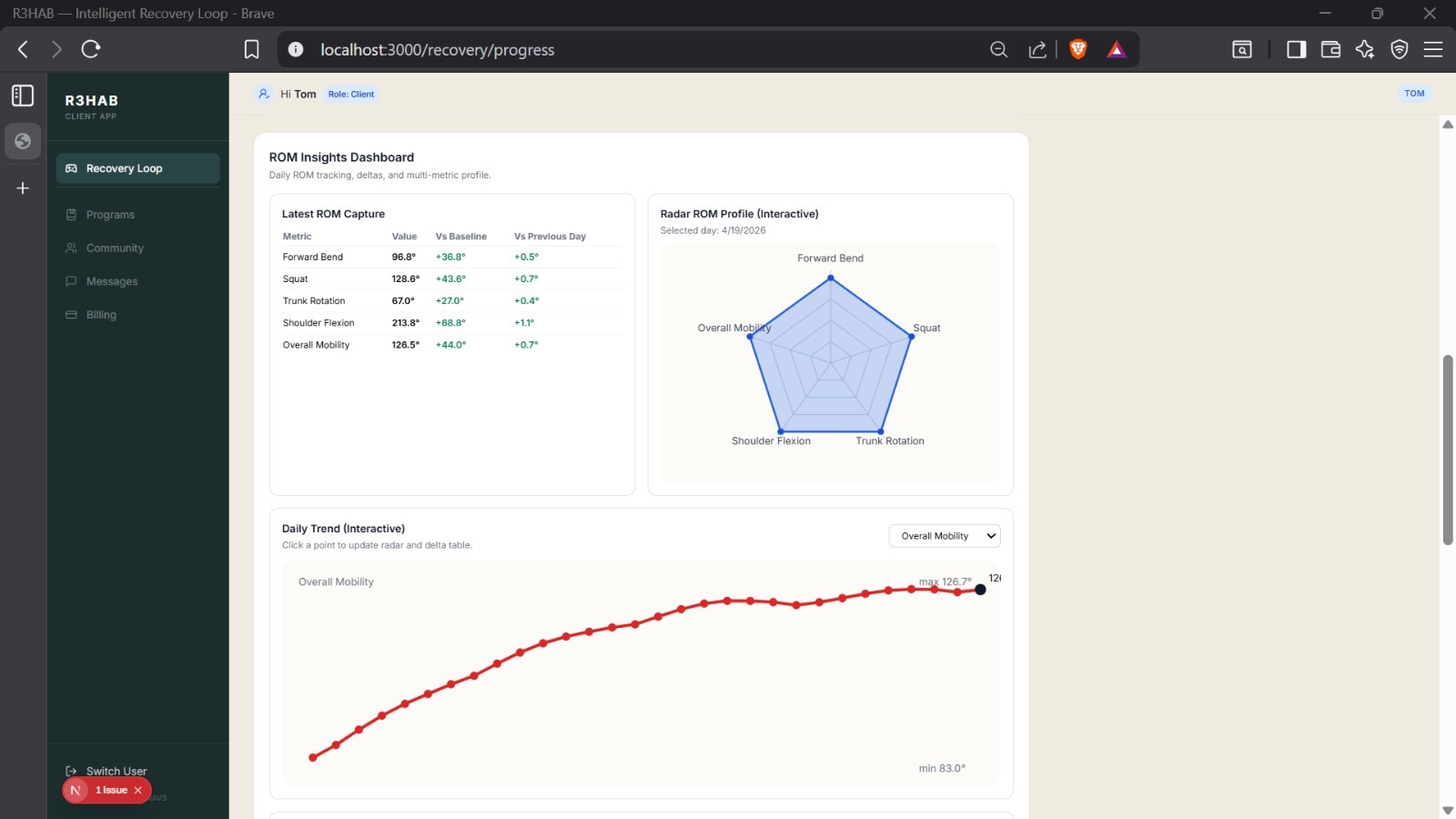
Client progress overtime
-
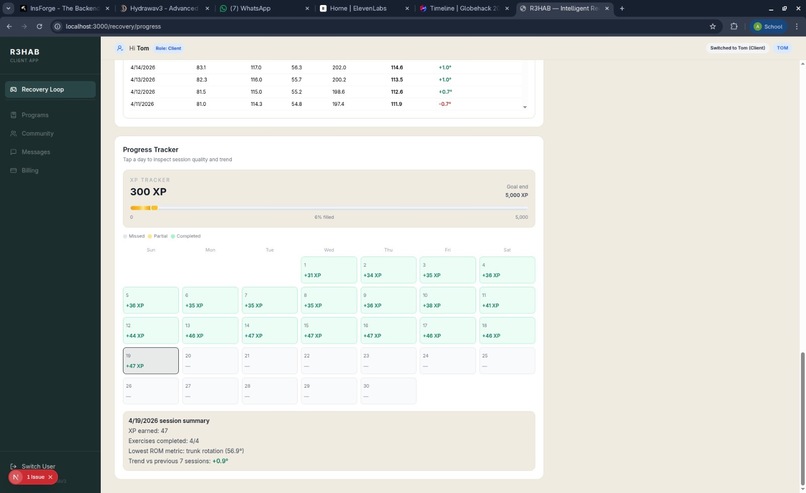
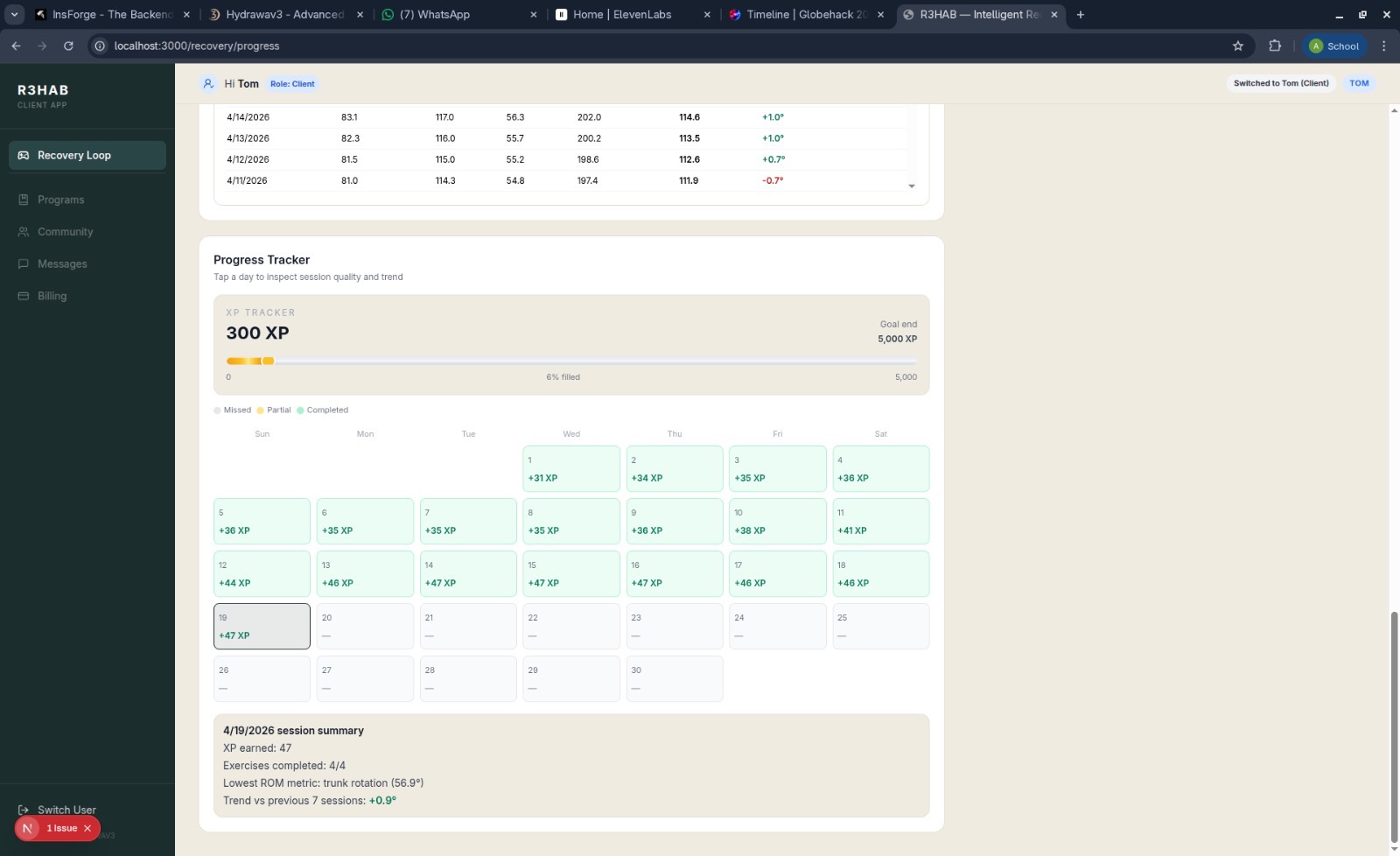
XP tracker for the game
Inspiration
Hydrawav3 Catalyst was inspired by one core gap we kept seeing in recovery workflows: practitioners can run great in-clinic sessions, but continuity between visits is inconsistent and manual follow-up is time-consuming. We wanted to reduce practitioner assessment overhead and improve patient adherence after sessions. The hackathon challenge gave us the perfect frame to build a closed-loop system that connects assessment, guided recovery, and measurable progress.
## What it does
Hydrawav3 Catalyst is a dual-surface platform:
- Practitioner dashboard for guided movement assessment, ROM-informed protocol flow, and session orchestration.
- Client recovery app for daily guided exercises with real-time camera posture/ROM analysis, voice coaching, and gamified adherence.
Key capabilities:
- Camera-based ROM and movement quality capture
- Voice-guided virtual coaching with corrective cues
- Daily completion logic with XP/streak progression
- Progress insights (calendar, trend charts, radar profile)
- Practitioner-to-client baseline export: assessment data can initialize client recovery baselines directly
The result is a practical recovery loop: Assess → Guide → Track → Adapt.
## How we built it
We built a full-stack web application:
- Frontend: Next.js + React + TypeScript + Tailwind
- Backend: FastAPI (Python)
- Pose tracking: MediaPipe pose landmarks
- Voice guidance: ElevenLabs TTS
- Data layer: InsForge-backed client/session continuity with mock fallback mode
System architecture:
- Practitioner captures guided assessment.
- Assessment is transformed into baseline ROM signals.
- Baseline can be exported to a client profile.
- Client runs daily exercises in Virtual Coach.
- Rep quality, ROM metrics, and completion data are logged.
- XP/streak and trend visuals update to reinforce adherence and support review.
## Challenges we ran into
- Pose detection strictness and false negatives: early thresholds were too rigid for demo conditions.
- Camera alignment/orientation issues: skeleton overlays and coordinate remapping needed tuning.
- Real-time UX noise: feedback cues could become too frequent and distracting.
- Data consistency across environments: user/profile ID mismatches and continuity-state differences caused demo drift.
- Multi-role navigation complexity: practitioner and client flows had to be clearly separated without breaking context switching.
## Accomplishments that we're proud of
- Delivered an end-to-end prototype with both practitioner and client experiences.
- Built a working real-time virtual coach that can guide, detect, and score movement reps.
- Integrated voice guidance in a meaningful way for form correction and session flow.
- Added a gamified recovery loop with measurable progress and trend visualization.
- Implemented baseline export from practitioner assessment to client onboarding.
- Refactored the UX into clearer navigation paths for judges and demo reliability.
## What we learned
- In recovery-tech UX, reliability and clarity matter more than maximal algorithmic strictness.
- “Good enough” motion scoring for adherence can be more valuable than high-precision scoring that frustrates users.
- Feedback pacing is critical: less frequent, higher-signal coaching improves usability.
- Data contracts (IDs, baseline semantics, continuity state) must be explicit early to avoid integration churn.
- A strong demo architecture requires deterministic states for comparability across machines.
## What's next for Hydrawav3 Catalyst
- Personalized adaptive plans that auto-adjust daily targets from recent ROM trends.
- Better multi-angle capture support and confidence scoring for movement validity.
- Practitioner review tools: flagged rep clips, trend anomalies, and auto-generated follow-up recommendations.
- EHR/clinic workflow integration for appointment and documentation continuity.
- Stronger analytics layer:
- adherence-risk prediction
- recovery velocity modeling
- expected-vs-actual progress tracking (e.g., (\Delta ROM_{day}) against projected trajectory)
Long-term, we want Hydrawav3 Catalyst to become a practical “recovery operating layer” that saves practitioner time while helping patients stay consistent between visits.
Built With
- css3
- elevenlabs-api
- fastapi
- html5
- insforge-api
- javascript
- mediapipe
- next.js
- python
- react
- tailwind-css
- typescript
- uvicorn


Log in or sign up for Devpost to join the conversation.