-
-
Hydra Cloud Shield
-
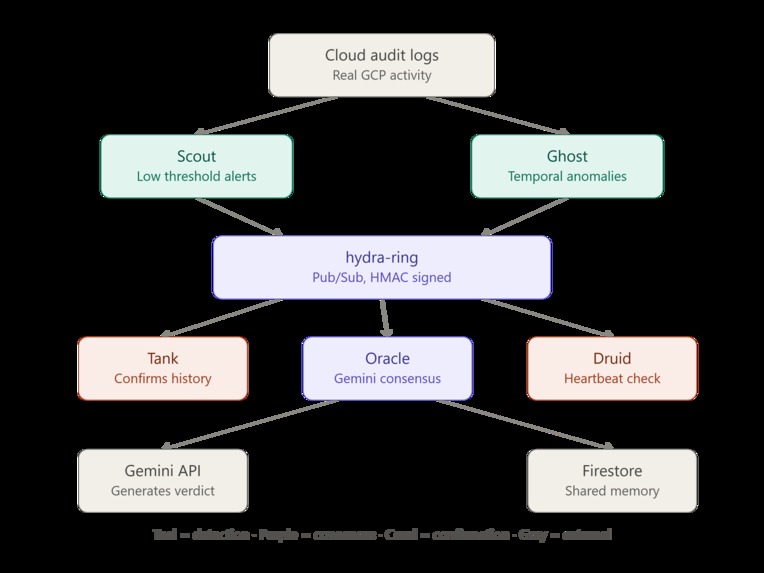
Archi and Flow Diag
-
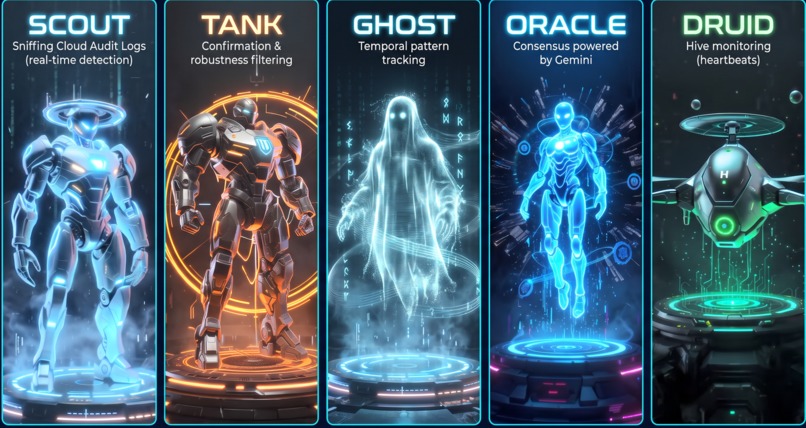
Meet the team
-
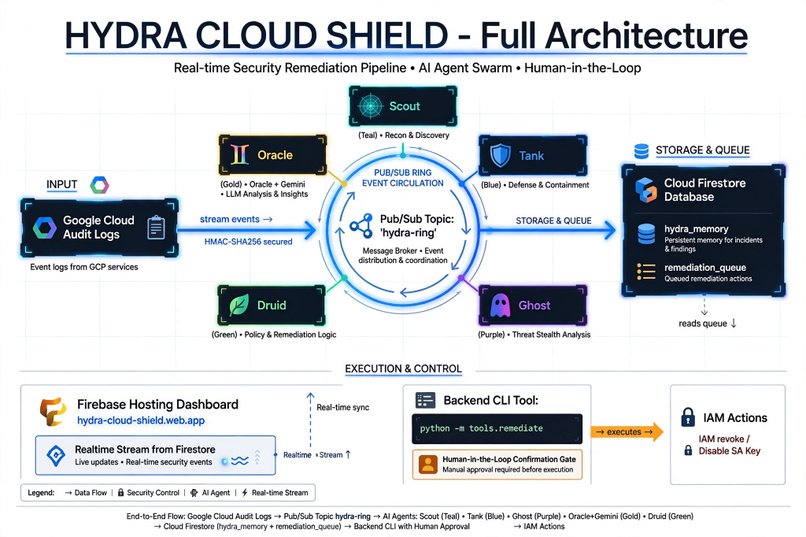
Full archi
-
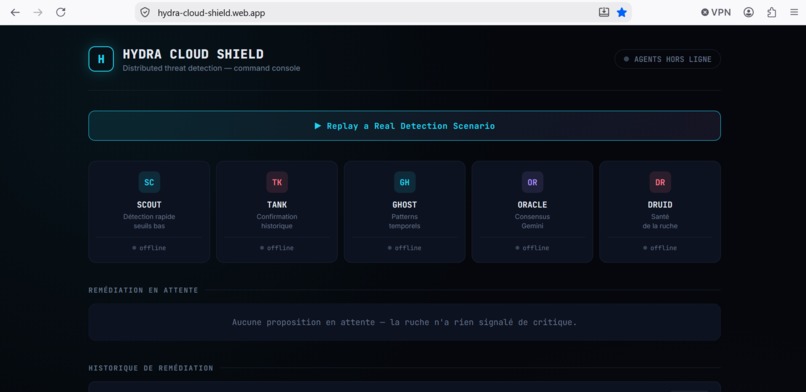
Web interface
-
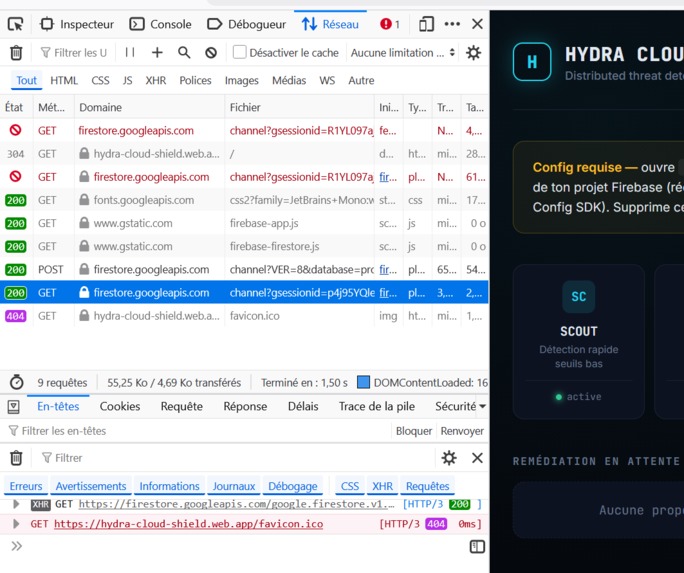
Hydra Cloud Shield — Real-Time Firestore Link & Network Inspection (Post-Cloud Shell Deployment)
-
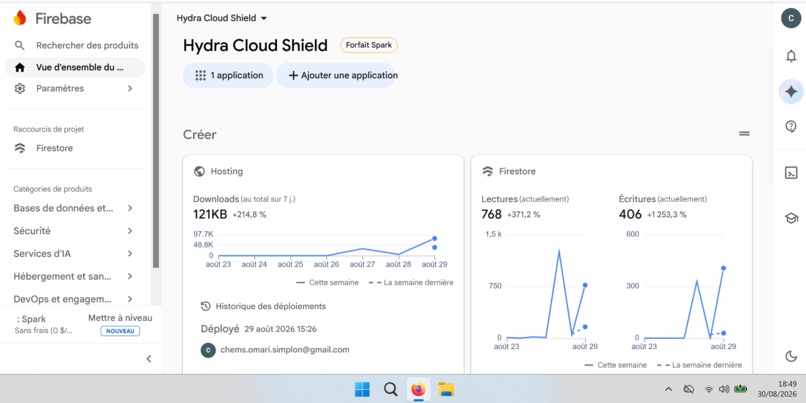
Firebase Console
-
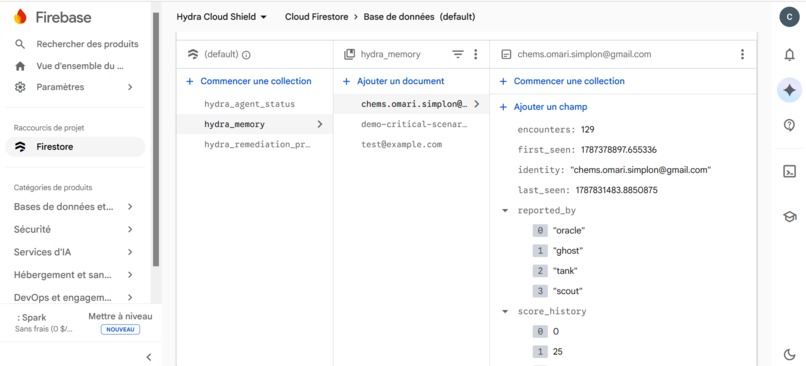
Firestore
Inspiration & Vision
« It’s not about complexity — it’s about finding the right lens to view a problem. »
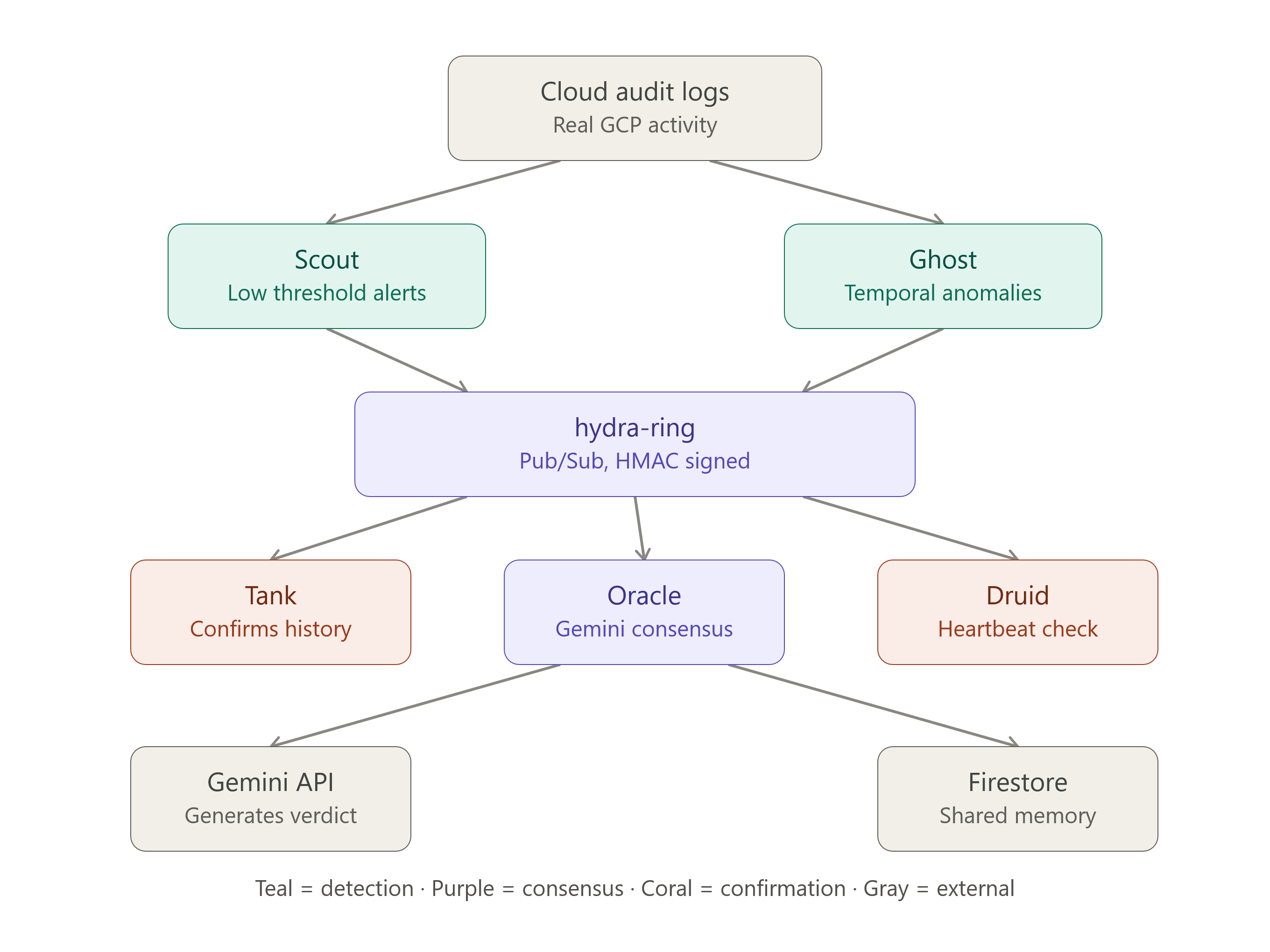
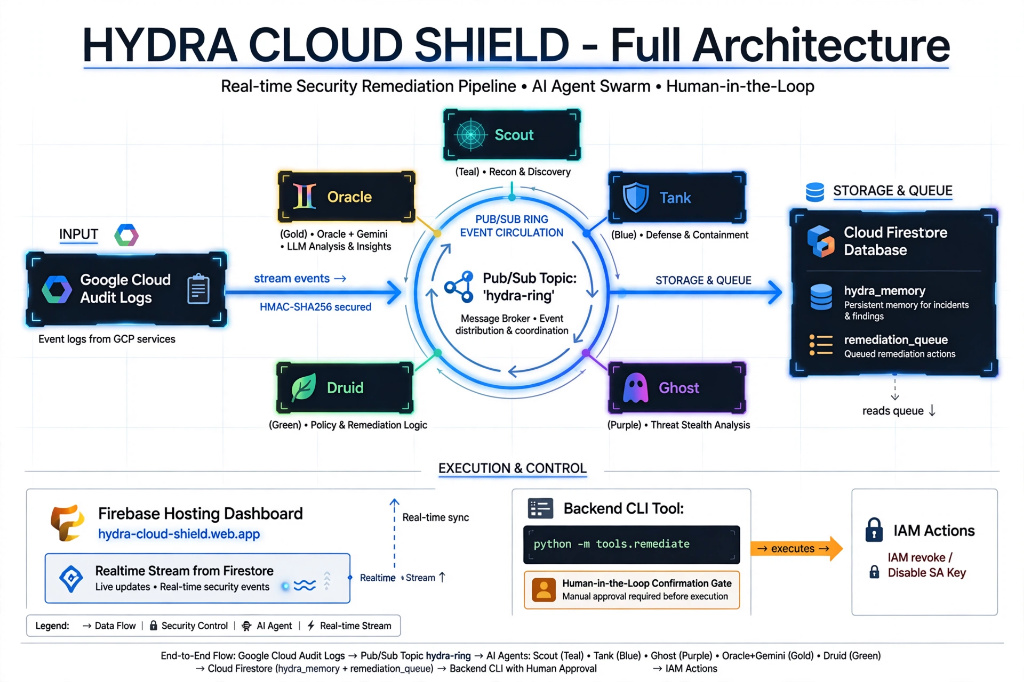
Hydra Cloud Shield is a self-regulating digital immune system for Google Cloud. Instead of a monolithic script that scrolls logs, 5 autonomous agents watch Audit Logs continuously, reason together via Pub/Sub and Firestore, and let Gemini reach consensus — proposing a real IAM fix only when a human says CONFIRMER.
Security teams still triage cloud audit logs manually — scrolling through IAM changes, service account key creations, and access anomalies one at a time, hoping to catch the one event that matters before it's too late.
Rather than building just another static script, Hydra Cloud Shield stems from a deeper research framework detailed in my work From Physics to Code: Autonomous Cybernetic Organisms and Alife (Artificial Life). HCS is a practical application of the RAGE framework, treating cloud security as an emergent, reactive ecosystem. Moving away from standard monolithic setups, the architecture balances core parameters like decentralization (multiservice, asynchronicity, no single point of failure), communication, resilience, and autonomy to build a self-regulating digital immune system.
It doesn't wait to be asked: it watches continuously, reasons collectively through a distributed swarm, and only asks a human when it's time to act.
What it does
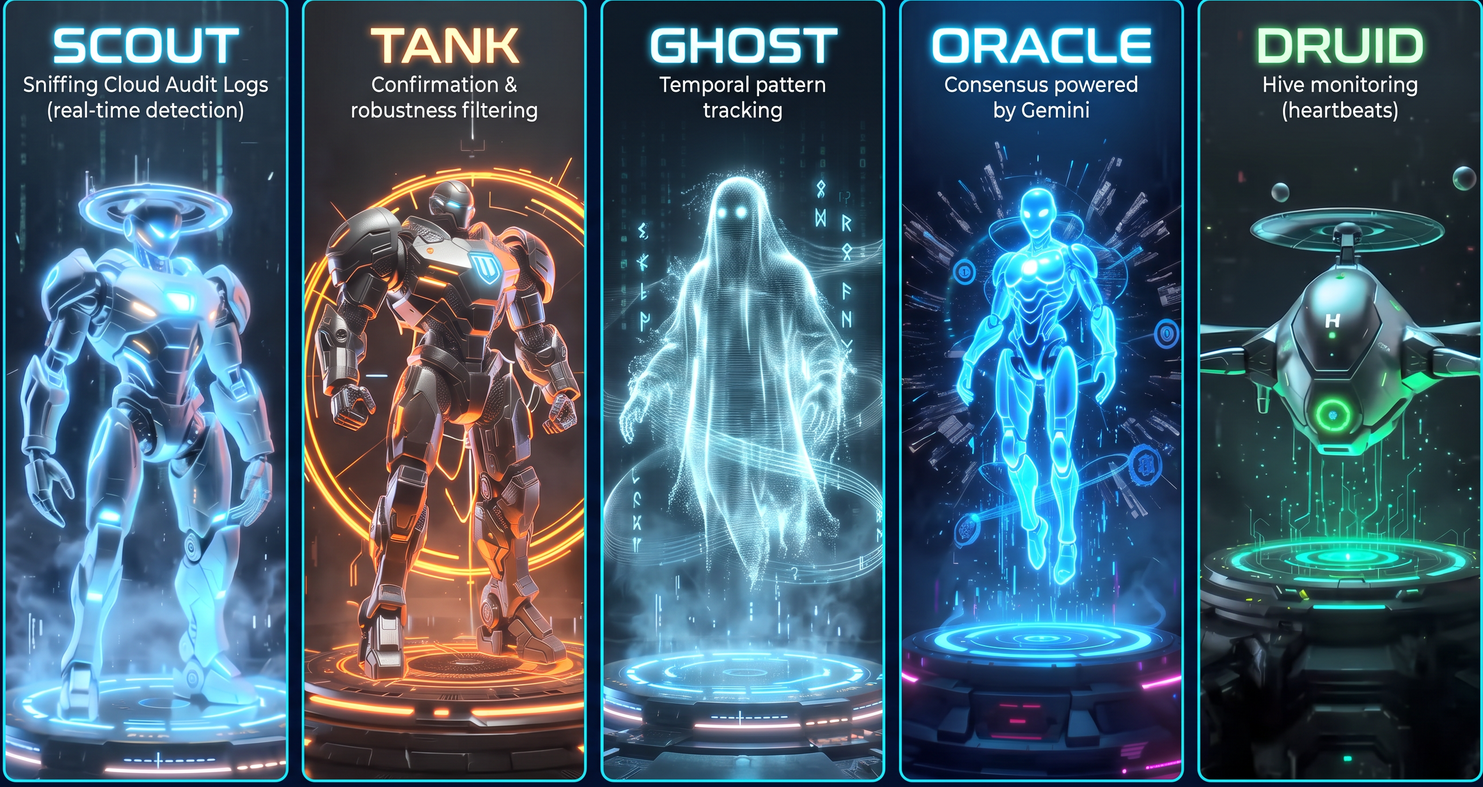
Hydra Cloud Shield is a swarm of 5 specialized AI agents deployed on Google Cloud that autonomously monitor real Cloud Audit Logs — no manual data entry required. A synthetic critical-scenario injector (tests/test_pulse.py) is included purely for reliable, reproducible demos through the real pipeline:
- Scout — first-line detection, low thresholds, catches suspicious events fast (IAM changes, new service account keys)
- Tank — deep analysis, checks the identity's history via Firestore before confirming or dismissing Scout's alert
- Ghost — passive surveillance, spots stealthy patterns (unusual hours, key age, frequency anomalies)
- Oracle — the consensus layer, powered by Gemini: synthesizes all signals into a final structured verdict with a natural-language explanation
- Druid — long-term memory keeper and swarm health monitor. In traditional distributed systems, nodes constantly exchange ping traffic. To keep HCS lightweight, fast, and compute-efficient, Druid relies on implicit heartbeats: rather than flooding the network with explicit messages, it uses the agents' actual operational activity as living proof of presence and health.
When the Oracle's verdict crosses a critical threshold, the system proposes a real remediation action — revoking an IAM role or disabling a compromised service account key — but never executes automatically. A human always confirms explicitly via a secure CLI (python -m tools.remediate) before anything happens.
How we built it
Hydra Cloud Shield is the cloud-native evolution of an earlier local prototype (Hydra-Smart-Shield, which used process-level scanning and local UDP sockets). We rebuilt the infrastructure around robust Google Cloud primitives:
- Cloud Shell & Local Orchestration — Instead of heavy, always-on cloud servers restricted by billing hurdles, the swarm's core intelligence and agent loop (
main.pywith dynamicBOX_ROLE) are orchestrated flexibly via Cloud Shell and local runtimes, keeping compute overhead completely optimized. - Google Cloud Pub/Sub / Asynchronous Ring — Provides a secure, HMAC-SHA256 signed messaging ring (
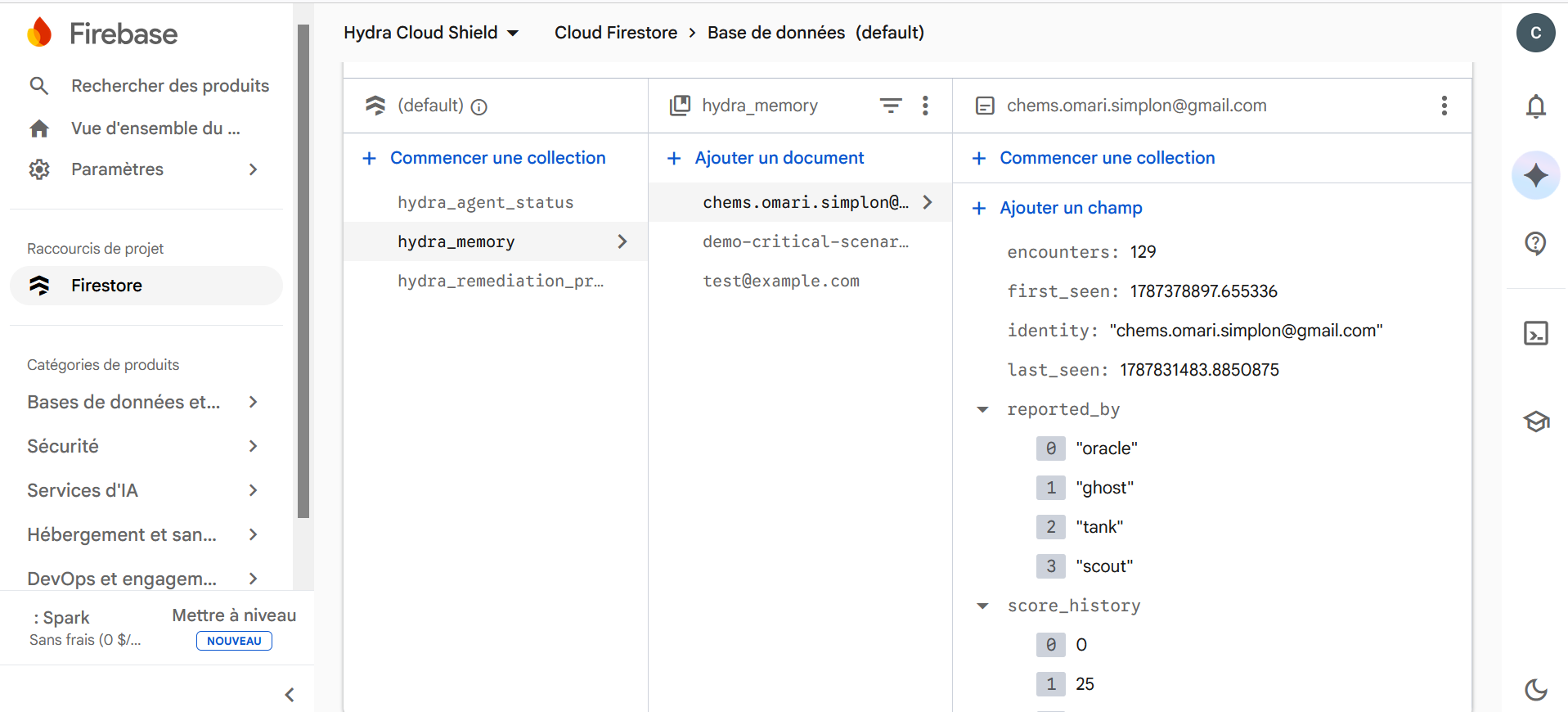
hydra-ring) for inter-agent communication and synchronization. - Cloud Firestore — Replaces local JSON files with transactional, persistent storage (
hydra_memoryand remediation queues). - Gemini via the GenAI SDK (public Gemini API) — Powers the Oracle agent to achieve intelligent, structured consensus scoring.
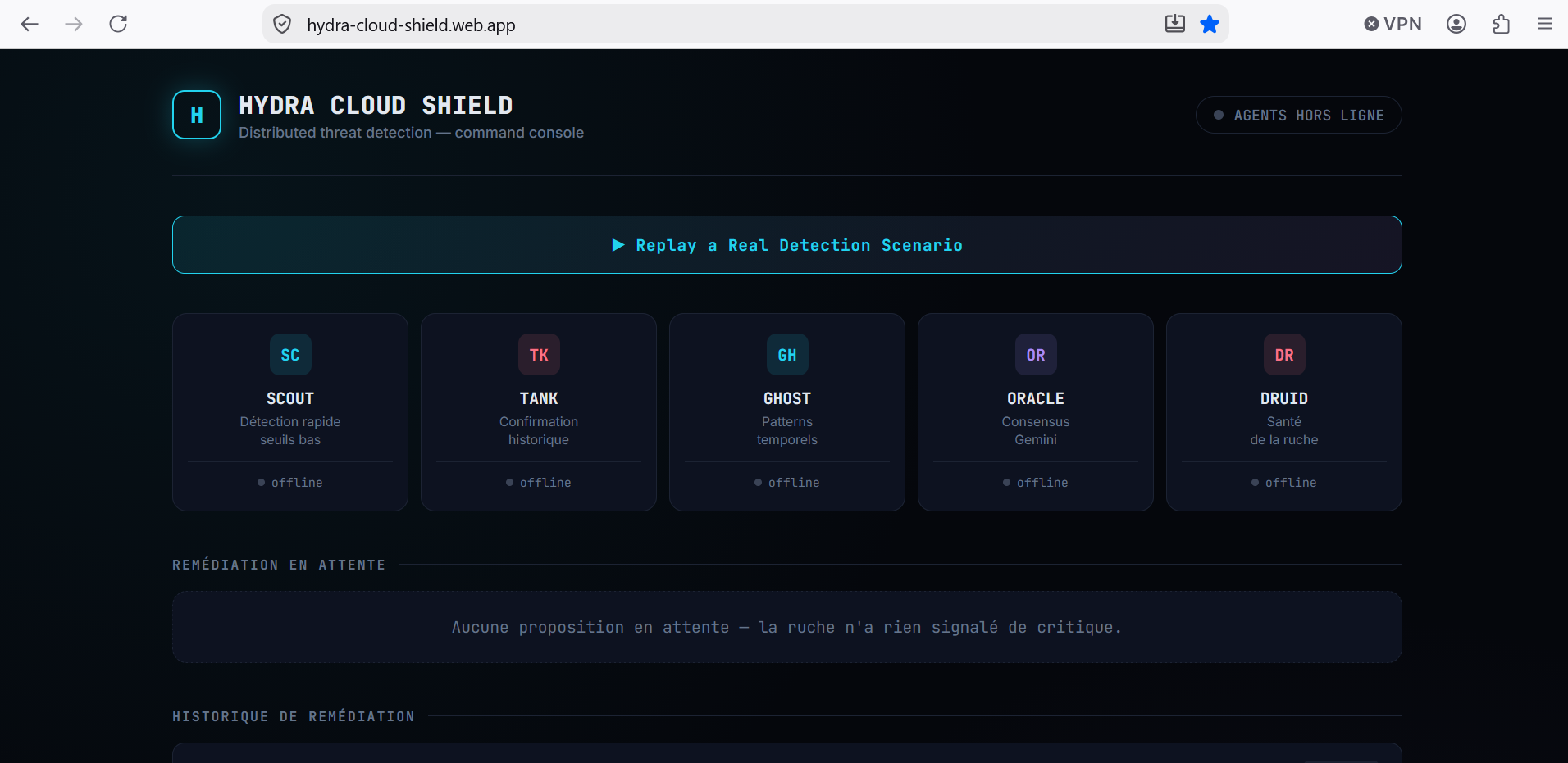
- Firebase Hosting & Realtime Dashboard — A zero-framework vanilla web dashboard (
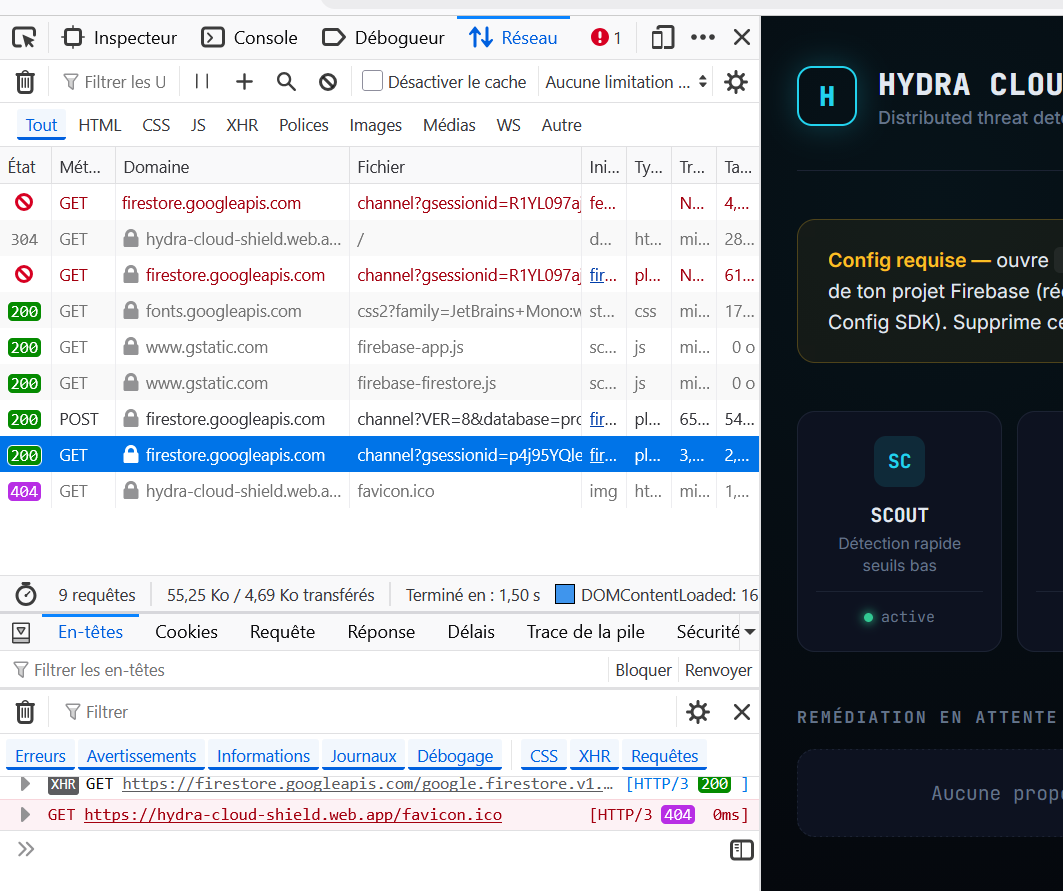
https://hydra-cloud-shield.web.app) providing real-time mission control directly connected to Firestore streams.
Challenges we ran into
- **GCP Billing & Infrastructure Constraints: Facing rigid billing hurdles and credit limits that restricted heavy managed services like Cloud Run right before the deadline, we rapidly pivoted the architecture to leverage Cloud Shell and agile local runtimes coupled with Firebase, proving that a complex AI swarm can run efficiently without massive cloud resource overhead.
- Porting process semantics to cloud event streams: Shifting from local OS process inspection (
psutil) to asynchronous Cloud Audit Logs required rethinking detection logic around high-latency, decentralized log ingestion. - Pub/Sub synchronization & swarm resilience: Ensuring that agents communicate reliably without cascading failures, leading to the implementation of lightweight implicit heartbeats observed by the Druid agent.
- Reliable structured LLM outputs: Prompt engineering and fallback parsers (
_parse_verdict) to ensure that Gemini's consensus responses can safely drive automated scoring loops without risking crashes due to malformed JSON.
Accomplishments that we're proud of
- True Distributed Swarm Architecture: Successfully translating theoretical Alife principles into a working, multi-process cloud infrastructure without SPOF.
- Production-Grade Safety (Human-in-the-Loop): Designing an architecture where AI handles intelligence and consensus, but destructive actions are strictly gated behind an explicit human confirmation workflow (
CONFIRMER). - Clean Operational Tooling: From the HMAC-secured messaging ring to the real-time Firebase mission-control dashboard and local setup scripts, the entire pipeline is built to be modular, auditable, and production-ready.
What we learned
Applying physical and ecological frameworks (like balancing centralization and resilience curves) from research like From Physics to Code to software architecture changes how you think about cloud agents. Designing systems that mimic biological resilience yields fault-tolerant behavior that traditional monolithic security daemons simply cannot match.
What's next for Hydra Cloud Shield
The version of HCS presented today is intentionally foundational. Looking ahead, our R&D roadmap explores advanced capabilities:
- Expanding signal sources beyond Cloud Audit Logs (e.g., VPC flow logs, Kubernetes audit streams).
- Integrating advanced R&D features ranging from auto-clone repair and furtivity to proportional automated responses.
- Refining agent scoring models using historical feedback loops inspired by adaptive systems.
A note on ethics: With great autonomy comes great responsibility. We strongly believe that any self-healing, auto-clone, or aggressive defense mechanism requires rigorous ethical boundaries and strict human-in-the-loop validation barriers before touching any production environment.

Log in or sign up for Devpost to join the conversation.