-
-
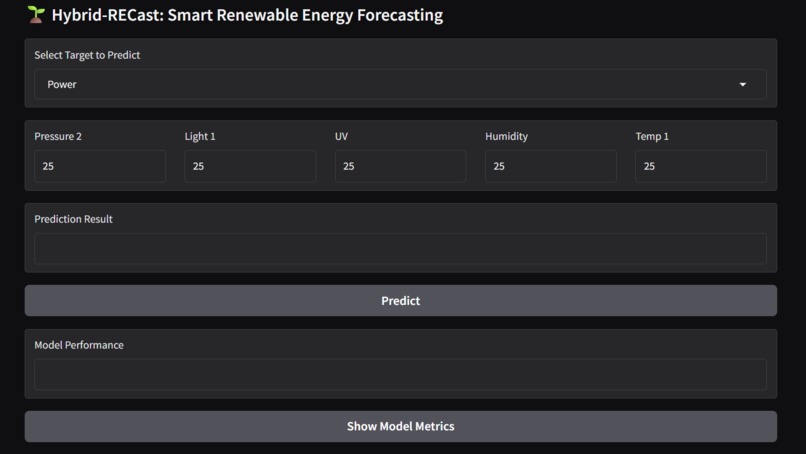
Main page
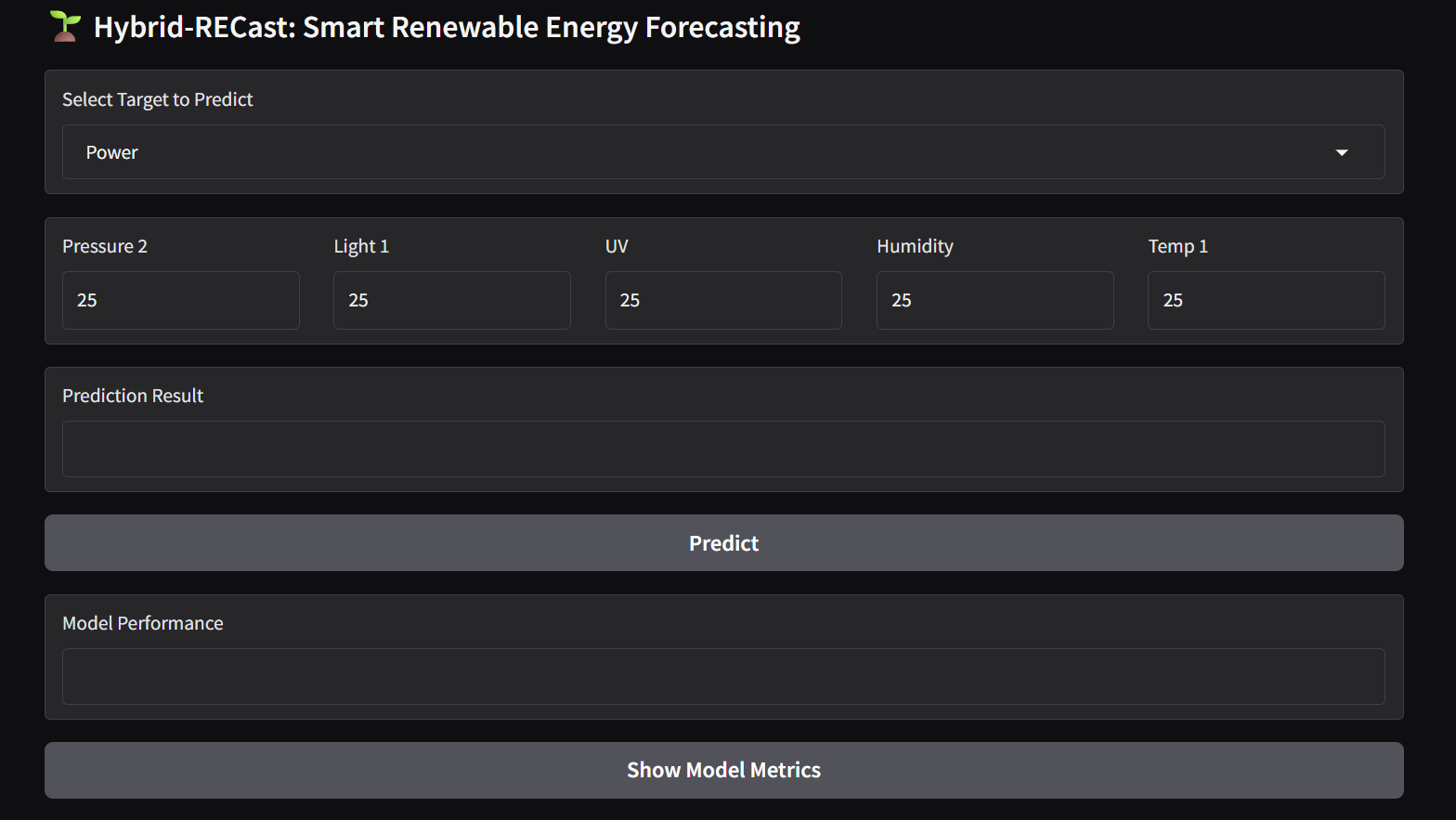
Inspiration
The transition towards clean energy is accelerating, but integrating solar and wind power into the grid remains challenging due to their high variability and weather dependence.
Unreliable forecasts often lead to load imbalance, power curtailment, and wasted energy — impacting grid stability and sustainability goals.
This inspired us to build Hybrid-RECast, a next-gen forecasting system that leverages hybrid machine learning ensembles to deliver highly accurate, real-time renewable energy predictions, empowering smart grids to become more resilient and efficient.
What it does
Hybrid-RECast provides hourly and daily forecasts for solar and wind energy generation.
Using historical weather data, real-time meteorological features, and advanced ML techniques, it delivers:
- 25% more accurate forecasts (R2-score reduced from 0.80 → 0.95)
- Better load balancing for smart grids
- Reduced energy wastage and improved renewable energy utilization
This system directly supports SDG 7 (Affordable & Clean Energy) by improving energy planning and advancing the goal of a sustainable, carbon-neutral future.
How we built it
Data Pipeline & Feature Engineering
- Collected open-source weather and generation datasets
- Cleaned and normalized data, handled missing values
- Engineered temporal, meteorological, and lag features
- Performed Chi-Square feature selection to retain top predictors
- Collected open-source weather and generation datasets
Modeling Approach
- Baseline Models: VAR, VECM (statistical) and XGBoost, LightGBM, Bayesian Linear Regression (ML)
- Final Solution: Stacked Ensemble Model
- Base learners: XGBoost + LightGBM + Bayesian Regression
- Meta-learner: Ridge Regression for optimal weight aggregation
- Base learners: XGBoost + LightGBM + Bayesian Regression
- Baseline Models: VAR, VECM (statistical) and XGBoost, LightGBM, Bayesian Linear Regression (ML)
Validation
- Used time-series cross-validation to avoid data leakage
- Optimized hyperparameters with grid search for lowest RMSE
- Used time-series cross-validation to avoid data leakage
Evaluation Metric
R2-score
Challenges we ran into
- Data gaps and noise: Weather data had missing intervals requiring interpolation
- Time alignment: Needed precise synchronization between weather and generation timestamps
- Overfitting risks: Seasonal trends made models overfit without proper validation
- Resource constraints: Training multiple base + meta models in limited time was computationally expensive
Accomplishments that we're proud of
- Achieved ~25% accuracy improvement over best single model
- Successfully combined statistical + ML + ensemble learning into one scalable pipeline
- Designed a system architecture ready for real-time API integration and cloud deployment
- Contributed towards solving a real-world sustainability challenge with measurable impact
What we learned
- Advanced time-series forecasting techniques and ensemble learning
- The importance of feature engineering + cross-validation for robust models
- How to build solutions that are not just accurate but scalable and deployable
- Effective teamwork, rapid experimentation, and result communication under hackathon deadlines
What's next for Hybrid-RECast
- Real-time weather API integration for live forecasting
- Cloud-native deployment as a microservice for large-scale adoption
- IoT-enabled grid integration for automated demand-response
- Model expansion to include other renewable sources (hydro, biomass) for holistic forecasting
Built With
- chi-square
- encoding
- feature
- handling)
- label
- lightgbm
- missing
- numpy
- one-hot
- pandas
- python
- regressor
- scikit-learn
- selection
- simpleimputer
- stacking
- value
- xgboost


Log in or sign up for Devpost to join the conversation.