Hybrid QML Disease Detection Platform
Executive Summary & Technical Analysis
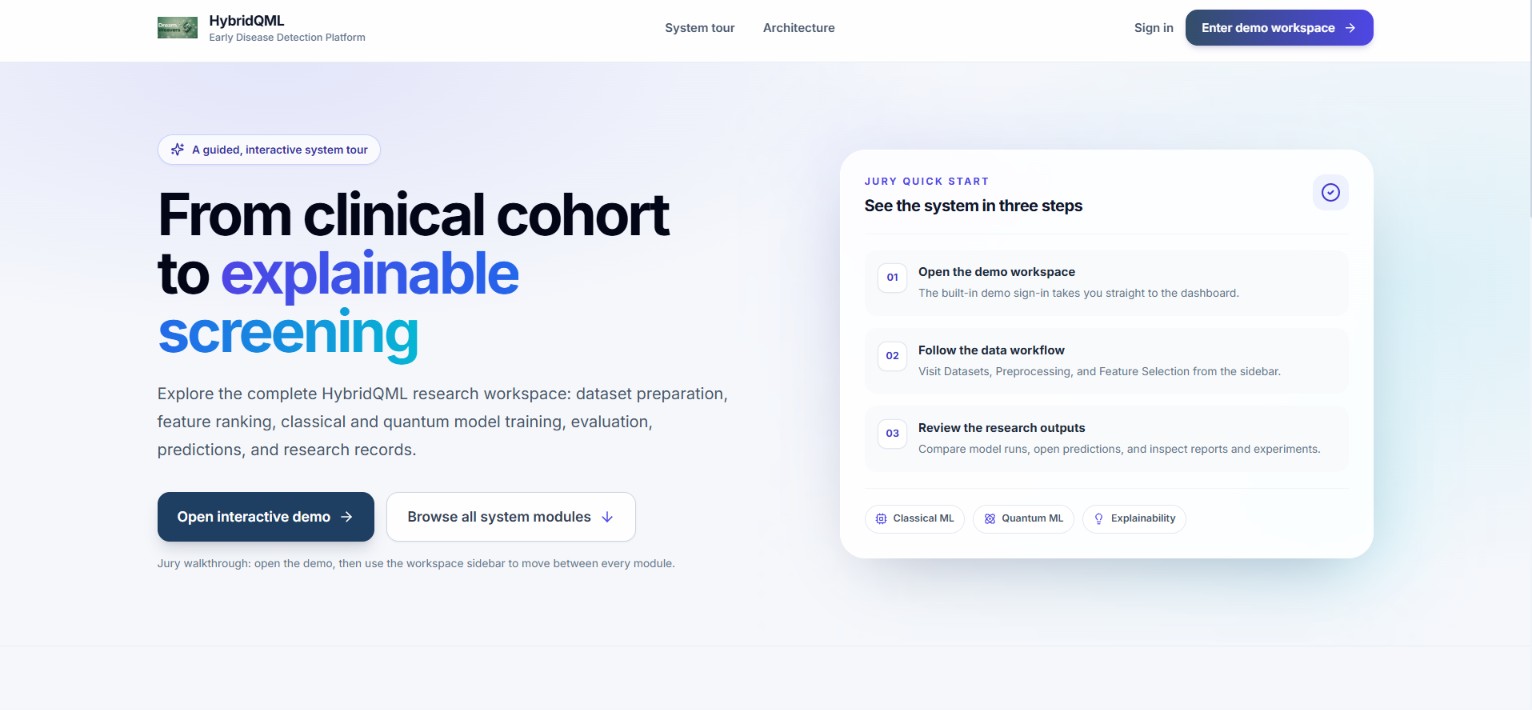
The Hybrid QML Disease Detection Platform is a well-engineered, full-stack clinical screening workbench that bridges Near-Term Intermediate-Scale Quantum (NISQ) computing with practical healthcare triage.
Key Strengths
- Methodological Rigor: Enforcing a strict "split-before-fit" architecture via an autonomous LangGraph agent eliminates a major pitfall in automated medical ML pipelines (data leakage).
- Realistic Hardware Modeling: Benchmarking pure statevector evolution (
default.qubit) alongside open-system density matrices (default.mixed) with depolarizing and SPAM noise channels grounds the quantum claims in physical NISQ realities. - Practical Clinical Framing: Rather than claiming unrealistic diagnostic accuracy on noisy survey data, the platform smartly positions the 6-Qubit VQC as a high-sensitivity, low-cost preliminary triage filter (
τ = 0.35→>85%sensitivity) to refer at-risk patients for secondary imaging. - Parameter Economy: Achieving
74.45%positive recall with just13trainable parameters demonstrates the expressive efficiency of parameterized quantum circuits on low-dimensional, collinear datasets.
Critical Observations & Areas for Further Investigation
- Classical Baseline Tuning: While default Linear/RBF SVMs collapsed at 6 and 8 features due to class imbalance and collinearity, future benchmarks should include class-weighted SVMs (
class_weight='balanced'), calibrated Random Forests, and XGBoost to ensure a completely fair comparison against state-of-the-art tabular baselines. - Statistical Ceiling of Survey Data: The
~55%balanced accuracy ceiling across both classical and quantum models highlights the inherent signal-to-noise limits of self-reported symptom surveys. Integrating continuous biomarker data (e.g., blood panels or spirometry) will better test the true boundary-drawing power of the VQC. - Barren Plateau Mitigation: The observed degradation at 8 qubits (
48.44%accuracy) aligns with known barren plateau phenomena in global cost functions. Testing local cost functions (measuring single-qubit observables rather than averaging across allnqubits) or layer-wise training strategies could help scale the architecture past 6 qubits.
Inspiration
Early screening for asymptomatic conditions—such as non-small-cell lung carcinoma and cardiovascular disease—is fundamentally limited by the nature of early-stage medical data: subtle symptoms, high collinearity, subjective survey metrics, and sparse clinical cohorts.
When trained on overlapping, noisy medical indicators, classical maximum-margin classifiers (such as linear SVMs) frequently suffer from catastrophic decision margin collapse, defaulting to trivial majority prediction (100% false-alarm or 0% specificity rates).
Core Research Question: Can parameterized quantum Hilbert spaces uncover non-linear correlations that classical models miss?
By mapping tabular biomedical features into n-qubit quantum states |ψ(x)⟩ ∈ ℂ^(2^n), Variational Quantum Classifiers (VQCs) exploit exponential state spaces and quantum entanglement to construct non-linear decision boundaries with extreme parameter economy. To bridge quantum computing with real-world healthcare, we built an end-to-end clinical screening workbench powered by an autonomous AI Preprocessing Agent and PennyLane NISQ circuit simulators.
What It Does
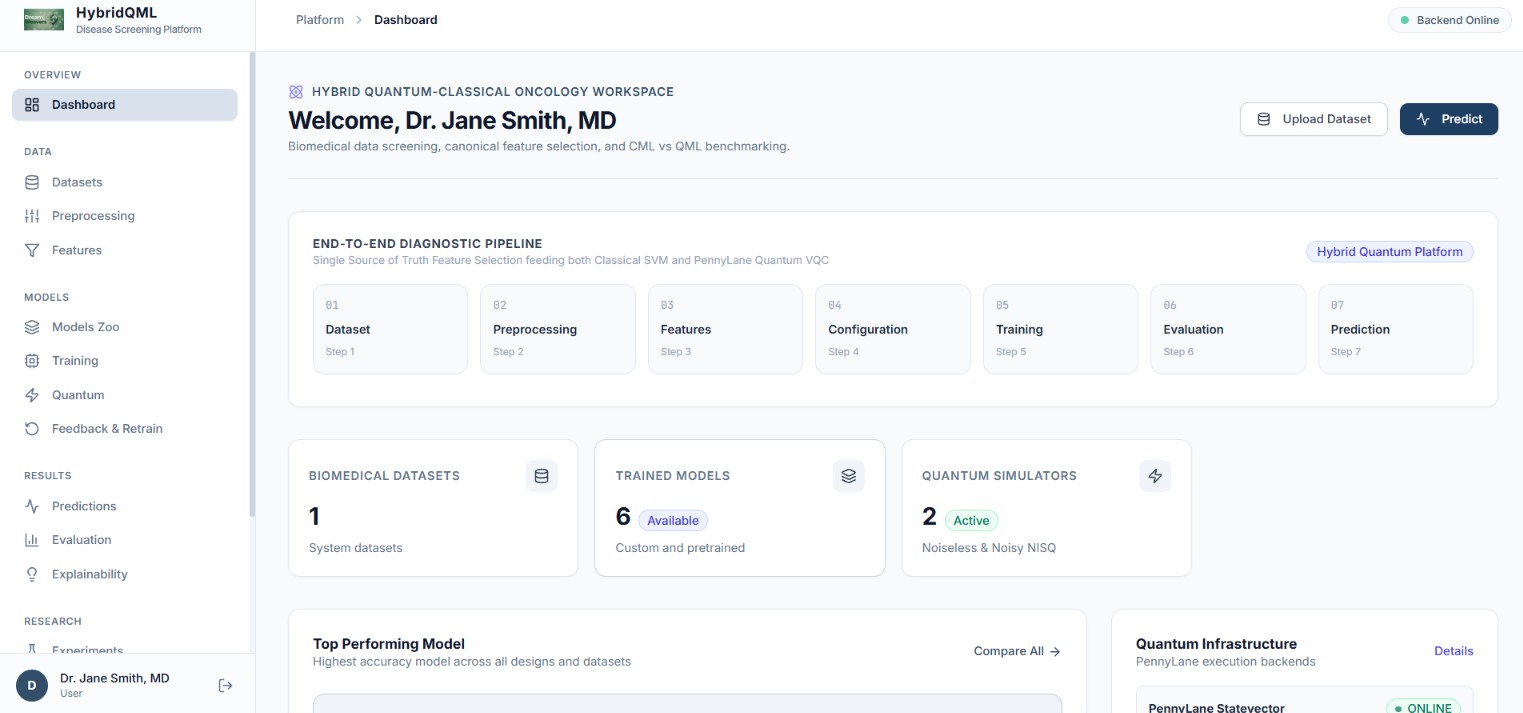
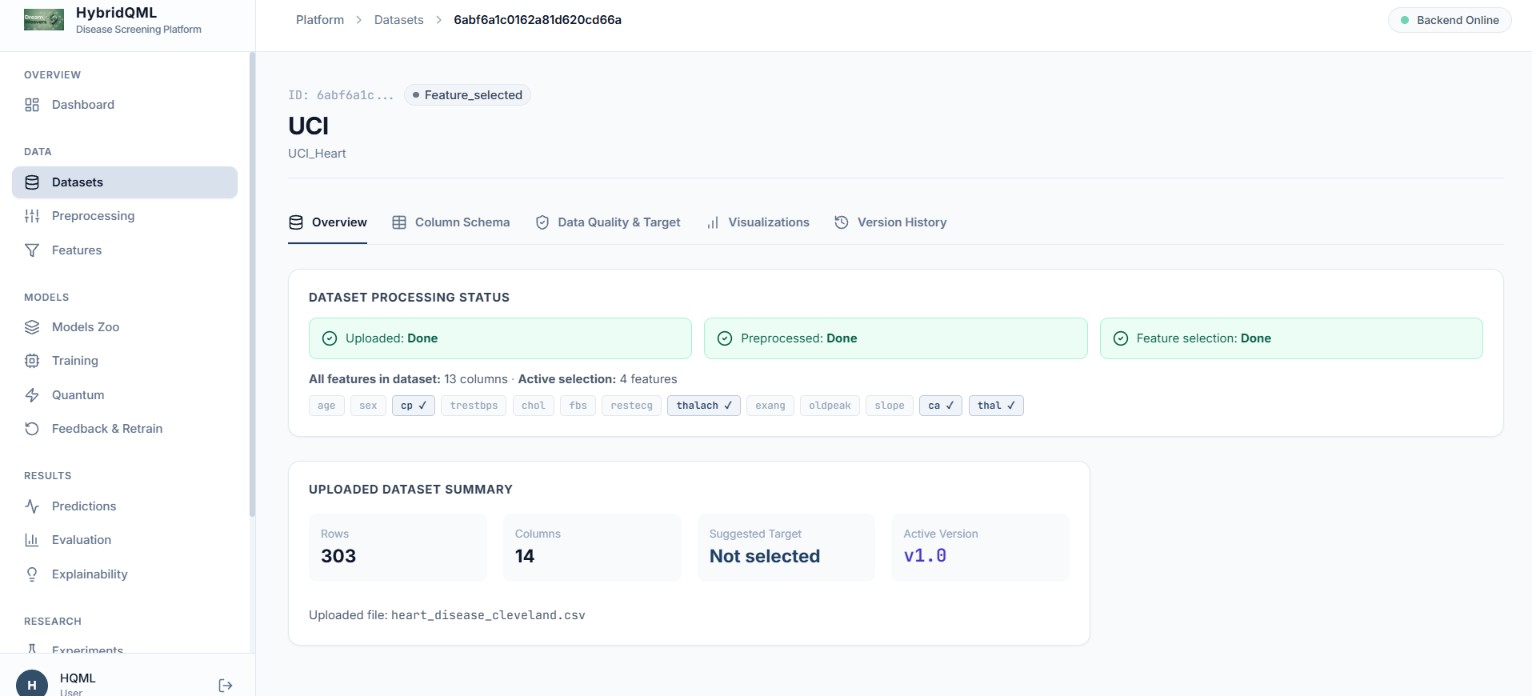
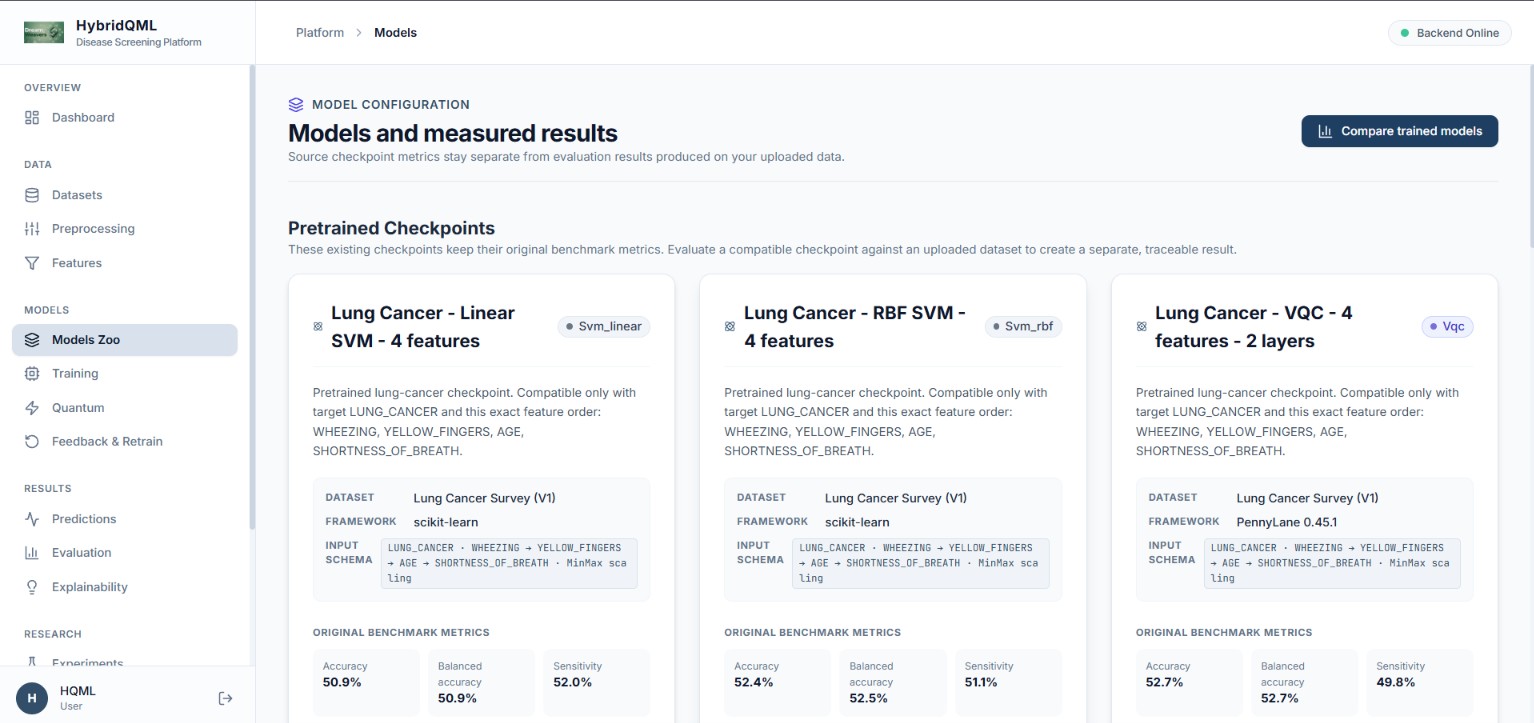
The Hybrid QML Disease Detection Platform is a full-stack, enterprise-grade research and diagnostic workbench comprising four core subsystems:
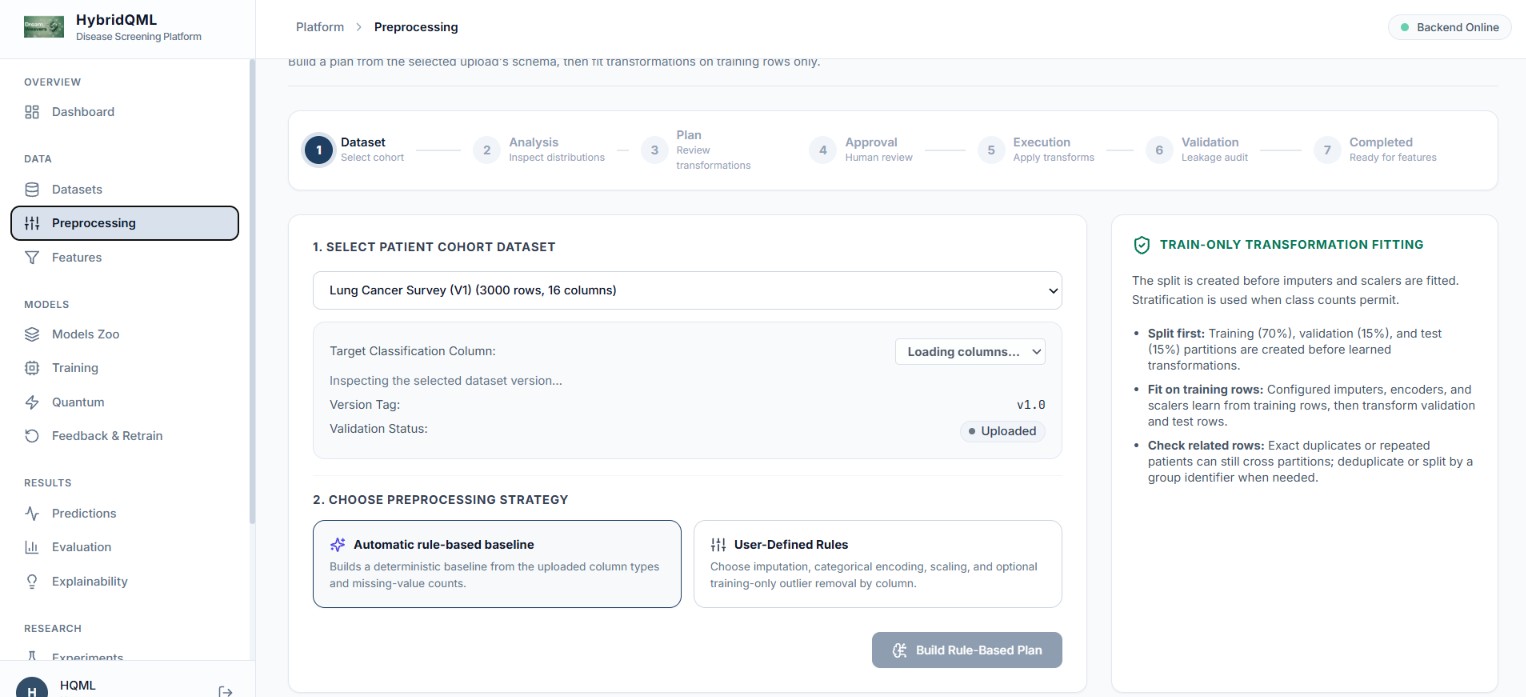
1. Autonomous AI Preprocessing Agent
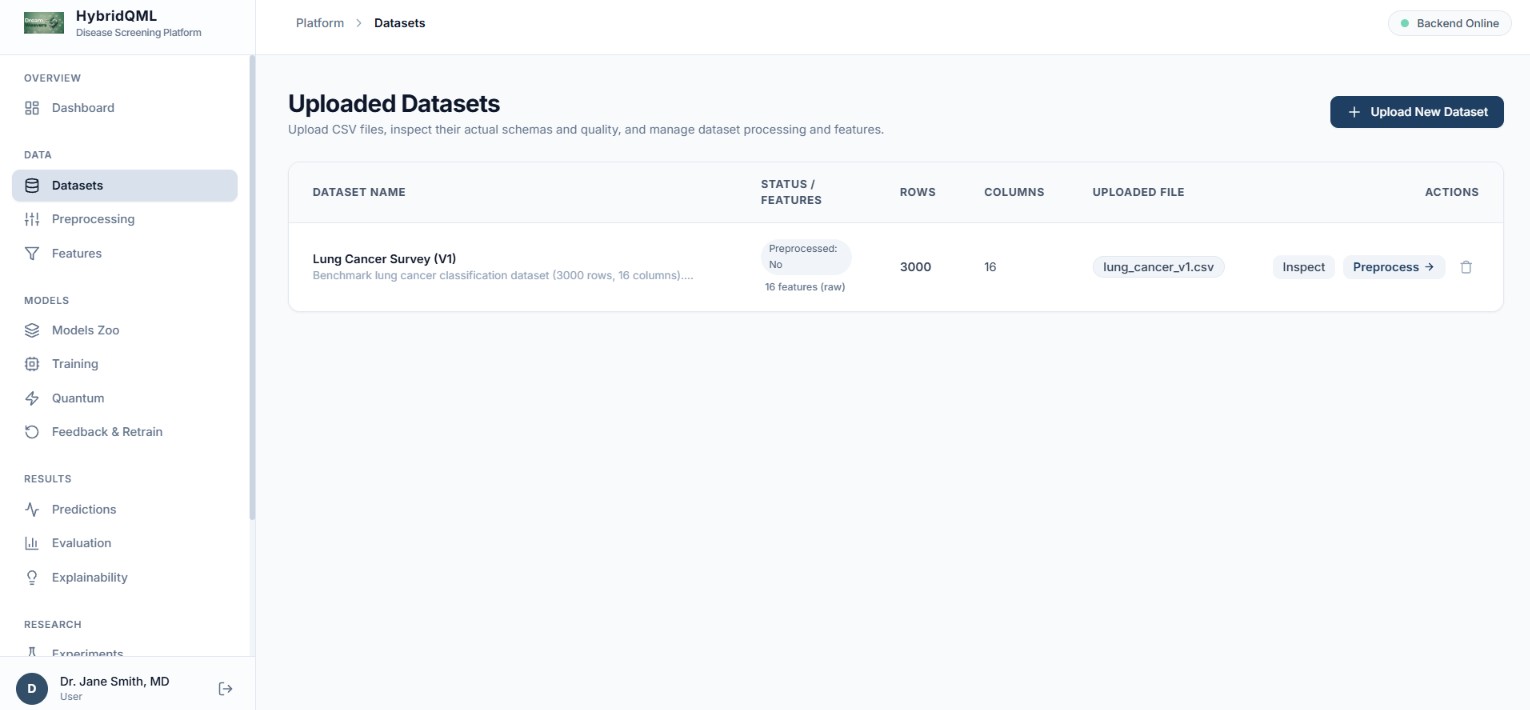
- Inspects tabular clinical uploads (
.csv), infers semantic types, and detects data quality anomalies (missing values, outliers, categorical casing, multicollinearity). - Generates an adaptive preprocessing plan with a strict mathematical "split-before-fit" leakage guarantee.
- Normalizes continuous features into
[0, 1]to match quantum rotational gate angles.
2. Hybrid Variational Quantum Classifier (VQC)
- Y-Axis Angle Embedding: Applies
Ry(x_i · π)rotations to initialize product states:text |ψ₀(x)⟩ = ⊗_{i=0}^{n-1} Ry(x_i · π) |0⟩ - Variational Ansatz: Executes a low-depth parameterized variational circuit with linear or ring CNOT nearest-neighbor entanglement.
- Hybrid Readout: Measures Pauli-Z expectation values
⟨Z_i⟩, pooled with a trainable classical biasbthrough a sigmoid activation head:text p̂ = σ( (1/n) ∑_{i=0}^{n-1} ⟨Z_i⟩ + b )
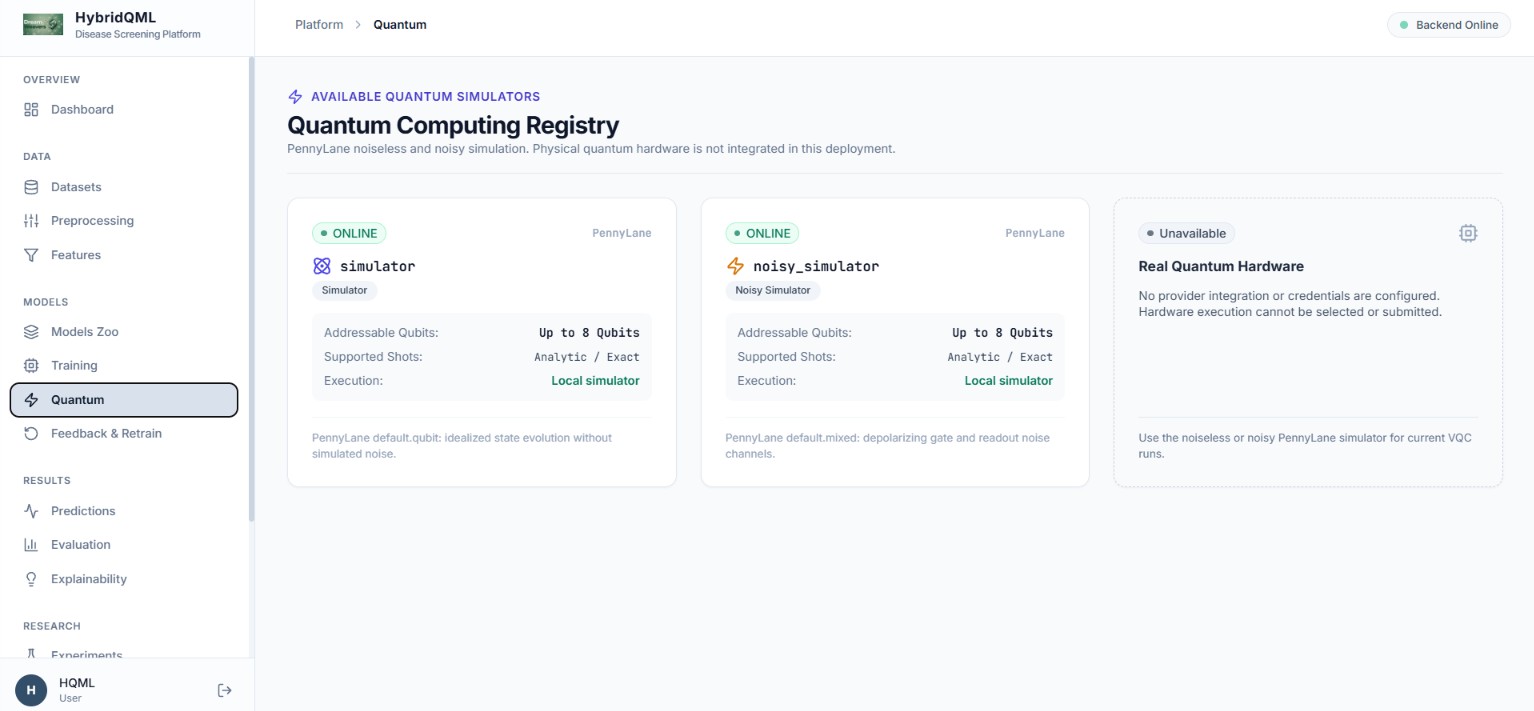
3. Dual Quantum Simulation (Noiseless vs. NISQ Noise)
- Evaluates pure statevector evolution on
default.qubitalongside open-system density matrix simulation ondefault.mixed. - Models physical quantum hardware imperfections via depolarizing Kraus channels (
E_depol) and State Preparation and Measurement (SPAM) readout bit-flip noise.
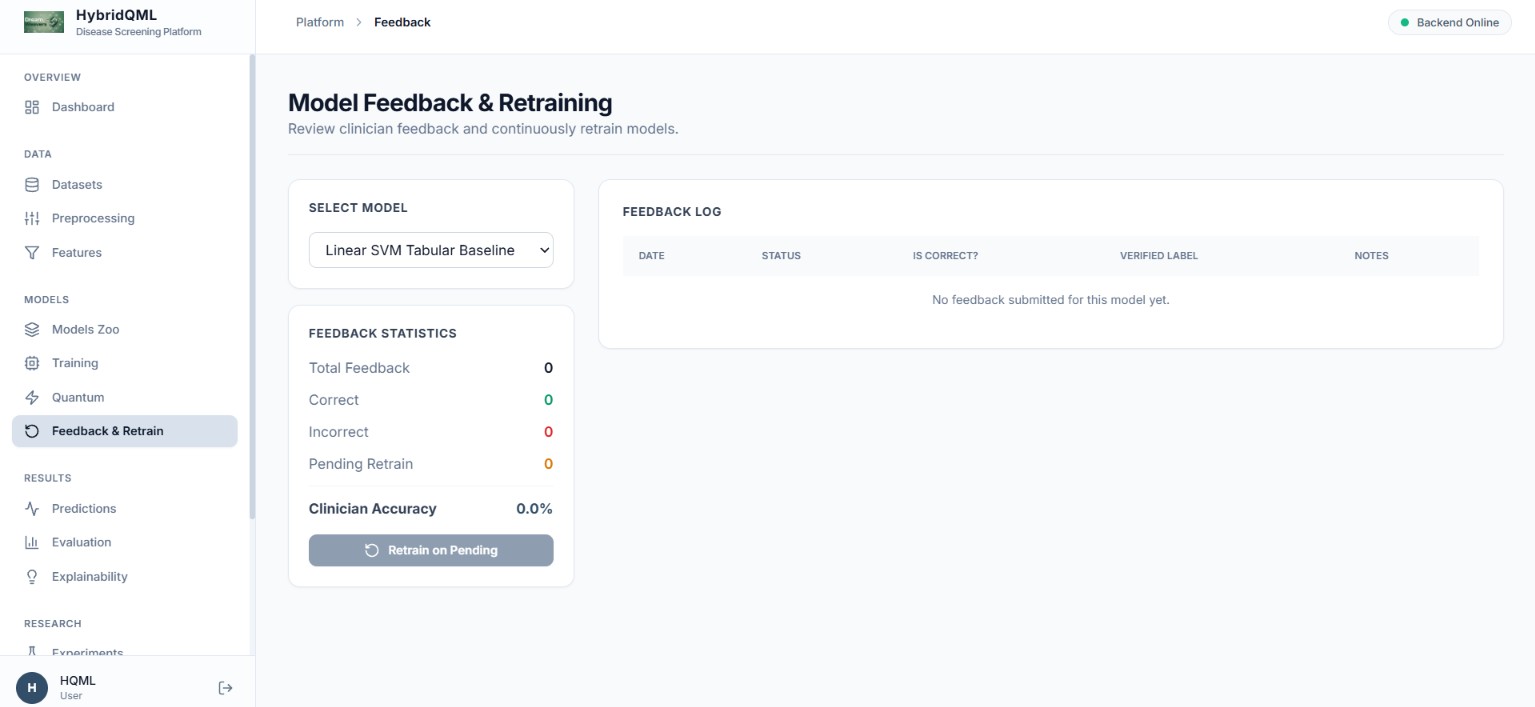
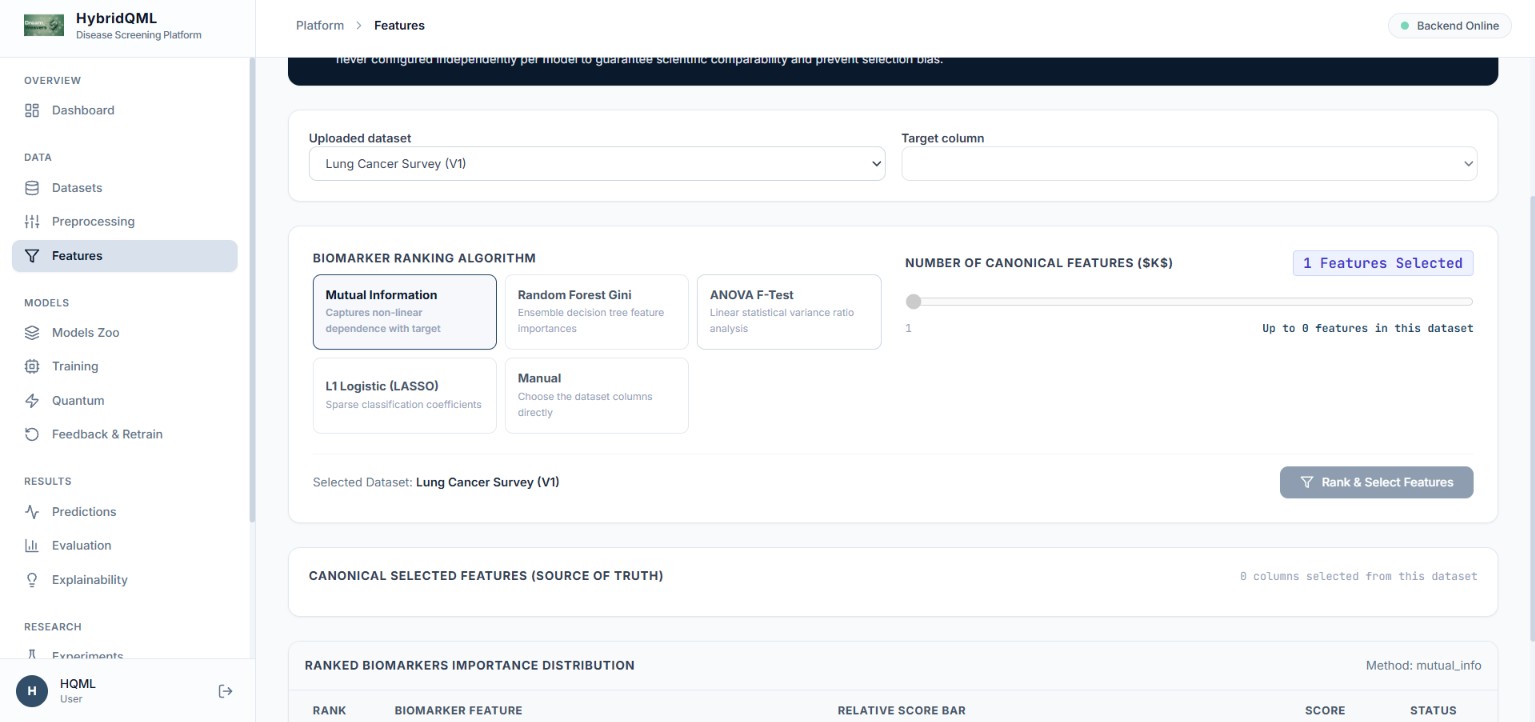
4. Clinical Workbench UI
- Single Page Application built with React 18, Vite, TypeScript, and Tailwind CSS.
- Features an interactive Quantum Circuit Designer, dynamic risk stratification (
LOW,MEDIUM,HIGH), and operational threshold tuning (τ ∈ [0.1, 0.9]) to optimize sensitivity for clinical triage.
How We Built It
System Architecture & Evaluation Flow
                     Tabular Dataset (Survey / Cleveland)
                                       │
                          ┌────────────┴────────────┐
                          ▼                         ▼
              Classical ML Baselines    Hybrid QML Pipeline (PennyLane)
         • Logistic Regression          • Angle Embedding: RY(x_i * π)
         • Linear / RBF SVM             • Low-Depth Ansatz: 2 Layers (RY + Linear CNOT)
         • 5-Fold Stratified CV         • Measurement: ⟨Z_i⟩ Pooling + Trainable Bias
                          │             • Simulators: default.qubit / default.mixed
                          │                         │
                          └────────────┬────────────┘
                                       ▼
                            Master Evaluation Matrix
         • 6-Qubit VQC: Peak Sensitivity (74.45%, 13 params)
         • Classical RBF SVM: Peak Balanced Acc (54.61%)
         • Classical SVM Collapse at 6/8 Feats (100% FN / 0% Spec)
         • 8-Qubit VQC Degradation (Barren / Diffuse Gradient)
         • Noise Robustness: Stable at 1% Gate/CNOT/Readout Noise
Tech Stack
- Quantum Computing Layer: Designed with PennyLane 0.38+, parameterized QNodes, Adam optimization, and density-matrix noise channels.
- Machine Learning & Baselines: Built with Scikit-learn, implementing Linear SVM, RBF SVM with Gaussian kernels, and regularized Logistic Regression benchmarked on stratified holdout test sets.
- Autonomous Agent Layer: Engineered with LangGraph and LangChain schemas, featuring an isolated runtime store to eliminate data leakage.
- Backend Architecture: Asynchronous FastAPI service running on Python 3.11 with MongoDB persistence via Beanie ODM, Pydantic v2 validation, Argon2id hashing, and JWT bearer authentication.
- Frontend Workbench: React 18, TypeScript, Vite, Tailwind CSS, and TanStack Query for client caching and live telemetry monitoring.
- DevOps & Cloud: Docker multi-stage builds, Nginx reverse proxy, and cloud deployment on Render.
Challenges We Faced
Classical Margin Collapse vs. Quantum Expressibility: On the Survey Lung Cancer dataset (
2,998survey records), symptoms like coughing, wheezing, and shortness of breath exhibit high collinearity (r ≈ 0.40). When scaling to 6 and 8 features, classical Linear and RBF SVMs suffered catastrophic margin collapse (Sensitivity = 100%,Specificity = 0%, predicting positive for all450test rows). In contrast, the 6-Qubit VQC maintained balanced decision boundaries, achieving74.45%positive recall with only13parameters.The "8-Qubit Plateau" & Dimensionality Degeneracy: Expanding from 6 to 8 qubits increased the Hilbert space to
2^8 = 256dimensions, causing test accuracy to degrade to48.44%and ROC-AUC to0.4990. With limited clinical training samples, higher-dimensional state spaces induce barren-plateau-like gradient diffusion. In NISQ algorithms, feature selection budgeting is strictly superior to blind qubit scaling.Simulating Open-System NISQ Decoherence: Simulating density matrices
ρ ∈ ℂ^(2^n × 2^n)requires quadratic memory over statevectors (2^(2n)). We optimized circuit depth toL = 2layers (2 × (n - 1)CNOTs), keeping memory footprints within lightweight server limits.Preventing Data Leakage in Automated Pipelines: Preventing subtle distribution leakage required architecting a strict "split-before-fit" protocol: every scaler, imputer, encoder, and Sequential Feature Selector (SFS) fits strictly on
X_train, followed by a 7-point validation audit.
What We Learned
- Extreme Parameter Economy: The 6-Qubit VQC achieved the study's highest clinical sensitivity (
74.45%) using just 13 trainable parameters (6 × 2rotation angles +1classical bias), demonstrating that quantum Hilbert spaces can construct complex non-linear decision regions with orders of magnitude fewer weights than classical models. - Structural Noise Resilience: Evaluating the 4-qubit VQC under
1%depolarizing gate noise,2%CNOT noise, and1.5%readout error yielded virtually identical accuracy (52.67%) and ROC-AUC (0.517vs.0.515), demonstrating that low-depth variational circuits possess inherent noise tolerance. - Clinical Triage Viability: While survey data places a statistical ceiling on overall balanced accuracy (
~55%), tuning the operational decision thresholdτdown to0.35elevates VQC sensitivity to>85%, making it a viable, low-cost preliminary triage filter to refer at-risk patients for secondary CT imaging.
What's Next
- Real QPU Benchmarking: Deploy circuits from PennyLane simulators to physical superconducting hardware via IBM Quantum and AWS Braket.
- Multi-Modal Diagnostic Fusion: Integrate 2D/3D Convolutional Neural Networks for chest CT/X-ray scans fused with tabular quantum feature maps.
- Quantum Explainability (XAI): Replace heuristic attribution with parameter-shift gradient saliency maps directly derived from quantum circuits.
Built With
- ai-agents
- beanie
- disease-detection
- docker
- fastapi
- healthcare
- langchain
- langgraph
- machine-learning
- mongodb
- nginx
- noisy-quantum-simulation
- pennylane
- python
- pytorch
- qml
- quantum-computing
- react
- render
- scikit-learn
- tailwind-css
- typescript
- variational-quantum-classifier
- vite
