-
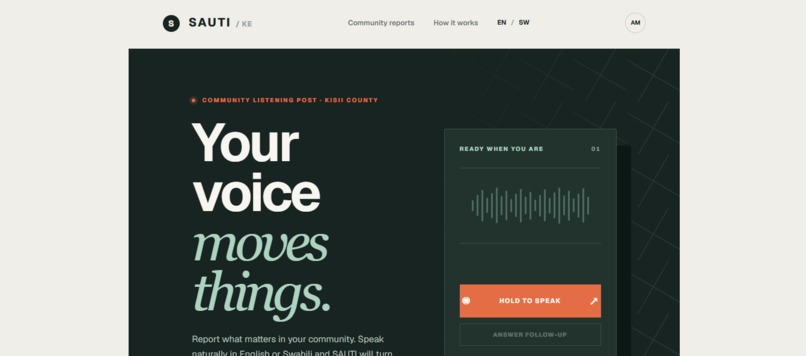
the interface
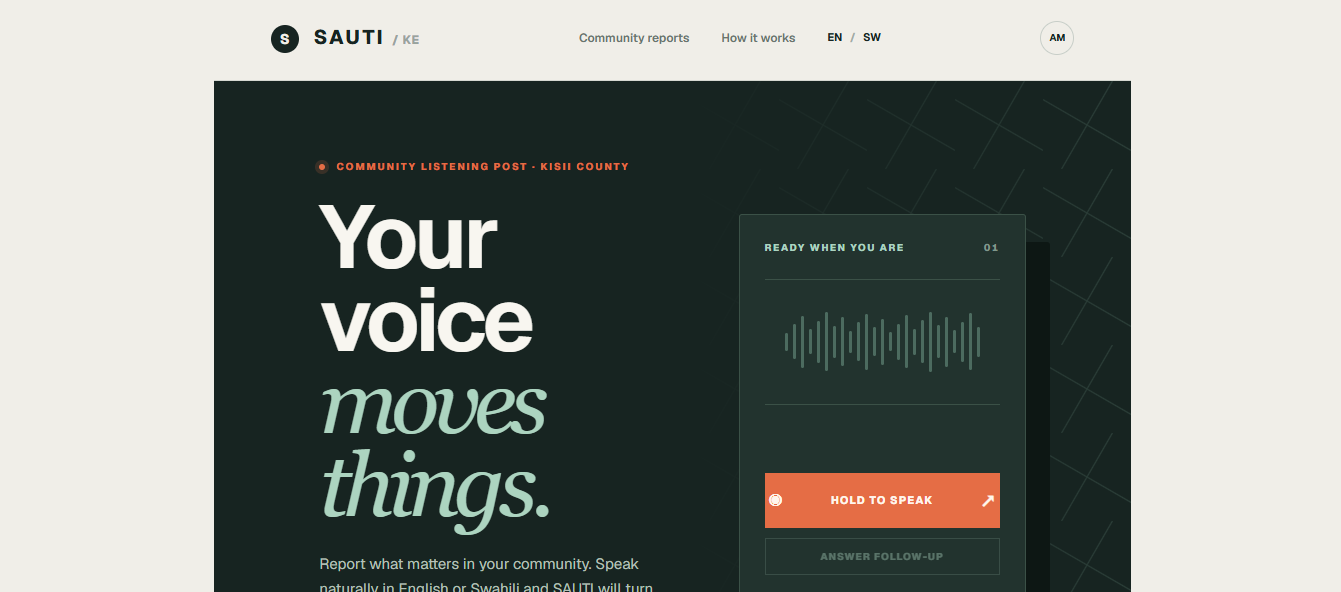
SAUTI AI KENYA
Inspiration
SAUTI AI Kenya was inspired by the need to make artificial intelligence more accessible to ordinary people, especially those who face language, literacy, connectivity, and digital-access barriers. Many people in Kenya have valuable questions and ideas but cannot fully benefit from digital platforms that depend on typing, reading, or using complex interfaces.
We wanted to build a voice-first AI assistant that allows users to communicate naturally using spoken language. The idea was inspired by everyday conversations in Kenya, where people use English, Kiswahili, and local languages to seek information, solve problems, and support their communities.
Our vision was to create an AI agent that listens, understands, responds, and helps users take meaningful action through voice.
What We Built
SAUTI AI Kenya is a voice-powered AI assistant designed to support users through natural spoken conversations. Users can ask questions, explain problems, or request guidance using their voice.
The system is designed to support practical use cases such as:
Agricultural advice and crop-related questions
Health information and basic guidance
Business and entrepreneurship support
Education and learning assistance
Access to digital information for underserved communities
Voice interaction in English and Kiswahili, with room for local-language expansion
For example, a farmer may ask a question such as:
“Ninawezaje kutibu ugonjwa wa mahindi?”
SAUTI AI can process the spoken question, understand the user’s intent, and provide a helpful response in a conversational format.
How We Built the Project
We approached the project as a voice-to-action AI agent. The main workflow consists of:
Capturing the user’s voice input.
Converting speech into text using speech-recognition technology.
Sending the transcribed message to an AI model for interpretation.
Generating a useful and context-aware response.
Converting the response into speech.
Presenting the answer to the user through a natural voice conversation.
We focused on creating an experience that feels simple and familiar, rather than requiring users to navigate complicated menus or type long messages.
The project was developed through teamwork, combining software development, AI integration, user-experience design, research, and product thinking. We also considered how the system could be adapted to Kenyan users and real community needs.
What We Learned
During the development process, we learned that building a voice AI agent involves more than connecting speech recognition to an AI model. A useful voice assistant must also consider:
Speech accuracy and different accents
Background noise and unclear audio
Language switching between English and Kiswahili
Response speed and conversation flow
Clear and understandable AI responses
User privacy and responsible handling of information
The importance of designing for people with different levels of digital literacy
We also learned the value of teamwork, rapid prototyping, testing, and continuously improving an idea based on user needs.
Challenges We Faced
One of the major challenges was ensuring that the system could understand different ways of speaking. Kenyan users may switch between English, Kiswahili, and local expressions during one conversation. This creates challenges for speech recognition, transcription, and response generation.
Another challenge was reducing the delay between the user speaking and receiving an answer. Voice applications must feel responsive to maintain a natural conversation.
We also faced challenges related to:
Integrating different AI and voice technologies
Handling inaccurate or incomplete transcriptions
Designing a simple user interface
Maintaining reliable conversations
Balancing innovation with limited development time
Ensuring that responses are useful, safe, and easy to understand
We addressed these challenges through testing, debugging, team collaboration, and refining the system architecture.
Our Impact
SAUTI AI Kenya is designed to reduce barriers between people and technology. By allowing users to communicate through voice, the project can support people who may struggle with traditional text-based applications.
Our goal is to make AI more inclusive and useful in everyday life, particularly in areas such as agriculture, healthcare, education, and small-business development.
Future Improvements
In the future, we plan to improve SAUTI AI Kenya by adding:
More Kenyan local languages
Better speech recognition for different accents
Offline or low-connectivity support
Integration with SMS and USSD services
More specialized AI agents for agriculture, health, and business
Voice-based form filling and service access
Stronger privacy and security features
Integration with trusted local information sources
Conclusion
SAUTI AI Kenya represents our effort to build technology that listens to people and responds in a way they understand. The project combines voice technology, artificial intelligence, and local problem-solving to create a more inclusive digital experience.
Through this hackathon, we gained practical experience in developing voice AI agents, working as a team, solving technical challenges, and transforming a community-focused idea into a working prototype. Our long-term goal is to continue improving SAUTI AI Kenya into a reliable voice-to-action platform for communities across Kenya and beyond.


Log in or sign up for Devpost to join the conversation.