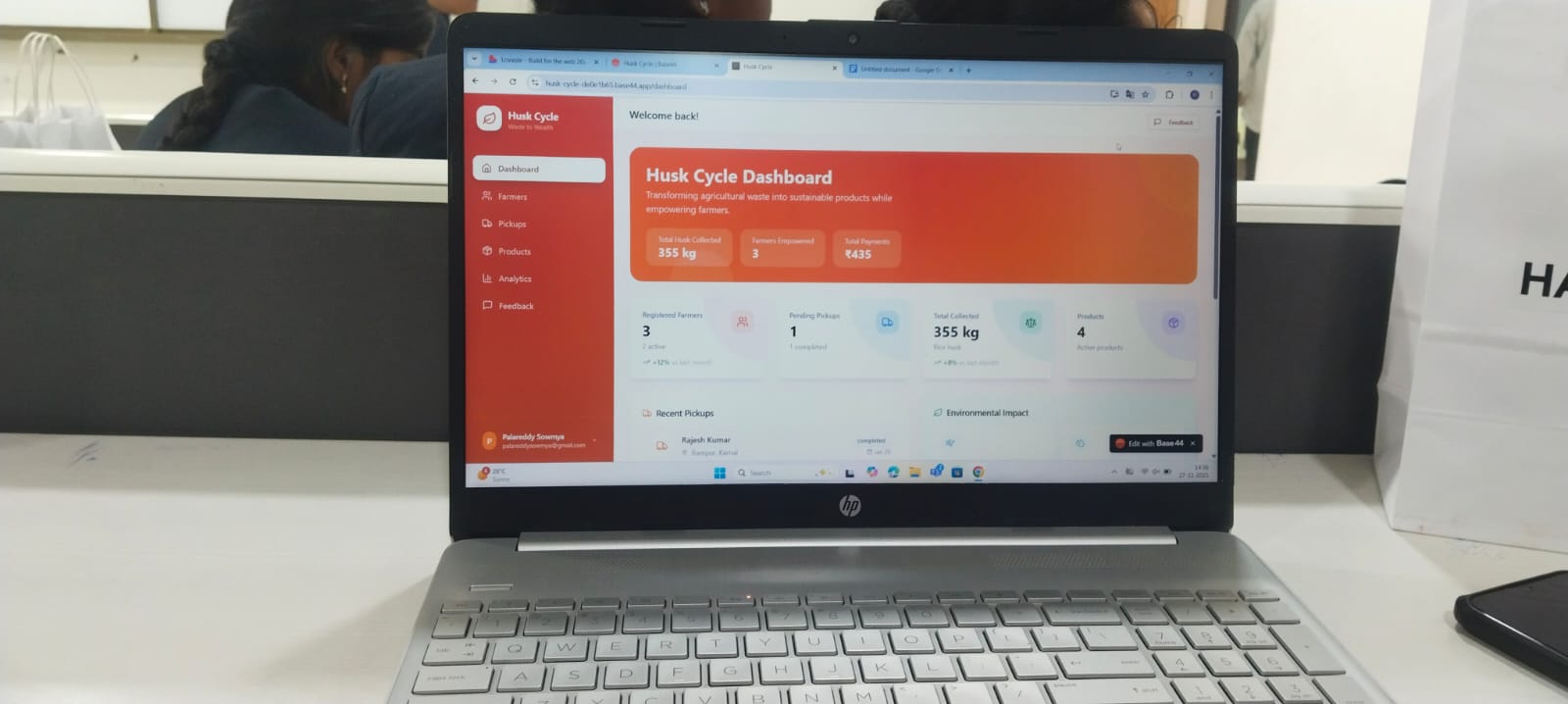

Inspiration
What it does
It reduces waste consumption
How we built it
By collaboration
Challenges we ran into
Accomplishments that we're proud of
What we learned
What's next for Husk cycle
Rice husk is the outer protective coating of a rice grain that’s removed during milling. Even though it’s considered a waste product, it’s actually a versatile biomass with a lot of useful properties.
What it is
- Made up of about 20 % silica, 30 % cellulose, 20 % lignin, and the rest water and trace minerals.
- Light, fluffy, and highly abrasive, with a low bulk density (around 0.1–0.2 g cm⁻³).
Common uses
- Energy – Burned as a renewable fuel in boilers, rice‑husk‑powered generators, and even small‑scale gasifiers. Its calorific value is roughly 14–16 MJ kg⁻¹.
- Construction – Incorporated into bricks, tiles, and concrete as a lightweight aggregate or filler, which improves insulation and reduces weight.
- Agriculture – Used as a mulch or soil amendment; when composted it adds organic matter and improves water retention.
- Bio‑char & activated carbon – Pyrolyzed rice husk becomes a high‑surface‑area bio‑char, useful for filtration, carbon sequestration, and soil remediation.
- Silica source – After burning, the ash (rice‑husk ash) is rich in amorphous silica, which is a raw material for making silicon, silica gel, and even solar‑grade silicon.
- Animal bedding – Its absorbent nature makes it a good bedding material for livestock.
- Composite materials – Ground husk can be mixed with polymers to create eco‑friendly particleboards or biocomposites.
Environmental points
- Because it’s a by‑product of rice production, using rice husk helps reduce waste and the need for landfill space.
- When combusted in controlled conditions, it can be carbon‑neutral (the CO₂ released is roughly the amount the rice plant absorbed while growing).
- Turning husk into bio‑char can sequester carbon in soils for long periods.
Processing basics
- Cleaning – Remove dust and stones.
- Drying – Reduce moisture to <10 % for most applications.
- Size reduction – Grinding or milling to the desired particle size.
- Thermal treatment – Depending on the end use, you might torrefy (mild heating), pyrolyze (no oxygen), or simply burn it.
In short, rice husk is far from “just waste”; it’s a low‑cost, renewable resource with applications ranging from building materials to high‑tech silicon production. If you have a particular use or industry you’re curious about, let me know and I can dive deeper!
Built With
- base44


Log in or sign up for Devpost to join the conversation.