-
-
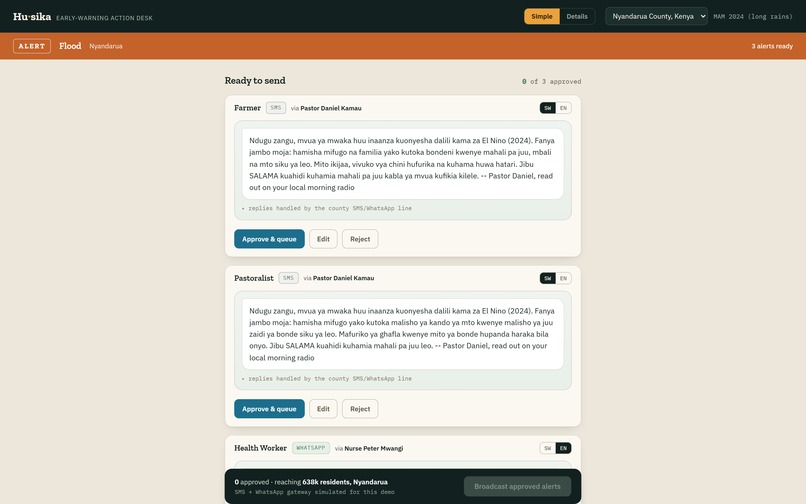
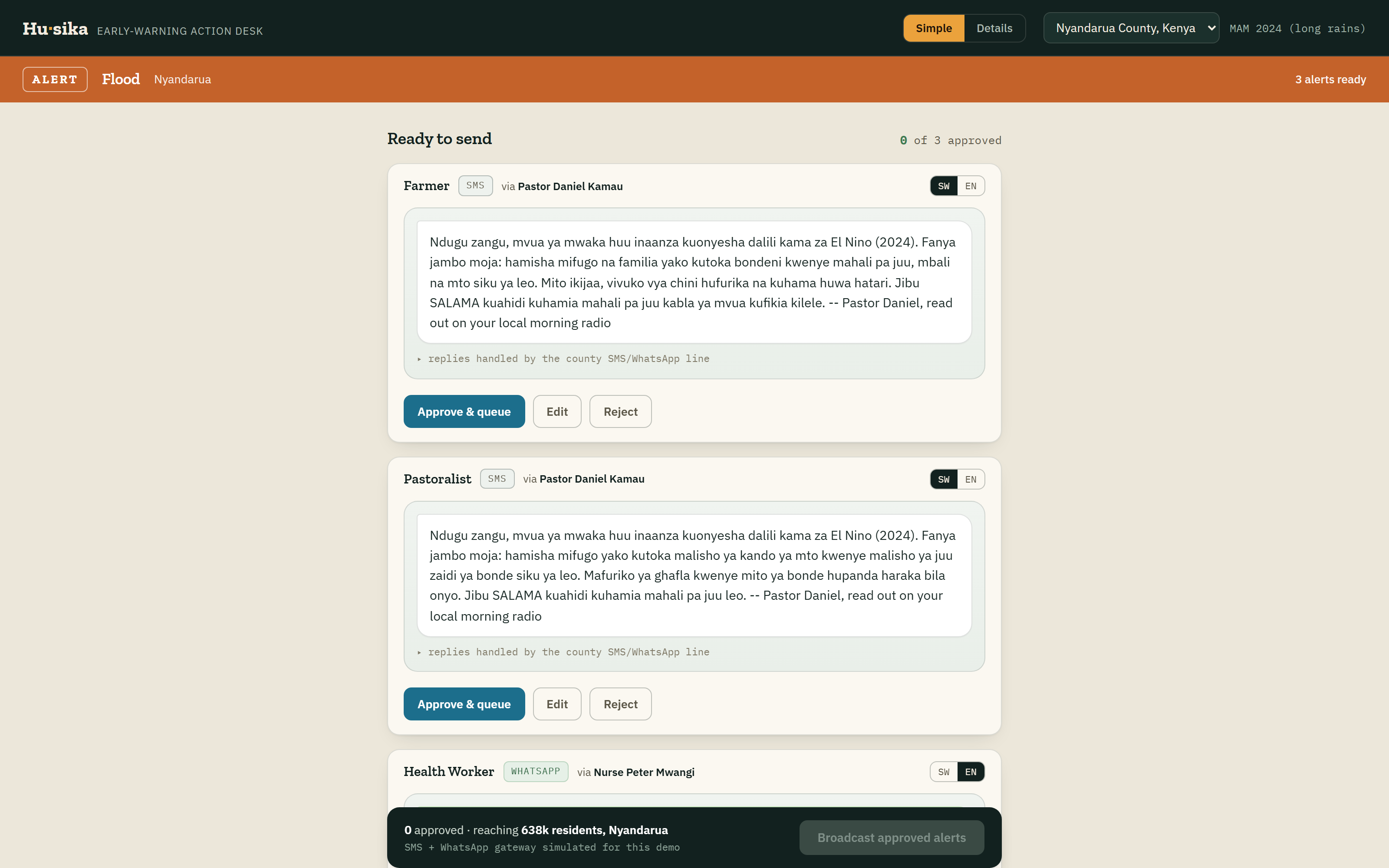
Nyandarua flood alert in Kiswahili: move family and animals to high ground, read out on local radio by a trusted pastor.
-
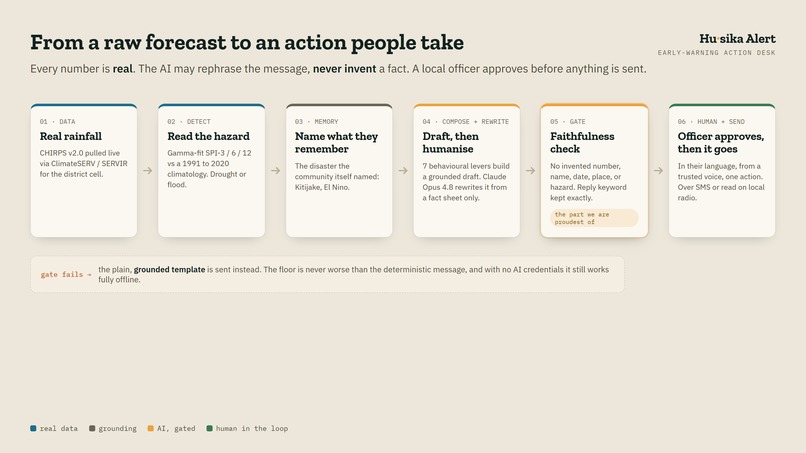
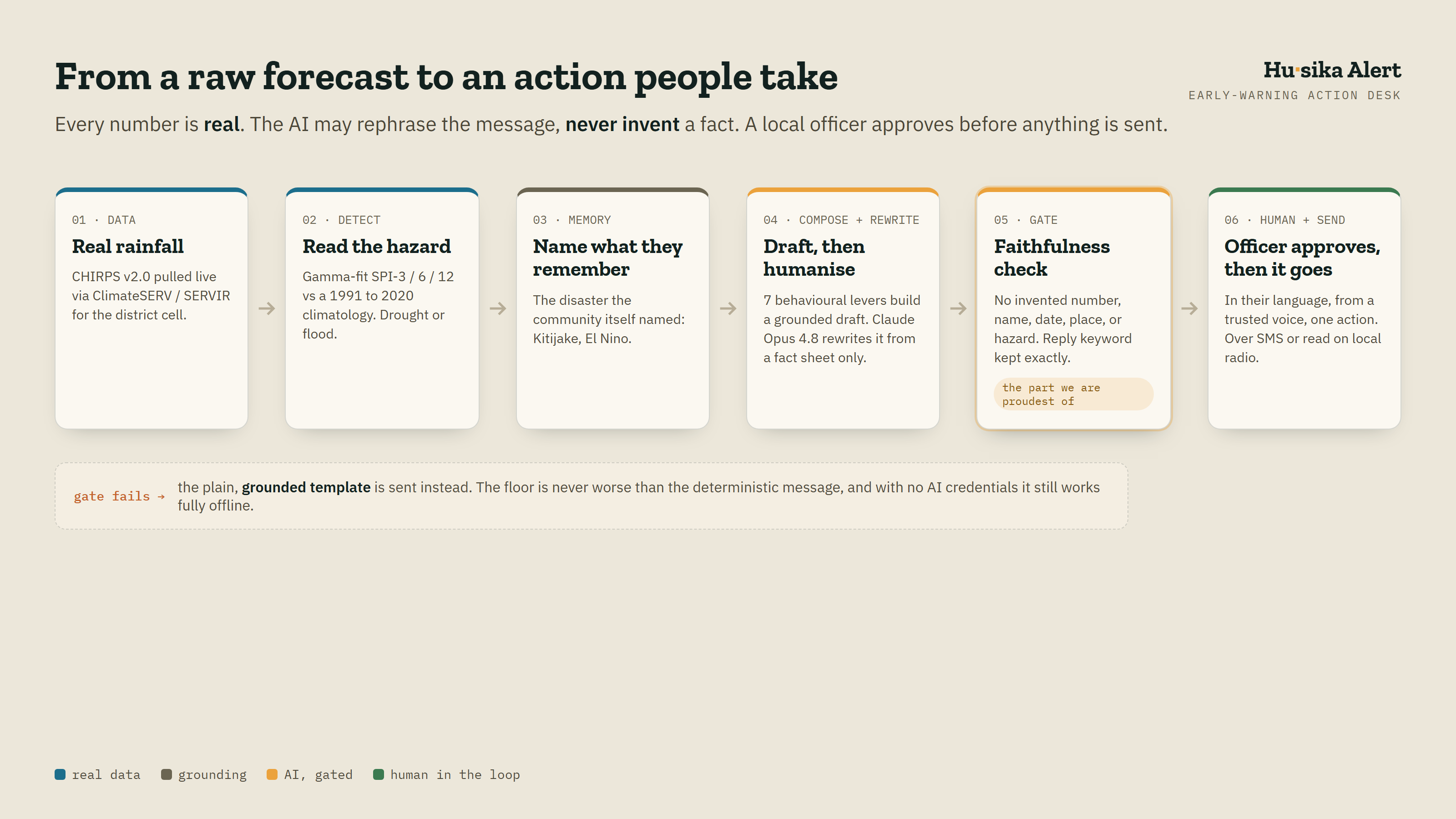
How it works: every number is real, the AI may rephrase but never invent, and a local officer approves before anything is sent.
-
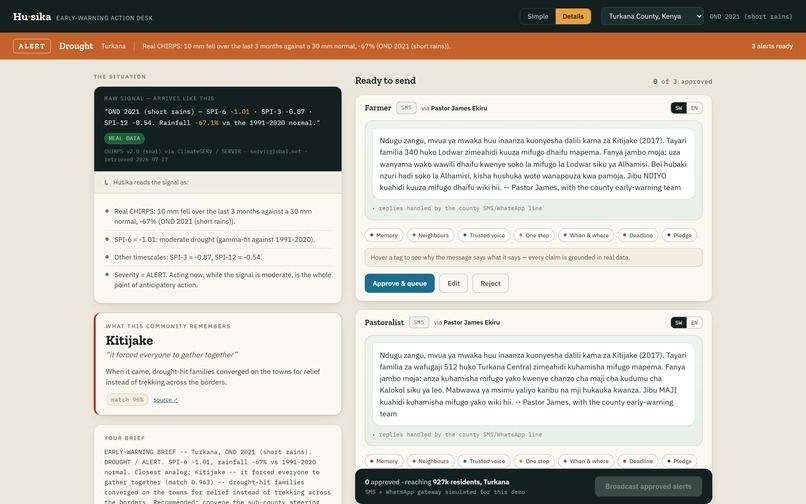
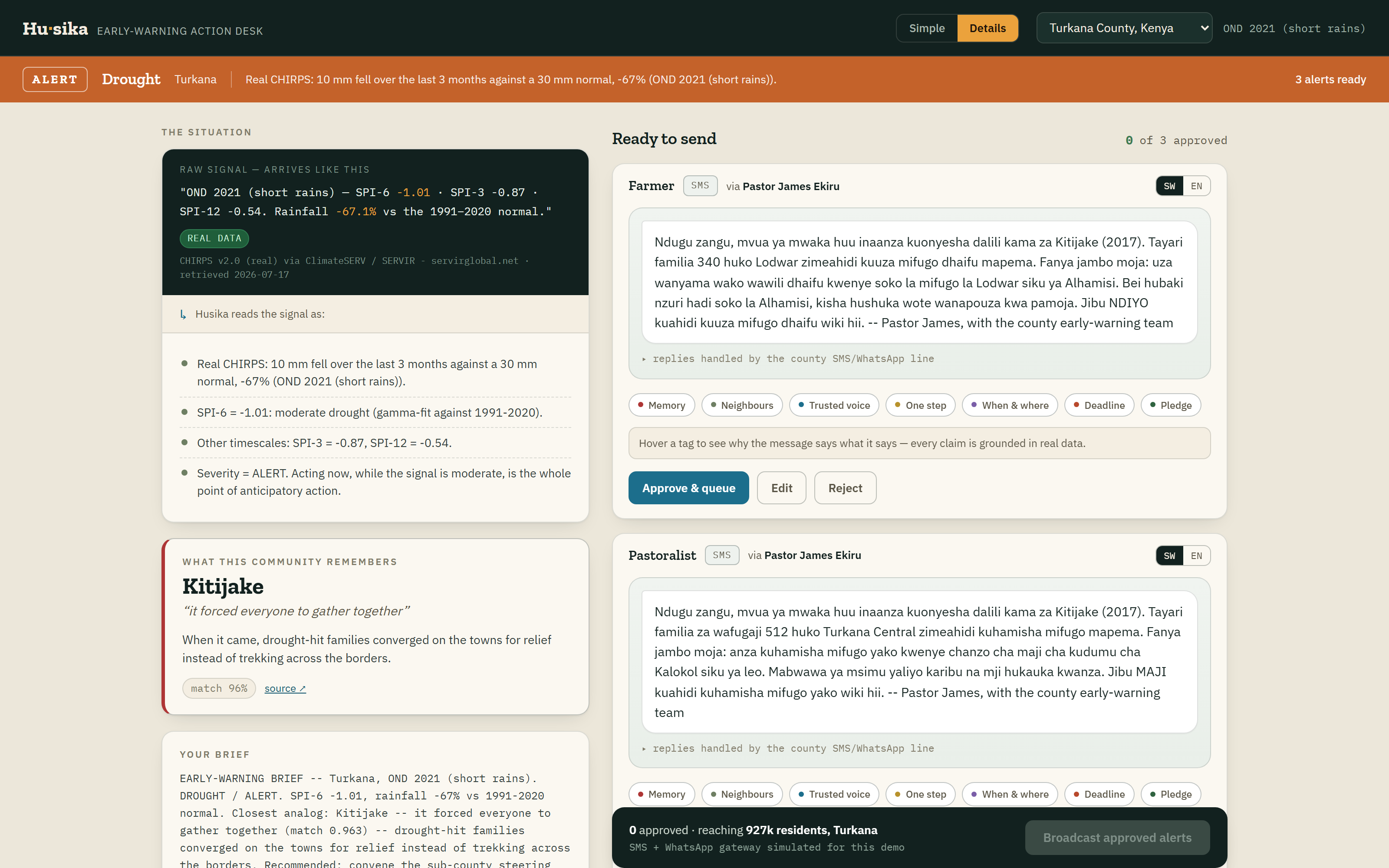
Turkana drought: the real CHIRPS signal and its source, the disaster the community named (Kitijake), and the 7 behavioural levers.
-
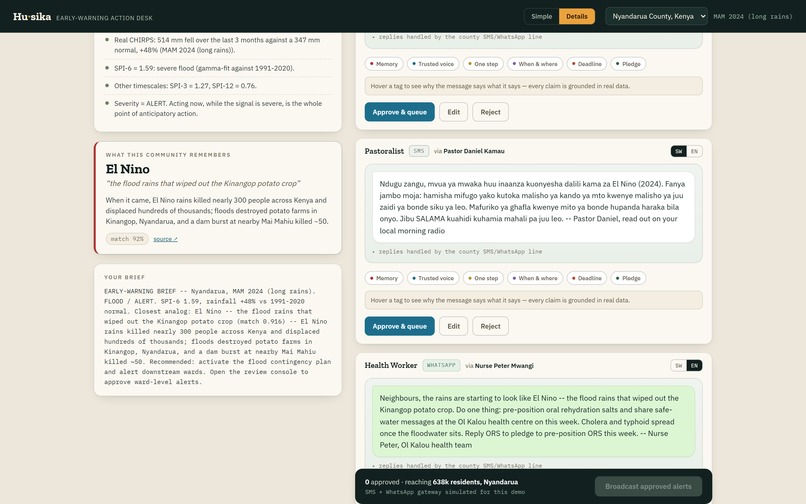
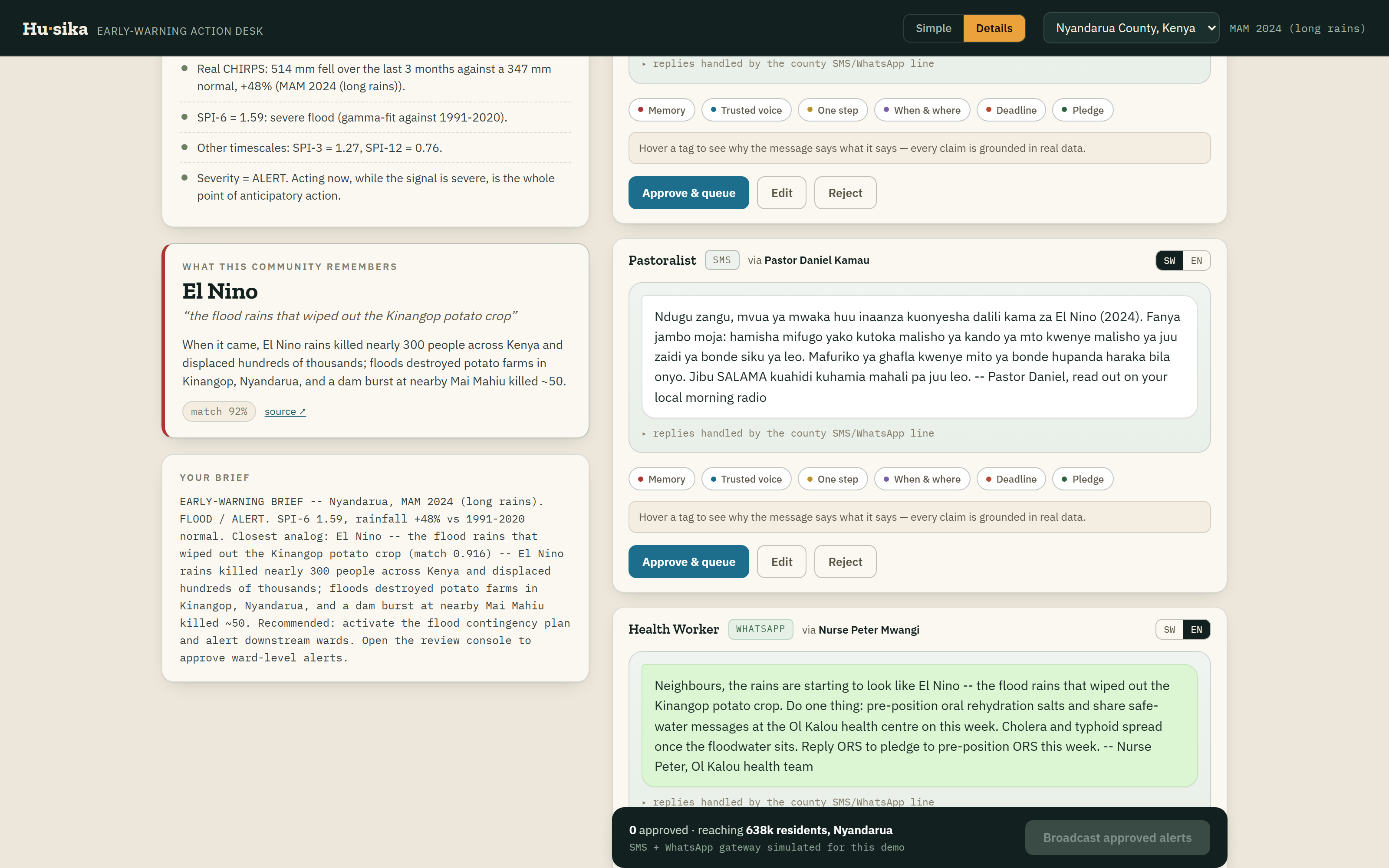
Nyandarua flood: the El Nino floods people remember, plus the English health-worker alert to pre-position ORS at the Ol Kalou clinic.
The problem: the last mile, not the forecast
ICPAC already forecasts well. People still lose everything. The gap is not the science, it is the last mile. A warning that reads "MAM 2024: SPI-6 +1.59, rainfall 48% above normal" cannot be acted on by a farmer in the Kenyan highlands or a herder in Turkana. ICPAC says it plainly: the job is to "turn forecasts into meaningful messages that drive timely action."
What Husika Alert does
Husika Alert reads real CHIRPS rainfall for a district, detects the hazard, and rewrites the warning as a message one specific person will act on: in their language, from a voice they trust, with one thing to do. Nothing is sent until a county officer approves it.
It uses what actually moves people:
- It names the disaster the community itself names. For Turkana, not "the 2017 drought" but Kitijake, "it forced everyone to gather together." For the Nyandarua highlands, the flood rains people call El Nino.
- It carries a real, counted number of neighbours who already pledged to act, counted from replies, never claimed.
- It comes from a trusted local voice, a pastor read out on local radio. 76 percent of sub-Saharan Africa trusts faith leaders; 44 percent trusts government.
- It asks for one thing, at a named place, on a named day, before a deadline.
Two real places, two real hazards
Turkana (drought). Real CHIRPS, OND 2021: 10mm against a 30mm normal, SPI-6 of -1.01. The alert fires while the signal is still moderate, when selling two weak goats is still a choice and not a loss.
Nyandarua / Kipipiri (flood). This scenario was built with Georges Njuguna, a farmer in Kipipiri, who told us what the data alone cannot: the danger in his highlands is too much rain, the 2024 El Nino floods wiped out the Kinangop potato crop, and the one thing people do is move animals and family from the low ground to high ground before the rivers rise. He also told us the hardest truth, that for the crop in the field there is no protection, so the alert never pretends otherwise. He added that the meteorological department's forecasts are not always accurate for their area, which is part of why the warning here travels through a trusted local voice on the radio. Real CHIRPS, MAM 2024: SPI-6 of +1.59, rainfall 48 percent above normal.
How it is built, and why you can trust it
Data, real not mocked. CHIRPS v2.0 via ClimateSERV's public API, 1991 to present for the district's cell, aggregated to dekads and months, with a 1991 to 2020 climatology and a gamma-fit SPI-3, SPI-6 and SPI-12. Every figure traces to that pull.
Memory. A catalogue of locally named disasters across all eight IGAD states, each one sourced.
Composition. Seven behavioural levers assemble a grounded draft. Claude Opus 4.8 then rewrites it from a fact sheet: the only facts it is allowed to use.
The guardrail we are proudest of. That rewrite is a proposal, not a result. It must pass an automated faithfulness check: no invented numbers, the reply keyword and the disaster name and the neighbour count kept exactly, no hazard drift, still short enough for SMS, or the grounded template ships instead. With no AI credentials it works fully offline, which is the posture last-mile early warning actually needs.
Extends Husika
This extends Husika, ICPAC's own last-mile early-warning service built by Bunifu. Husika solved delivery. We add the layer that makes the message land: memory, trust, and a single easy step.


Log in or sign up for Devpost to join the conversation.