When a major hurricane strikes, humanitarian funding decisions must be made quickly, while critical information is still fragmented across reports, dashboards, and spreadsheets. Although the United Nations produces detailed disaster assessments outlining affected populations, decision-makers lack a unified way to translate this information into actionable funding scenarios. As a result, high-severity areas can remain underfunded, while resources become concentrated in lower-impact sectors. These imbalances are difficult to detect in advance and are usually identified only after a response has concluded, when opportunities to improve outcomes have already passed. HurriCare was created to address this gap.
What it Does
HurriCare invites users to step into the role of a decision-maker. In the first stage of the simulation, users allocate limited resources across regions and humanitarian sectors, such as shelter, health, food security, and WASH, based on their own judgment. This “player” phase reflects the real conditions under which funding decisions are made. The gamified interface lowers the barrier to experimentation, and encourages users to test assumptions and explore alternative strategies without real-world risk.
Core Features
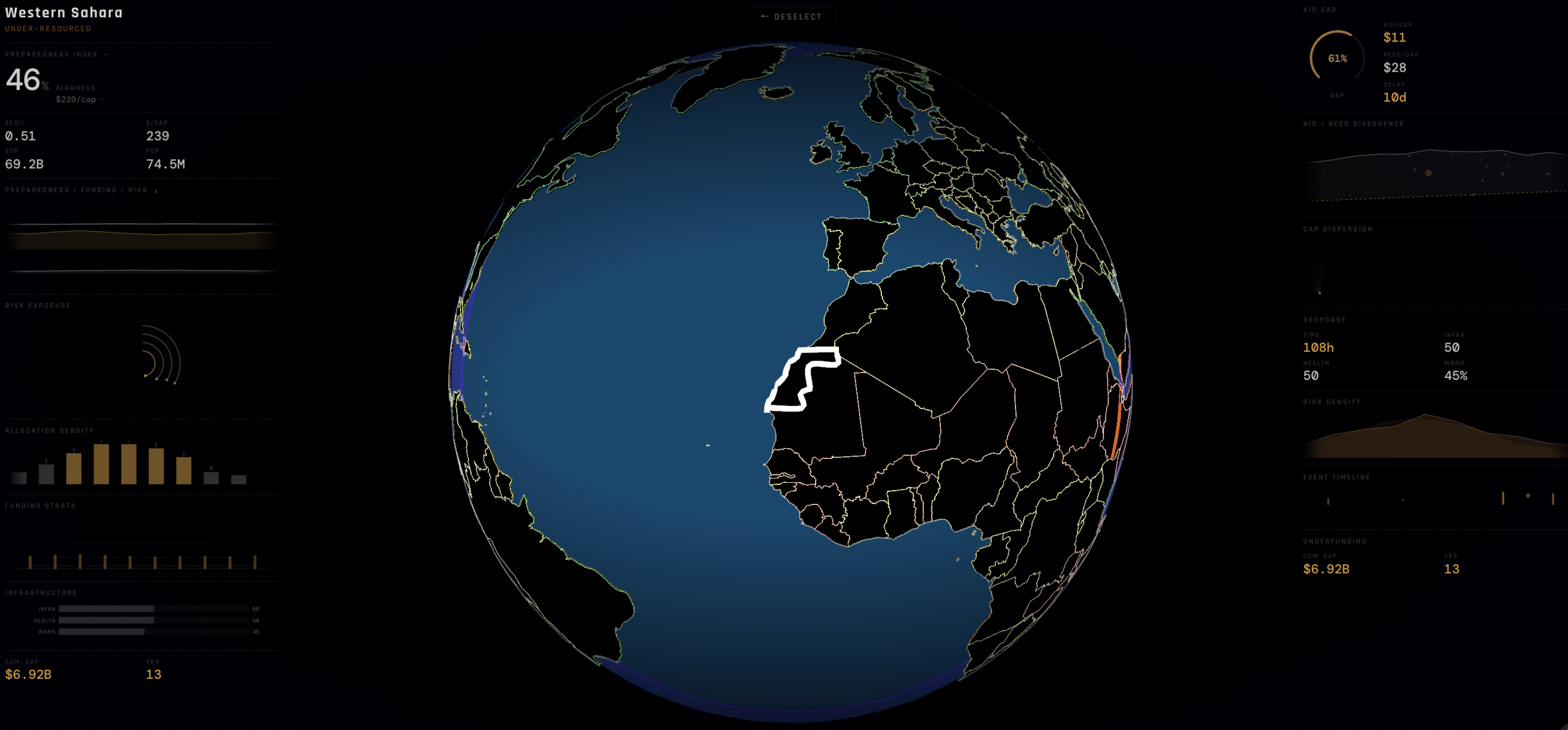
3D Interactive Globe
Visual exploration of hurricane tracks, impacted regions, and disparities in resources and funding.Funding Disparity Map
Geospatial visualization of mismatches between humanitarian need and resource allocation.Hurricane Response Plans
ML-driven ideal response plans tailored to hurricane characteristics.Data Visualization Analytics (SphynxAI)
Dynamic visualizations of impacted regions, funding disparities, and humanitarian need, accompanied by natural-language explanations.Voice-Based Narrative Agents (ElevenLabs)
AI voice agents provide immersive, human-centered context by narrating personal accounts from affected individuals with each hurricane scenario.Simulation & Comparison Framework
Compare user-designed, ML-generated, and historical allocation strategies.
Step 1
Once a user-designed plan is submitted, HurriCare introduces a second perspective: an ML-derived ideal allocation. This model generates a transparent, needs-based benchmark informed by severity indices, population exposure, and humanitarian best-practice principles. By presenting this idealized plan alongside the user’s choices, the platform creates an immediate point of comparison.
Step 2
The final stage grounds the simulation in reality. HurriCare overlays the historical, real-world funding response that followed the selected hurricane. This comparison completes the learning loop. Users can see not only how their decisions differ from an optimized benchmark, but also how both compare to what actually occurred, where funding fell short, where it exceeded need, and which regions or sectors were consistently under-served.
Step 3
Throughout the process, animated hurricane tracks provide temporal context, choropleths and coverage layers expose regional disparities, and side-by-side simulation comparisons make tradeoffs immediately visible. By allowing users to manipulate inputs and observe outcomes in real time, HurriCare supports exploratory analysis rather than passive consumption of data. A final end dashboard includes natural-language explanations of all visualized data to reduce cognitive load.
Technical Stack
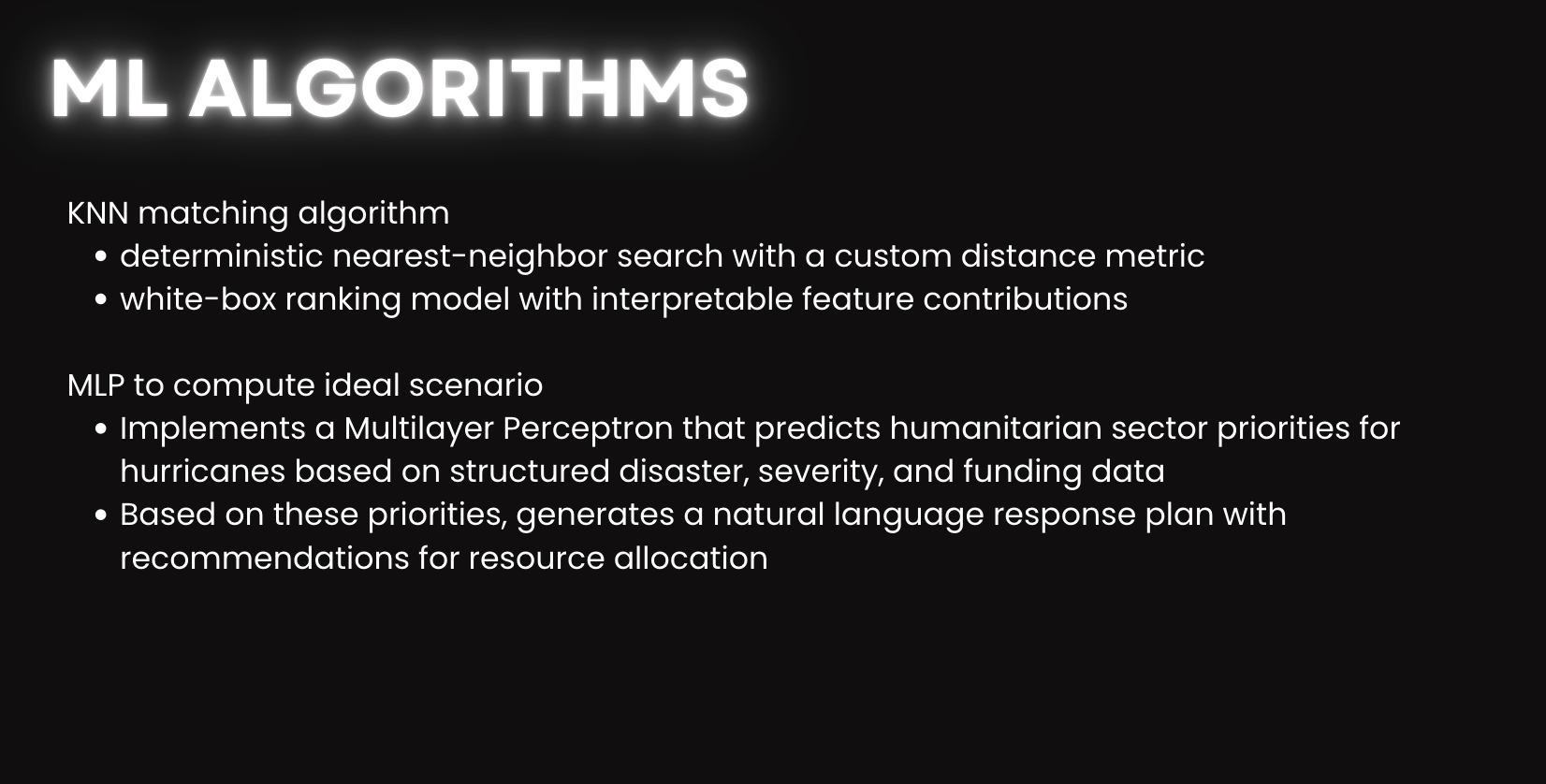
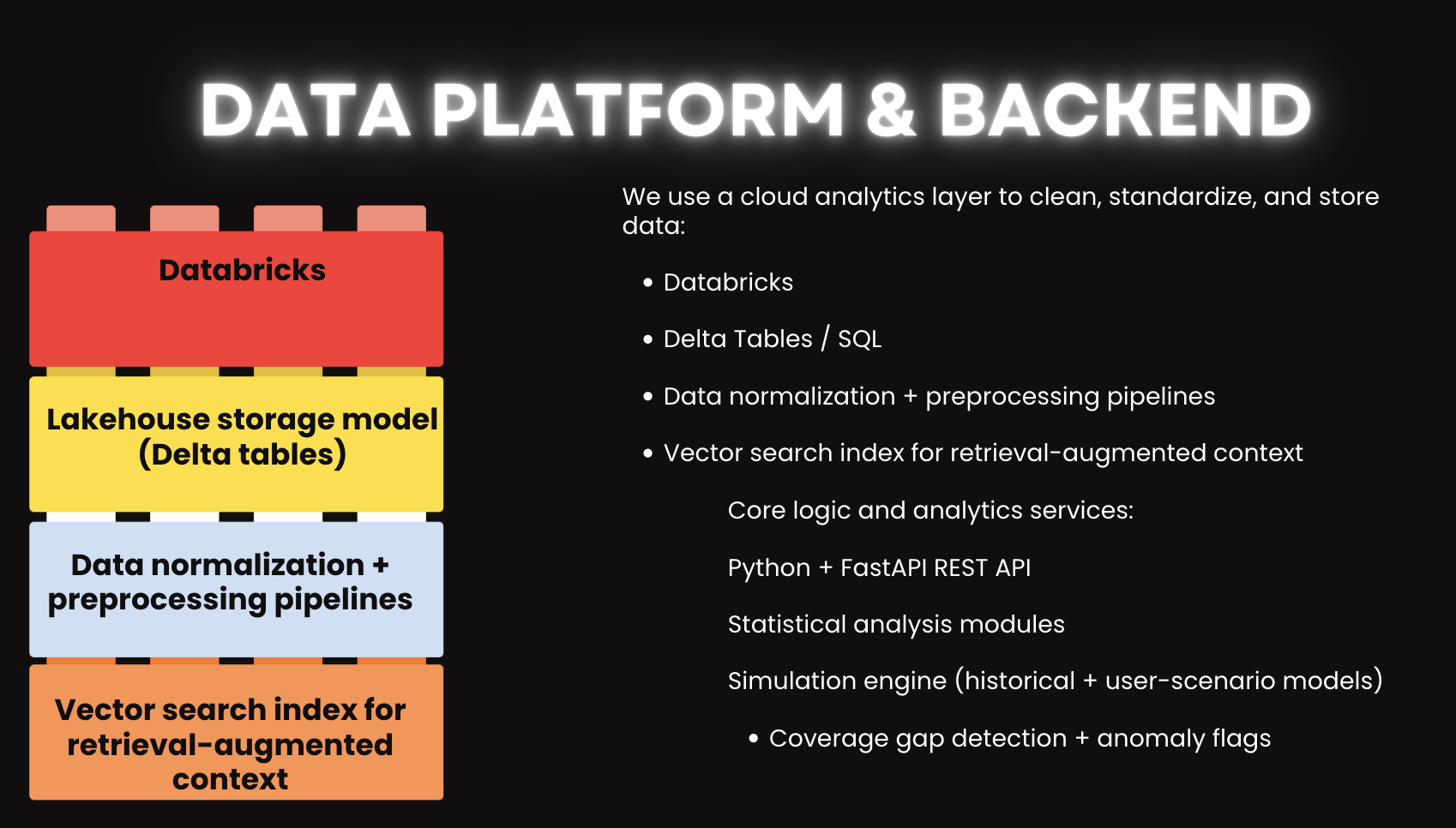
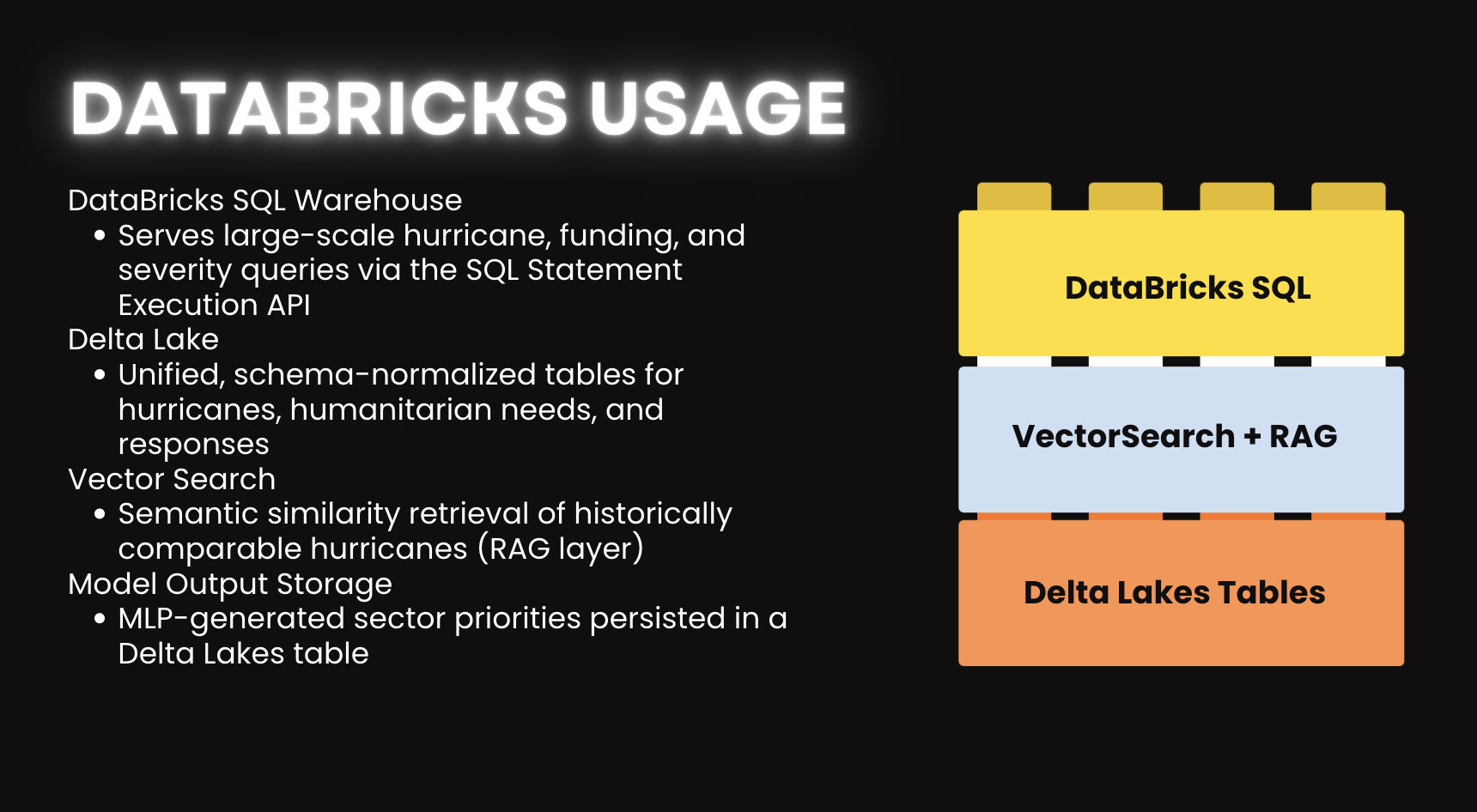
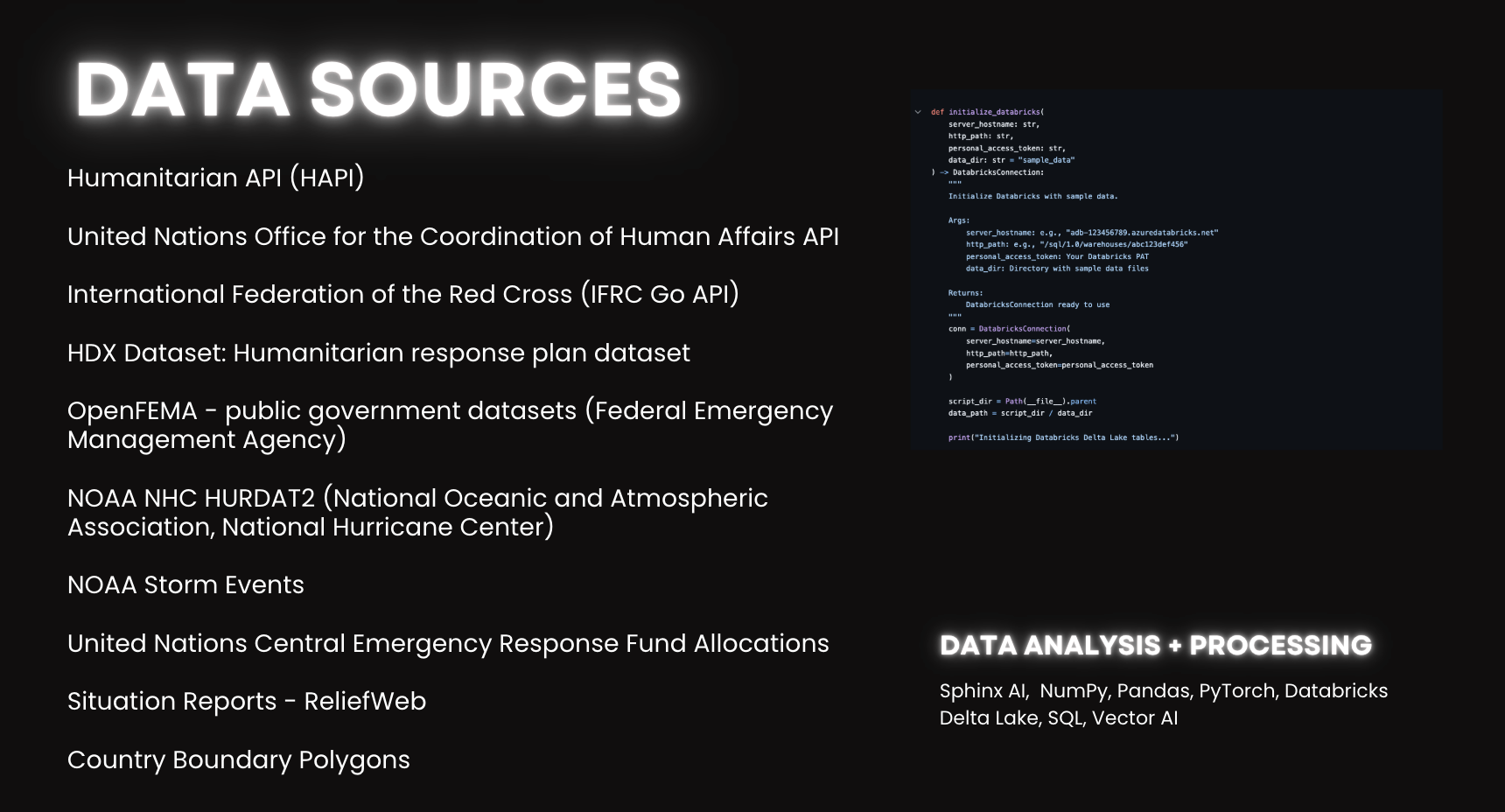
HurriCare uses a React frontend for interactive geospatial visualization and gameified scenario design, paired with a Python backend that handles data processing, simulation, and machine learning. The backend leverages NumPy, Pandas, and SQL on Databricks Delta Lake for scalable analytics, alongside Vector AI with a KNN-based deterministic nearest-neighbor algorithm to perform white-box ranking with interpretable feature contributions. Machine learning components are implemented in PyTorch, including an MLP that predicts humanitarian sector priorities from disaster and severity data, while Sphinx AI converts these outputs into grounded natural-language response plans.
Built With
- databricks
- javascript
- python
- sphinx
- sql
- typescript
- vector-ai


Log in or sign up for Devpost to join the conversation.