-
-
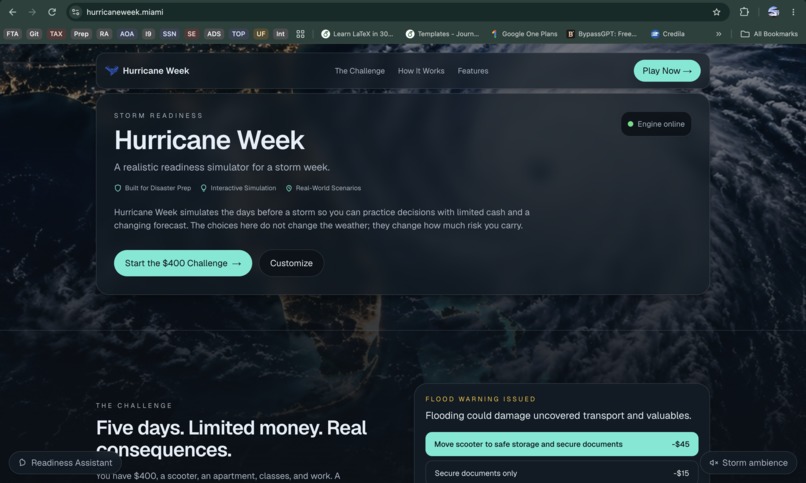
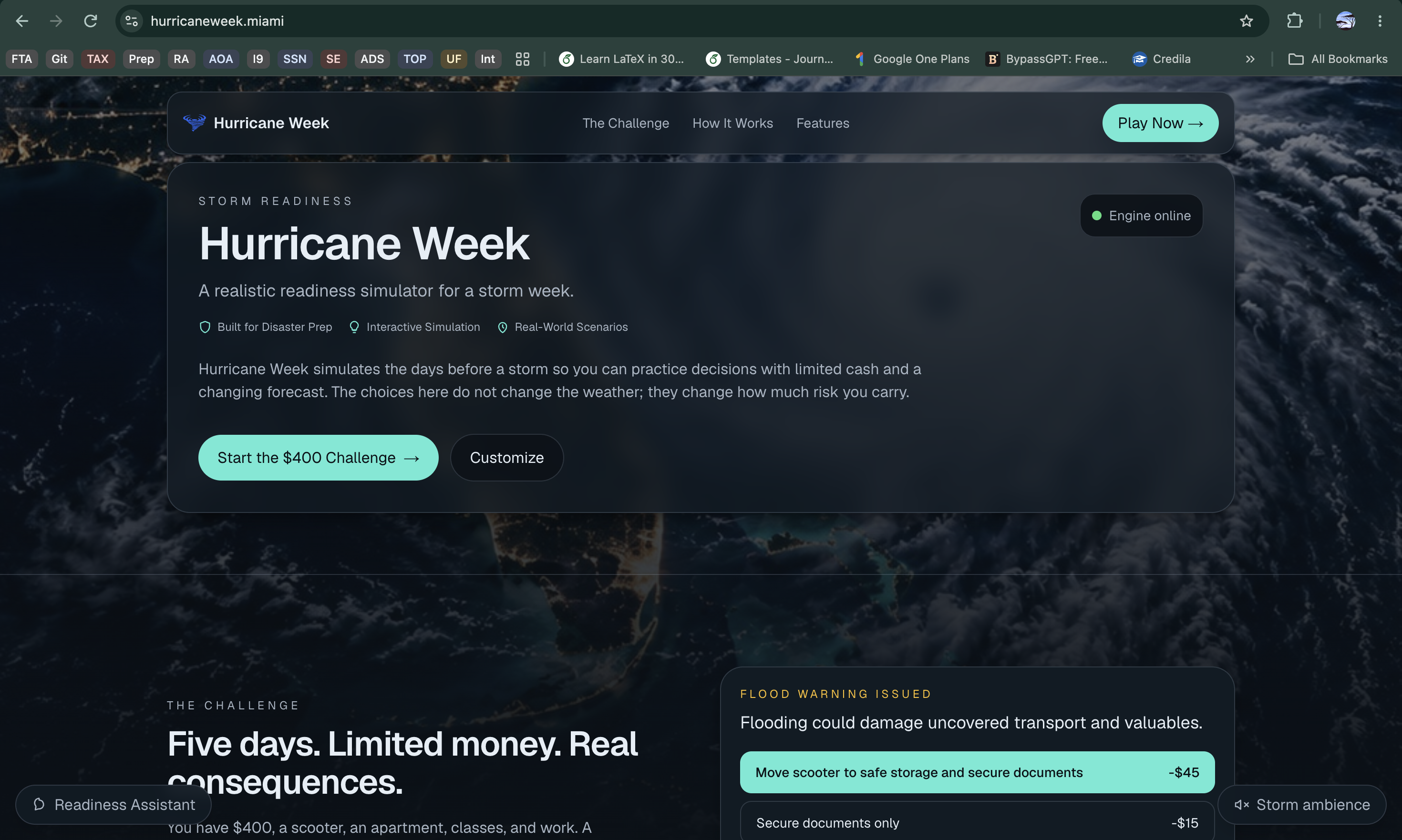
Hurricane Week turns NOAA’s 120-hour advisory window into an interactive preparedness challenge at hurricaneweek.miami, on DigitalOcean.
-
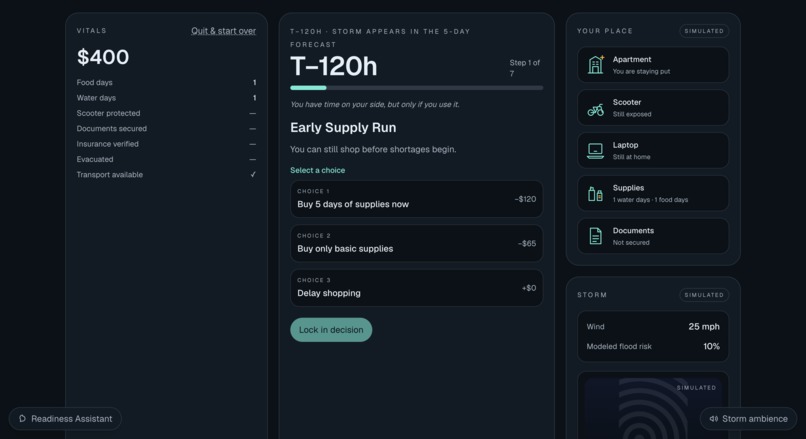
Every decision has a cost and a consequence, tracked live.
-
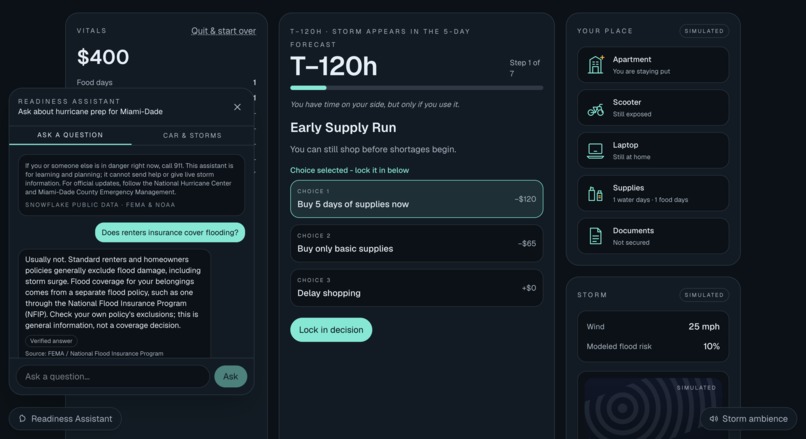
Readiness answers retrieved from FEMA/NOAA preparedness facts via Snowflake Cortex.
-
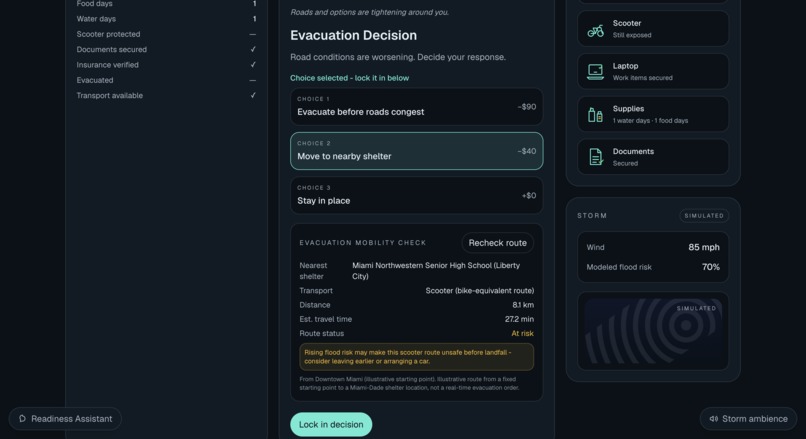
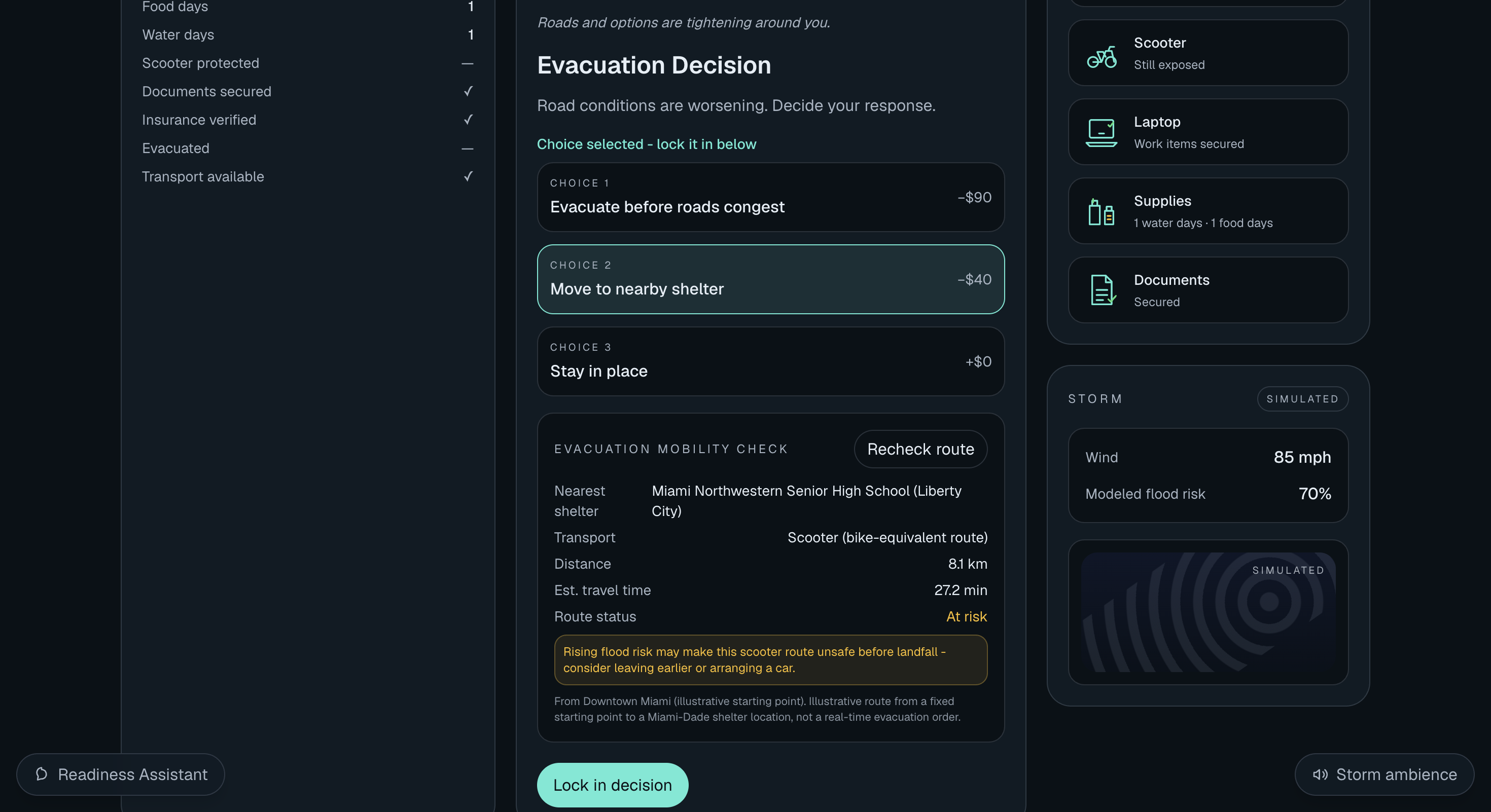
Real routing data flags when your transport can't outrun the flood risk before landfall.
-
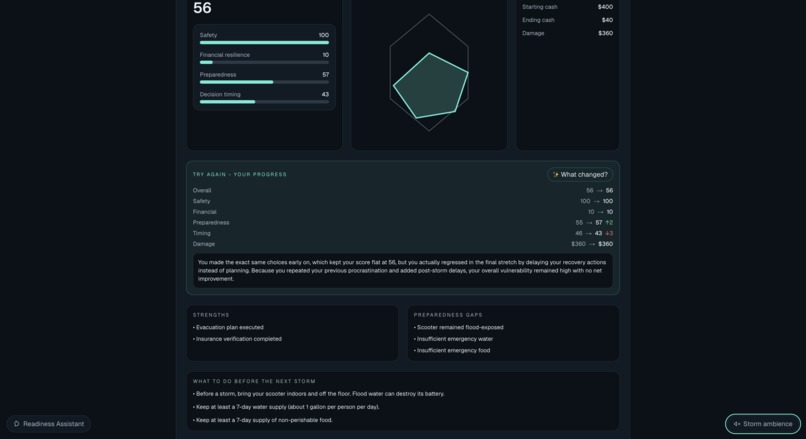
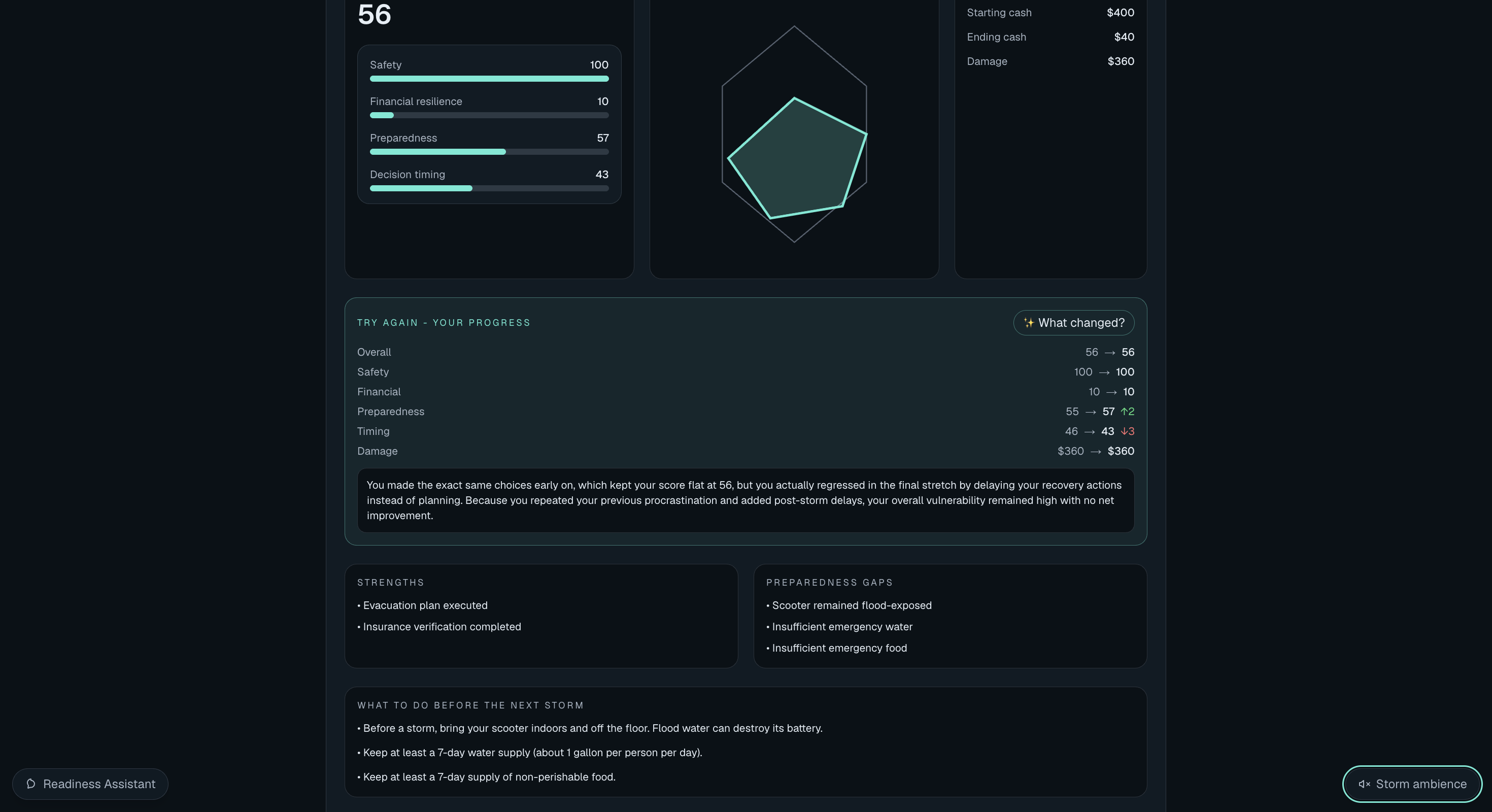
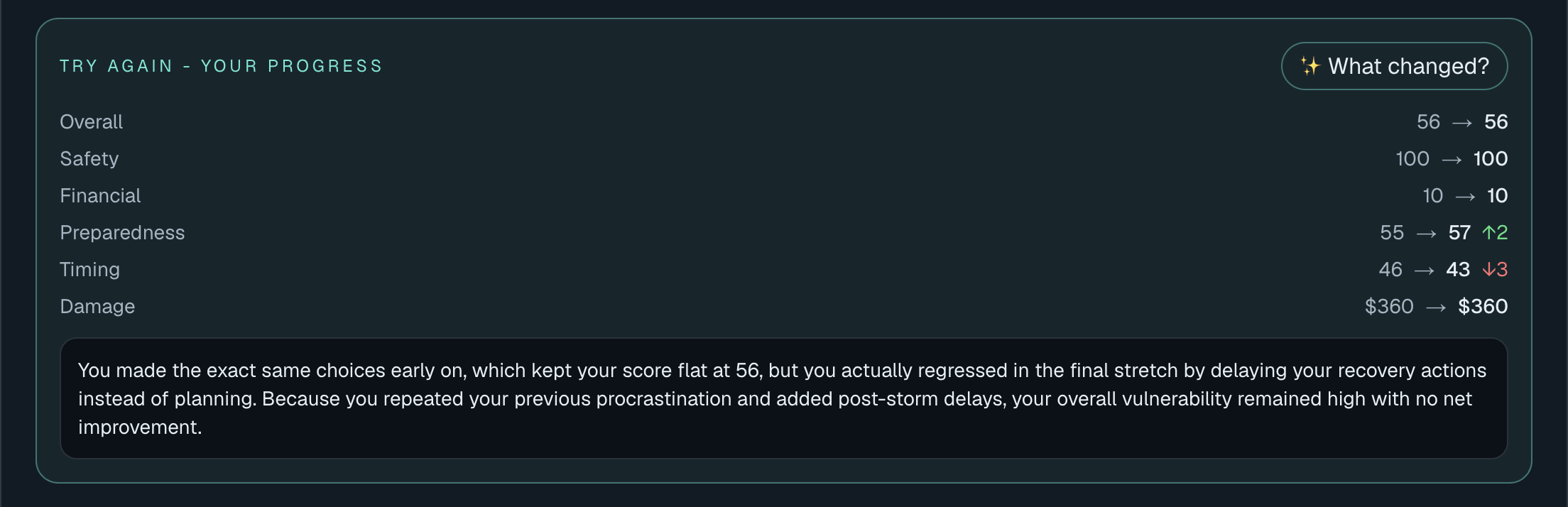
Compare runs and see exactly what changed - plus Gemini's take on your biggest mistake and best call.
-
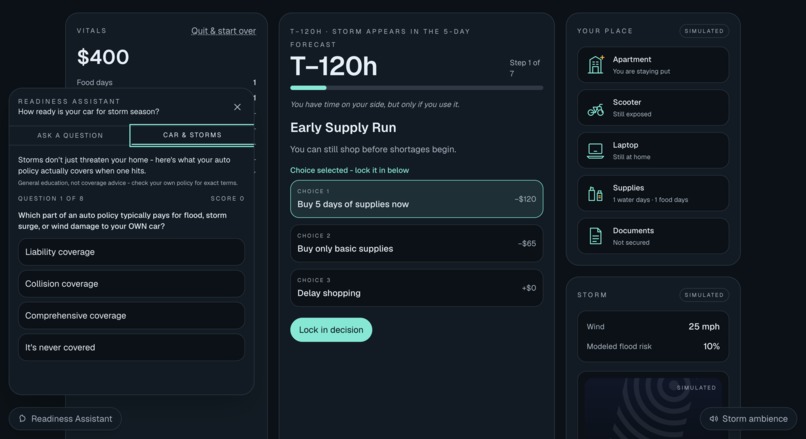
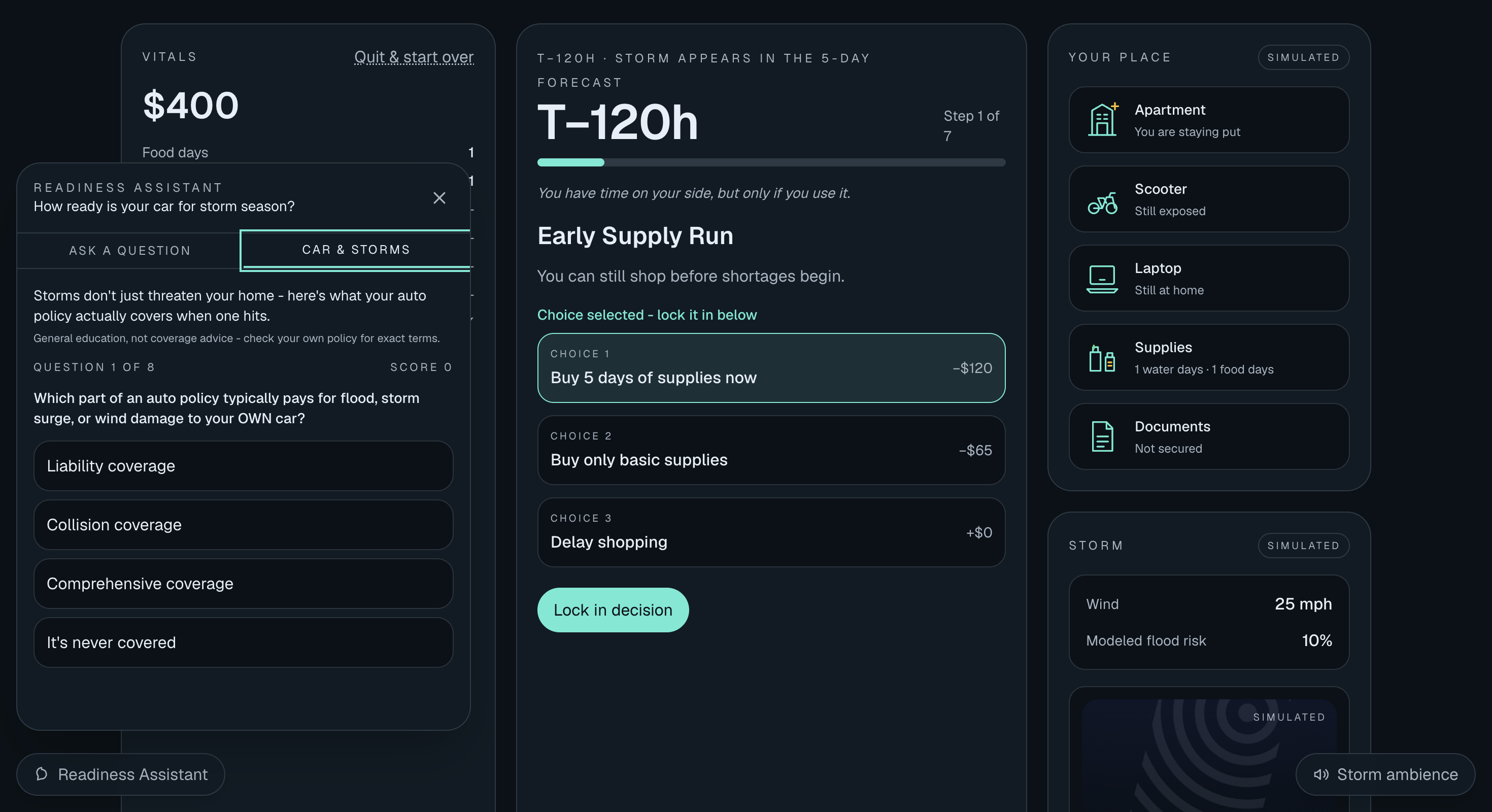
A gamified auto insurance quiz teaches real storm coverage - while AI-generated ambient audio builds tension as landfall nears.
-
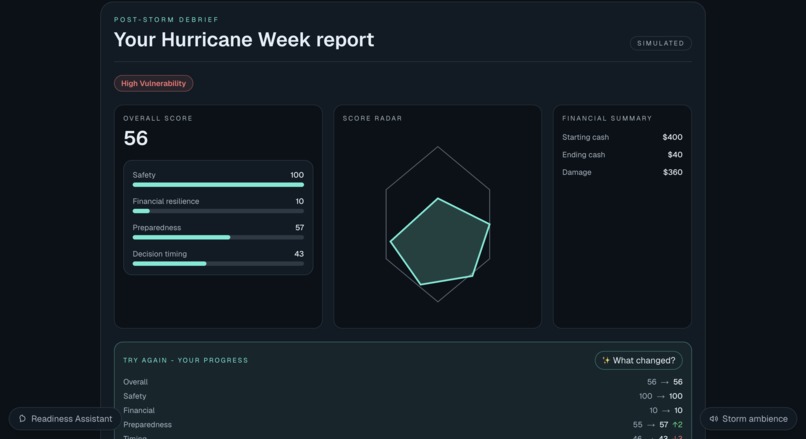
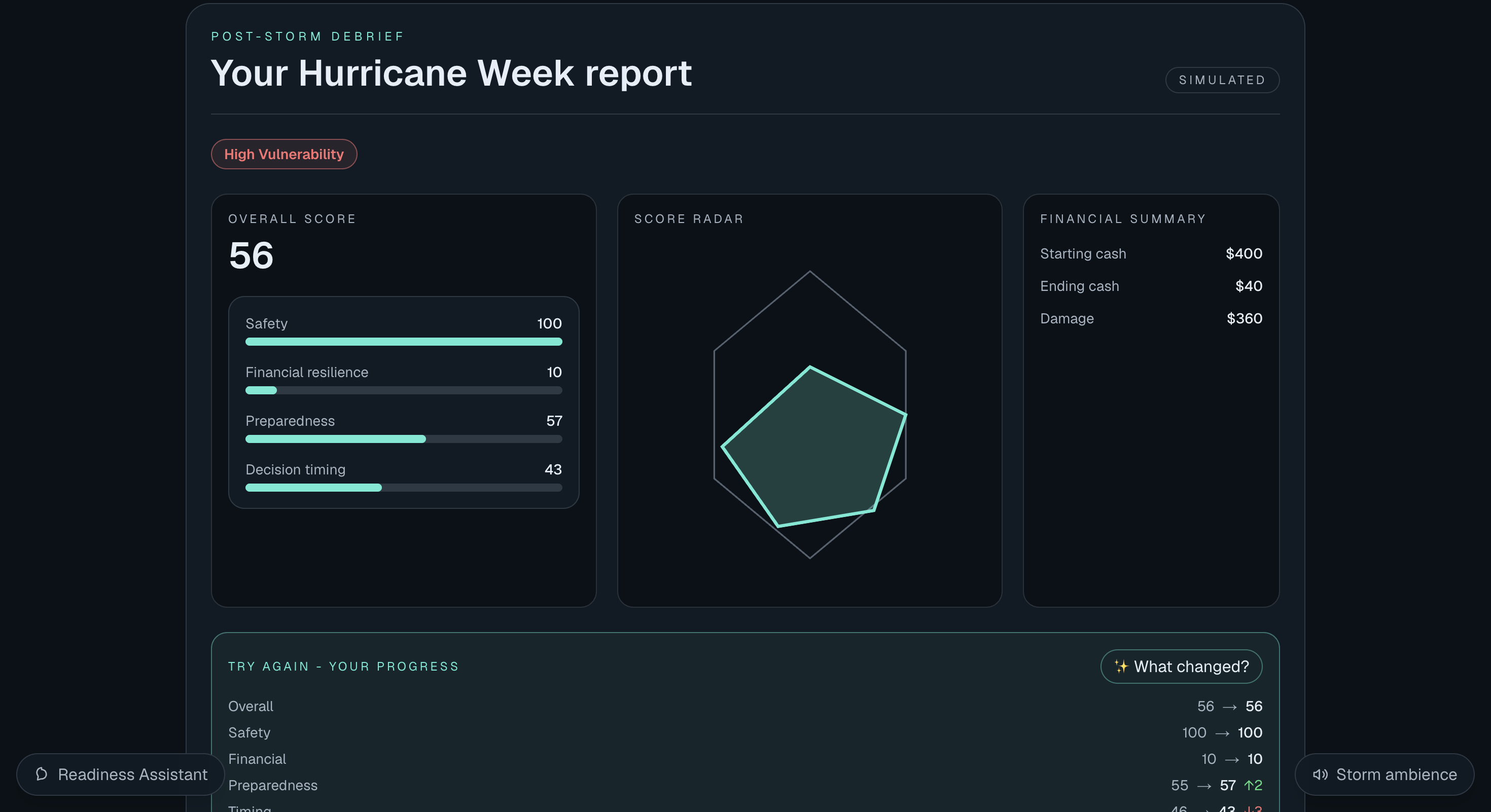
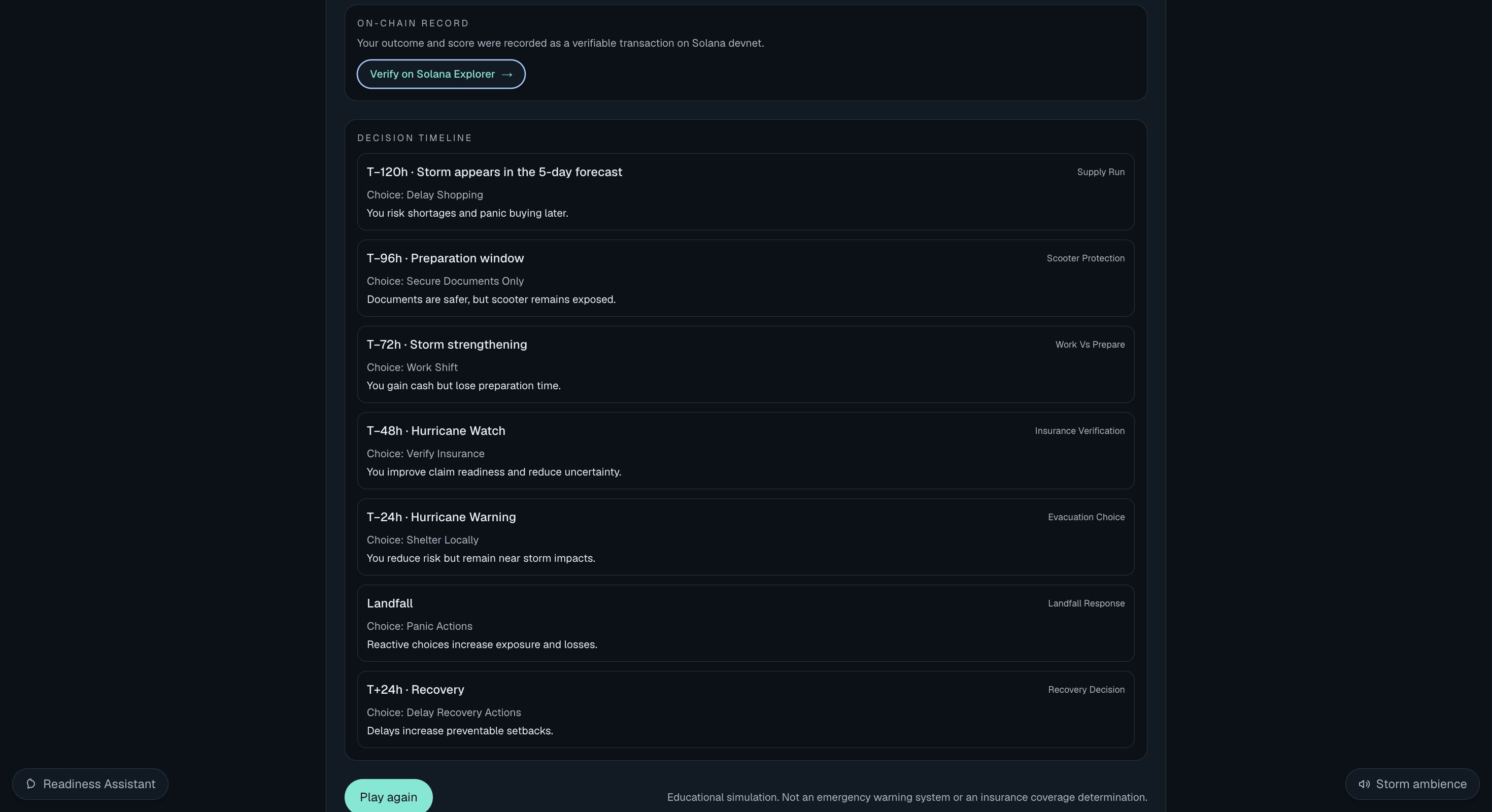
Overall score, safety, financial resilience, preparedness, and decision timing - one glance at your storm week.
-
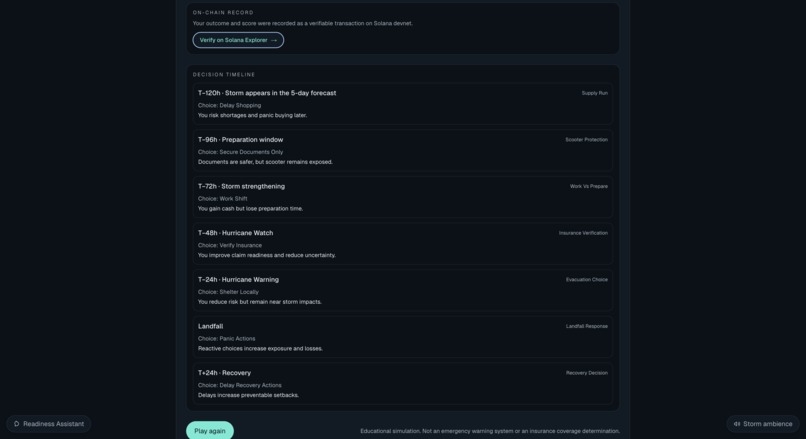
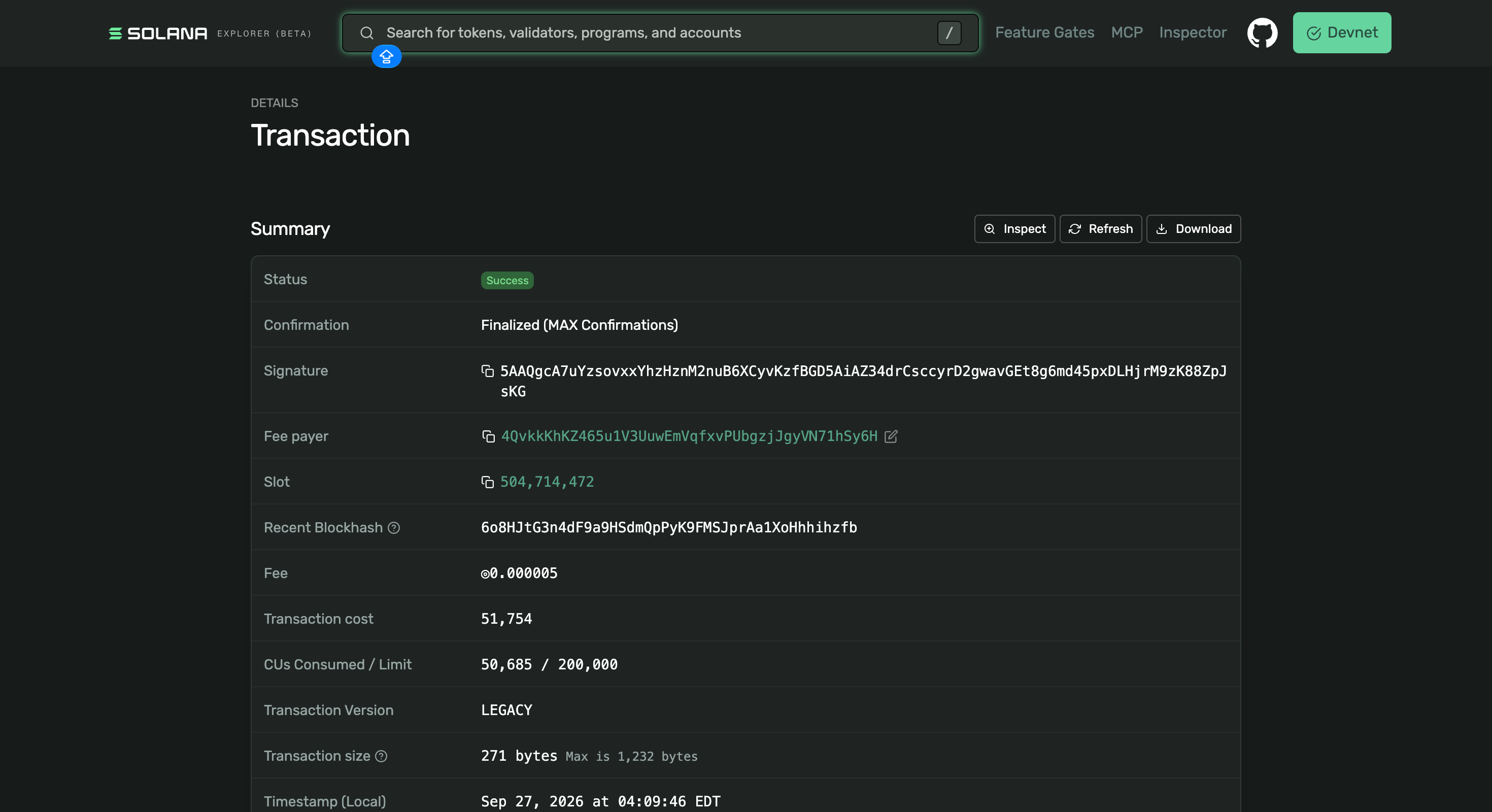
Every decision, on-chain: your outcome verified as a real Solana devnet transaction.
-
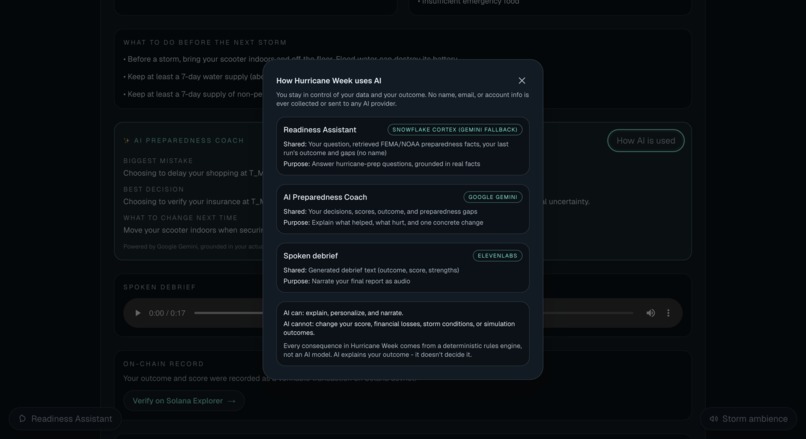
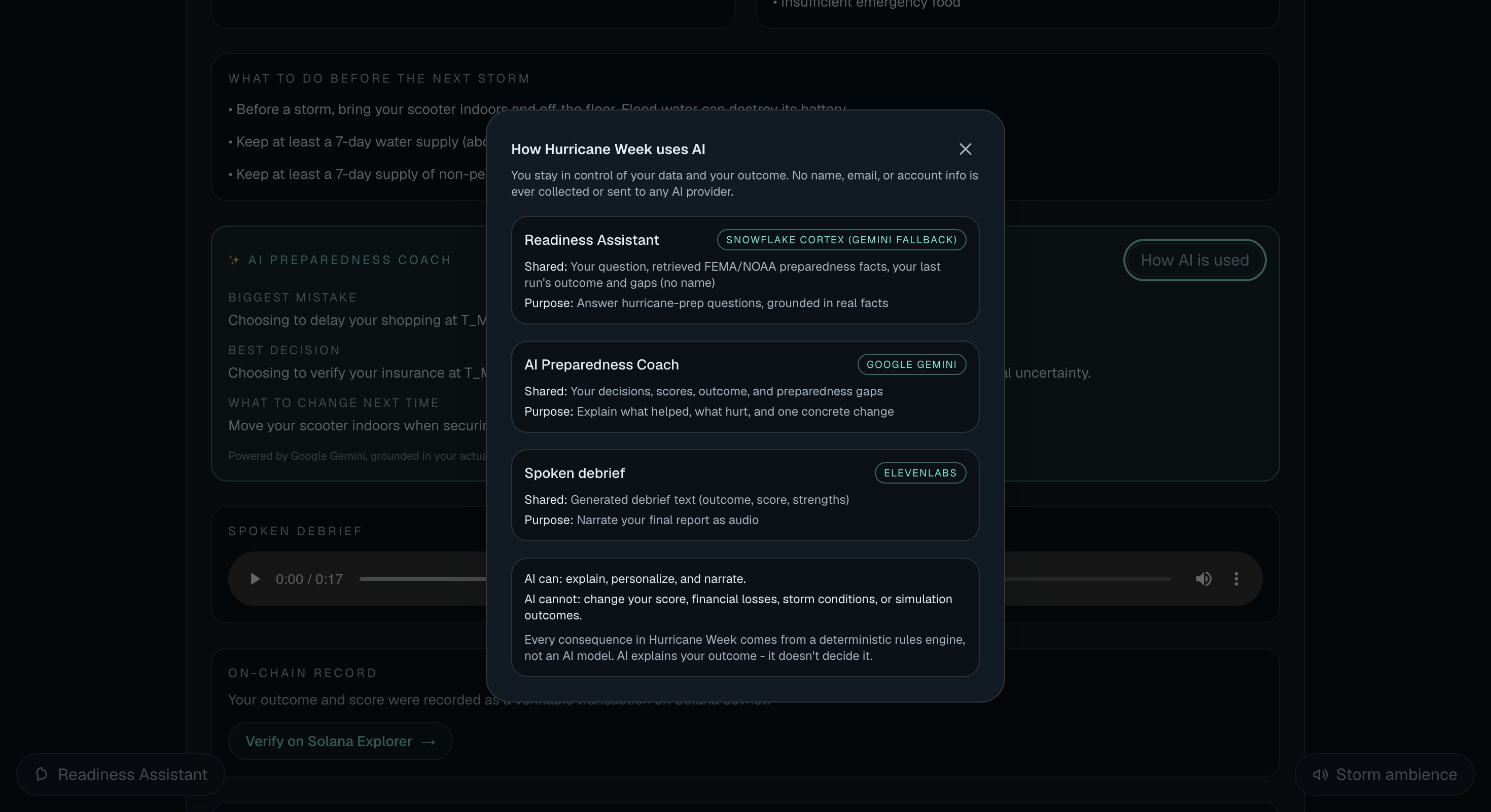
Every AI feature discloses what data it received and what it can't touch - your score always comes from a deterministic engine.
-
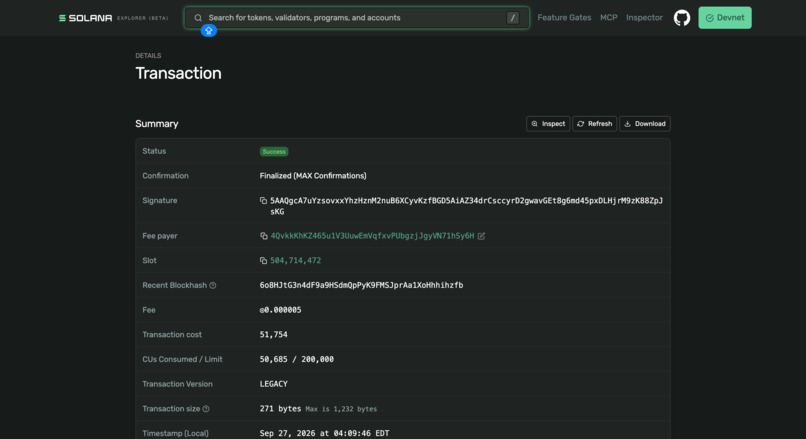
Your debrief is narrated by ElevenLabs; Your final outcome and score, recorded as a Solana devnet memo transaction.
-
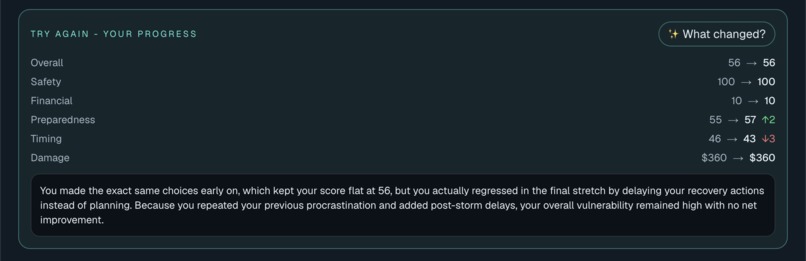
Replaying shows real score deltas, with Gemini explaining exactly what changed.
-
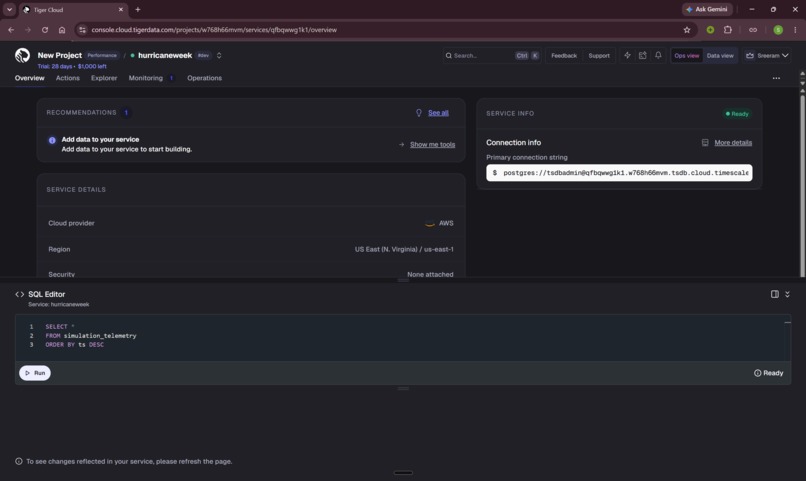
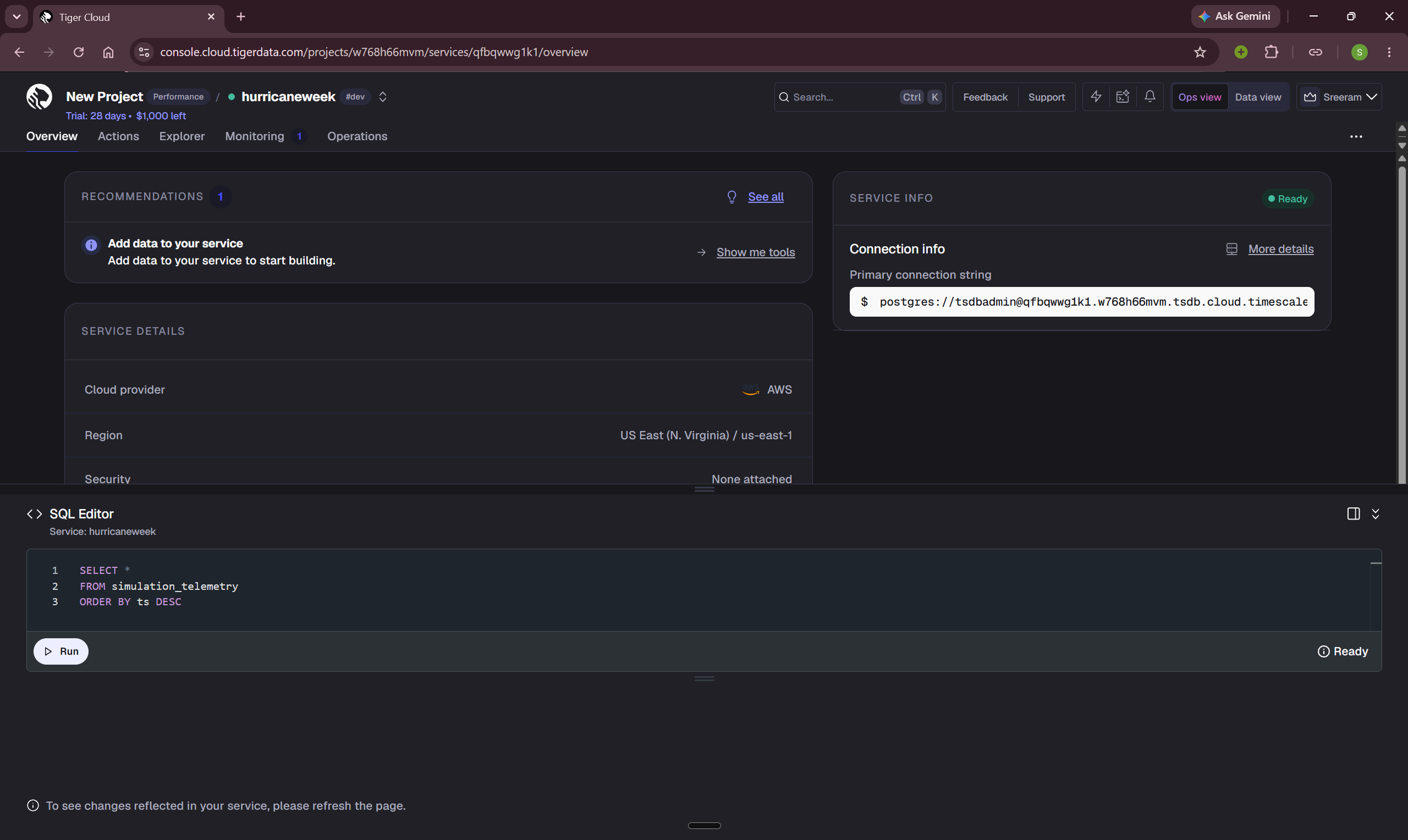
Every decision is a real row in a TimescaleDB hypertable, not just Postgres.
-
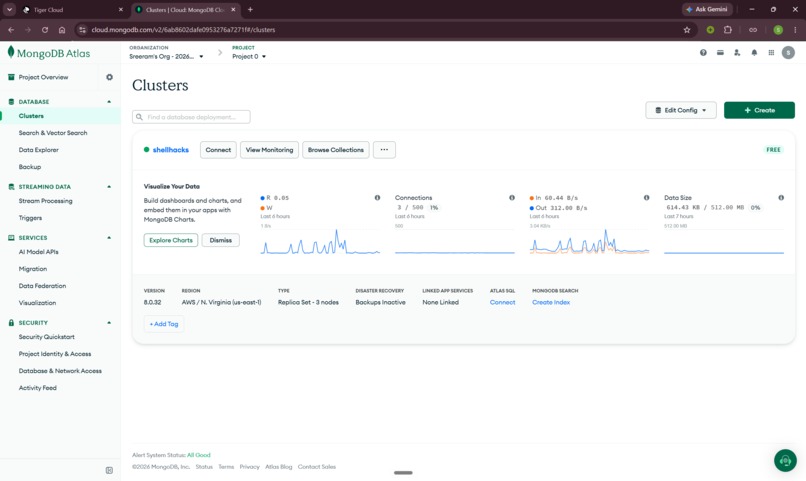
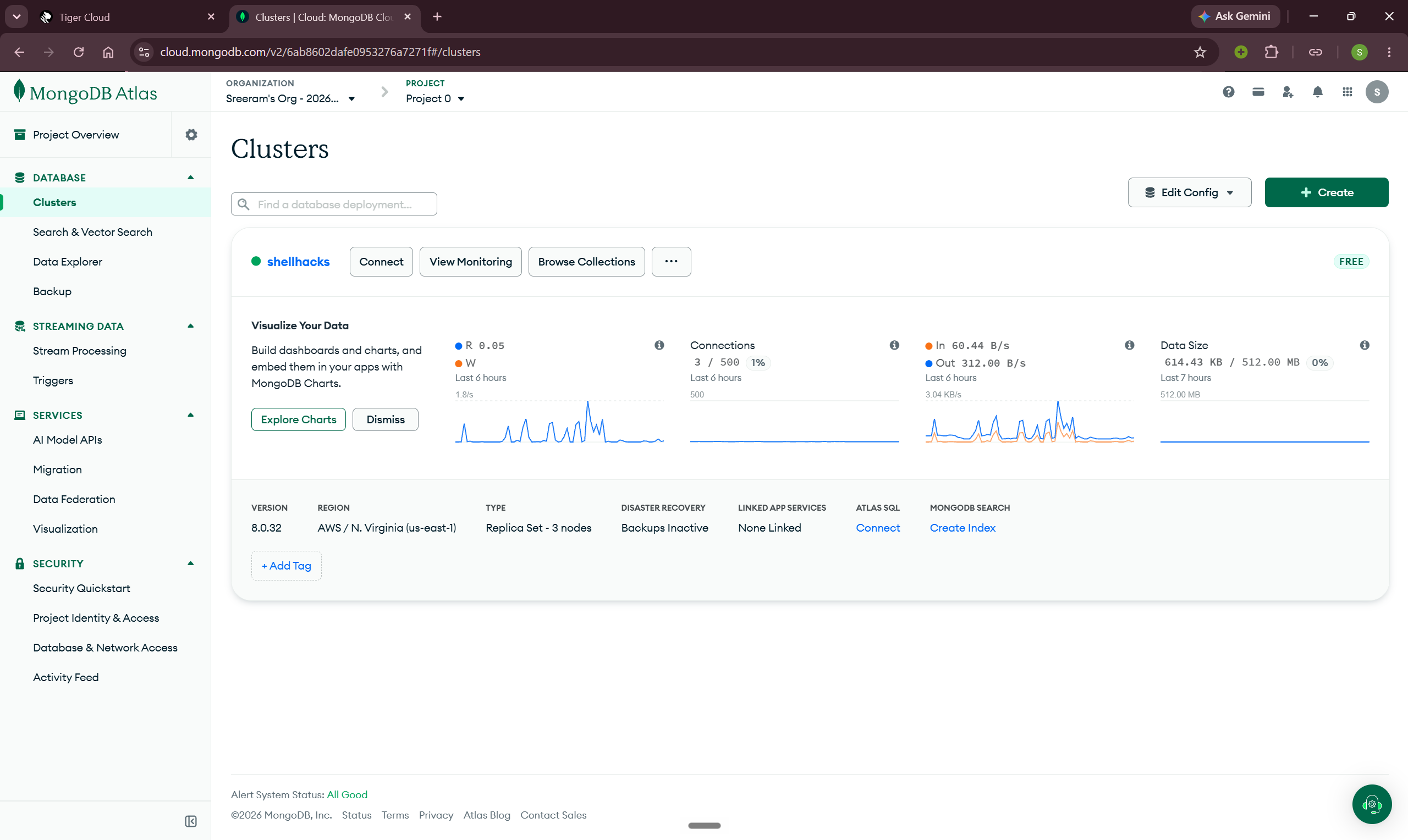
Live traffic on our MongoDB Atlas cluster every player session and decision, persisted in real time.
Inspiration
Living and studying in Florida makes hurricanes hard to think of as an abstract problem. Every season, students hear the same advice: stock up on supplies, protect your belongings, understand your insurance, know your evacuation options, and prepare early.
But knowing that advice is very different from acting on it when you have $400, classes or work, limited transportation, belongings to protect, and five days before landfall.
So we asked: what if hurricane preparedness wasn't another checklist you read and forget, but something you could experience before facing it for real?
That became Hurricane Week: a simulation where you make the decisions, live with the consequences, and learn why preparation matters, safely.
There isn't always a perfect choice. That's intentional. Spending money now may prevent a larger loss later. Working an extra shift brings in cash but costs preparation time. Doing nothing costs $0 today and can cost hundreds at landfall.
Why $400? The Federal Reserve's Report on the Economic Well-Being of U.S. Households uses a $400 unexpected expense as its benchmark for financial resilience: roughly a third of American adults couldn't cover one in cash. For a college student or early-career renter, that's a realistic, razor-thin cash cushion: it forces real trade-offs between groceries, fuel, and protecting what you own. Start with $5,000 instead and every choice is easy: board up the windows, rent an SUV, book a hotel out of town, no hesitation. At $400, every dollar spent on sandbags is a dollar you might need to evacuate later.
Why five days? Hurricane forecasts and preparedness decisions become increasingly actionable as landfall approaches. We use a 120-hour countdown to move players from early preparation through warning, evacuation, landfall, and recovery compressing the disaster lifecycle into a few minutes of play.
What it does
Hurricane Week is an interactive hurricane-preparedness and financial-resilience simulation where decisions compound over time.
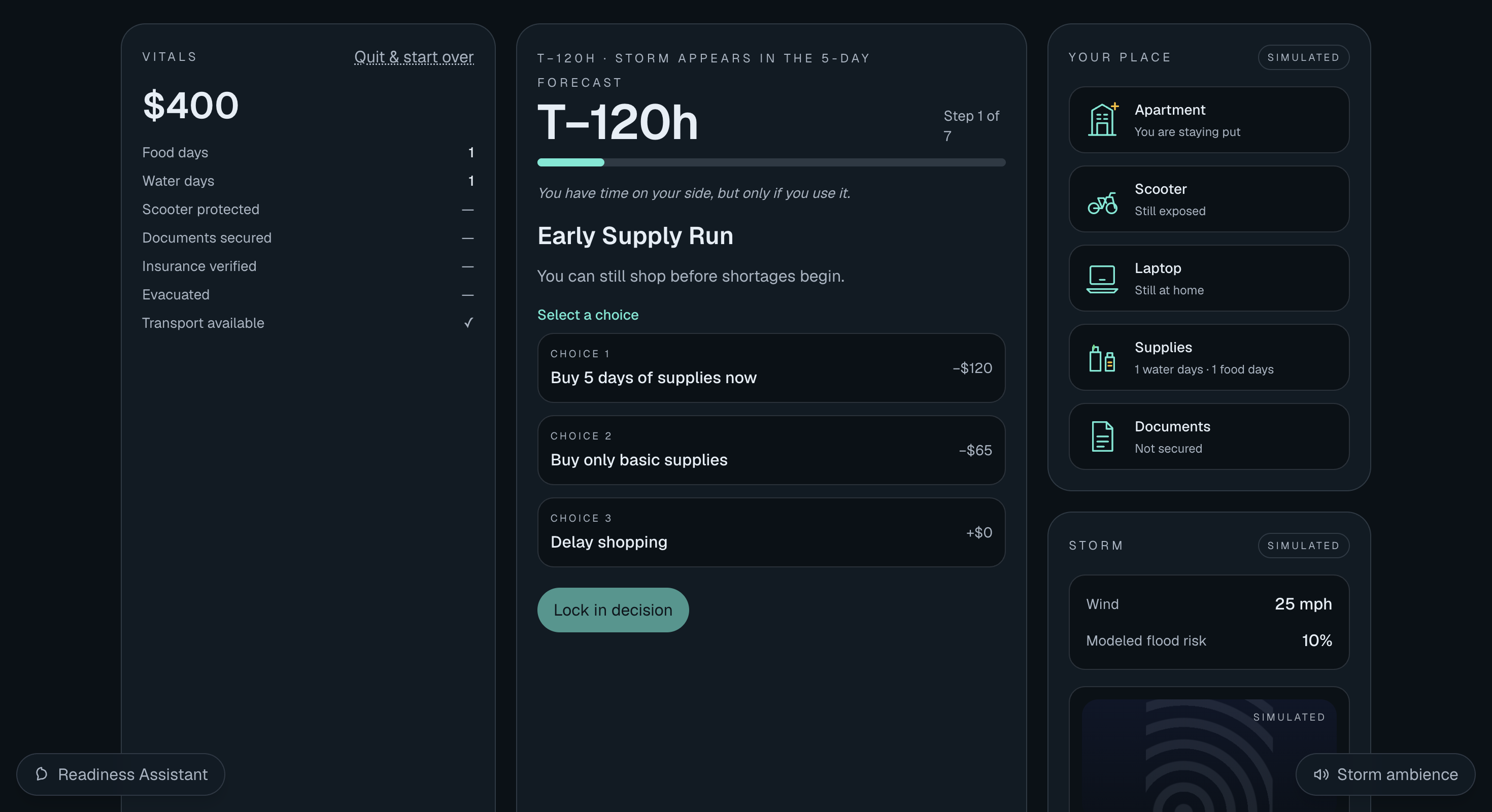
You play a Miami-Dade resident with $400 and five days before landfall. The storm moves through seven stages:
T-120h → T-96h → T-72h → T-48h → T-24h → Landfall → Recovery
Simulated wind rises from 25 mph to 105 mph and flood risk from 10% to 85% at landfall.
At each stage you face a tradeoff: spend $120 on supplies early or keep the cash? Skip work to prepare, or earn another $60? Protect your scooter and documents? Verify your insurance and photograph your belongings? Spend $90 to evacuate early, move to a nearby shelter, or stay put?
Your choices change persistent state: cash, food and water, evacuation status, insurance verification, document security, transportation protection, and financial loss. And consequences can be delayed. Leaving a scooter exposed saves money four days out, but if it's still unprotected when flood risk peaks, you take a $220 loss at landfall.
At the end, you get a post-storm report scoring four explainable dimensions (Safety, Financial resilience, Preparedness, and Timing), plus what went well, where you were vulnerable, and what to do before a real storm. Any life-threatening outcome triggers a safety gate: no amount of money saved offsets it.
AI Preparedness Coach
After the rules engine decides the outcome, Google Gemini reviews your actual decisions and identifies the single decision that hurt you most, the one that helped most, and one concrete change for next time, plus a personalized action plan. AI never decides whether you succeeded. Code determines what happened; AI explains what it means.
Try Again: compare your runs
Play again and Hurricane Week compares your new run with your last one: score changes and financial loss side by side. A "What changed?" button has Gemini explain which specific decisions moved your outcome, so you learn from the difference, not just the number.
AI Transparency: "How AI is used"
A built-in panel shows exactly what each AI feature receives and what it can't affect. No name, email, or account information is ever collected or sent to any AI provider. We want players to see how AI is used, not just trust it.
Auto Insurance Readiness Quiz
Eight scenario-based questions on what students most often get wrong about auto insurance in a storm: comprehensive vs. liability coverage, why liability-only never pays for your own car, whether moving your car to higher ground affects a claim, total-loss payouts, rental reimbursement, and claim documentation. Each answer includes a sourced explanation.
Evacuation mobility check
At the evacuation decision, Hurricane Week calculates real distance and travel time from an illustrative downtown Miami starting point to the nearest of several Miami-Dade evacuation center locations using OpenRouteService, adjusted for your transportation (car, scooter, or transit). If rising flood risk makes a scooter or transit evacuation unsafe before landfall, it flags it.
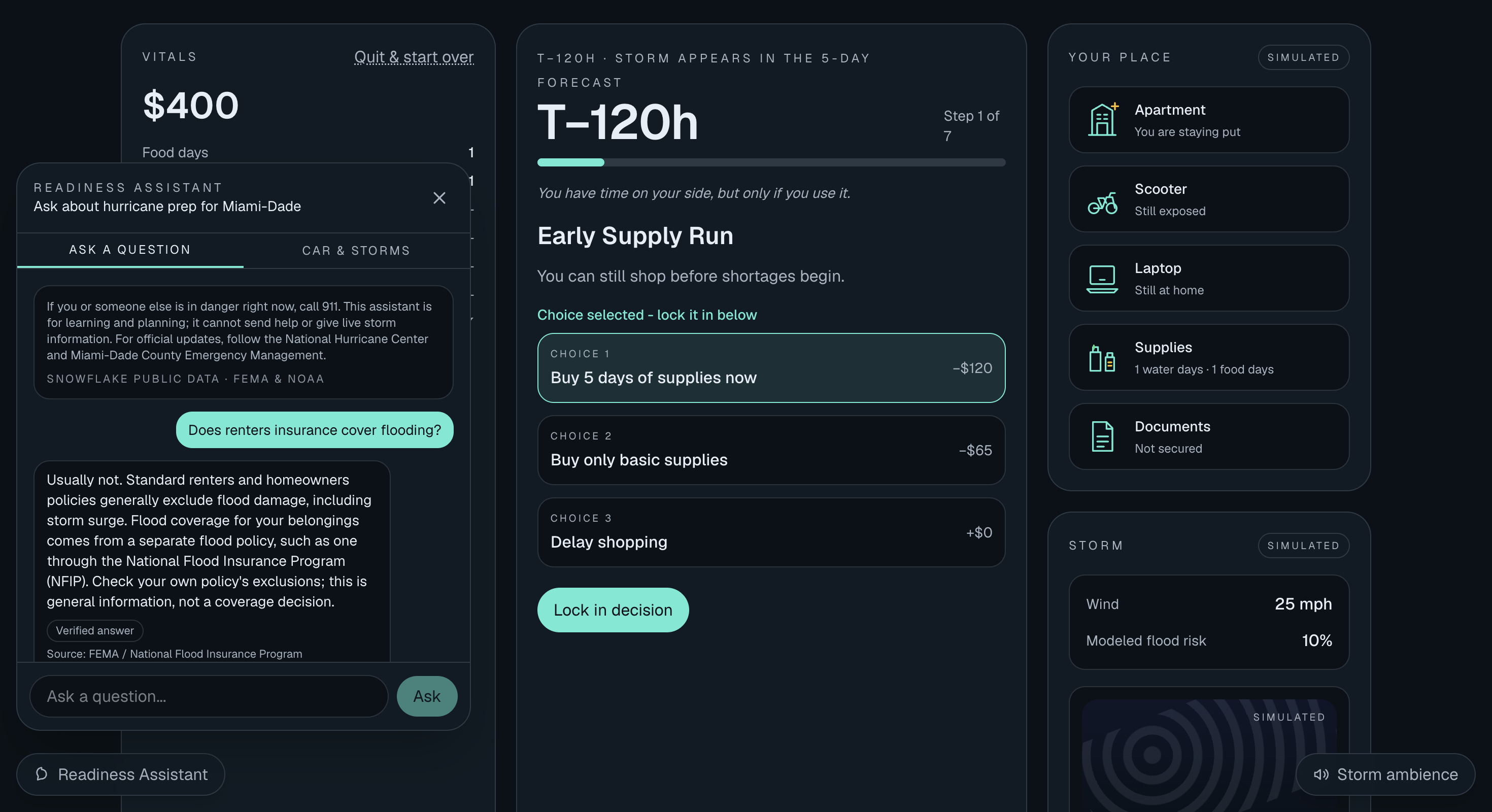
Readiness Assistant
An optional side panel where players can ask hurricane-preparedness questions. Instead of a generic chatbot, answers are grounded in FEMA and NOAA preparedness facts through a Snowflake Cortex RAG pipeline, with Gemini as a fallback. The core experience is the simulation, not a chat window.
Sound and voice
ElevenLabs generates hurricane wind and rain ambience during play and narrates your final report as a spoken post-storm debrief.
Verifiable completion record
When you finish, a Solana devnet memo transaction records your simulation ID, outcome, and score, with a Solana Explorer link.
How we built it
The frontend uses Next.js 16, React 19, TypeScript, and Tailwind CSS. A FastAPI backend runs the simulation lifecycle, event selection, consequences, scoring, persistence, AI services, audio, and reporting.
Deterministic simulation engine
Each event's choices modify state such as cash, supplies, evacuation, insurance verification, document security, and transportation protection. Events have eligibility rules, so a scooter rider meets different scenarios than someone without one, and earlier decisions determine whether later scenarios still apply.
We separated immediate effects from delayed consequences. At landfall, the consequence engine re-evaluates your accumulated state against the worsening storm:
Decision → State change → Worsening storm → Delayed consequence → Recovery
Explainable scoring
We didn't want an LLM arbitrarily deciding someone was "73% prepared." Scoring is deterministic, so every outcome traces back to the state and decisions that produced it. Generative AI only enters afterward, to explain.
Time-series telemetry with Tiger Data
Every decision writes a timestamped snapshot (stage, event, choice, cash, all four scores, and JSONB context) to a TimescaleDB hypertable on Tiger Data. A continuous aggregate pre-computes per-stage decision counts and average scores, and a compression policy keeps older chunks compact. This lets us reconstruct how a player's resilience evolved over the storm, not just the final result.
Persistent state with MongoDB Atlas
MongoDB Atlas persists active simulations, so a session survives backend restarts and redeploys. MongoDB → current state. Tiger Data → decision history.
Snowflake Cortex RAG
We loaded FEMA and NOAA preparedness knowledge into Snowflake. For each question, Hurricane Week embeds it, retrieves the most relevant chunks by vector cosine similarity, and passes them with the question to Cortex AI_COMPLETE for a grounded answer.
Gemini
Gemini powers the Preparedness Coach, the personalized plan, the "What changed?" run comparison, and the assistant fallback. It receives structured game context (outcome, scores, gaps, decision history), never personal data.
Resilient integrations
Every sponsor integration degrades gracefully. If an AI, audio, database, or blockchain service is unavailable, the core simulation keeps running. Even if Tiger Data is unreachable at startup, the app logs a warning and continues.
Deployment
The full stack runs on DigitalOcean App Platform, with separate services for the FastAPI backend and Next.js frontend, auto-deploying from main. Live at hurricaneweek.miami.
Challenges we ran into
Making consequences matter. Awarding points after each answer would have been easy. Building persistent state and delayed consequences meant reasoning about whole chains of decisions, so a harmless-looking early choice can become expensive at landfall.
Balancing depth with playability. Model too much and it becomes a weather dashboard; too little and choices feel meaningless. We focused on the variables that create understandable tradeoffs: money, time, supplies, transportation, evacuation, insurance, and property protection.
Keeping AI explainable. We built the deterministic engine first, then decided carefully where AI adds value, and built a transparency panel so players can see those boundaries.
Grounding answers. Emergency preparedness is no place for confident hallucinations, so the assistant retrieves authoritative facts before generating anything.
Resilience. With many external services, we made sure no single outage could break the demo.
Accomplishments that we're proud of
- A complete, playable, deployed system, not just a concept.
- Seven stages of evolving state, conditional events, delayed consequences, and four-dimensional deterministic scoring.
- A clear line between rules and AI: code decides, AI explains, and the transparency panel shows exactly how.
- A replay loop that teaches through comparison, with Gemini explaining what changed.
- An end-to-end RAG pipeline over FEMA and NOAA facts.
- A time-series telemetry layer with hypertables, continuous aggregates, and compression.
- Every integration degrades gracefully.
Most importantly: someone can actually use it. Give a player $400, five simulated days, and an approaching hurricane, and their own decisions teach the lesson.
What we learned
Hurricane preparedness is fundamentally a decision-making problem under constraints. As a storm approaches, time, money, transportation, and availability start eliminating options, so when you act matters as much as what you do.
Simulations are far more memorable when consequences persist. A choice matters more when it comes back several minutes later.
And our biggest technical lesson: not every problem inside an AI application should be solved by AI. Rules, consequences, storm progression, and scoring are easier to verify when they're deterministic. Language models are most useful once reliable systems have established the facts they need to explain.
What's next for Hurricane Week
- Insurance claims inside the simulation: belongings with real values and locations, renters, flood, and auto policies, deductibles, and an item-by-item payout breakdown at landfall.
- More player profiles: a car owner, a student in a dorm, a household with pets, a resident in a flood zone, someone who depends on medication.
- Real community data: flood-risk zones, evacuation data, and local shelters so the simulation adapts to different neighborhoods.
- Decision quality under uncertainty: judging each choice by what was known at the time, separately from luck.
- Community insights: showing players how others handled the same storm, powered by our Tiger Data aggregates.
- Institutional use: universities and emergency-management organizations building scenarios for their own communities, turning Hurricane Week into a broader disaster decision-training platform.
Impact
Hurricane Week is built first for students and hurricane-prone communities. Universities could use it during hurricane-season campaigns, residence-hall programming, or orientation. Emergency-management and financial-literacy programs could adapt it. Insurance educators could use it to show how preparation, documentation, and coverage interact, without anyone learning those lessons through an actual loss.
It isn't trying to predict the next hurricane. It's decision training.
If someone finishes Hurricane Week and later buys supplies earlier, secures their documents, protects their vehicle, checks what their insurance actually covers, or simply starts preparing before everyone else, it has done something beyond being a hackathon demo.
A hurricane warning tells you to prepare. Hurricane Week lets you discover why.
Educational simulation. Not an emergency warning system or an insurance coverage determination.
Built With
- cortex
- css
- digitalocean
- elevenlabs
- fastapi
- gemini
- mongodb-atlas
- next.js
- openrouteservice
- postgresql
- pydantic
- pytest
- python
- react
- snowflake
- solana
- tailwind
- tiger-data
- typescript


Log in or sign up for Devpost to join the conversation.