-
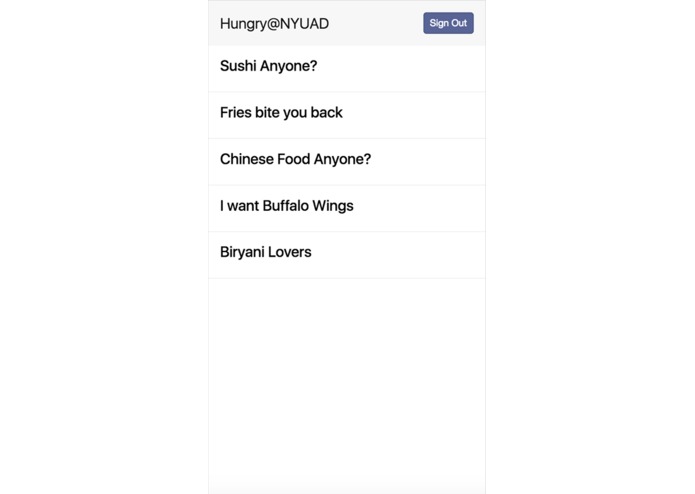
Screen-shot of the initial homepage
We got the inspiration for our application ‘Hungry@NYUAD’ from a Facebook group created by NYUAD students called Hungry@NYUAD. The NYUAD campus is located on Saadiyat Island that is very isolated from the main city and there aren’t many cheap and nearby places for students to eat at, especially during late at night. It is also a 15-20 minute ride to the city. Due to these reasons, students order food almost on a daily basis and since most restaurants require a minimum order price for delivery, they created the Facebook group Hungry@NYUAD to order collaboratively. However, the communication regarding ordering collaboratively is often very inconvenient and inefficient and several problems occur. For example, often people see posts by someone ordering food after the food has already been ordered and assume that the ordering is still happening. Or sometimes people don’t have enough trust in the chaotic communication system that exists on the Facebook group and hence, they pull back their contribution. Another problem that exists is that often people commit to ordering without really knowing if the order is going to be a success or not since they don’t know how many other people are contributing.
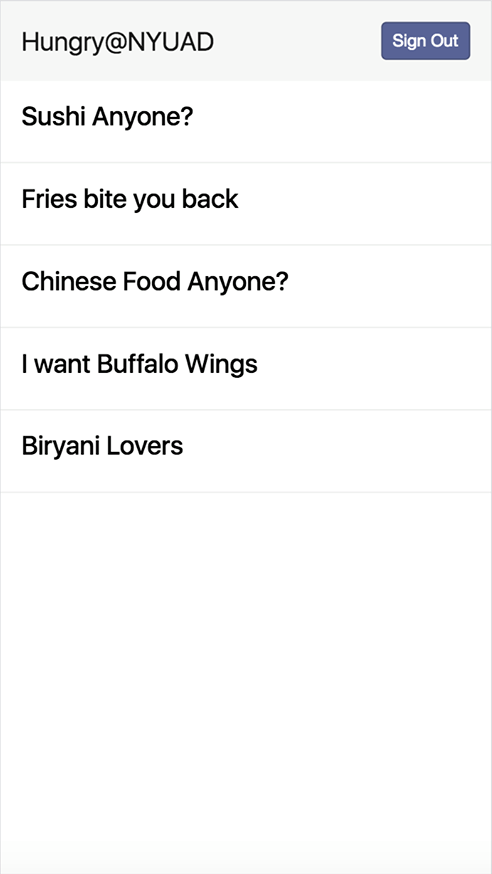
Our application aims to solve all these and other problems and aims to provide a better system for people to gather and order food collectively. Briefly, the app allows people to log in with Facebook and then create ‘campaign’ to order food which can then be joined by other people. Apart from this, the app is intended to include some very helpful features, even though not all features of the application are functioning right now. The homepage shows a list of all open campaigns that will have a specific deadline by which the campaign will close. Each campaign will also show the name of the restaurant and a progress bar showing how much of the minimum price requirement has been reached (i.e. how much contribution has already been made). This feature allows people to know if this campaign will be a success or not and they can decide whether to join the campaign or not with more trust in the procedure. More details can be accessed when you click on a particular campaign, such as the name of the campaign creator, the time that the restaurant takes to deliver etc.
We used Meteor, which is a framework suitable for releasing a mature application instead of prototyping, to build this application. Since we were working within a tight time-frame and it was very difficult for us to make a fully functioning app, the styling of our front end is still in its primitive form and this is definitely something we aim to improve in future. We managed to make a fully functioning app that runs properly on both server and user end. We also built a fully functioning database that stores information of restaurants when input by the users and the input given regarding on-going campaigns. The app also makes the 'campaigns' disappear from the feed once the deadline has past just in case the owner forget to delete it, so that other users don't see expired campaigns. In this process, we learned about the thinking process of turning the discovery of a problem into something that can actually solve it. We also learned about the principles of web front-end design through seminars hold by CS major seniors.
We have a lot of plans for this application since right now it is more of an idea, than a proper app and we can see all the ideas that we have, converting into fully functioning features. The first thing we are gonna do is to make the app good-looking in terms of design and implement some mobile features like pushing-notification. Then we're going to deploy the app on to a server and release a beta version to let fellow students help us improve it. After we reach a certain amount of users, we can reach out to the restaurants for discount, and that's when we profit. We will also propagate the app to other colleges in UAE. I believe it will have a huge market share in the local food-ordering market.


Log in or sign up for Devpost to join the conversation.