Inspiration
Theme: Early Warning → Early Action
Kenya's droughts are rarely unexpected—they are forecast months in advance. Yet humanitarian responses often begin only after food insecurity has already escalated into a crisis. By then, emergency procurement, transport, and relief operations become significantly more expensive, while vulnerable communities in the Arid and Semi-Arid Lands (ASALs) have already suffered avoidable losses.
We asked a simple question:
What if every seasonal climate forecast automatically generated an actionable logistics plan instead of just another warning?
Hungerless was built to bridge the gap between climate forecasts and humanitarian action. Rather than simply predicting where food insecurity may occur, it determines what should be moved, where it should come from, how much it will cost, and when intervention should begin. The goal is to help governments, county disaster managers, NGOs, and humanitarian organizations act before a drought becomes a humanitarian emergency.
What it does
Hungerless is an AI-assisted Anticipatory Action & Logistics Decision Support System that transforms climate forecasts into operational plans for food security across Kenya.
The platform combines historical agricultural production, livestock statistics, seasonal rainfall forecasts, and county-level food demand to estimate future food surpluses and deficits before drought conditions peak.
Once a potential shortage is detected, Hungerless automatically:
- Identifies counties with available food surpluses.
- Determines the most efficient transport routes.
- Calculates logistics costs using real Kenyan fuel prices and trucking capacities.
- Recommends suitable commercial fleets for deployment.
- Visualizes supply chains through interactive geospatial maps.
- Generates executive decision briefs, operational risk assessments, and budget summaries using DeepSeek-V3.2.
Unlike traditional dashboards that stop at displaying risk, Hungerless converts early warnings into actionable logistics plans, allowing agencies to pre-position food supplies while transport remains affordable, roads remain accessible, and communities remain resilient.
To ensure reliability in high-stakes humanitarian operations, every recommendation is grounded in deterministic mathematical models before AI is ever involved.
How we built it
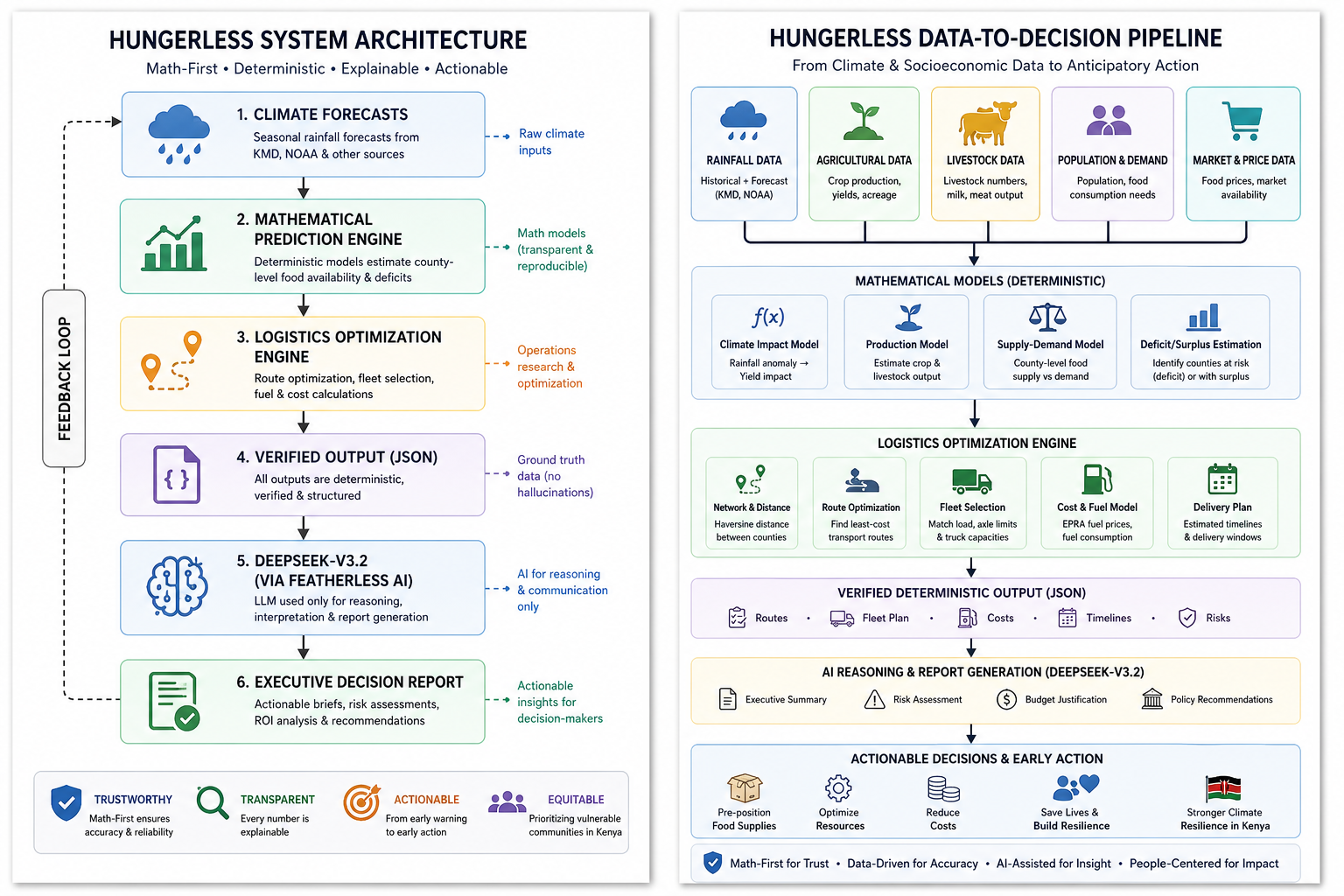
Hungerless follows a Hybrid Intelligence Architecture, where mathematics provides certainty and AI provides reasoning.
1. Prediction Engine
A deterministic Python backend built with Pandas and NumPy processes historical climate, crop production, and livestock datasets to estimate county-level food availability.
Yield variation is calculated using a rainfall sensitivity model:
$$ \text{Yield}{pred} = \text{Yield}{base} \times \left(1 + 1.2 \times \frac{\text{Rain}{forecast}-\text{Rain}{avg}}{\text{Rain}_{avg}}\right) $$
The output is transparent, reproducible, and fully explainable.
2. Logistics Optimization Engine
After identifying food deficits, Hungerless computes the operational response.
Using county GPS coordinates and the Haversine distance formula,
$$ d = 2R \arcsin\left(\sqrt{\sin^2\left(\frac{\Delta\varphi}{2}\right)+\cos\varphi_1\cos\varphi_2\sin^2\left(\frac{\Delta\lambda}{2}\right)}\right) $$
the platform calculates optimal transport routes between surplus and deficit counties.
Real Kenyan logistics constraints—including EPRA diesel prices, KeNHA axle load regulations, and commercial truck capacities—are incorporated to estimate:
- Transport costs
- Fuel consumption
- Fleet requirements
- Delivery timelines
- Route distances
Instead of simply identifying where a crisis may occur, Hungerless determines how to respond before it happens.
3. AI Decision Support Layer
Large Language Models are intentionally not used for calculations.
Instead, deterministic outputs from the prediction and logistics engines are converted into structured JSON and supplied to DeepSeek-V3.2 through the Featherless AI serverless platform.
The AI functions exclusively as a strategic assistant, generating:
- Executive summaries
- Humanitarian situation reports
- Budget justifications
- Operational risk assessments
- Policy recommendations
This architecture eliminates AI hallucinations in numerical calculations while preserving the communication and analytical strengths of modern language models.
4. Interactive Dashboard
The platform is delivered through Streamlit with Folium-powered geospatial visualization, allowing planners to explore food deficits, logistics routes, operational costs, and county-level risk through an intuitive interactive interface.
Challenges we ran into
The biggest challenge was ensuring that generative AI could be safely integrated into humanitarian logistics.
In disaster response, an LLM hallucinating a transport distance, fleet requirement, or budget is more than a technical error—it can delay aid delivery and compromise critical decisions.
To solve this, we adopted a strict separation between calculation and reasoning. Every numerical output shown by the AI originates from deterministic mathematical models, with the language model acting only as an interpreter of verified data.
Another challenge was sourcing reliable local operational datasets—including Kenyan fuel prices, commercial trucking specifications, county agricultural statistics, and logistics constraints—to ensure the platform reflects real-world humanitarian operations rather than theoretical assumptions.
Accomplishments that we're proud of
Our proudest achievement is the Hybrid Intelligence Architecture.
By separating deterministic computation from AI reasoning, Hungerless demonstrates that Large Language Models can safely support humanitarian decision-making when grounded in verified mathematical models.
We successfully integrated climate forecasting, logistics optimization, geospatial visualization, and AI-assisted reporting into a single platform that transforms seasonal forecasts into practical action plans.
Instead of simply warning that a county may face food shortages, Hungerless tells decision-makers what to move, where to move it from, how much it will cost, what fleet is required, and when intervention should begin.
What we learned
This project reinforced that the future of applied AI is not just about better prompts—it's about better guardrails.
Grounding language models in deterministic mathematics transforms them from chatbots into trustworthy decision-support systems capable of assisting high-stakes humanitarian operations.
We also gained valuable insight into Kenya's agricultural supply chains and learned how anticipatory logistics can dramatically reduce operational costs compared to reactive emergency responses after disasters have already unfolded.
What's next for Hungerless
The next step is expanding Hungerless into a comprehensive anticipatory action platform for climate resilience in Kenya.
Future enhancements include:
- Integrating real-time flood monitoring and road accessibility data.
- Connecting live meteorological feeds from organizations such as the Kenya Meteorological Department and NOAA.
- Incorporating community observations and indigenous ecological knowledge from pastoralist communities to complement automated forecasts.
- Introducing scenario planning tools that allow decision-makers to compare intervention strategies before resources are deployed.
Our long-term vision is to help Kenya shift from reacting to food crises to preventing them through data-driven anticipatory action, ensuring that climate forecasts become practical decisions rather than missed opportunities.


Log in or sign up for Devpost to join the conversation.