Inspiration
The spark for HumanSign came from witnessing two invisible crises unfolding simultaneously in my own community.
First, in education, I saw the "Thinking Gap" widening. Peers were using AI to bypass the struggle of learning, submitting perfect code and essays without understanding the core concepts. It wasn't just about grades; it was about the loss of critical thinking.
Second, and perhaps more urgently, I realized the "Decent Work Crisis" hitting freelancers. Honest developers and writers in the Global South are losing contracts because clients cannot distinguish between their original work and AI-generated output. They are facing a new form of "algorithmic discrimination."
I realized the root cause was a lack of proof. In the physical world, we have signatures. In the digital world, honest effort is invisible. I wanted to build a tool that didn't just detect AI, but verified humanity—restoring value to the people who actually do the work.
What it does
HumanSign is a verification system that proves human authorship in digital work through behavioral biometrics. It works by:
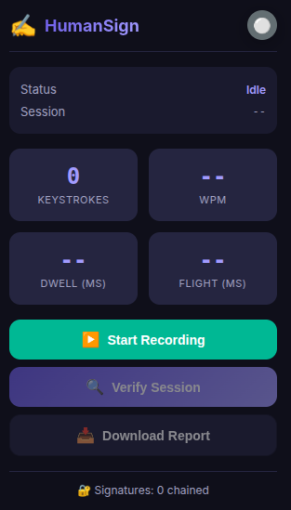
- Capturing Human Patterns: A browser extension passively monitors typing behavior, recording timing data like "flight time" and "dwell time" without storing the actual content.
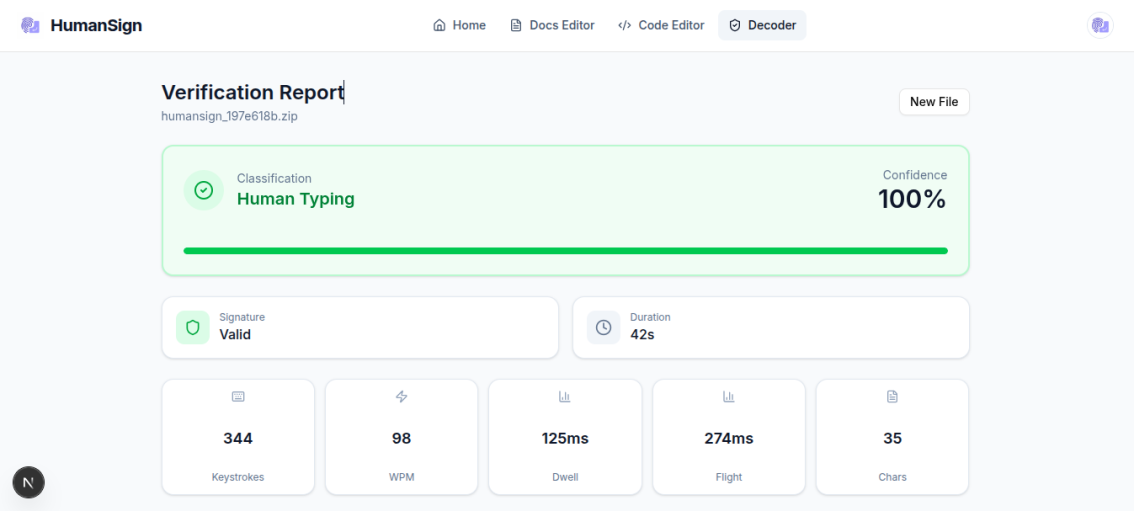
- Analyzing Cognitive Signatures: An AI/ML engine processes these patterns to detect the natural variance in human typing that distinguishes it from bot-generated content.
- Generating Proof: The system creates a cryptographic token—an immutable digital certificate that serves as verifiable proof of human authorship.
HumanSign ensures that educators can verify authentic student work, and freelancers can prove their originality to clients, restoring trust in the digital workspace.
How we built it
I built HumanSign from scratch as a comprehensive, three-part system. This was a "heavy" engineering challenge that required connecting distinct technologies:
1. The Tracker (Browser Extension)
Built using JavaScript (Manifest V3), this extension passively sits in the background of web editors. It captures timing data—specifically "flight time" and "dwell time"—without recording the actual text content, ensuring privacy-by-design.
2. The Verifier (AI/ML Engine)
I built a backend that processes these timing arrays to detect the "human signature." We implemented a statistical model to calculate the Coefficient of Variation \(\delta\) of the Inter-Keystroke Intervals (IKI).
The core logic relies on the fact that human cognitive load creates high variance, whereas bots are linear:
$$\delta = \frac{\sigma}{\mu}$$
Where \(\sigma\) is the standard deviation of keystroke latency and \(\mu\) is the mean.
3. The Proof (Cryptographic Token)
The results are hashed to create a "slight blockchain" effect—an immutable digital certificate that proves authorship.
Note: Since this was an ambitious project for a learner, I utilized Gemini as a "pair programmer" to help architect the system, debug complex asynchronous data flows, and understand the cryptographic principles needed for the verification tokens.
Challenges we ran into
Since I am still learning, building a full-stack security product presented massive technical hurdles:
The "Real-Time" Hurdle: Syncing the browser extension's data stream with the ML backend without causing lag for the user was incredibly difficult. Asynchronous data flows had to be perfectly orchestrated.
Privacy vs. Utility: I had to learn how to analyze how someone types without storing what they type. Implementing this "Edge AI" approach while maintaining user privacy was a steep learning curve.
Full-Stack Complexity: Connecting a Chrome Extension to a Web App and a Python backend required managing CORS issues, authentication states, and secure API endpoints simultaneously. Each layer had its own challenges.
Statistical Modeling: Understanding and implementing behavioral biometrics required diving deep into time-series analysis and determining the right thresholds to distinguish human from AI patterns.
Accomplishments that we're proud of
Building a Complete System: As a learner, I successfully architected and deployed a full-stack application that spans browser extensions, web apps, ML backends, and cryptographic verification.
Privacy-First Design: Creating a system that can verify humanity without compromising user privacy is a technical achievement I'm genuinely proud of.
Real-World Impact: HumanSign addresses genuine problems affecting both education and economic opportunity. It's not just a technical demo—it's a tool that can restore value to honest work.
Learning Velocity: The sheer amount of new skills acquired during this hackathon—from behavioral biometrics to cryptography to browser extension development—represents a massive personal growth milestone.
What we learned
This hackathon was a massive educational sprint. I went from a learner to a builder in several key areas:
AI/ML: Understanding Behavioral Biometrics and training models on time-series data. Learning how human cognitive patterns manifest in keystroke dynamics.
Browser Extensions: Mastering the DOM, background service workers, and the intricacies of Manifest V3 permissions and content script injection.
Web Security & Cryptography: Learning how to hash data to create a tamper-proof record, and understanding the principles behind immutable verification systems.
System Architecture: How to build a scalable product that bridges the gap between a local user action and a cloud-based verification system, managing state across multiple platforms.
Product Thinking: Understanding that technical innovation must be balanced with user experience and privacy considerations to create something people will actually use.
What's next for HumanSign
Enterprise Integration: Building APIs and plugins for Learning Management Systems (LMS) like Canvas and Moodle, and freelance platforms like Upwork and Fiverr.
Advanced ML Models: Training more sophisticated models that can detect nuanced patterns across different writing styles, languages, and input methods (voice-to-text, mobile typing, etc.).
Blockchain Integration: Exploring full decentralized verification through blockchain-based credential systems, creating a permanent, public record of verified human work.
Mobile Support: Extending HumanSign to mobile platforms where typing patterns differ significantly but are equally distinctive.
Community Standards: Working with educators and industry leaders to establish HumanSign certification as a recognized standard for verified human authorship.
HumanSign is the result of this journey—a tool built to ensure that in the age of AI, human creativity remains a distinct and valued asset.

Log in or sign up for Devpost to join the conversation.