Inspiration
Just as computational simulations of atoms, molecules and cells have shaped the way we study the sciences, true-to-life simulations of human-like agents can be valuable tools for studying human behavior as well as to power entertainment applications such as AI Companions, Intelligent NPCs in Games and short-form media creation.
What it does
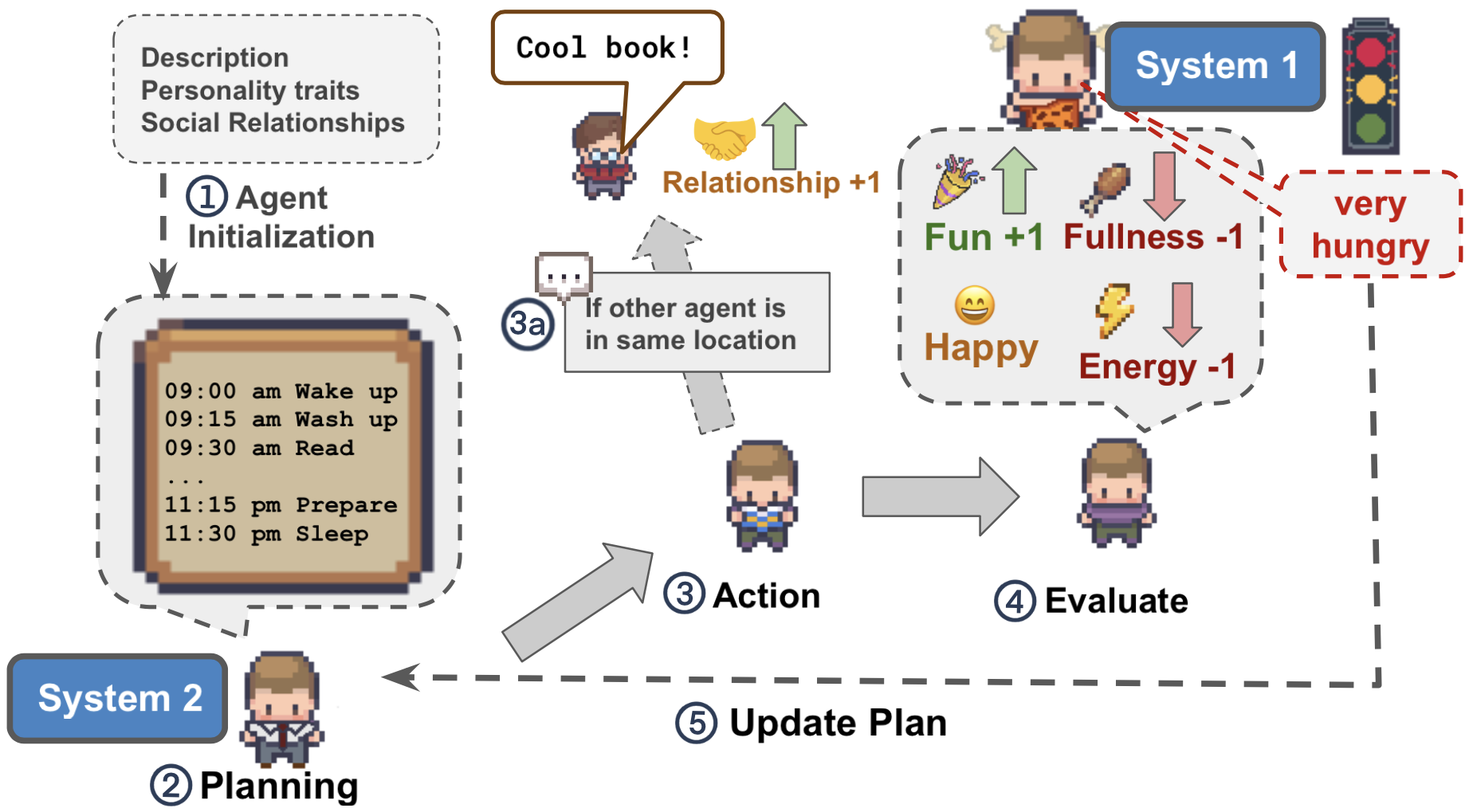
We propose Humanoid Agents, a system that guides Generative Agents to behave more like humans by introducing three elements of System 1 processing: Basic needs (e.g. hunger, health and energy), Emotion and Closeness in Relationships. Humanoid Agents are able to use these dynamic elements to adapt their daily activities and conversations with other agents.
Our platform also includes a Unity WebGL game interface for visualization and an interactive analytics dashboard to show agent statuses over time.
How we built it
We implement Humanoid Agents with MindsDB API to access GPT-3.5-turbo, Flask, Unity, Python Dash.
Challenges we ran into
The main challenge lies in identifying and orchestrating the 20+ prompts required to guide the GPT-3.5-Turbo to behave like humans instead of its default behavior of an assistant. For instance, in identifying the emotion experienced by a human from doing an activity, asking the LLM directly how it will feel does not work. Instead, we need to phrase it as asking what is the typical emotion expressed in an activity. Furthermore, LLMs do not always follow the expected output format and we need to use Regex to update the output format when that happen (which itself needs to be iteratively identified).
Accomplishments that we're proud of
We are proud to have a working prototype of human-like agent simulation platform (with open source code, visualization dashboard and Unity gaming environment). This can support others to build more features on top of this platform.
What we learned
We learned that it's important to pay attention to details like the prompt structure. We need to be clear and direct about asking the LLM what we want, without superfluous details and when possible, decomposing complex requirements into separate prompts. More powerful LLMs (e.g. GPT-4, Claude 3 Opus) might be able to do this decomposition but they might not be cost effective for such applications, which involves substantial number of calls to LLMs.
What's next for Humanoid Agents
- Support customized map and agents on Game Interface
- Support other aspects of System 1 thinking (such as morals, empathy and cultural values)

Log in or sign up for Devpost to join the conversation.