-
-
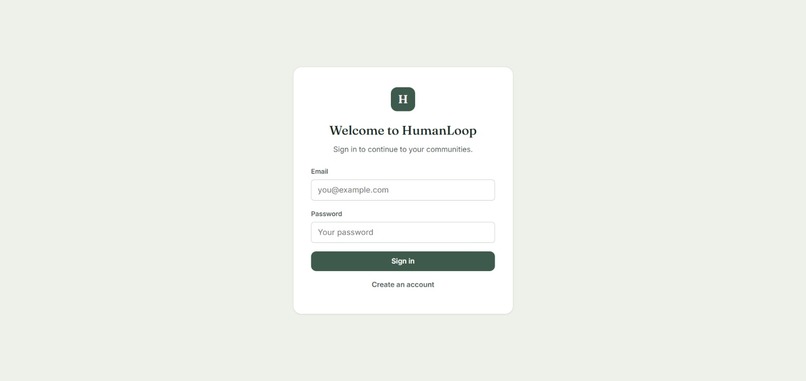
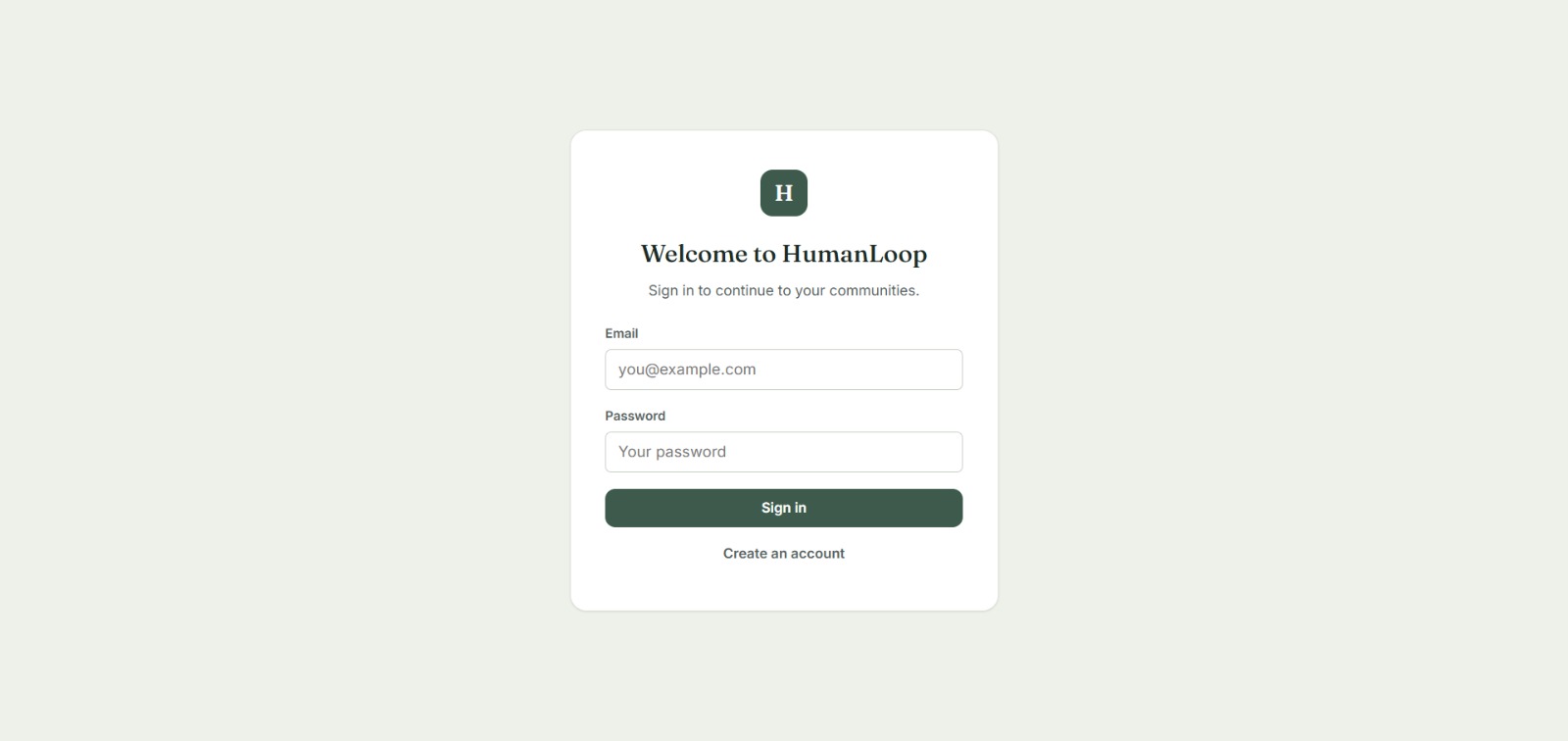
Users can securely log in to access the HumanLoop
-
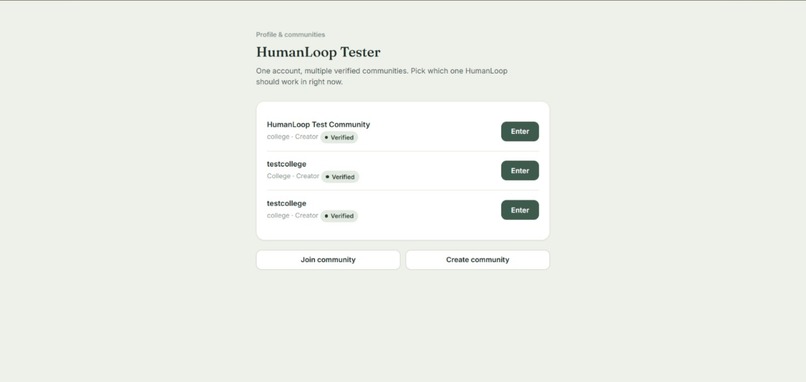
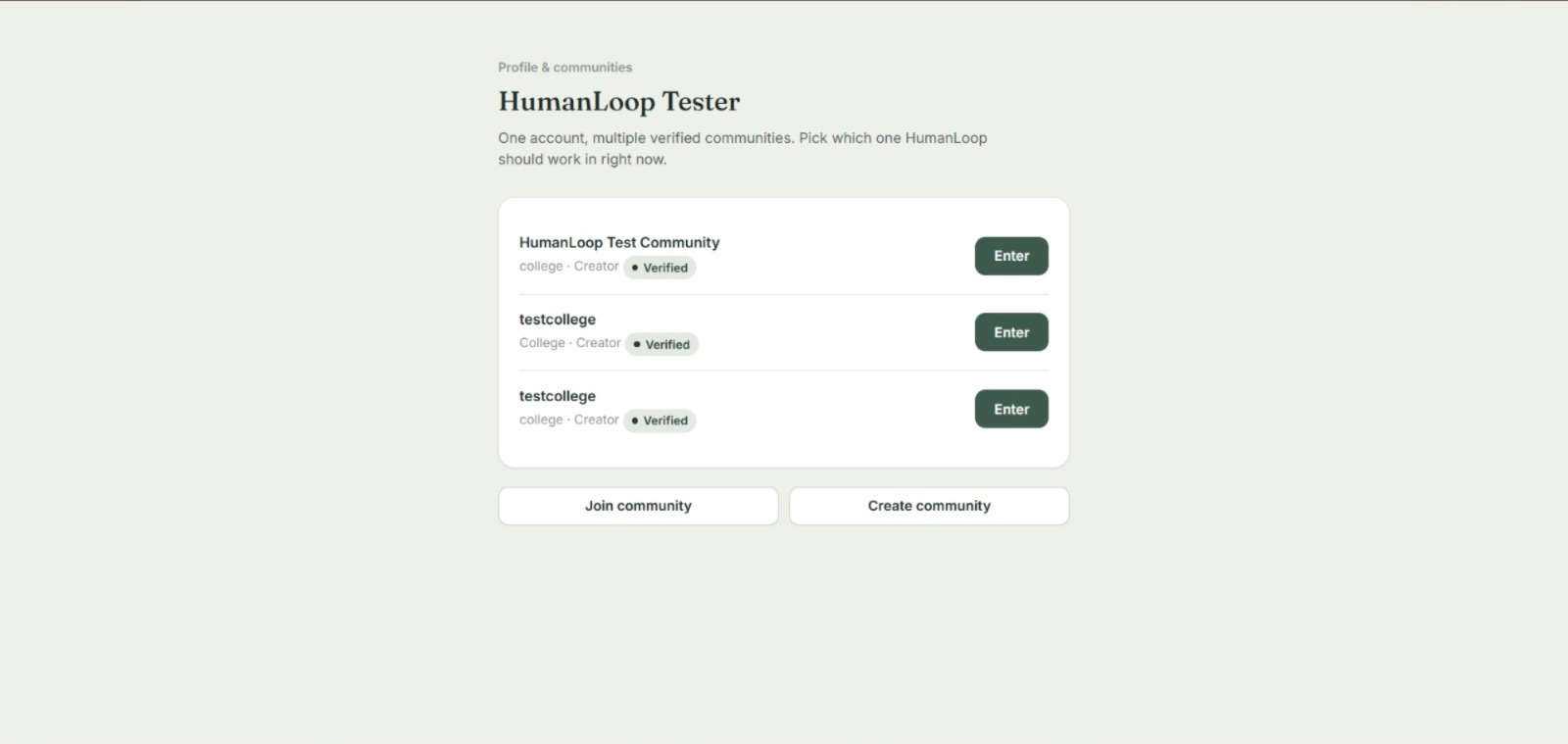
Users can view their profile and select a verified community to work in.
-
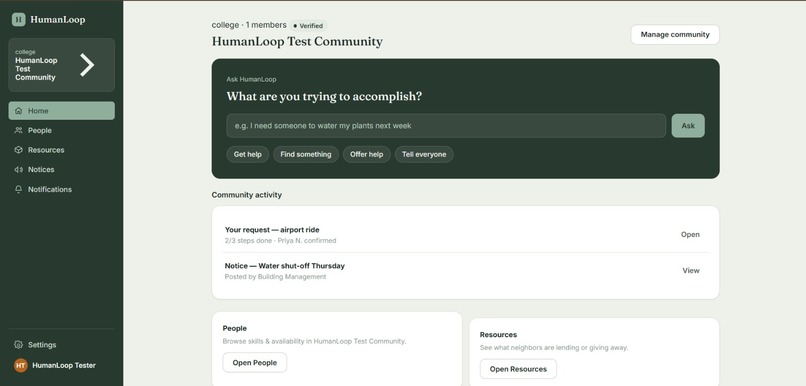
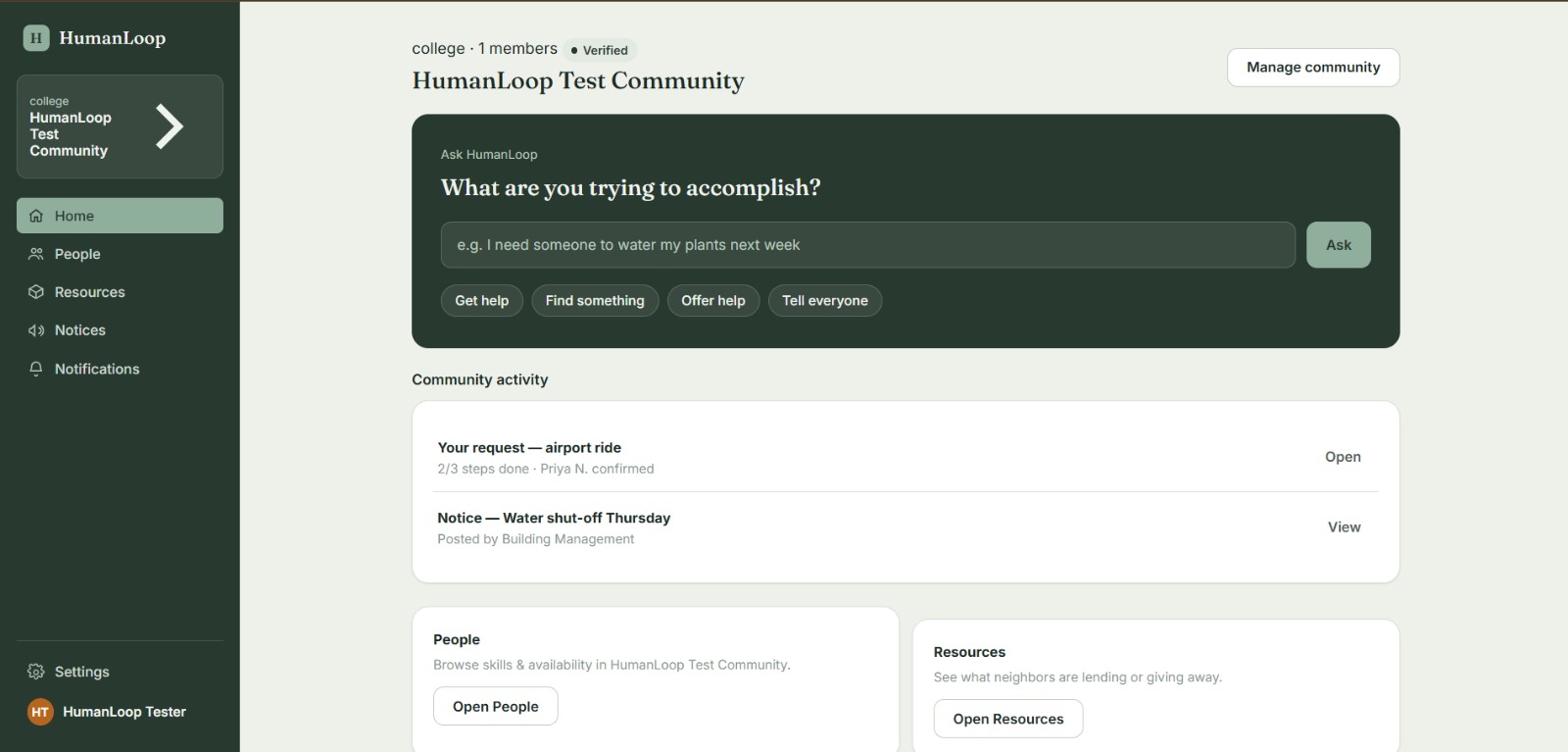
Users can ask HumanLoop for help, view community activity, and find people or resources.
-
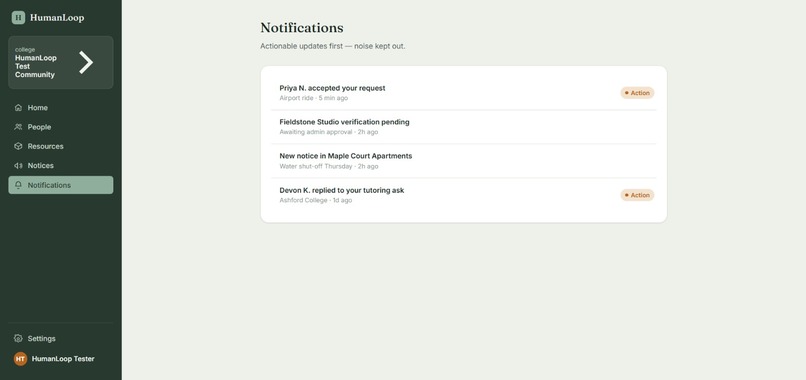
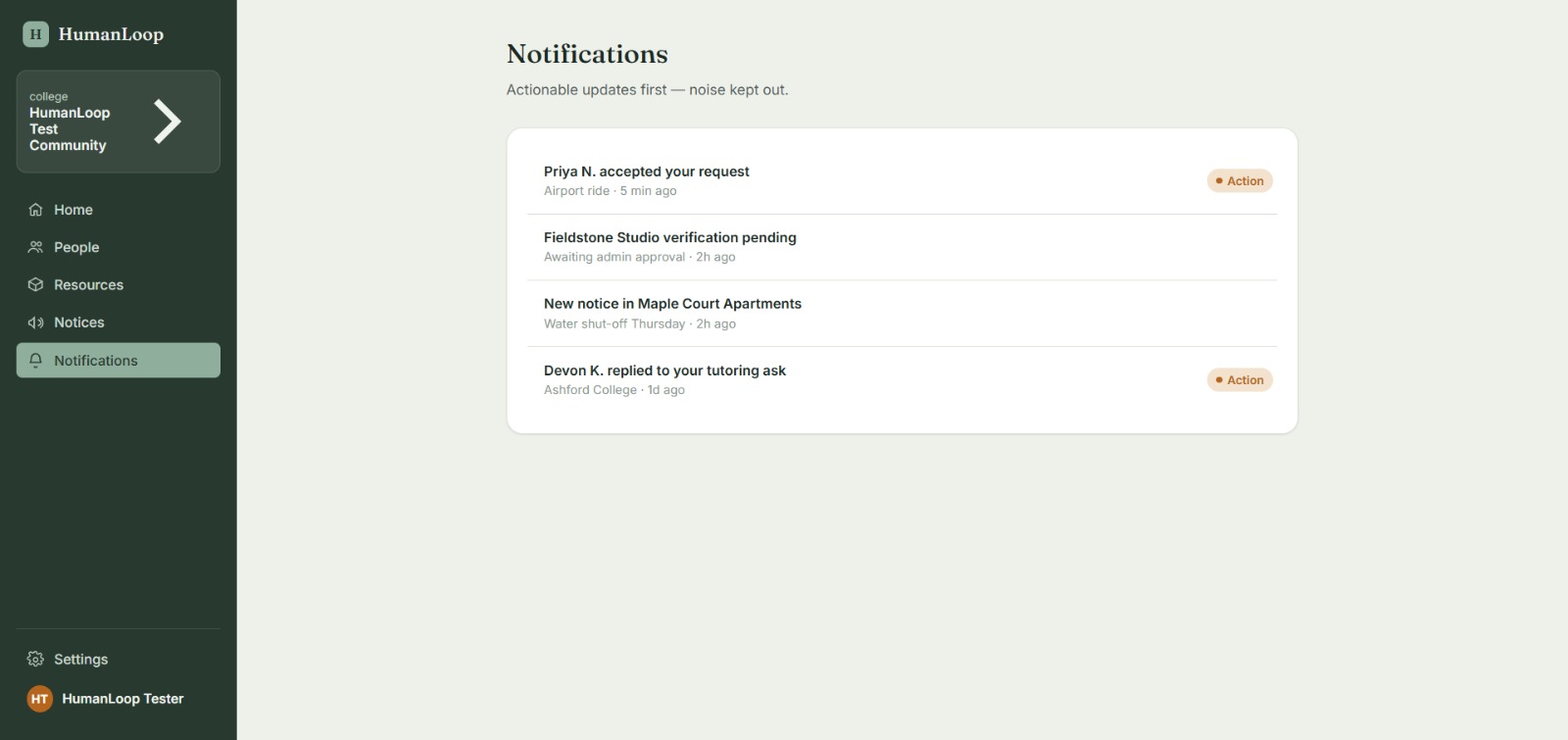
Users can view important community updates, requests, and notifications.
-

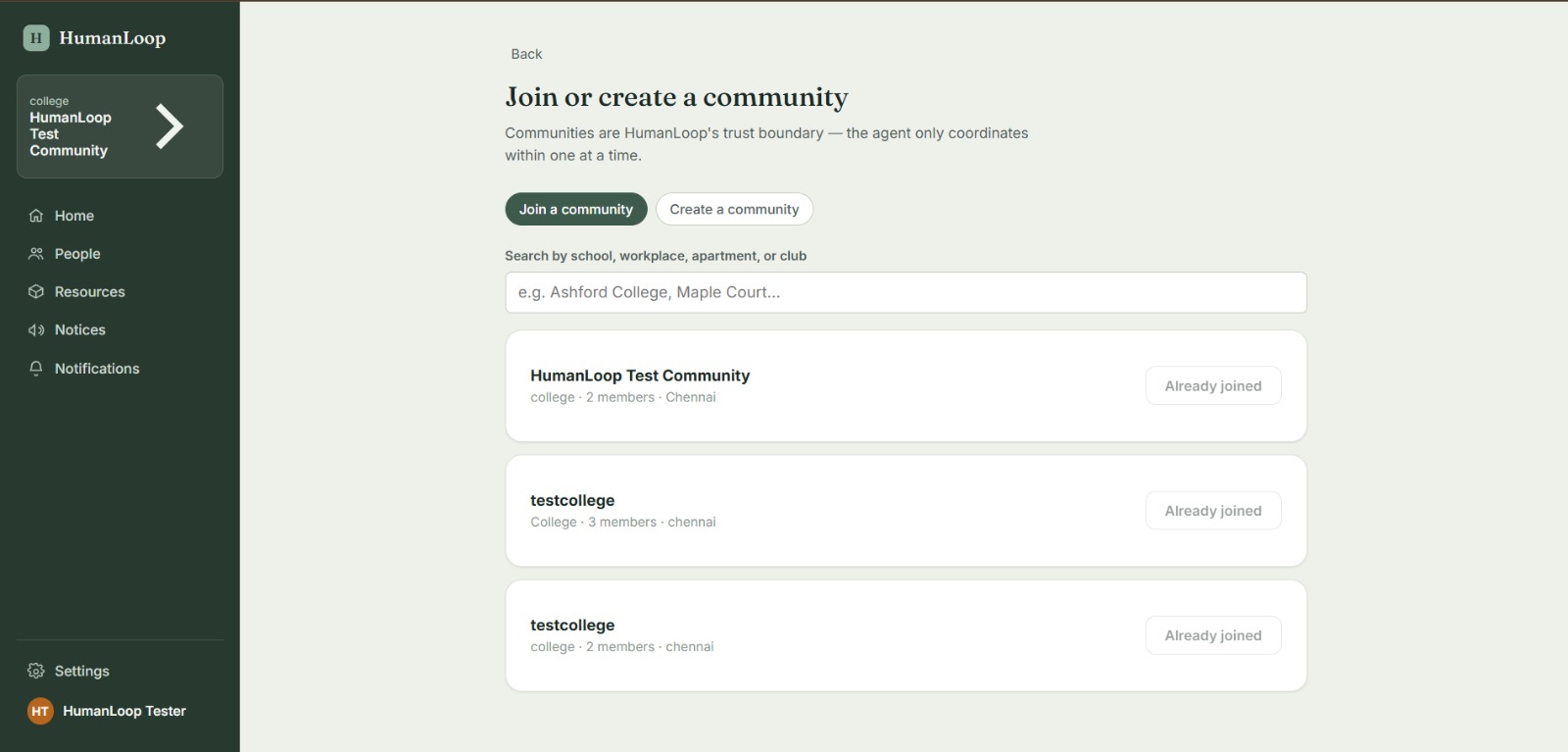
Users can join an existing community or create a new trusted community
-
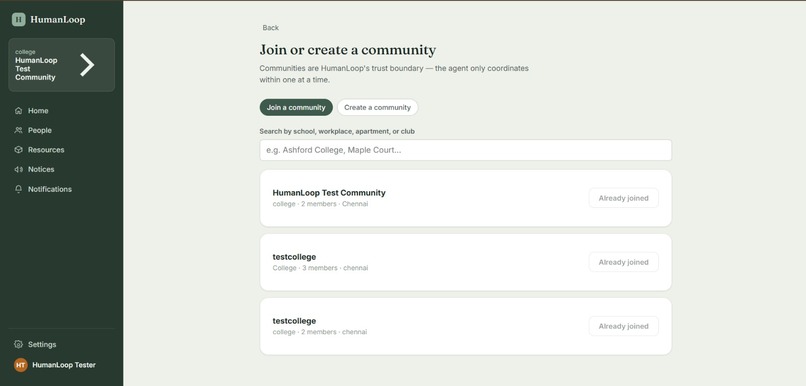
Users can search for communities and join the ones they are interested in
-
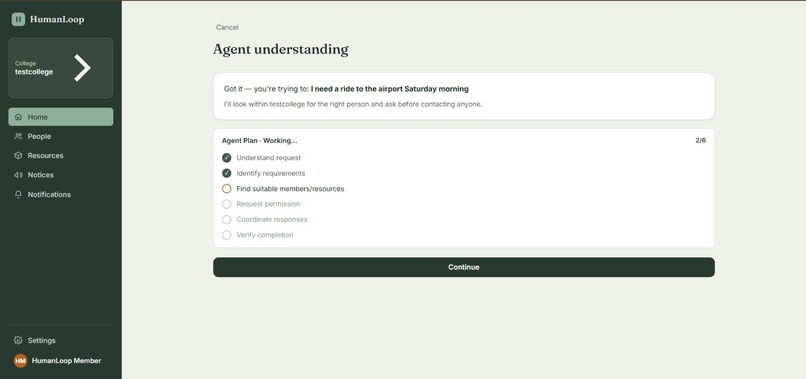
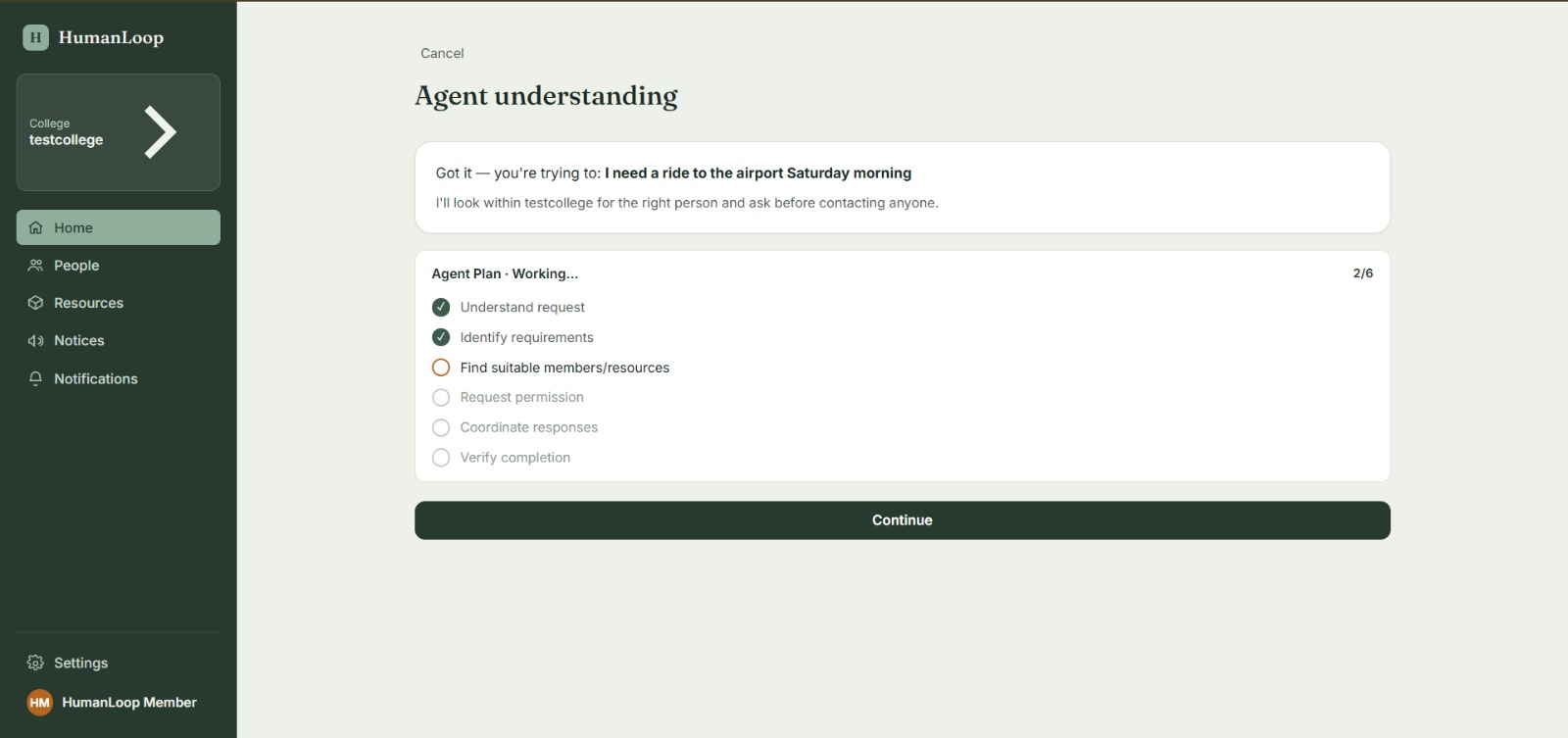
Agent Understanding Page: HumanLoop understands the request, creates a plan, finds suitable people, and coordinates the task.

Inspiration
Every community is full of people who are willing to help — but finding the right person at the right time is often harder than it should be.
A student might need help understanding a topic before an exam. A neighbor might need to borrow a tool. Someone might need a ride, while another person nearby already has the time and ability to help. In most communities, these problems are solved through scattered group chats, repeated messages, personal contacts, or simply hoping the right person sees a post.
We felt there was a gap between having a connected community and actually being able to coordinate within it.
We wanted to build something that could take a simple human request and turn it into meaningful action — without turning the AI into a replacement for the people involved.
That idea became HumanLoop.
HumanLoop is a community-scoped AI coordination agent designed to help people discover and coordinate with the right people, skills, and resources within communities they already belong to.
The core idea is simple:
Let AI handle the coordination work, while humans remain at the center of the solution.
What it does
HumanLoop allows users to create or join multiple verified communities such as colleges, apartment communities, workplaces, clubs, and other trusted groups.
A user can select one active community and simply tell HumanLoop what they are trying to accomplish.
For example:
“I need someone to help me with calculus this weekend.”
Instead of responding with a generic AI-generated answer, HumanLoop treats this as a coordination task.
The agent:
Understands the user's request. Creates an action plan for solving it. Searches the active community for suitable verified members. Presents potential matches and explains why they may be relevant. Asks the user for permission before contacting another member. Initiates the coordination process. Tracks the request through to completion.
This creates a transparent flow:
Request → Understanding → Plan → Matches → Permission → Coordination → Completion
The important distinction is that HumanLoop does not try to solve every problem itself.
The AI coordinates. People help people.
How we built it
HumanLoop was built as a full-stack web application with a React frontend, FastAPI backend, and PostgreSQL database.
Frontend
We built the user experience using:
React Vite Component-based UI Interactive agent workflow Community switching Community creation and joining Member verification and management Request and coordination interfaces Agent progress visualization
The interface was designed around the idea that users should be able to see what the agent is doing rather than simply receiving an unexplained AI response.
Backend
The backend was built using:
Python FastAPI PostgreSQL SQLAlchemy Alembic REST APIs
The backend handles authentication, users, communities, memberships, verification, requests, matching, and request status.
Agent layer
The agent layer is responsible for turning a user's request into a structured coordination workflow.
When a request is created, HumanLoop generates an action plan and searches the active community for verified members who could potentially help.
The system then connects the request to actual community membership data instead of relying entirely on fabricated AI responses.
This was an important design decision for us: the agent should operate on real community context.
Challenges we ran into
Building HumanLoop in a hackathon environment was challenging because the idea required much more than simply creating a chatbot interface.
One of our earliest challenges was defining what the AI agent should actually be responsible for.
We explored several directions before realizing that the strongest version of HumanLoop was not an AI that simply answered questions, but an agent that could understand an objective and coordinate the steps required to move it forward.
Building the community architecture
We also had to think carefully about trust.
If an agent can find and contact people, it cannot simply search across everyone on the platform. That led us to establish the community as the agent's trust boundary.
A user can belong to multiple communities, but HumanLoop operates within one active community context at a time. This prevents unrelated communities from being mixed together and gives the agent meaningful context for every request.
Connecting the agent to real data
Another major challenge was moving from a UI prototype to an actual working system.
We had to connect:
Authentication → Communities → Memberships → Verification → Requests → Matching → Agent workflow
Getting the frontend and backend to communicate correctly, handling authentication, database migrations, membership states, verification requests, and API errors required significantly more iteration than we initially expected.
Building under time constraints
Because this was built during a hackathon, we also had to make difficult decisions about scope.
There were many features we wanted to build, but we focused on getting the core coordination loop working end-to-end instead of building a large collection of disconnected features.
That meant repeatedly simplifying, testing, debugging, and prioritizing the pieces that mattered most to the actual product experience.
Accomplishments that we're proud of
We are proud that HumanLoop became more than a visual concept.
We built a working foundation where a user can move from:
“I need help” → Agent understands → Plan is created → Verified members are found → User selects a person → Permission is requested → Coordination begins → Task can be completed
We are particularly proud of the community-scoped architecture.
A single account can belong to multiple communities, while the agent maintains one active community context. This creates a clear boundary for the information and people the agent can coordinate with.
We are also proud of making the agent's reasoning and progress visible through the interface.
Rather than hiding everything behind a chat window, HumanLoop shows the stages of the coordination process so that users can understand what is happening and remain in control.
Most importantly, we built HumanLoop around a principle that shaped the entire project:
AI should strengthen human communities, not replace them.
What we learned
The biggest lesson we learned was that building an AI agent is not just about making the AI smarter.
The difficult part is designing the system around the intelligence.
An agent that interacts with real people needs boundaries, permissions, context, reliable data, and a clear way for humans to remain in control.
We learned that seemingly simple product decisions — such as who the agent is allowed to contact, which community it can search, when it needs permission, and how progress is communicated — become extremely important when AI moves from generating text to taking action.
We also learned the importance of building from the user journey backward.
Instead of asking “What AI features can we add?”, we started asking:
“What should happen after a person tells HumanLoop they need help?”
That shift helped us turn a collection of possible features into a coherent end-to-end product.
Finally, the hackathon taught us how important prioritization is. We had to balance ambition with time, focus on the core value of the product, and continuously test whether each feature actually contributed to the experience.
What's next for HumanLoop
The hackathon version of HumanLoop establishes the foundation for a much larger vision.
Our next goal is to evolve HumanLoop from a basic coordination workflow into an intelligent coordination layer for communities.
Smarter community-aware intelligence
Future versions will give the agent stronger long-term community context.
HumanLoop could understand members' skills, availability, interests, resources, previous successful interactions, and community-specific patterns while keeping each community's information separate.
This would allow the agent to make increasingly useful decisions without requiring users to explain the same context repeatedly.
Skills, resources, and volunteering
We want HumanLoop to become a broader bridge between people, skills, resources, and time.
Members could offer:
Skills they can teach or share Items they are willing to lend Resources they want to give away Time they can volunteer Specific types of help they are comfortable providing
Instead of simply asking “Who can help?”, HumanLoop could understand what a community already has and connect those resources to people who need them.
Smarter matching
Our current foundation can evolve into a much richer matching system.
Future matching could consider:
Relevant skills Availability Location within a community Previous successful interactions Reliability Request urgency Specific requirements of the task
The goal would be to make every match increasingly relevant while maintaining transparency about why someone was recommended.
Real coordination and scheduling
HumanLoop could eventually connect with calendars and scheduling systems to coordinate availability, confirm meeting times, send reminders, manage follow-ups, and handle multi-step requests.
This would move the agent from simply finding someone to actually helping coordinate the entire task.
Trust and reputation
As communities grow, trust becomes even more important.
Future versions could introduce stronger trust signals based on verified membership, successful interactions, reliability, and community feedback.
The goal would not be to create a public social ranking system, but to give the agent better information for making safe and useful coordination decisions.
Expanding across communities
The same foundation can support many different environments:
Universities → Classrooms → Apartment communities → Workplaces → Clubs → Neighborhoods → Local organizations
Each community would maintain its own context and trust boundary while allowing a user to participate in multiple communities through one account.
Long-term vision
Ultimately, we see HumanLoop becoming more than a request-management application.
We envision an AI coordination layer for human communities — one that helps people discover opportunities to help each other, share resources, organize activities, and solve everyday problems that are currently buried inside group chats and disconnected conversations.
The long-term goal is not to build an AI that makes communities unnecessary.
It is to build an AI that makes existing human connections easier to activate.
HumanLoop keeps humans in the loop — while making the loop work better.
Built With
- agents
- ai
- alembic
- api
- authentication
- automation
- collaboration
- community
- css
- database
- fastapi
- fullstack
- git
- html
- javascript
- machine-learning
- natural-language-processing
- python
- react
- restapi
- sqlalchemy
- vite
- webapp

Log in or sign up for Devpost to join the conversation.