
Basic ideas
Recently, the clinical review is in the difficult position that the patients in the clinical review are fewer and fewer. I think that the patients do not familiar with the health industry is a big reason. The clinical trials are just for the doctors and some big pharmacy company but the patients can not understand the complex terms, their curative effect and the side effects, so that they will fear to volunteer. We set PD-1 inhibitor as an example, use different data frame to demonstrate the post-clinical model, so that the patients in the clinical trail can have their expect of the treatment, and this will give them confidence. We can use ML tech to solve this. I have the mission to develop the clinical trail part into an app. And this APP can run on their own device so the people who want to contribute can do a bit, this will make the public familiar with the industry, and in the long term anyone can benefit.
Pain point
Eligible patient recruitment is a limiting factor in the completion of clinical trials, including those of immuno-oncology therapies. 80% of clinical trials are delayed or closed because of issues with recruitment. 11% of sites in a given trial fail to enroll a single patient and 37% under-enroll. We want to change this.
The technical barrier: let everyone can touch and feel the science and the advanced tech, we do not want them to struggle in the misty of unknown.
What it does
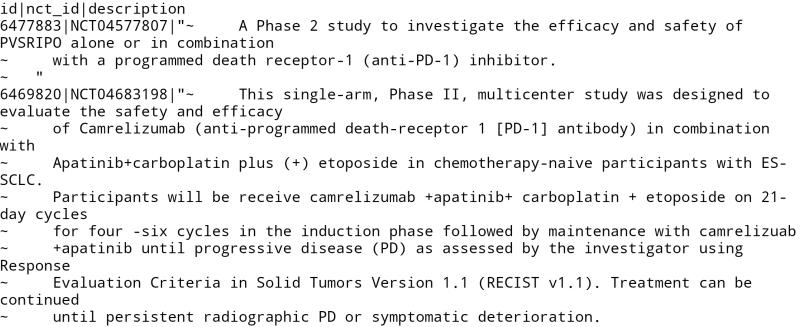
A solution to this problem is a model that will predict the likelihood of someone benefiting from the treatment of focus. We found on the Clinical Trails Transformation Initiative website and download it want to train a model to show the good effect of the drug. Our hypothesis is that patient participation will significantly increase as chances of treatment failure significantly decrease. What's more, when this goes in to the APP form, everyone can receive some knowledge of hygiene and sanitation, and there are also some packages that can run on the device if they want.
How we built it
ML, database, distributed calculating, popularization of science
Challenges we ran into
There are some problem with down loading the data, so we do not have enough time in the model demonstrate progress.
We also need a good UI designer.
Accomplishments that we are proud of
We look after the weakest group in the clinical trail, in the Internet age, everyone counts and all of us should benefit.
The calculate of data in the ML process will need hashrate, we can overcome it by put the data into different package and run on the public's device. This can also make the public familiar to the health industry.
The measure will affect both the patients and the pharmacy company
“Deep to the capillary”: the machine learning part can make everyone in public to join in, especially the next generation.
What we are facing is not the crowd, but each person, everyone is not only the terminal, but the great source of the power that innovate the medical progress.
We are from different background, using different language, has different culture, but we can corporate together. We overcome some device problem to communicate.
Business Model
We are a non-profit commonweal organization, if we have profit we just want more talents to innovate the health industry going better.
What we learned
We can not beat down with the setbacks, accurately, we have a big amendment of the direction.
What's next?
We can expand this kind of drug to all kinds of drugs, Google can show her magic to collect or coordinate some clinical trail data.
Log in or sign up for Devpost to join the conversation.