-
Brand Logo
-
Human2Human mobile application screenshots
Inspiration
You’re on your way to work in the downtown core, and you walk past several homeless people asking you for money. One particularly plucks at your heartstrings, and you wished you had something to give. But the reality is that you never have cash on you anymore, and you’re usually rushing to your next meeting when walking through the city.
I’m sure we’ve all experienced this before, many times.
What it does
Human2Human is a social program and mobile application that helps you get your giving on.
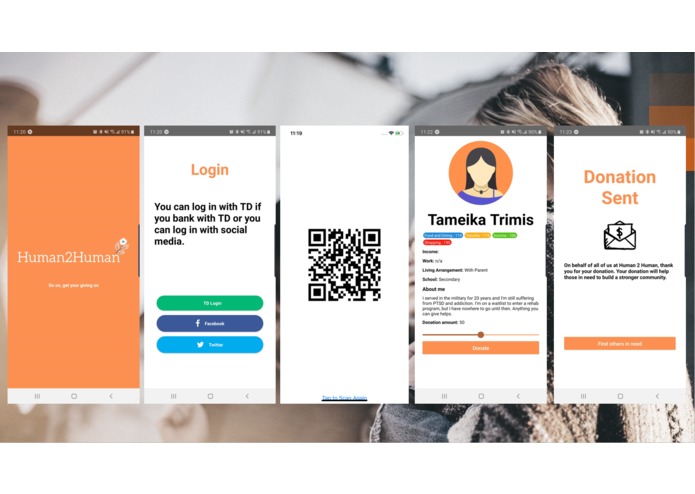
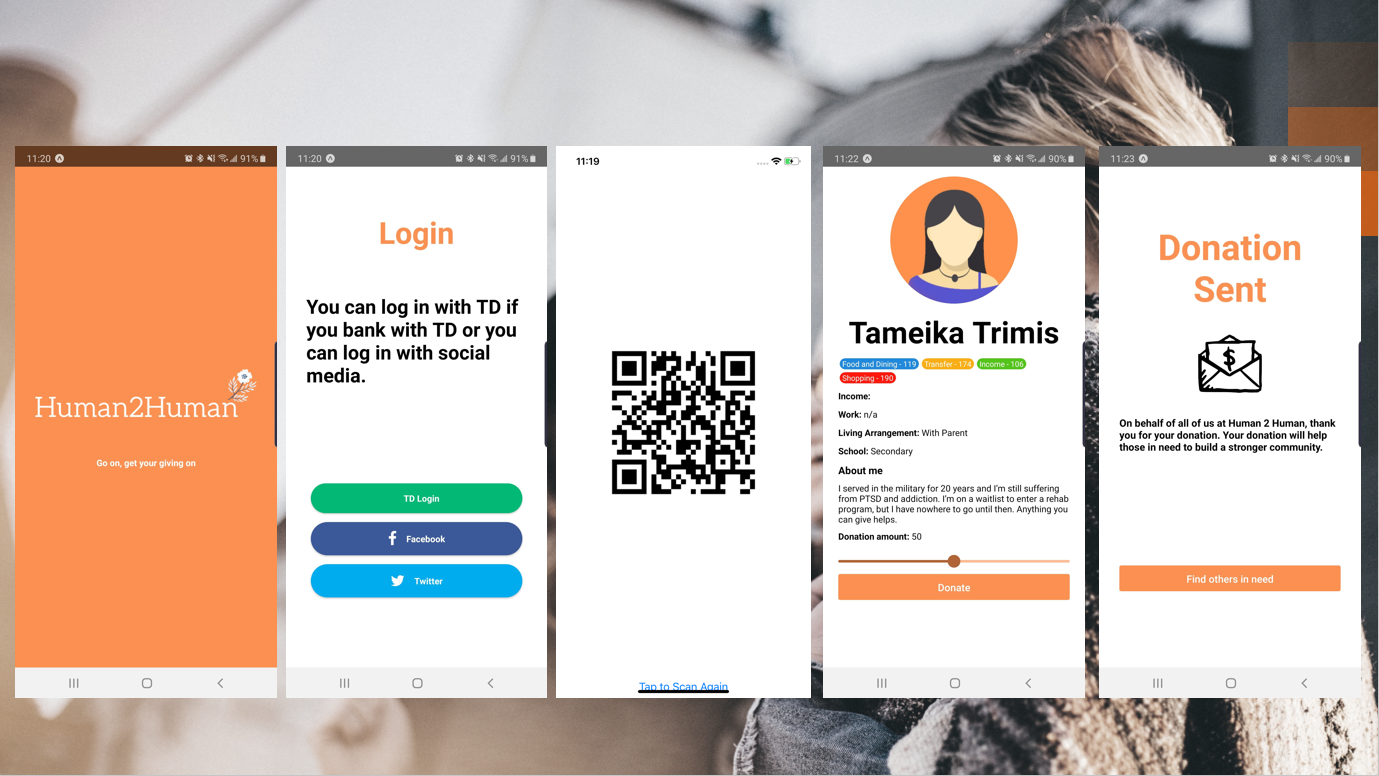
Imagine that person in need, let’s call him David, has a QR code which he received when he registered for the Human2Human program from a local shelter or at a TD bank branch. You, the donor, can scan this QR code from the Human2Human mobile app, verify David’s identity through the photo on his Human2Human profile, learn about his story through the bio he wrote, and make an online donation in seconds. Instead of rifling through a bag for the change you wish you had, you can spend this time actually talking to David, and making that human connection. Afterward, David can use his special TD card linked to the account where your donation was deposited to buy food, save for shelter, of whatever else David needs. If David’s plight is still in the back of your mind, you can easily locate him from your transaction history and donate again.
Beyond ease of use, there are additional benefits of digitizing personal donations. People spend less money when using cash compared to credit, so by sending digital money through the app, David will get more money per interaction on average. In addition, his money is safe from being lost or stolen while he’s out on the streets.
The increased spend is fine with you too; you’re spending more money today, but unlike untraceable cash donations, the Human2Human app tracks your donations history. You can use this charitable giving history to submit a tax credit, and receive up to half of that money back. Talk about a win-win!
How I built it
We discussed the products roles and collaboratively designed mock ups. We decided to use React.native which allows us to utilize our web-development skills to build out a native mobile app. We used TD’s Davinci API to GET real customer data for the user logging in (donor) and for the user that will receive donation payments (donee). We also used the TD Davinci API to CREATE transactions between the user logging in (donor) and the user that will receive donation payments (donee). We used development tools such as Expo for testing and running simulators for our native app. We used GitHub for version control so our developers can collaborate efficiently. Most of our code is primarily written in React Native JavaScript.
Challenges I ran into
Strategy Challenges
- What if the QR code gets stolen? Solution: By creating a profile of the user with a photo, a donor can check that the QR code the person has matches their profile image
- How can we balance program transparency and the right to privacy? Solution: Much value of the program lies in insights from the data history of the homeless person’s spending. This data can be used in aggregate by governments or non-profits to help design solutions to the homelessness problem. 3. To participate in the program, the individual must be willing to have their transaction history visible to Human2Human. How do we incentivize positive behavioural spending without paternalistic control on the individual’s choice of spending? Solution: Our current iteration simply transfers money to the individual, but in future iterations, the homeless person could list items they need and the end user could choose to contribute directly to those items or to unrestricted money.
- How do we provide additional business value to justify the investment into a CSR initiative? Solution: Through Human2Human, TD plays the role of facilitating the connection between individual contributors and individuals in need, instead of paying a lump sum donation Research has shown that CSR is not profitable in the short-term, but expected by shareholders. https://ir.lib.uwo.ca/cgi/viewcontent.cgi?article=2849&context=etd
Technical Challenges
- Coming from web-development background, learning React Native was entirely new and we faced a learning curve
- React Native is still a relatively new language and not yet well supported in the community, which so help and documentation was difficult to find when we ran into problems
- Many times, certain versions of the API did not match the documentation, or was moved between libraries
- Debugging in React Native was not built in, and we didn’t have the time to debug properly. As a result, many problems we faced took substantially more time to resolve
- Setting up our environments to run the Native device simulators has proven to be difficult and did not work initially
- The initial documentation for setting up our environment was not sufficient to fully on-board and dive directly into coding
- Finding component libraries that fit our product design was challenging, due to React Native’s recency, so there are fewer libraries built around the ecosystem.
Accomplishments that I'm proud of
- The simplicity of our solution to tackle a real problem
- Learning more about the homeless population’s life, struggles, and needs
- The impact of humanizing the connection between a person in need and a person who can give
- Branding the application, the program, and it’s value to communities and to TD
- Building a fulling functioning, branded, proto-type mobile application
- Used minimal mock-data
- Used the TD API to get and create transactions
- Learning React Native, and how to set up a working environment for React Native
What I learned
The homeless population in Toronto has extremely high mobile phone possession. A recent survey suggests that 90% of homeless people have a mobile phone in North America. https://www.tandfonline.com/doi/abs/10.1080/10530789.2017.1305140
CSR is understood as a short-term expense with the expectation of long-term profit, an expectation of shareholders of Canadian banks. https://ir.lib.uwo.ca/cgi/viewcontent.cgi?article=2849&context=etd
What's next for Human2Human
Product Enhancements
- Donating for specific uses: The future state of the app would have categories to donate to (for example: groceries, winter coat, saving for rent, children’s items) that are informed by the common needs in the local regions and selected by the individual in need when setting up their profile. As a donor, you would be able to choose the category most meaningful to you and to the homeless person.
- Ability to manage their profile online: Given that the majority of homeless people have a mobile phone, Human2Human will allow donees to use their phone to store and present their QR code, edit their profile information, receive push notifications, and report suspicious activities on their account.
- Data-driven insights: The app will provide donees with a spending trend dashboard and transaction report to track the donations they receive and spend
- Spending more easily: Human2Human will develop functionality to allow donees to make purchases with their QR codes.
- Categorize food, drinks and shopping. We can categorize the company’s ID and we can show the top 5 transactions that occur in each section
- Tag the donations: We can track how many donations an individual is receiving by tagging the donations. This could provide insights on more lucrative areas, better behaviours etc.
Program Enhancements
- Expanding partnerships: Build partnerships with other organizations such as retail stores to provide discounts and allow donees to use their QR codes to make a purchase. These partnership network will be used to create job opportunities for Human2Human donees.
- Data-driven programs: Analyze the transaction data to monitor trends on homeless people’s spending and connect existing non-profits and public services directly to homeless individuals. The trends can indicate if they need help accessing specific resources such as rehab, mental health centres, hospitals etc.
- Financial Education: Provide educational programs and events to Human2Human donees to help them strengthen their financial literacy
Business Value
By aggregating the data of Human2Human users, we can develop profiles for frequent donors. This data can be cross-referenced with the users’ other online activity to draw insights about the characteristics of people who tend to donate, and sent to non-profit and fundraising agencies.
As CSR becomes an expectation from shareholders and a key differentiator for up-coming generations of investors, TD’s brand benefits from leading this trend.
Human2Human will be an initiative that delivers big impact at minimal cost provides, which provides significant business value. Through this app, TD facilitates the connection between private individual donors and private individuals in need without bearing the main financial cost. Human2Human’s program provides many opportunities for TD to partner with other organizations to sponsor the product and program enhancements. This model will have a sustainable, long-term, and transformative impact on the homeless population and throughout local communities.
Built With
- davinci-api
- expo.io
- javascript
- react-native

Log in or sign up for Devpost to join the conversation.