Human (Pending Review)
Project Summary
Human (Pending Review) is a mobile, portrait-mode resource-management game built for Meta Horizon.
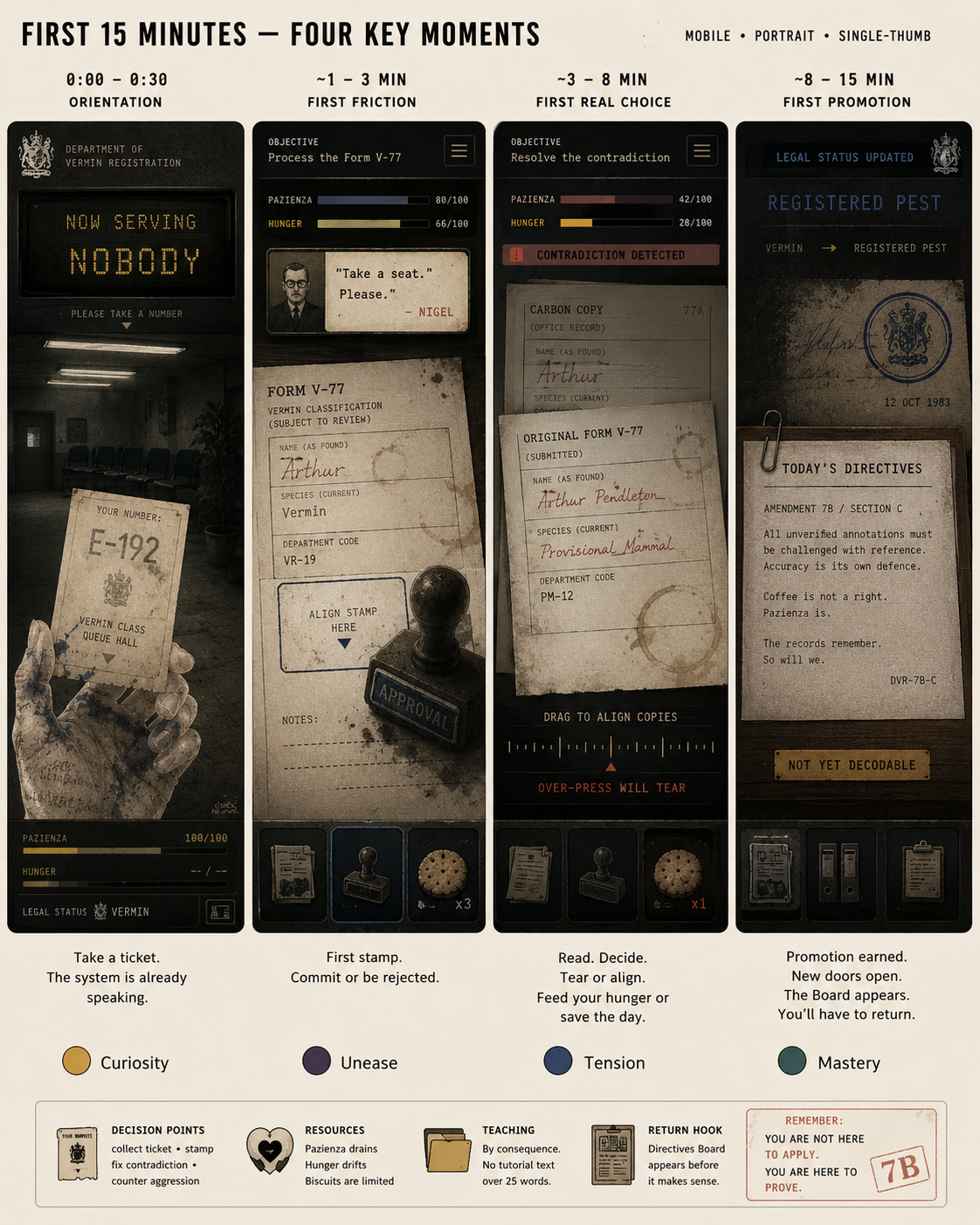
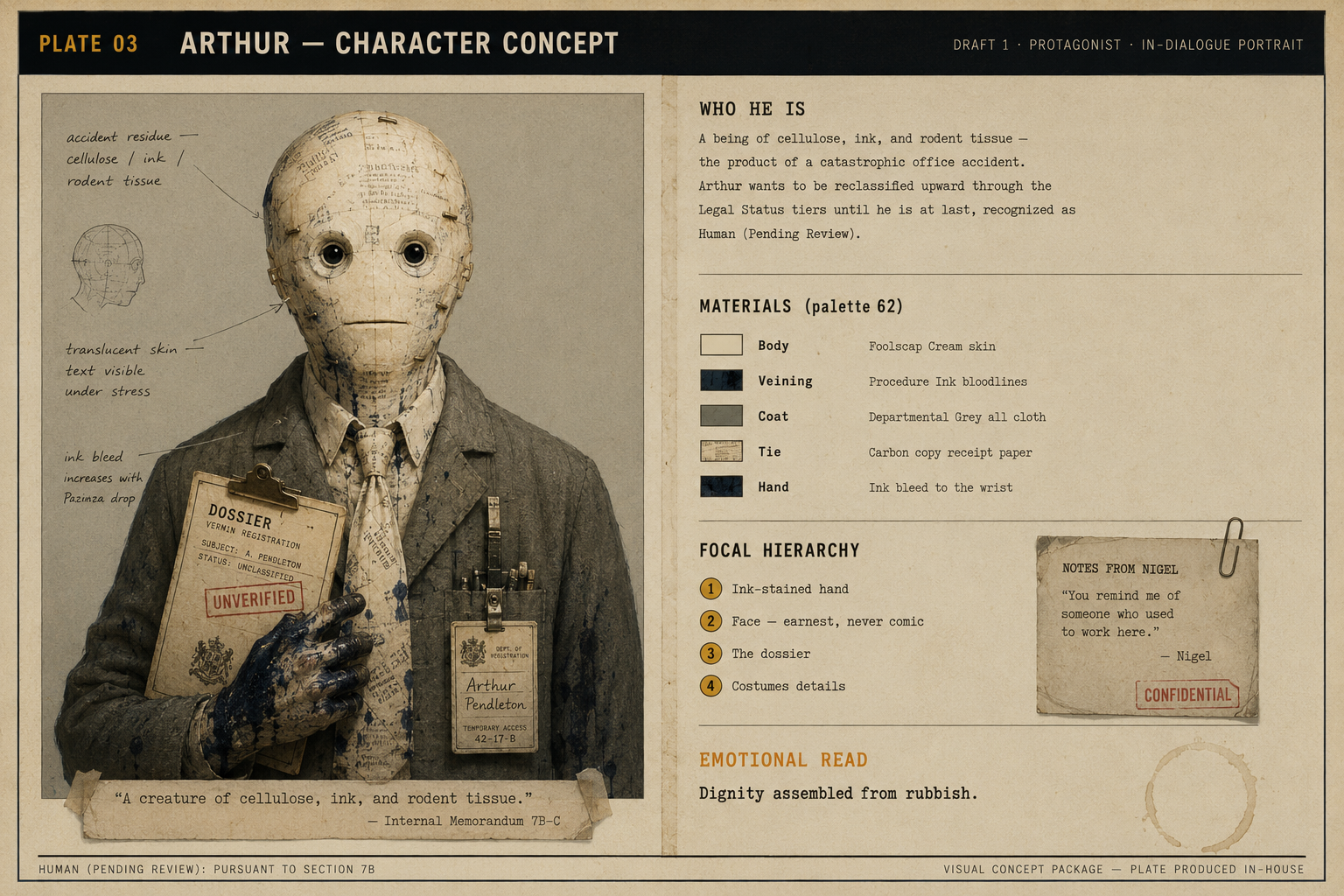
Players control Arthur, a failed administrative lifeform assembled from cellulose, ink, and rodent tissue after a catastrophic office accident. To earn legal recognition as a human being, Arthur must survive a hostile bureaucracy by processing paperwork, managing resources, navigating contradictions, and advancing through government-defined Legal Status tiers.
The game combines tactile document interactions, survival-resource management, bureaucratic problem-solving, and asynchronous social systems into a single progression loop.
Genre
Primary Genre: Resource Management
Secondary Genres:
- Bureaucratic Simulation
- Puzzle / Audit Game
- Narrative Progression
- Asynchronous Social Competition
Platform
Target Platform: Meta Horizon
Device: Mobile
Orientation: Portrait
Interaction Model: Single-thumb touchscreen gameplay
Core Gameplay Loop
- Receive forms from applicants.
- Stamp, approve, reject, or audit paperwork.
- Detect contradictions and administrative errors.
- Survive workplace aggression and resource pressure.
- File evidence into the Department archive.
- Earn promotions and improve Legal Status.
- Unlock new offices, systems, and investigations.
Core Loop:
Stamp → File → Audit → Counter-Aggression → Promotion
Key Features
Precision Stamping System
The player physically positions, rotates, and applies official stamps to government documents. The entire production plan was built around validating whether this interaction feels satisfying on a touchscreen.
Resource Management
Players manage:
- Pazienza (primary survival resource)
- Hunger
- Coffee Dependency
Every decision trades one resource against another.
Contradiction Detection
Official records frequently disagree.
Players compare forms, carbon copies, annotations, and archived evidence to identify administrative contradictions before filing.
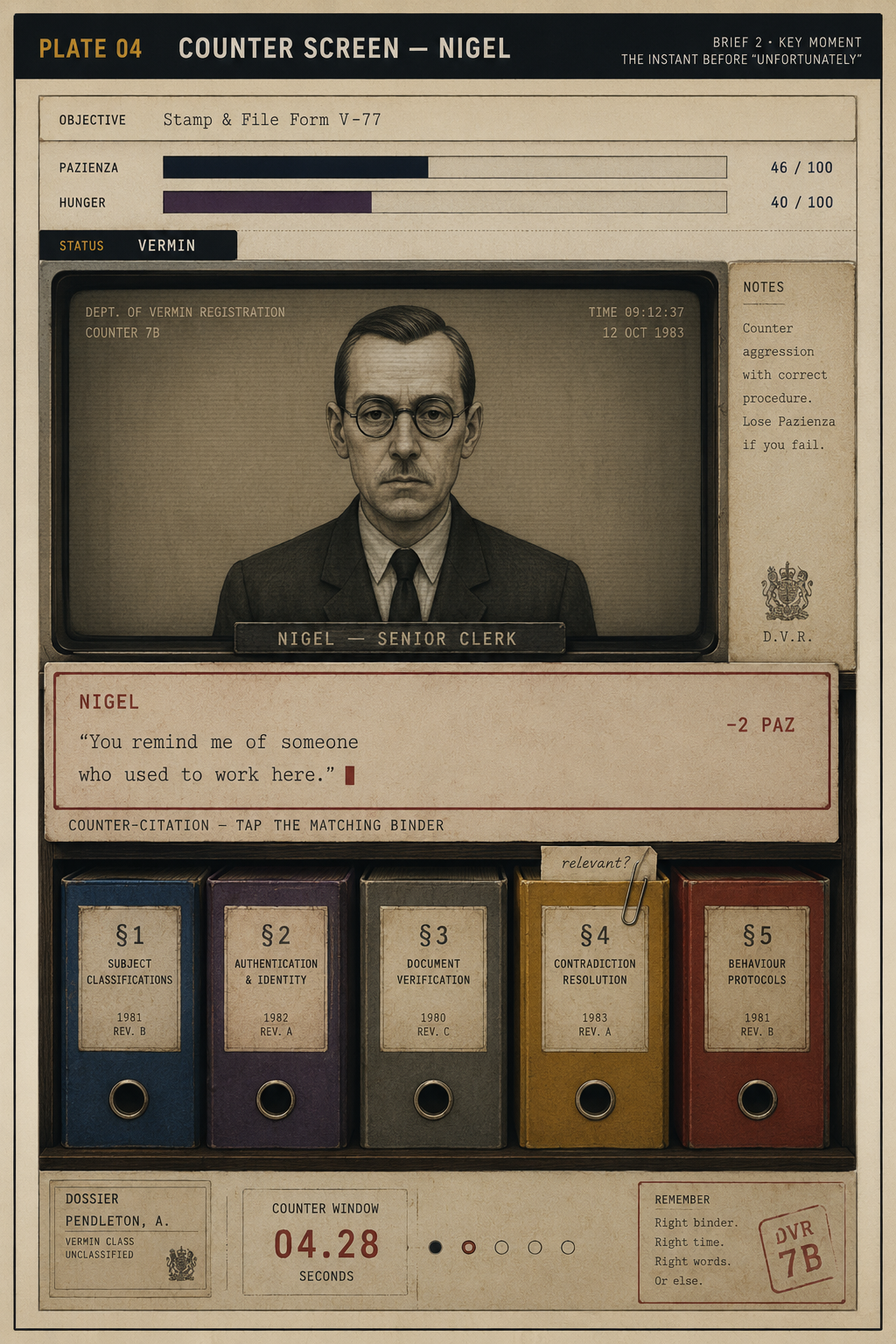
Counter-Citation Defense
Hostile clerks attack Arthur verbally and administratively.
Players defend themselves by locating supporting regulations and submitting the correct counter-citation before their Pazienza collapses.
Catastrophe Events
High-level sessions introduce crisis states that remix existing mechanics:
- Kinetic Triage
- Origami Filing Protocol
These increase pressure without introducing entirely new controls.
Legal Status Progression
Arthur advances through government classifications including:
- Vermin
- Registered Pest
- Higher administrative tiers
- Human (Pending Review)
Progression represents increasing legal recognition rather than traditional power growth.
Ghost Applicants
Players discover traces left behind by previous applicants.
These asynchronous artifacts create the feeling of a shared bureaucratic history inside the Department.
Weekly Efficiency Review
All players receive the same weekly docket and compete for the highest efficiency score.
This transforms Meta Horizon persistence and leaderboard systems into an in-fiction administrative performance review.
Inspiration
The project began with a simple question:
What would a bureaucracy game look like if the player were the one trying to prove they deserve to exist?
Many bureaucracy games focus on power, optimization, or authority.
Human (Pending Review) explores recognition instead.
The project draws inspiration from:
- Administrative systems and government paperwork
- British municipal design from the late 1970s and early 1980s
- Bureaucratic absurdism
- Identity, classification, and institutional legitimacy
Rather than treating paperwork as background flavor, every mechanic is built around the emotional consequences of being documented, classified, and evaluated.
Innovation
Bureaucracy as Survival Gameplay
The player's primary threat is not combat.
Pressure emerges from administrative workload, contradictory records, resource scarcity, and institutional hostility.
Identity as Progression
Progression is measured through legal recognition.
The player does not become stronger by acquiring equipment or abilities.
The player becomes more legitimate.
Narrative Through Administration
Story progression is delivered through forms, classifications, annotations, directives, and official records.
The bureaucracy itself functions as the narrative system.
Platform Systems Become Fiction
Leaderboards, persistence, and asynchronous player traces are integrated directly into the world rather than existing as external platform features.
Meta Horizon Integration
The project was designed specifically to benefit from Meta Horizon ecosystem features.
Persistent Progression
Legal Status advancement, departmental records, and player history persist across sessions.
Asynchronous Social Systems
Ghost Applicant artifacts create indirect player interaction without requiring real-time multiplayer.
Weekly Shared Challenges
The Efficiency Review distributes identical weekly dockets to all players, enabling meaningful competition and comparison.
Platform-Native Competition
Performance rankings are framed as Department efficiency evaluations, turning platform engagement systems into narrative content.
How We Built It
Development was organized around a production-first philosophy.
The first milestone validates a single question:
Does stamping a document on a phone feel satisfying?
The MVP includes:
- One office
- One document type
- One promotion
- Pazienza resource system
- Six Nigel aggression events
Additional systems are introduced only after the core stamping interaction is validated.
This approach minimizes production risk and ensures that every later feature is built on a proven gameplay foundation.
Challenges
Making Bureaucracy Fun
The central challenge was transforming paperwork into a satisfying gameplay loop without relying on combat or traditional action mechanics.
Maintaining Tone
The premise is inherently absurd.
We worked to ensure that Arthur's struggle remained sincere rather than becoming a parody.
Mobile Readability
Forms, annotations, stamps, and records contain dense information that must remain legible on small screens.
Designing Pressure Without Violence
The game creates tension through administrative systems, deadlines, resource management, contradictions, and social hostility rather than physical conflict.
What We Learned
We learned that small physical interactions can become emotionally meaningful when connected to a strong narrative context.
A stamp is normally just an office tool.
Inside this project, a stamp becomes evidence that a character deserves legal existence.
We also learned the value of validating a core interaction before expanding scope. By focusing first on tactile satisfaction, every subsequent system became easier to evaluate, prototype, and refine.
Most importantly, we learned that bureaucracy can be more than a setting. It can function as a complete gameplay language, capable of supporting progression, narrative, tension, competition, and emotional investment.


Log in or sign up for Devpost to join the conversation.