-
-
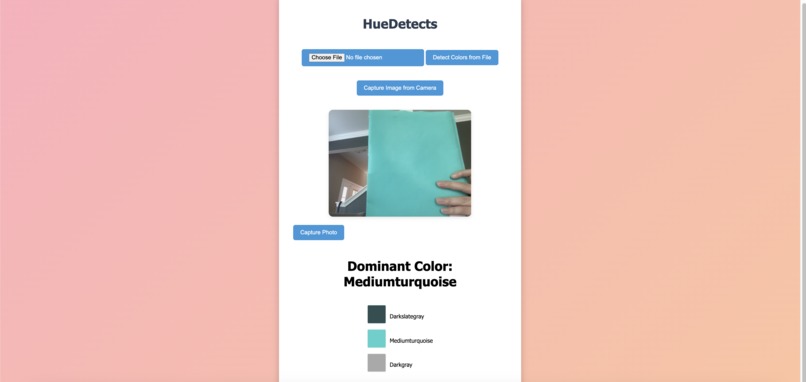
Successfully Captures Dominant and Main Colors of Live Camera Photo
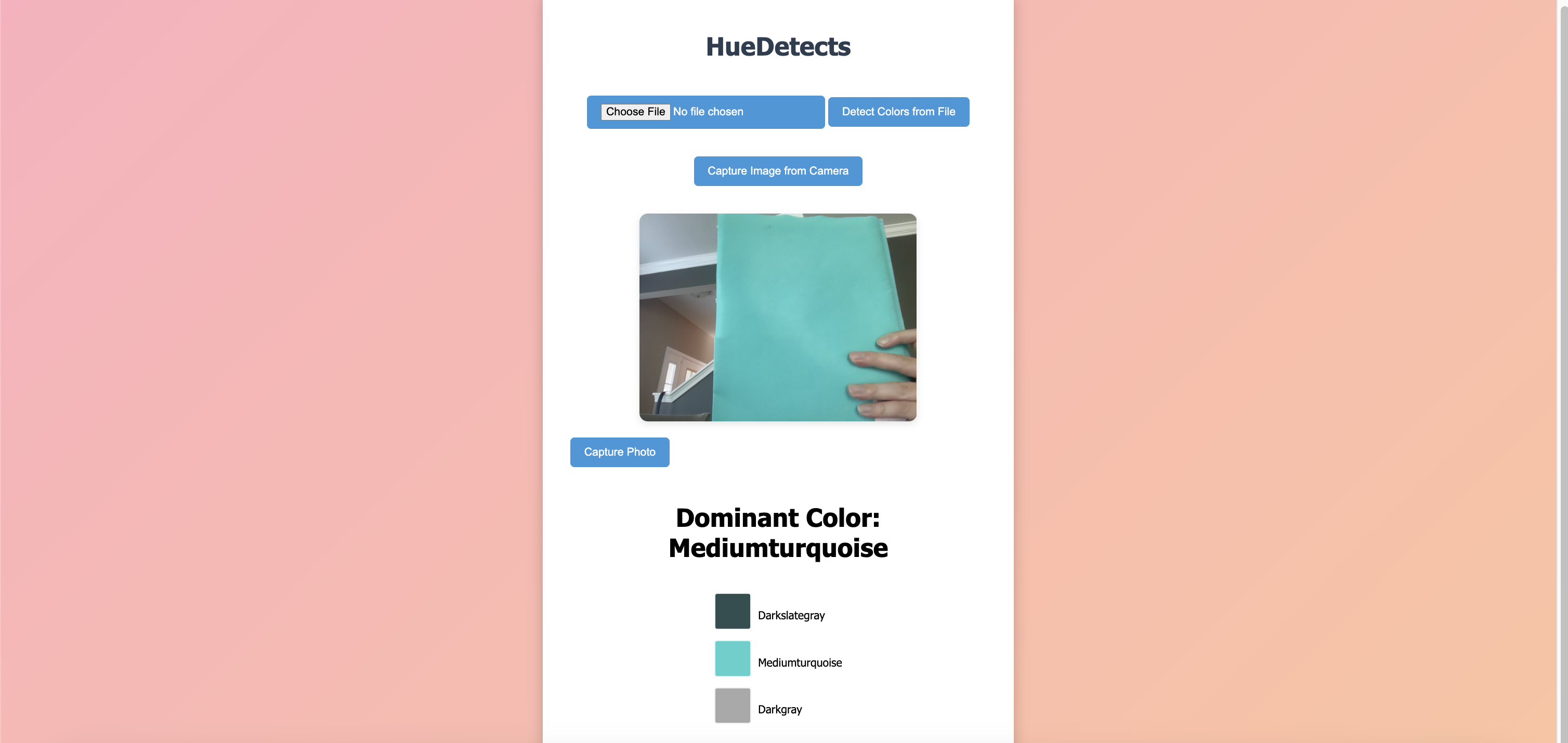
Inspiration
The inspiration for HueDetect came from our personal experience with friends who are color-blind. Seeing firsthand how challenging it can be for them to distinguish colors in everyday situations motivated us to create a tool to assist them. By leveraging technology, we aimed to develop a solution that empowers color-blind individuals to detect and understand the colors around them more easily. HueDetect is designed to provide an accessible and user-friendly experience for anyone with color vision deficiencies.
What it does
HueDetect detects the dominant and key colors from images captured via the camera or uploaded by the user. It provides a clear breakdown of the most prominent colors, their names, and their representations through visual color boxes. This enables color-blind users to better perceive the colors in their surroundings, whether through photos, real-time camera feeds, or selected images.
How we built it
The project was built using Flask for the back-end to handle image uploads, and a combination of Python libraries such as PIL for image processing and KMeans clustering to analyze color data. webcolors was integrated to convert RGB values into human-readable color names. The front-end was built with basic HTML, CSS and JavaScript for an intuitive user interface, allowing users to either upload images or capture them directly using their camera. Ngrok was used to create a public-facing URL for easy accessibility during development.
Challenges we ran into
One challenge was accurately detecting and converting the wide range of color shades into names that are meaningful for users. The process of mapping RGB values to color names required fine-tuning to ensure the detected colors were representative of what users would typically perceive. Another challenge was integrating camera functionality with browser compatibility across devices, ensuring users could seamlessly switch between uploading images and capturing them in real time.
Accomplishments that we're proud of
We are proud of successfully building an accessible tool that allows color-blind individuals to easily identify colors in both images and live camera feeds. The integration of machine learning (KMeans) for color detection, combined with the simplicity of the user interface, provides an effective solution for those with color vision deficiency. Additionally, creating a seamless flow between back-end processing and front-end presentation is an achievement we’re particularly proud of.
What we learned
Through this project, we learned the importance of optimizing image processing for real-time use, as well as the nuances involved in converting raw RGB data into practical and understandable results for users. We also gained insight into creating accessible tools that can have a meaningful impact on daily life, and the technical challenges associated with cross-platform functionality (e.g., camera integration).
What's next for HueDetect
Moving forward, we plan to enhance HueDetect by adding more granular color detection for users who want deeper insights into the specific hues within images. Additionally, expanding the platform to allow for real-time feedback during video streams could provide color-blind users with even more practical applications in daily life. Additionally, we would like to enhance the color detection to identify the exact color and location on the processed image capturing. We also hope to refine the user experience further and explore potential mobile app development.
Built With
- collab
- css
- css-libraries/technologies:-flask-(back-end)
- flask
- html
- javascript
- kmeans-clustering-(color-detection)
- libraries
- ngrok
- ngrok-(public-url-access)-apis:-browser's-mediastream-api-(for-camera-access)
- pil-(image-processing)
- python
- webcolors-(color-name-conversion)

Log in or sign up for Devpost to join the conversation.