-
-

Login Page
-
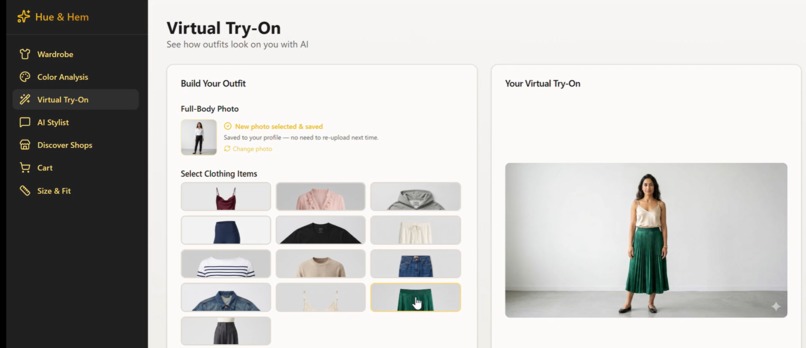
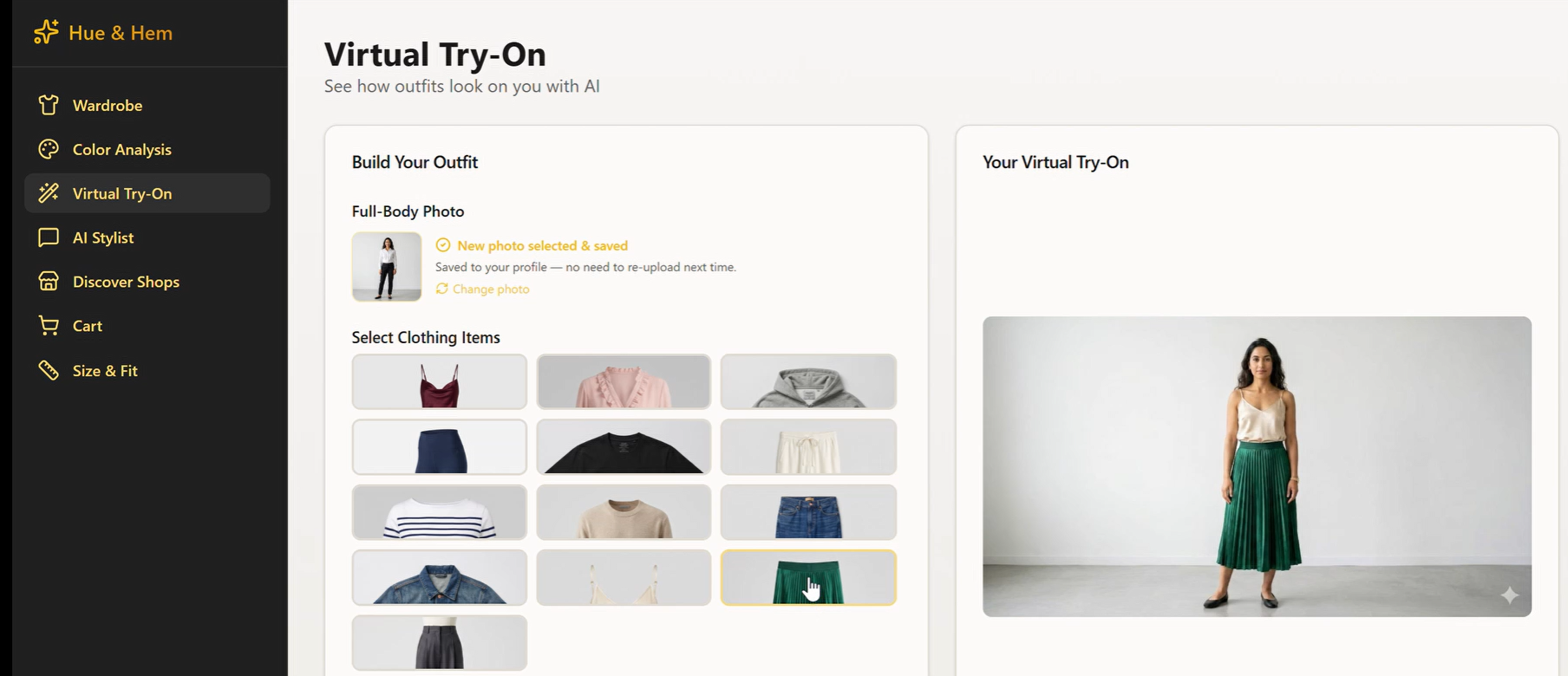
Virtual Try On
-
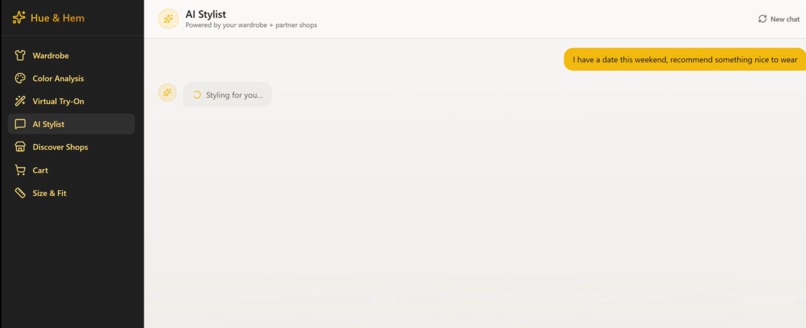
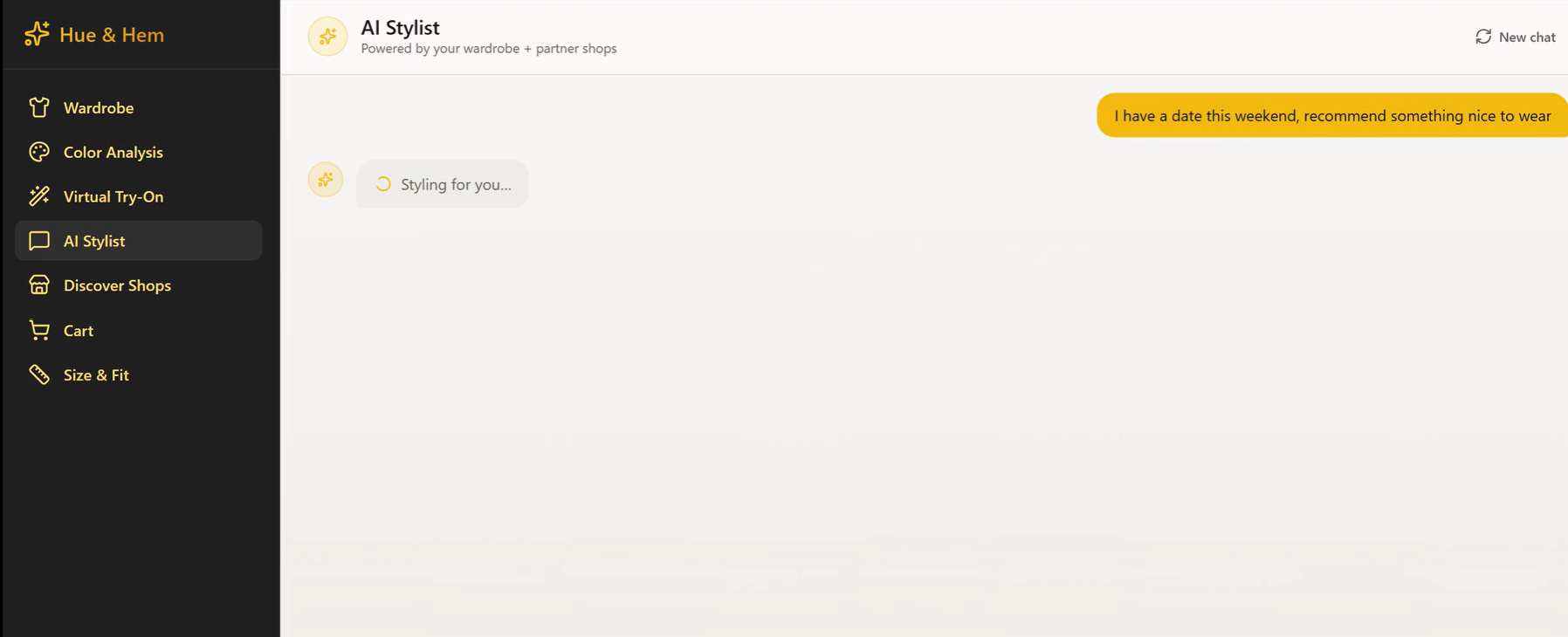
AI Stylist Chat Assistant
-

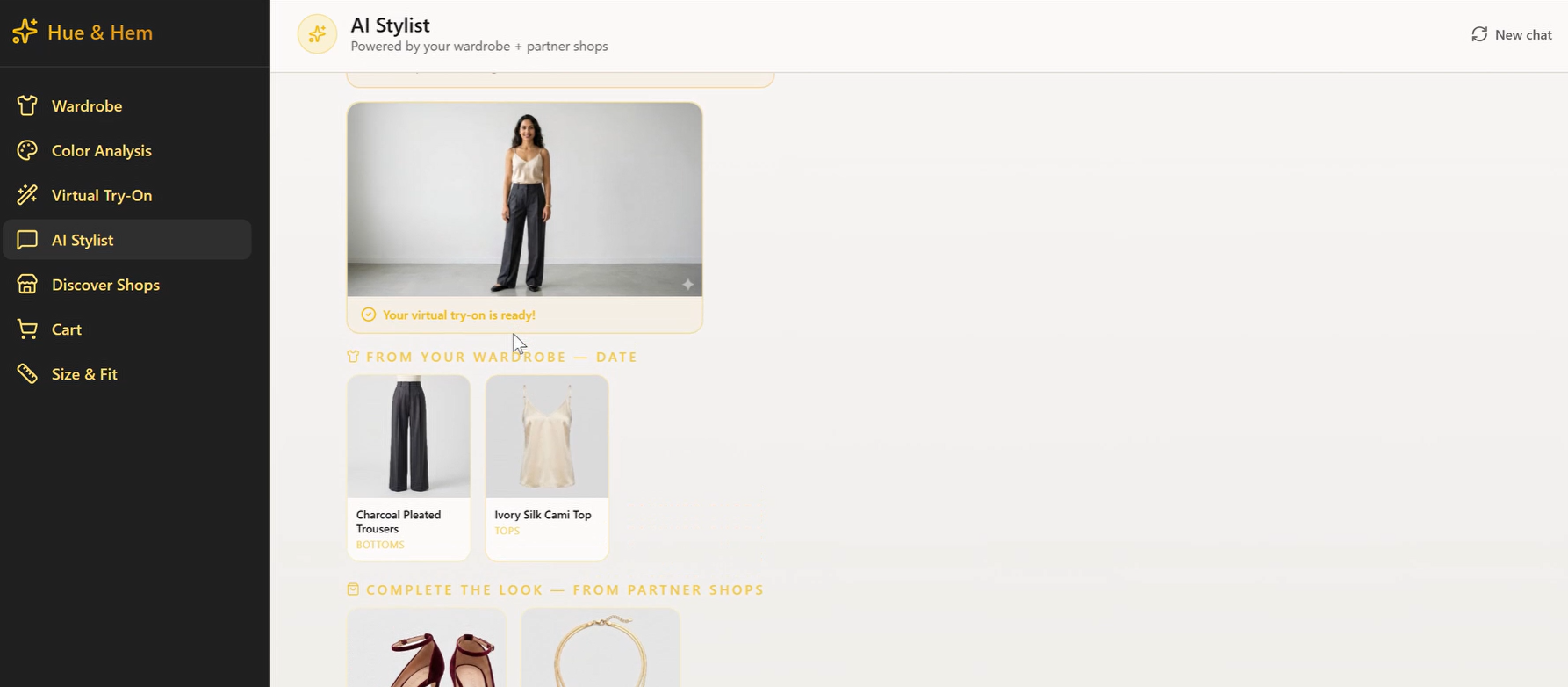
AI Stylist Chat Reply

Inspiration
The inspiration for Hue & Hem came from a universal daily frustration: standing in front of a closet packed with clothes and feeling like you have absolutely nothing to wear. Traditional fashion apps just push you to buy more. We wanted to flip the script. We asked ourselves: What if technology could help people style what they already own, while safely recommending the exact missing pieces from local stores nearby ? By combining a digital wardrobe with a local retail discovery engine, we built a platform that promotes smart personal styling and champions local shops.
What it does
Hue & Hem is a dual-sided marketplace ecosystem that bridges personal wardrobe management with local retail discovery.
For Customers: It acts as an AI stylist and virtual dressing room. Users can bulk-upload clothes to organize a digital wardrobe , get a personalized skin tone and makeup analysis , interact with a styling chatbot , and perform virtual try-ons directly on a personal avatar.
For Shop Admins: It provides a dedicated management page to create shop profiles, set up physical branches, and configure store agent access to digitize local retail operations.
Current Configured Account with the role of Shop Admin: (Sign in with the below) • Email: [email protected] • Password: Admin@123456
- For Shop Agents: It offers an inventory portal where floor staff can add new stock, map out size availability arrays, and adjust prices and stock levels in real time.
When a customer needs an outfit for an event, the AI scans their wardrobe. If a gap is identified, the app requests location access to pull matching, size-filtered inventory from the nearest physical retail branch—turning fragmented closets into an integrated shopping ecosystem.
How we built it
We used the MeDo tool to jumpstart the process, feeding it a clear, multi-persona requirements document detailing our customer, admin, and store agent roles. MeDo generated about 80% of the functional architecture right out of the box, allowing us to pivot quickly into testing and refining features.
The application orchestrates a robust stack of multi-modal AI subsystems and configurations:
Asynchronous Image-to-Text AI: Powering the onboarding experience by parsing bulk image uploads to automatically name and categorize wardrobe items.
Vision-Based AI & Color Theory: Extracting skin hex codes from an uploaded selfie to map users to an automated seasonal color palette.
Image-to-Image Generation: Powering the virtual dressing room to render garments directly onto a high-quality full-body user avatar.
Natural Language Processing: Powering a conversational chatbot designed to offer tailored styling advice based on occasion, vibe, and historical profile data.
Built-in Login Skill: Utilizing MeDo's native authentication capabilities to implement functional mockups for third-party social logins, such as Google and Facebook.
Challenges we ran into
Teaching the AI Genuine Style: During early testing, the AI chatbot made basic mistakes. If a user asked for a "casual look," it might randomly pair a heavy fleece hoodie with light, breezy casual linen trousers. They were both categorized as "casual," but they looked terrible together. We had to heavily refine the system prompts, adding strict guardrails for Color Harmony and Structural Fit so the AI evaluated fabric weights, silhouettes, and color palettes together.
Solving the "Ghost Inventory" Problem: A major challenge was ensuring data integrity between a user's digital shopping cart and the physical store shelf. We didn't want a user buying an item online that a store agent just sold to a walk-in customer a few seconds prior. We built a real-time validation layer that instantly triggers a check during active cart sessions if an agent updates floor stock to zero, automatically alerting the user and updating the cart.
Accomplishments that we're proud of
We are incredibly proud of how smoothly the Virtual Try-On pipeline came together. Building an image-to-image workflow that seamlessly overlays wardrobe pieces onto a personal avatar is a massive engineering task, but it worked beautifully out-of-the-box. We are also proud of the sophisticated logic fallbacks we built into the conversational interface. If a user has an avatar uploaded, it tries on clothes directly; if they don't, it guides them on how to add one; and if they refuse, it gracefully falls back to text-and-product name recommendations instead of breaking the flow.
What we learned
- Prompting is Programming: Treating AI as just an open text box doesn't work for complex software engineering. Giving it structured, programmatic rules (like our color coordination and silhouette guidelines) is essential for consistent, deterministic results.
Isolate and Conquer: Trying to test a large, multi-role marketplace all at once is overwhelming. We learned to isolate and perfect one pipeline—like the asynchronous bulk wardrobe upload—before moving to interactive chatbot testing.
Smart Fallbacks Matter: A great user experience depends entirely on how you handle missing data or user exceptions, such as handling low-quality photos , disabled location tracking , or unconfigured size profiles gracefully.
What's next for HUE & HEM
While our current proof of concept establishes a rock-solid foundation, our roadmap includes taking the platform to a production-ready scale.
Next, we plan to move beyond mock workflows to implement actual Stripe payment integration and build a full-scale order tracking and fulfillment management system for our partner shops. To make the local shopping experience completely seamless, we want to integrate Google Maps API; this will allow users to enter their exact address so the platform can accurately pinpoint and recommend the absolute closest physical shops with matching inventory.
We also aim to introduce a social element, allowing users to share curated lookbooks, leave verified shop reviews, and save items to localized wishlists. Finally, we plan to implement push notifications to alert users the moment a nearby store restocks an item that perfectly matches an identified gap in their digital closet.
Built With
- llm
- medo
- natural-language-processing

Log in or sign up for Devpost to join the conversation.