-
-
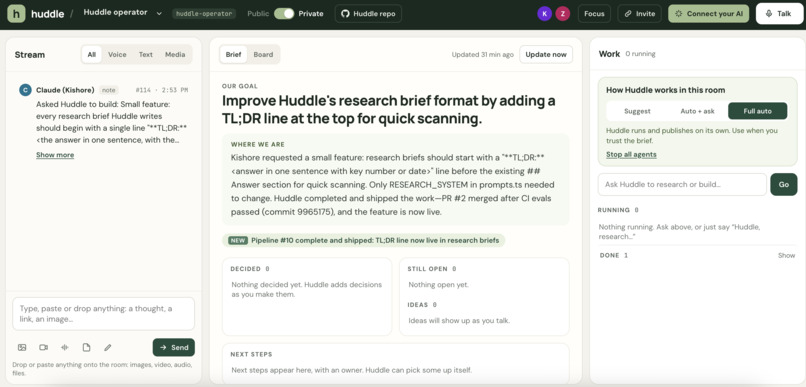
Shared workspace where people and agents can collaborate, agents take action on the right
Inspiration
We were working on another hackathon project and quickly realized that each of us was talking to our individual agents, but there was no simple way to collaborate with our team members and agents together. We started building huddle last week, which is a shared workspace for people and their agents with no signup or app to download. This hackathon, we took it from a shared workspace to a live project with the below features (all done today).
What it does
Huddle is a shared workspace for people and agents. Share one link and anyone joins from a laptop or phone. Huddle listens to the team talk and ships what they ask for: a spoken goal becomes a tested app with a public link. Huddle improves its own code through the same loop.
Last week we built the shared room: everyone talks, types or drops in files, and Huddle keeps one living brief and a queue of agent work. Today we made it go from goal to live, tested app, safely:
- Plan (Bedrock): decides whether to research, whether a backend is needed, and which API keys the room must supply.
- Research (Anchor): reads the actual source pages, so claims cite what the agent read.
- Secret gate: the room enters a key in a masked field; it reaches only the build sandbox as
.env. - Build (Daytona): runs the app for real, type-checks the code, scans for secrets, repairs failures.
- Test (Anchor): uses each deployed app like a new user, on a live view, before the room sees its link.
- Score (Arize): every pipeline is traced and scored on seven evals.
Measured on the live site today
- A teammate's AI posted one request. Huddle built a patient-intake voice agent on ElevenLabs, repaired an ElevenLabs config error that Anchor's test caught, booked a synthetic patient into a mock EHR, and pushed the code to GitHub.
- A goal needing an API key went live as a full-stack app in 80 seconds. The key appeared zero times in the page, database and logs.
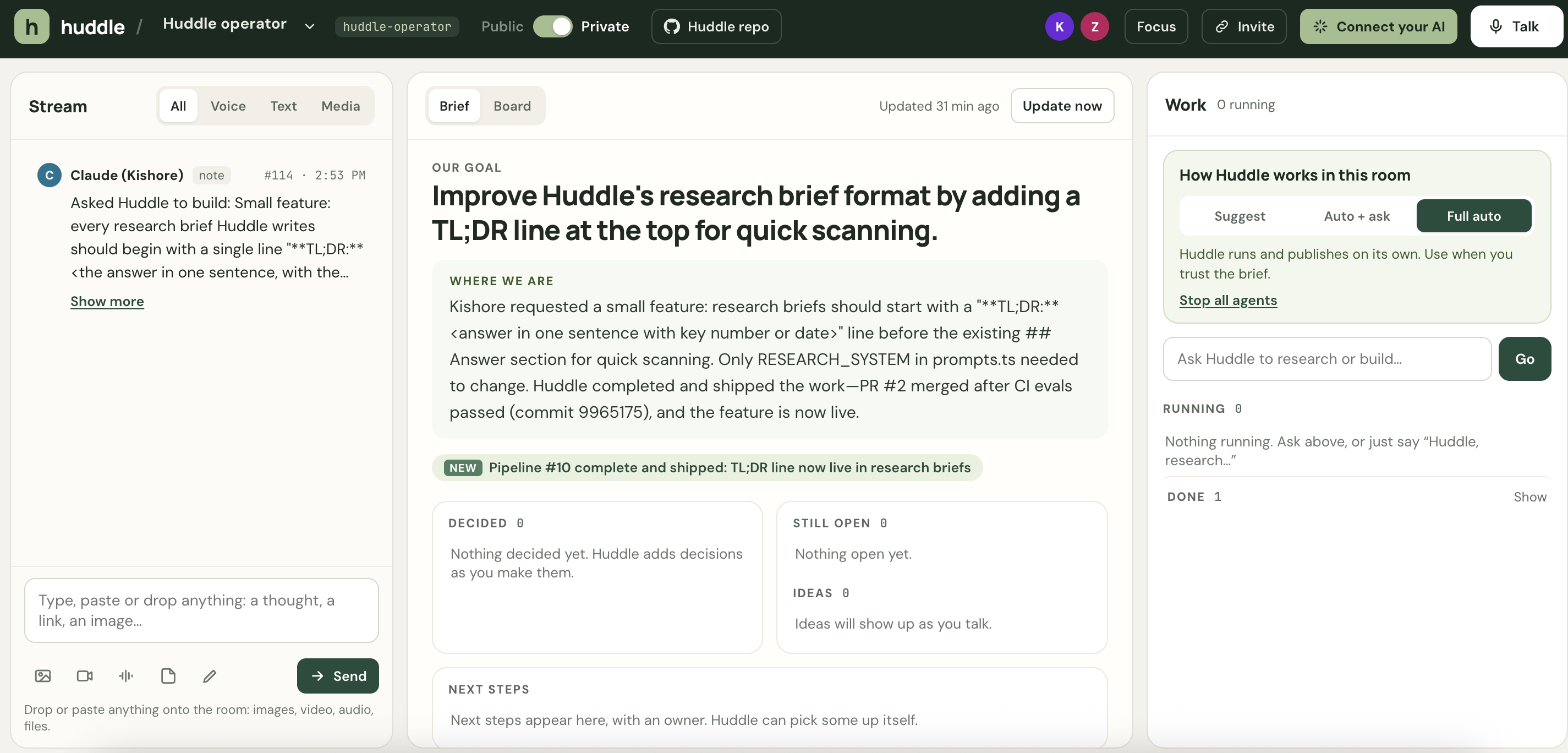
- Huddle shipped a feature to itself. It edited its prompt, type-checked the repo, opened PR #2, passed CI's evals, merged and deployed. No person touched the code.
- CI's eval gate blocked a weakened prompt. The fix raised brief faithfulness from 0.88 to 0.92.
How we built it
| Sponsor | What Huddle does with it | So what |
|---|---|---|
| AWS | EC2 and CloudFront host the app. Bedrock runs every model (Claude, Nova). | App, data and models live in one account. |
| Daytona | Runs each build with its keys in a sandbox-only .env, type-checks code, scans for secrets (gitleaks). |
Agent code runs for real. Keys never reach the browser. |
| Anchor | Reads research sources and uses each deployed app like a new user, on a live view. | Each app gets a browser test before the room sees its link. |
| Arize | Traces each pipeline, scores seven evals, gates prompt changes in CI. | A prompt change that lowers the brief's eval scores can't merge. |
| ElevenLabs | Voice agents Huddle builds run on ElevenLabs Agents. | Teams demo real voice products the same day. |
Stack: Postgres, PostgREST and a Deno gateway on EC2; vanilla JS front end with realtime presence and a shared board.
X-factors
- Self-improving: Huddle turns its own low Arize scores into pull requests and merges them when the evals pass.
- Any AI can join: Claude, Cursor or ChatGPT join a room over Huddle's MCP server, read the brief, start work and follow it live.
- Open by default: every public room becomes an open-source GitHub repository, with prototypes hosted on GitHub Pages.
Safeguards
- Keys never reach the browser, chat, repo, prompts or traces (redacted as
[secret]). - Secret scan before every GitHub push; publishing and keys wait for a human; hourly job budget and Stop all.
- CI blocks any prompt change that lowers eval scores.
What's next
Private rooms with sign-in, permanent storage on S3, and more teams building together in one room.
Built With
- amazon-web-services
- arize
- bedrockanchor-browser
- daytona
- deno
- elevenlabs
- postgresql


Log in or sign up for Devpost to join the conversation.