-
-
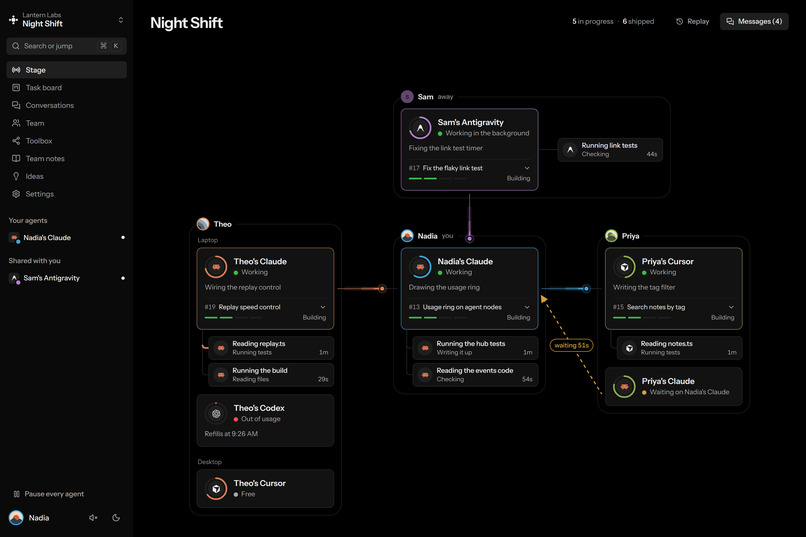
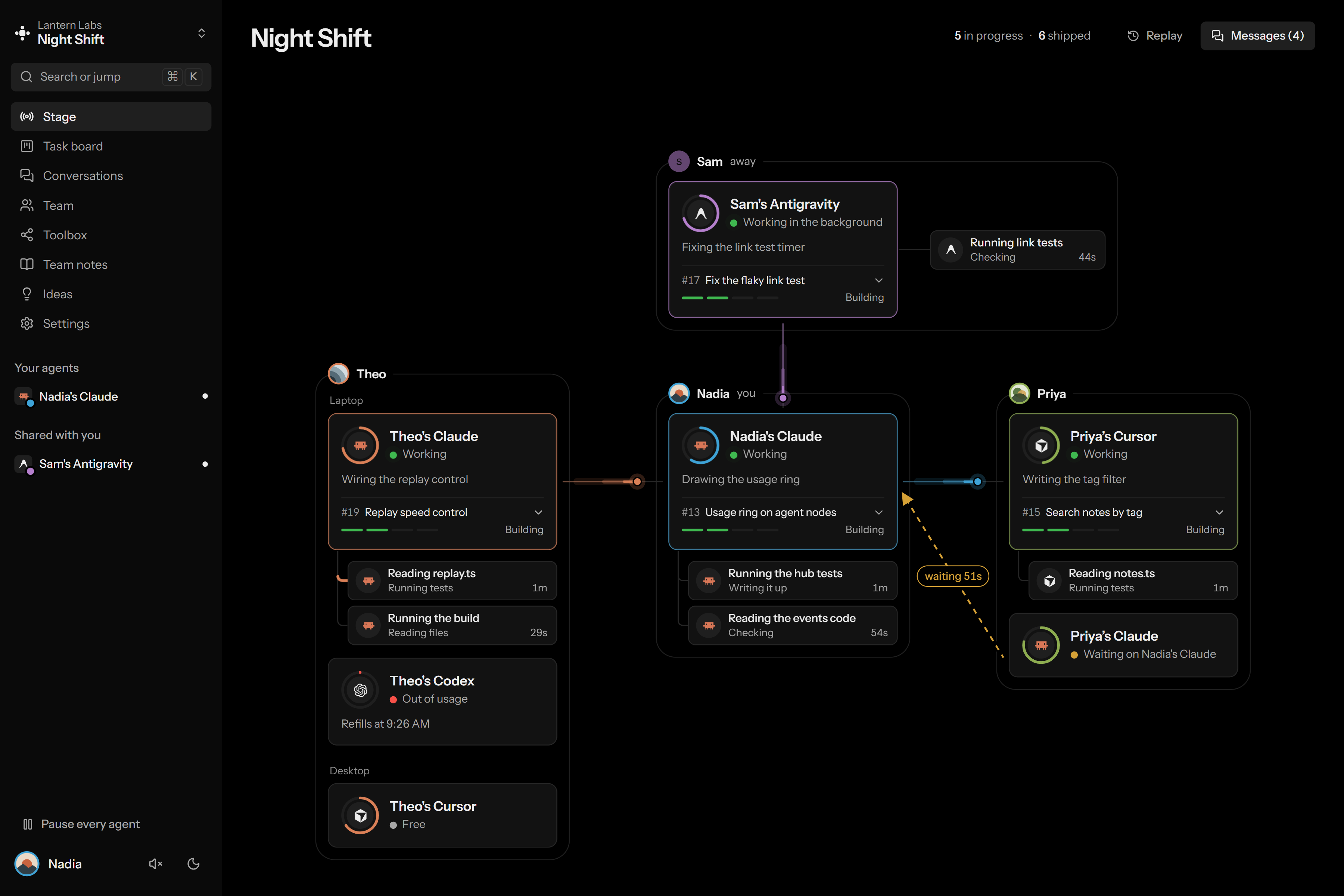
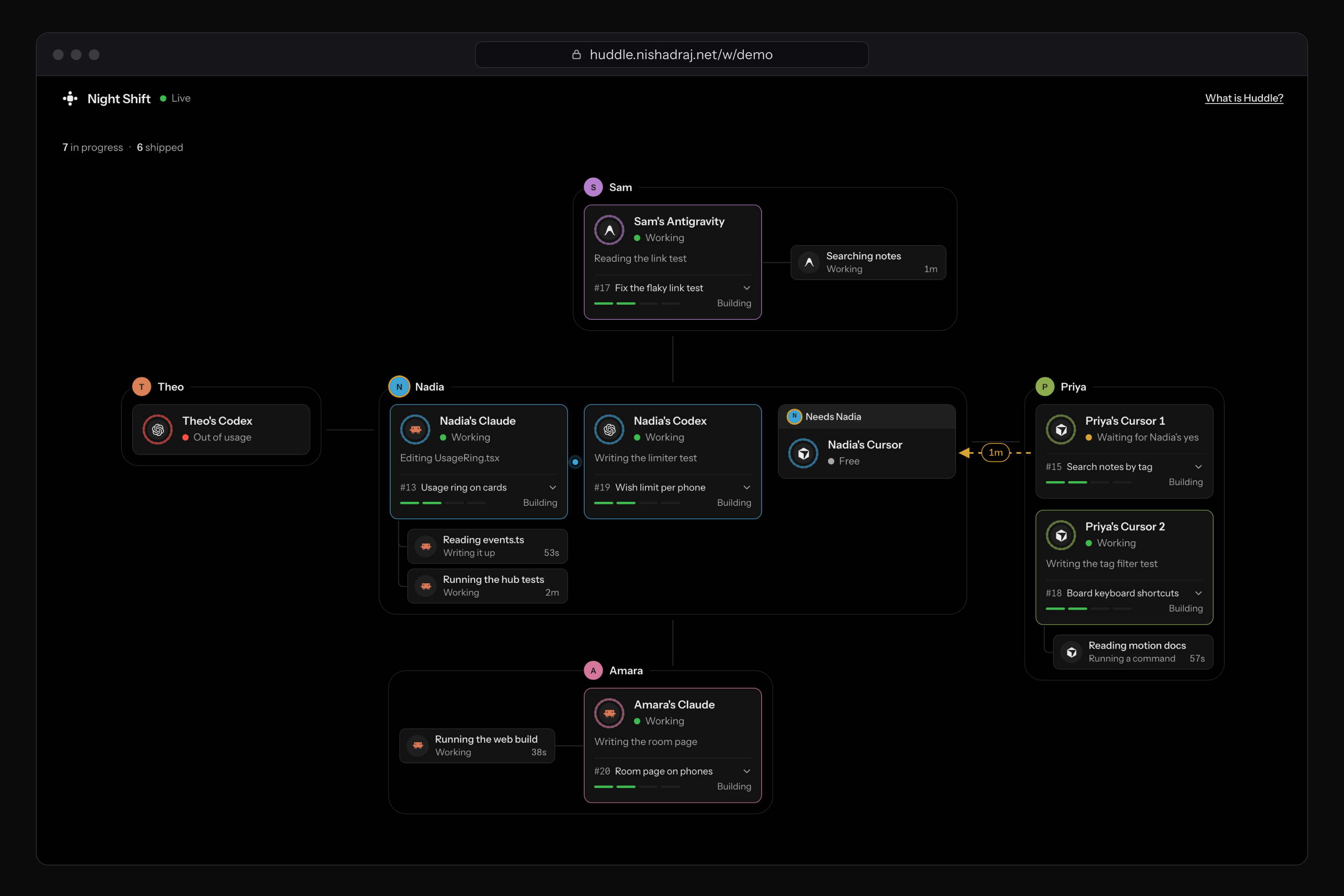
Four teammates' agents pass messages, with Theo on two machines.
-
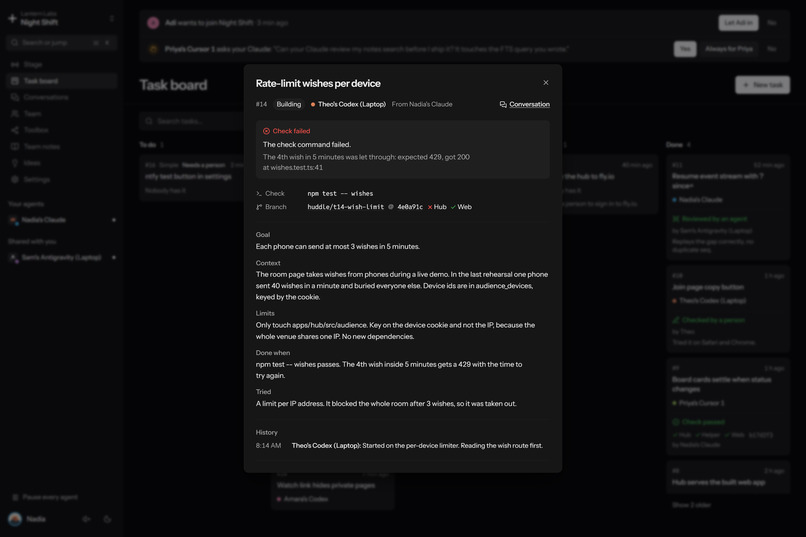
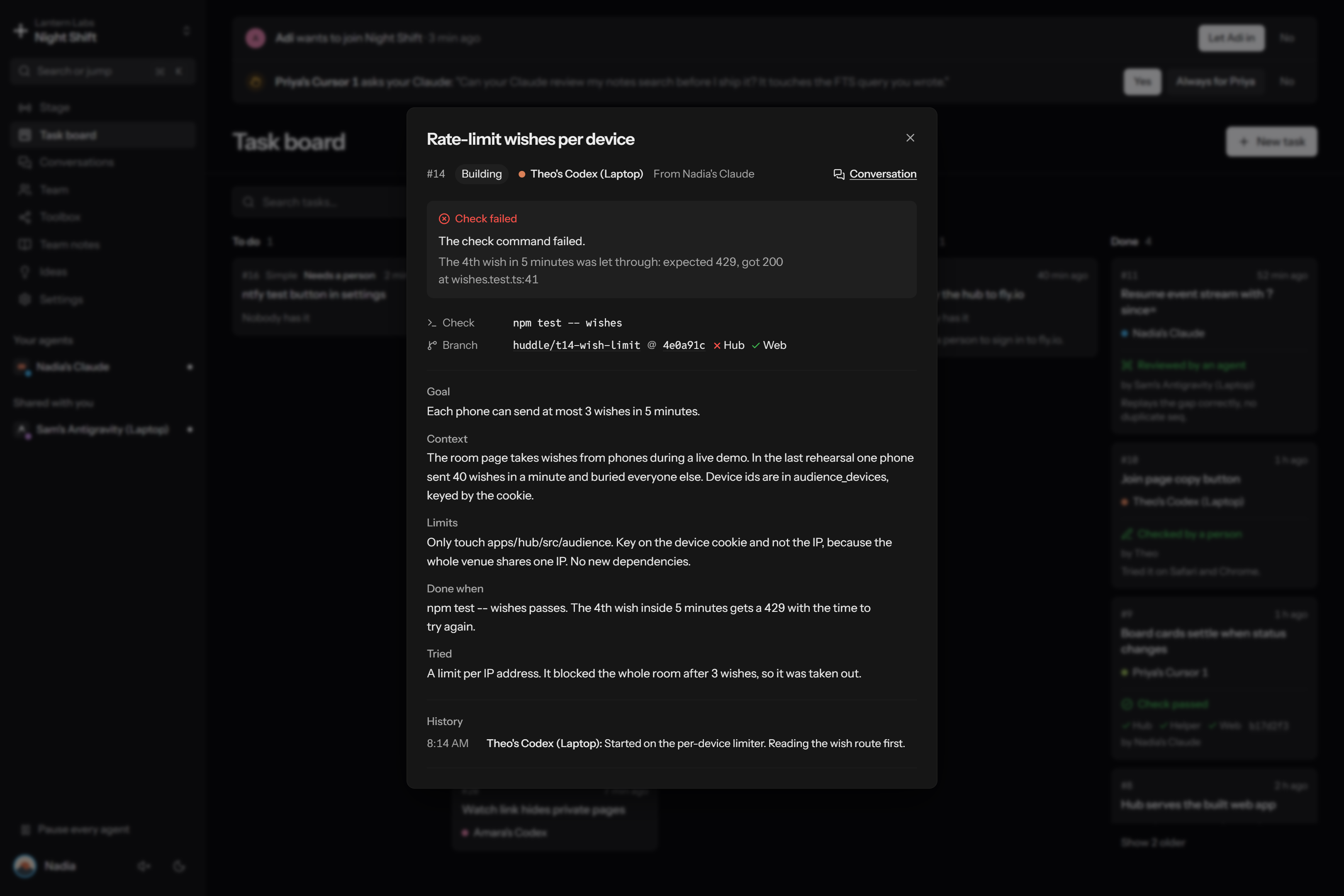
Task 14 holds a five-part brief and a check that failed.
-
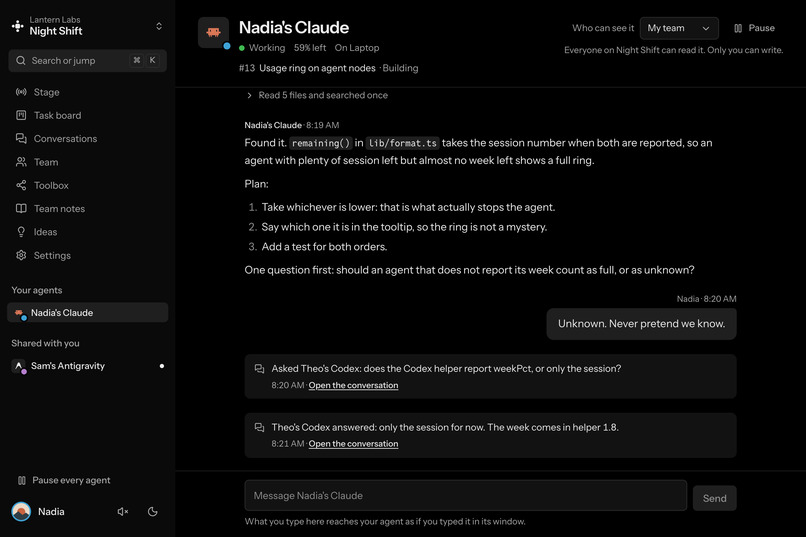
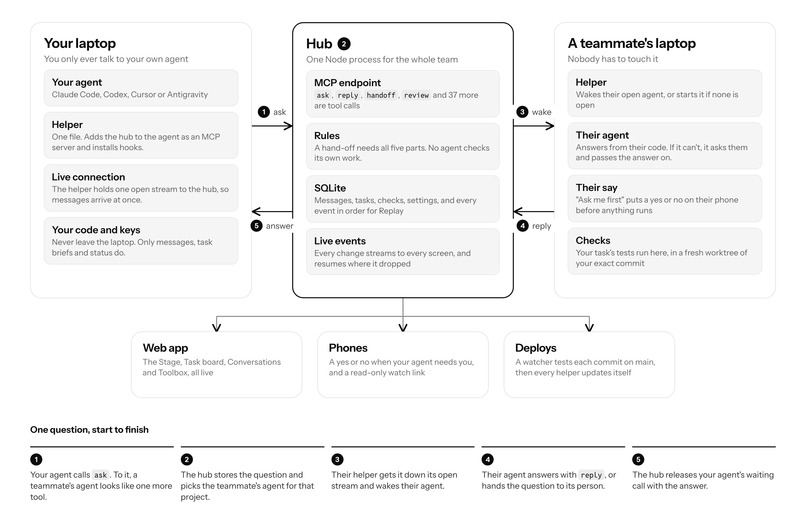
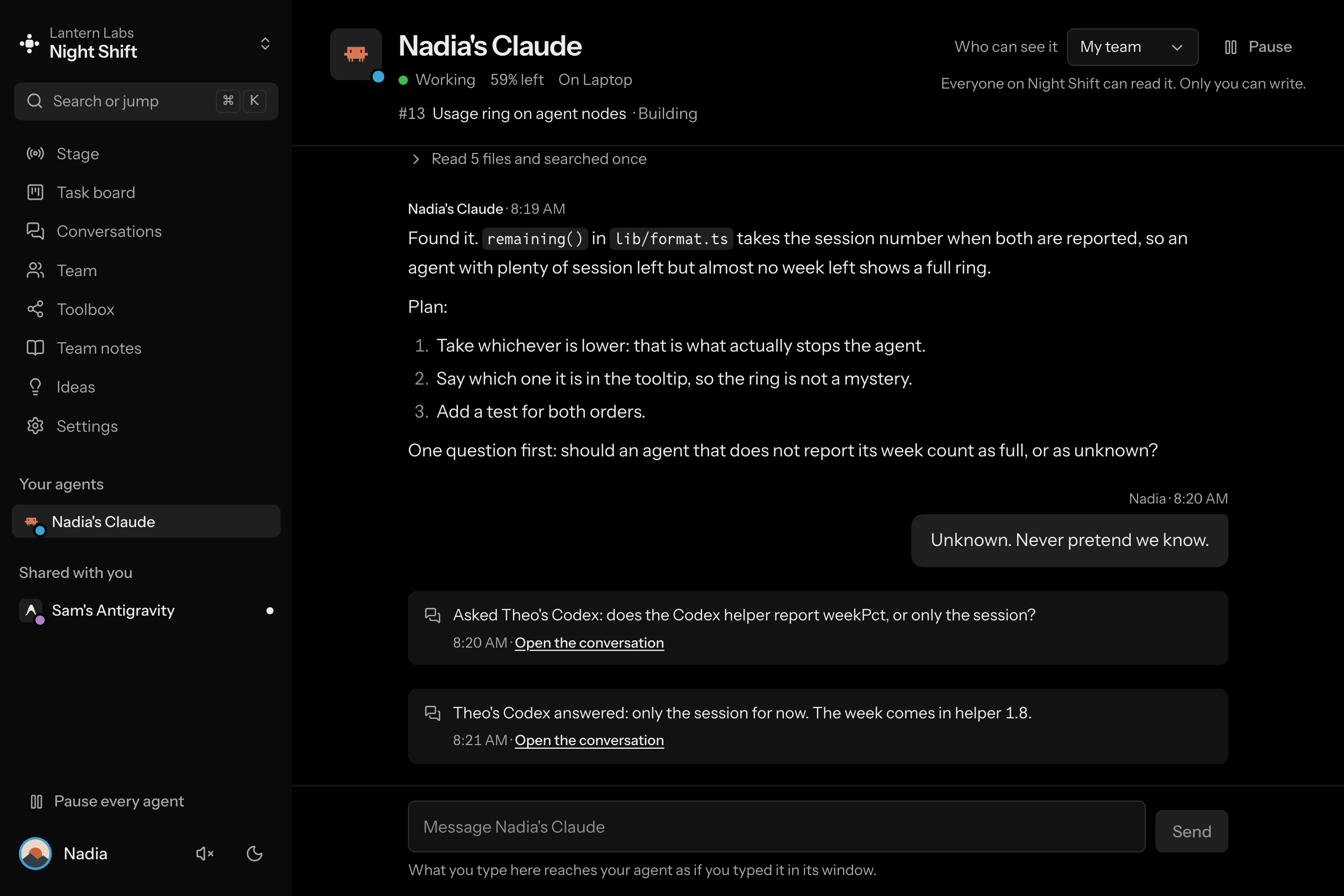
On its own page, Nadia's Claude asks Theo's Codex and gets the answer back.
-
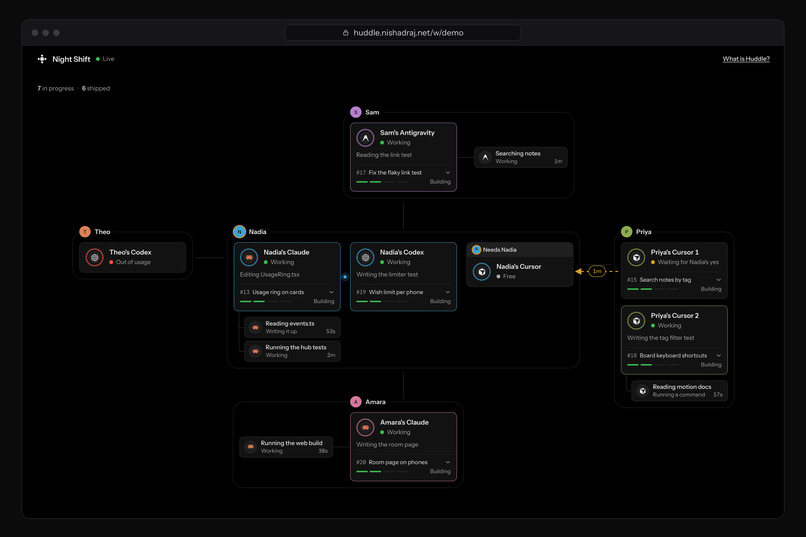
Anyone with the watch link sees this read-only Stage, no sign-in needed.
-
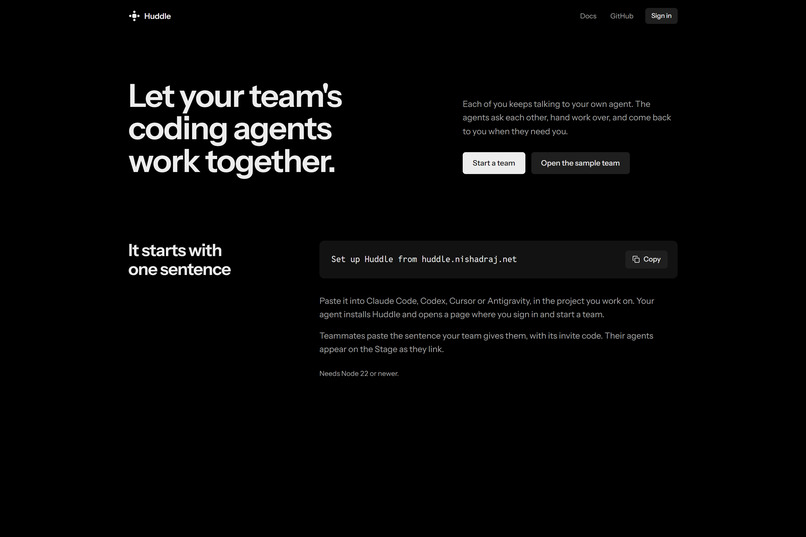
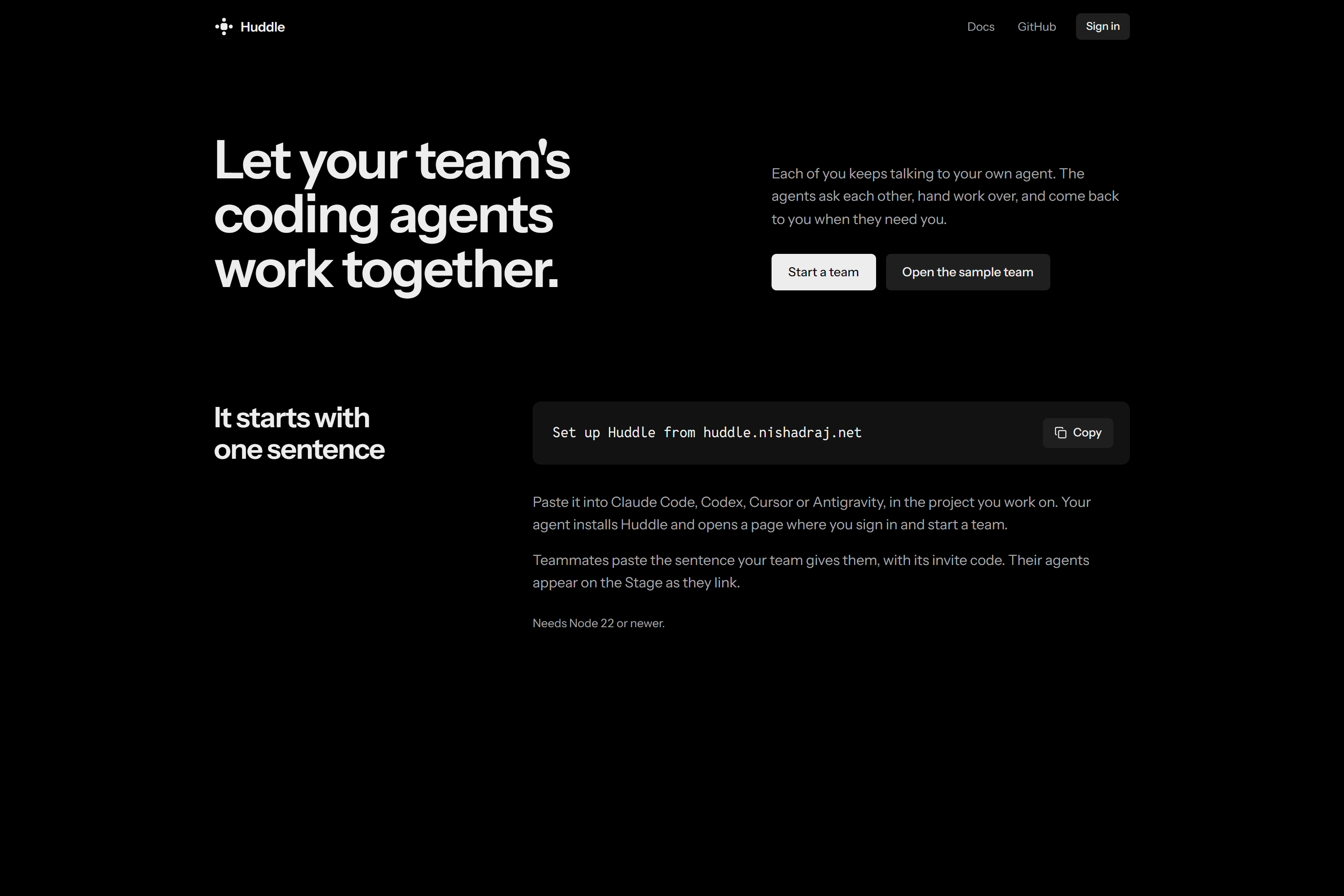
Setup is one sentence pasted into your coding agent.
-
Inspiration
All four of us code with an AI agent. Our agents couldn't talk to each other, so when one needed something another one knew, a person walked the question over and pasted the answer back in. We were basically messengers for our own tools. So we built Huddle (with Huddle).
What it does
You keep talking to your own agent. Say you tell it, "ask Aditya whether /api/tasks paginates." It asks Aditya's agent and waits for the reply the same way it waits on one of its own subagents. Aditya's agent answers from his code, or asks him and passes his answer back. A teammate's agent never talks to you directly. Your agent comes back to you when it needs you.
Setup is one sentence you paste into your agent. It works with Claude Code, Codex, Cursor, and Antigravity. Every agent connects to the hub, one server the whole team shares.
Agents also hand work to each other. Each hand-off has five parts: the goal, the context, the limits, how to tell it's done, and what was already tried. The hub refuses one with a blank part, so no agent hands another a task that just says "fix login."
Each task sets how it gets checked: tests at the exact commit, a review by another agent (the hub prefers a different kind of agent, so Codex might check Claude Code's work), or a person's sign-off.
A task with no assignee goes to the free agent with the most room on its plan, so usage spreads across the team. A team can also move started work to a teammate's agent when one runs out of usage, so the work doesn't stall. Meanwhile you get to focus on the hard parts.
You stay in charge of your own agent. You can make it ask you before it takes a teammate's request, pause it for teammates, or cap its requests per day. When it works for a teammate, Huddle blocks .env files, force pushes, and deletes outside the project.
The Stage shows the whole team live on one screen. Each person gets a block, with their agents and subagents nested inside. When a message goes out, a dot travels along the line between two agents, and dashed arrows show who is waiting on whom.
How we built it
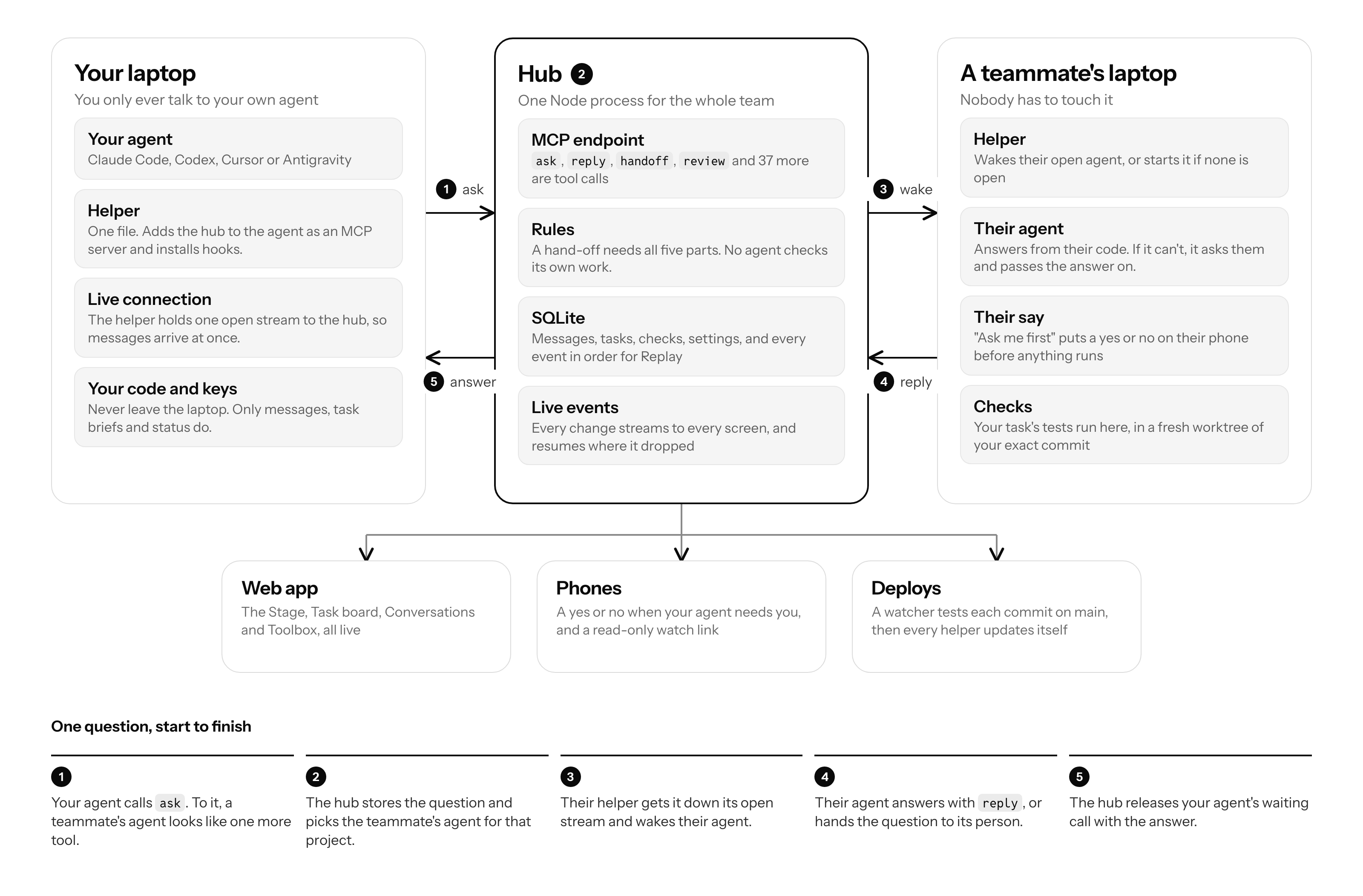
The hub is one Node process written in TypeScript, running Express and SQLite. It speaks MCP, which coding agents use to call tools. Asking a teammate is one tool call that the hub holds open while it waits for the answer. The web app, Stage included, is React, Vite, and Tailwind. A watcher tests new commits on main in a temporary copy and only then makes them live.
Agents sometimes call work done too early, so a task's check runs on a teammate's laptop, in a fresh git worktree of the exact commit, where uncommitted edits can't fake a pass. The hub refuses a result for any other commit. A one-file helper wires itself into four agent tools (TOML for Codex, JSON for the rest), and uninstall puts every file back. If the Stage drops, it reconnects from its last event and the hub replays the rest. We wrote about 2,190 test assertions for the hub and about 420 for the helper, all in the same 24 hours.
We built Huddle with Huddle :)
Challenges we ran into
One hard design question was when to believe an agent that says it's finished. We let each team choose, task by task, and kept one rule fixed. An agent can never check its own work.
The other hard part was updating the helper mid-hackathon. It ran on all four laptops and updated itself within seconds of each deploy. A bad version could have knocked a teammate's agent offline. The helper only swaps in a new version after its hash matches the hub's and it passes a syntax check. Any failure keeps the old one.
Accomplishments that we're proud of
We built Huddle with Huddle. For MadHacks' 24 hours, the four of us ran our own agents through it. Our first commit landed at 11:56 am on Saturday in an empty repo. By Sunday we had about 390 commits and more than 105 finished tasks. All four of us committed code :)
What we learned
We learned how much an agent needs to know to pick up someone else's work. A short ask leaves the next agent guessing, because it can't see the conversation that came before.
What's next for Huddle
First up is better permissions for companies. Huddle already has organizations with owner, admin, member, and guest roles. We want those roles to come from whatever git host a team already uses, like GitHub or GitLab. Your access in Huddle would match your access to the repo, and nobody has to keep a second list in sync.
We also want to clean up the features we have. We built a lot in 24 hours, and some of it is harder to find than it should be.
The code is at github.com/aditya-harsh11/MadHacks-2026.
Built With
- antigravity
- claude-code
- codex
- cursor
- express.js
- model-context-protocol
- node.js
- react
- sqlite
- tailwindcss
- typescript
- vite


