-
-
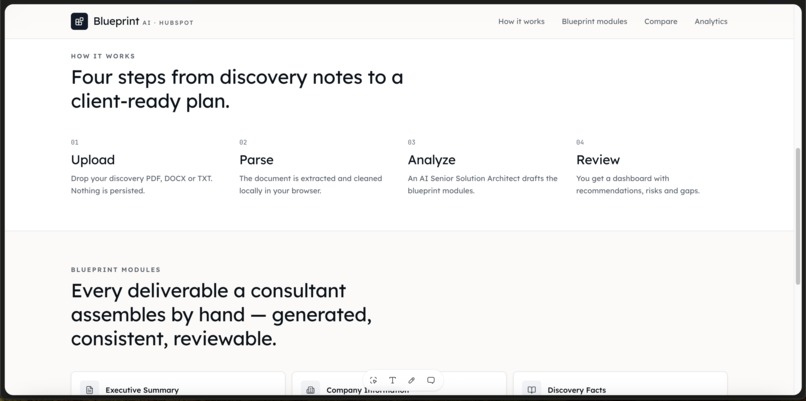
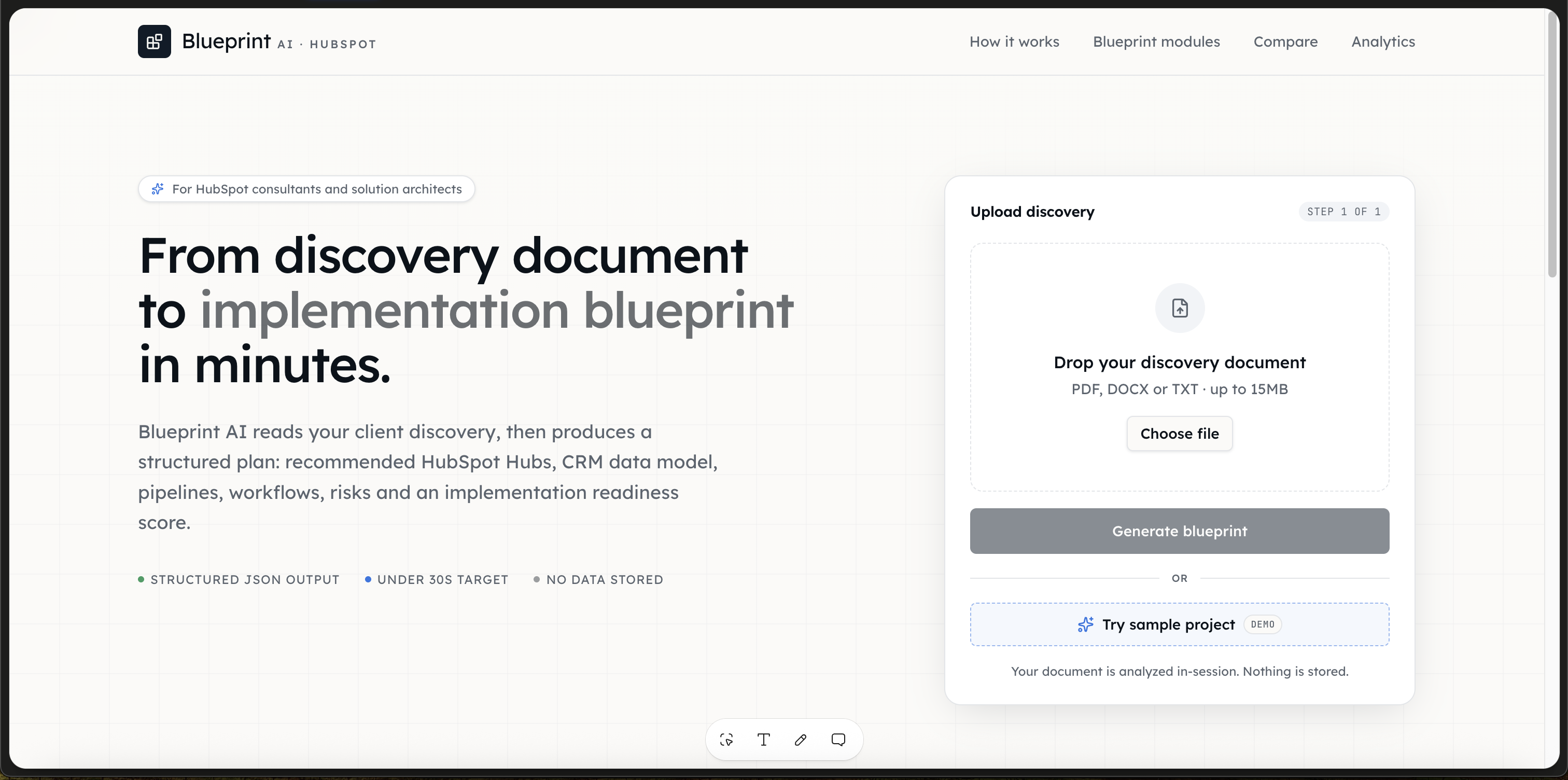
Home page
-
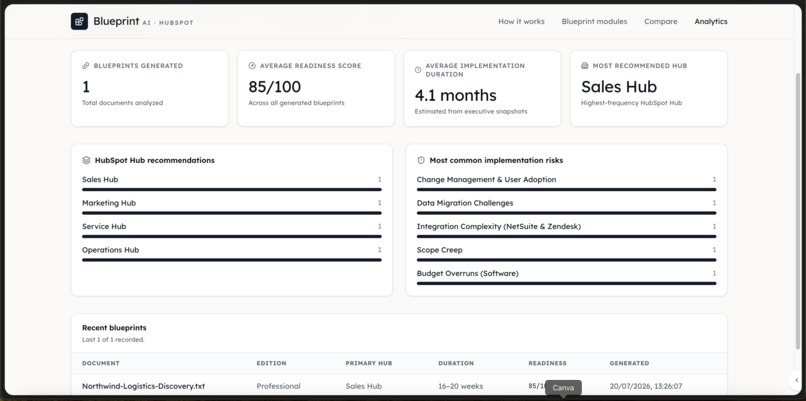
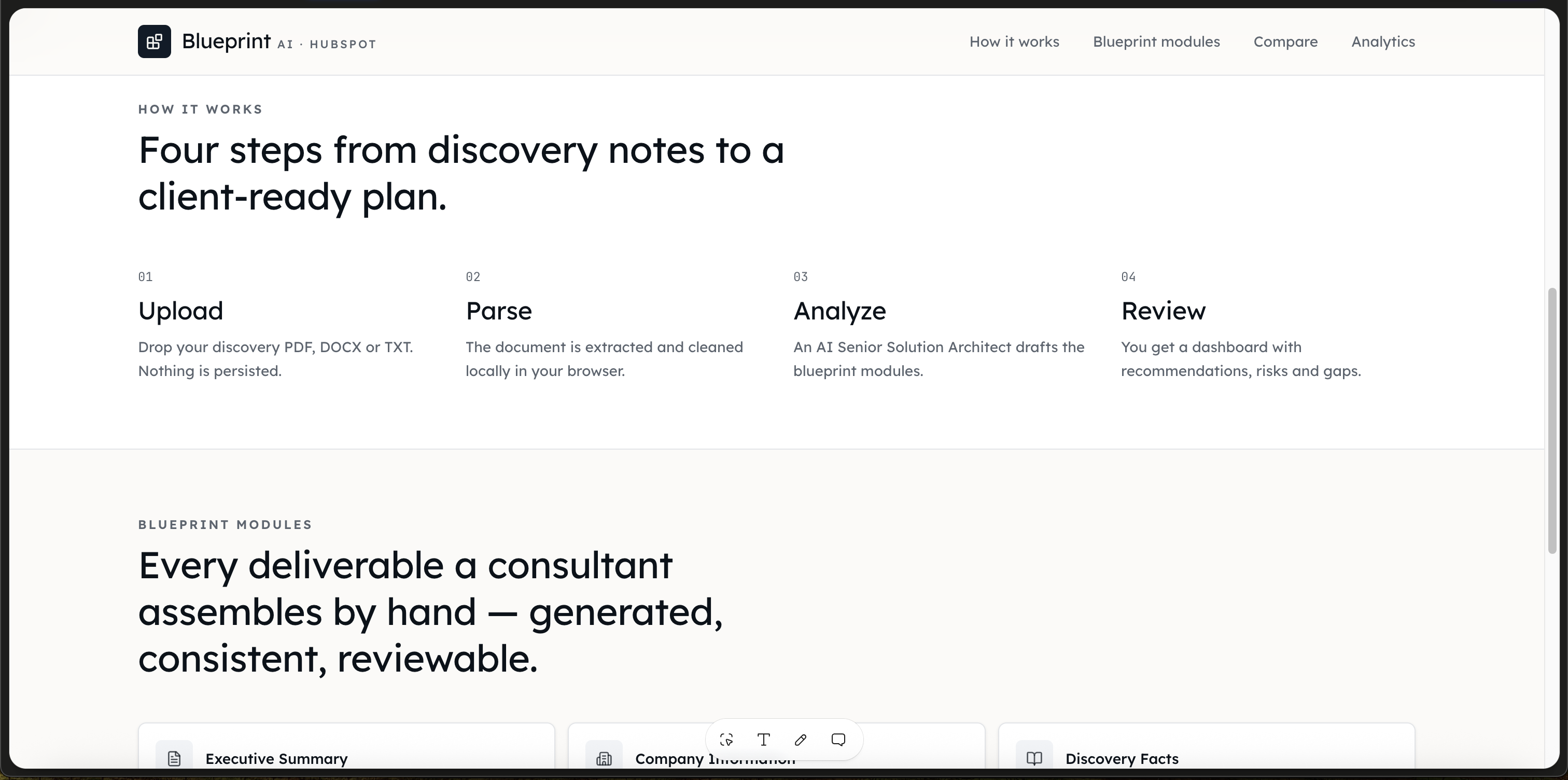
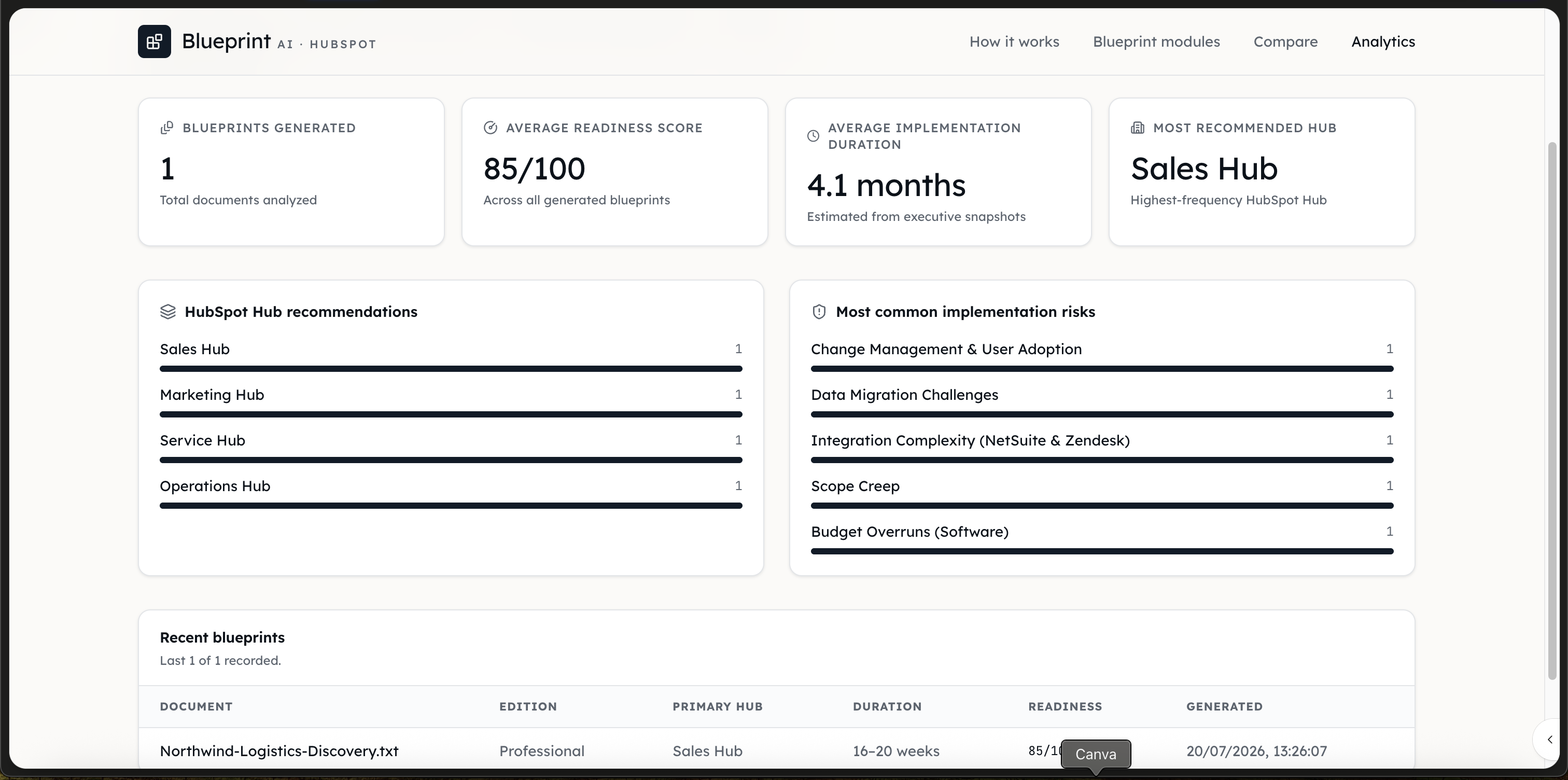
Summary of the discovery uploaded
-
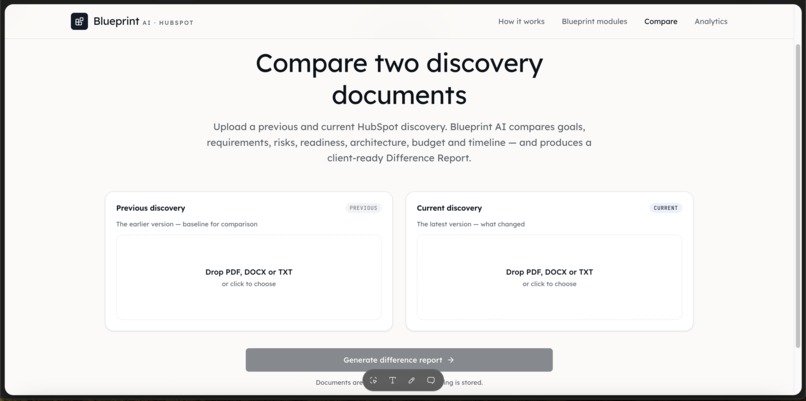
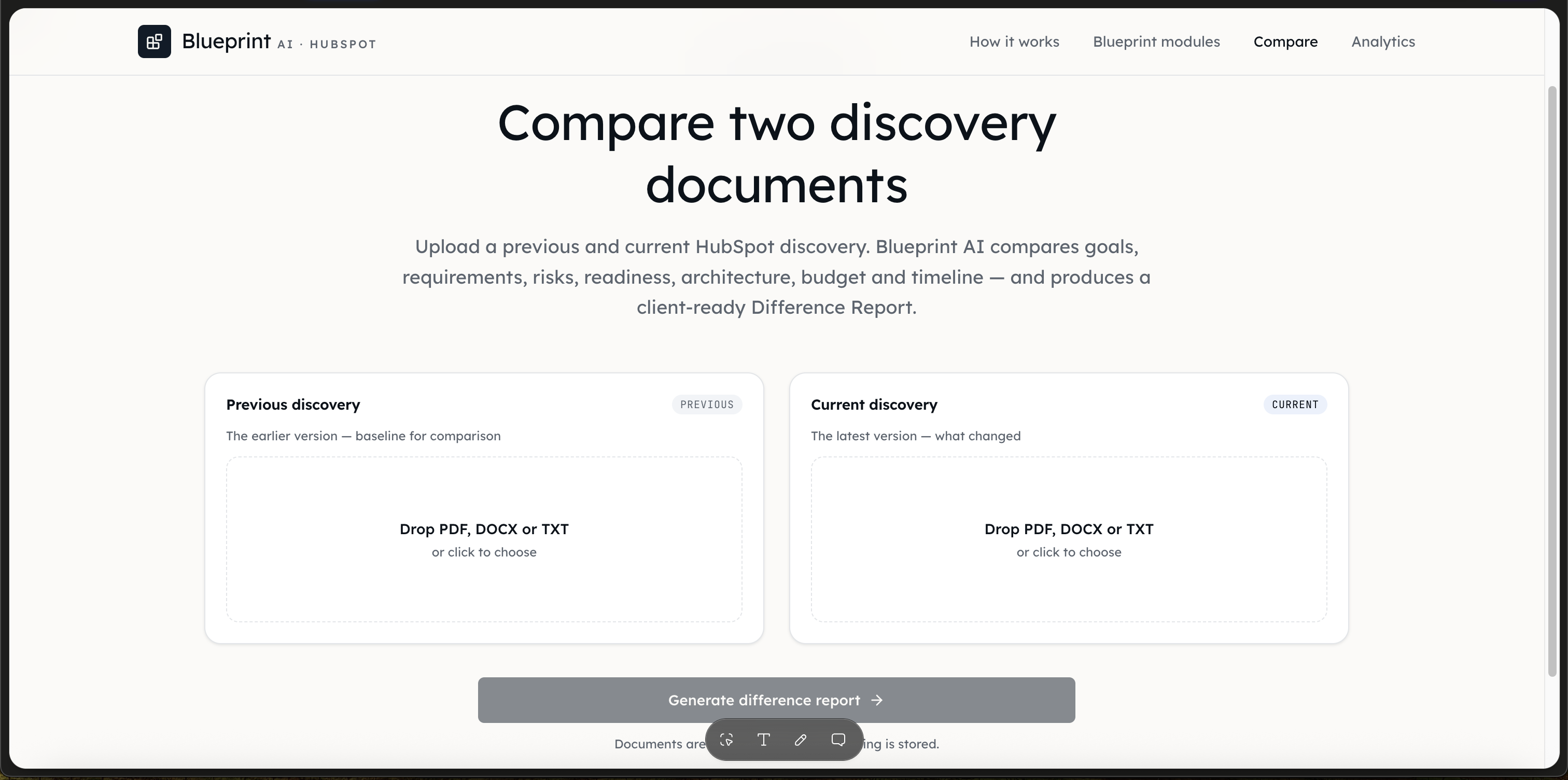
Can compare 2 discovery documents
-
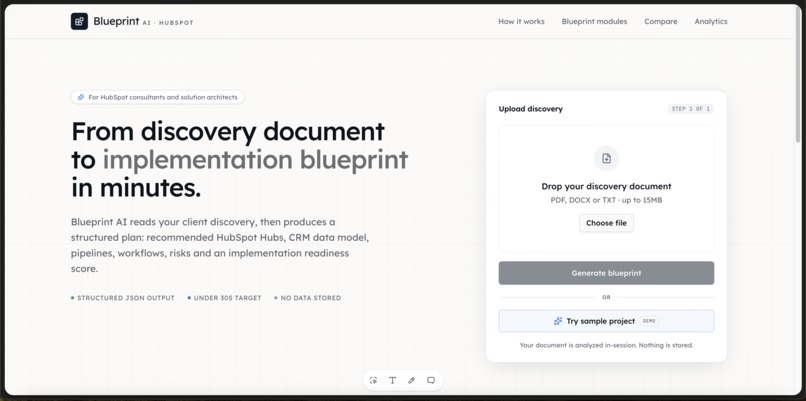
can upload or try the sample project
Inspiration
What it does
How we built it
Blueprint AI – From Discovery to HubSpot Implementation in Minutes
Inspiration
Every successful HubSpot implementation starts with a discovery workshop. While discovery sessions uncover valuable business requirements, transforming those notes into a structured implementation blueprint is still a largely manual process.
Consultants often spend hours reviewing documents, identifying business goals, designing CRM architecture, defining pipelines, planning automations, documenting risks, and preparing implementation roadmaps. The quality of these deliverables depends heavily on individual experience, making the process difficult to scale and standardize.
As someone who works closely with HubSpot implementations, I wanted to build an AI assistant that could accelerate this process while still producing structured, transparent, and consultant-friendly recommendations.
That became Blueprint AI.
What it does
Blueprint AI converts client discovery documents into a complete HubSpot implementation blueprint using GPT-5.6.
Instead of generating generic summaries, the application produces consultant-ready implementation artifacts including:
- Executive Summary
- Discovery Facts
- Business Goals
- Current Challenges
- Recommended HubSpot Hubs
- HubSpot Edition Recommendation
- CRM Architecture
- Sales & Service Pipelines
- Custom Property Recommendations
- Workflow Automation Opportunities
- Integration Recommendations
- Reporting Strategy
- Risks & Assumptions
- Missing Discovery Information
- Implementation Roadmap
- Readiness Score
The generated blueprint can also be exported as a professionally formatted PDF suitable for client delivery.
In addition, Blueprint AI includes an AI Copilot that allows consultants to ask follow-up questions about the generated implementation plan, along with a comparison feature for evaluating multiple discovery documents.
How we built it
The application was built using:
- React
- TypeScript
- TanStack Start
- Tailwind CSS
- GPT-5.6 through the Lovable AI Gateway
- Zod for runtime validation
The application sends structured prompts to GPT-5.6 and requests structured JSON responses. These responses are validated before rendering, ensuring the dashboard and exported blueprint remain reliable even when handling complex AI outputs.
To improve engineering quality, Codex was used after the initial application was developed to review and refactor the codebase. The engineering improvements included:
- Centralized AI Gateway logic
- Runtime validation of AI responses
- Shared upload validation utilities
- Standardized error handling
- Improved TypeScript typing
- Removal of duplicate components
- Request timeout handling
- Accessibility improvements
- Production-readiness review
These changes improved maintainability while preserving the application's behavior.
Challenges
One of the biggest challenges was producing highly structured consultant deliverables rather than generic AI responses.
The prompts needed to consistently generate implementation recommendations that were practical, evidence-based, and organized into predictable sections suitable for real consulting engagements.
Another challenge was ensuring reliability. Because the application depends on structured AI output, runtime validation was introduced to detect malformed responses before they reached the user interface.
Finally, balancing flexibility with consistency required careful prompt engineering so that recommendations remained grounded in the uploaded discovery document while still providing actionable implementation guidance.
What we learned
Building Blueprint AI reinforced that modern language models can do much more than summarize documents.
With carefully designed prompts, structured outputs, runtime validation, and thoughtful application design, GPT-5.6 can function as a practical implementation assistant that supports real consulting workflows.
We also learned the importance of treating AI outputs as application data that should be validated and handled with the same engineering discipline as any other external service.
Future Roadmap
Blueprint AI is designed as the foundation for a broader implementation platform.
Future enhancements include:
- Direct HubSpot API integration
- One-click CRM configuration
- Automated workflow deployment
- Knowledge base integration using RAG
- Multi-user collaboration
- Version history
- Team workspaces
- Consultant review workflows
- Industry-specific implementation templates
Why this matters
Blueprint AI demonstrates how GPT-5.6 can help consultants spend less time producing documentation and more time solving business problems.
By transforming unstructured discovery conversations into structured implementation blueprints, the application reduces repetitive work while improving consistency, transparency, and implementation quality.
Challenges we ran into
Accomplishments that we're proud of
What we learned
What's next for HubSpot Blueprint AI
Built With
- chatgpt5.6
- codex
- github
- lovable
- openai


Log in or sign up for Devpost to join the conversation.