HUBRIS — Turning Uncertainty Into Confidence
Inspiration
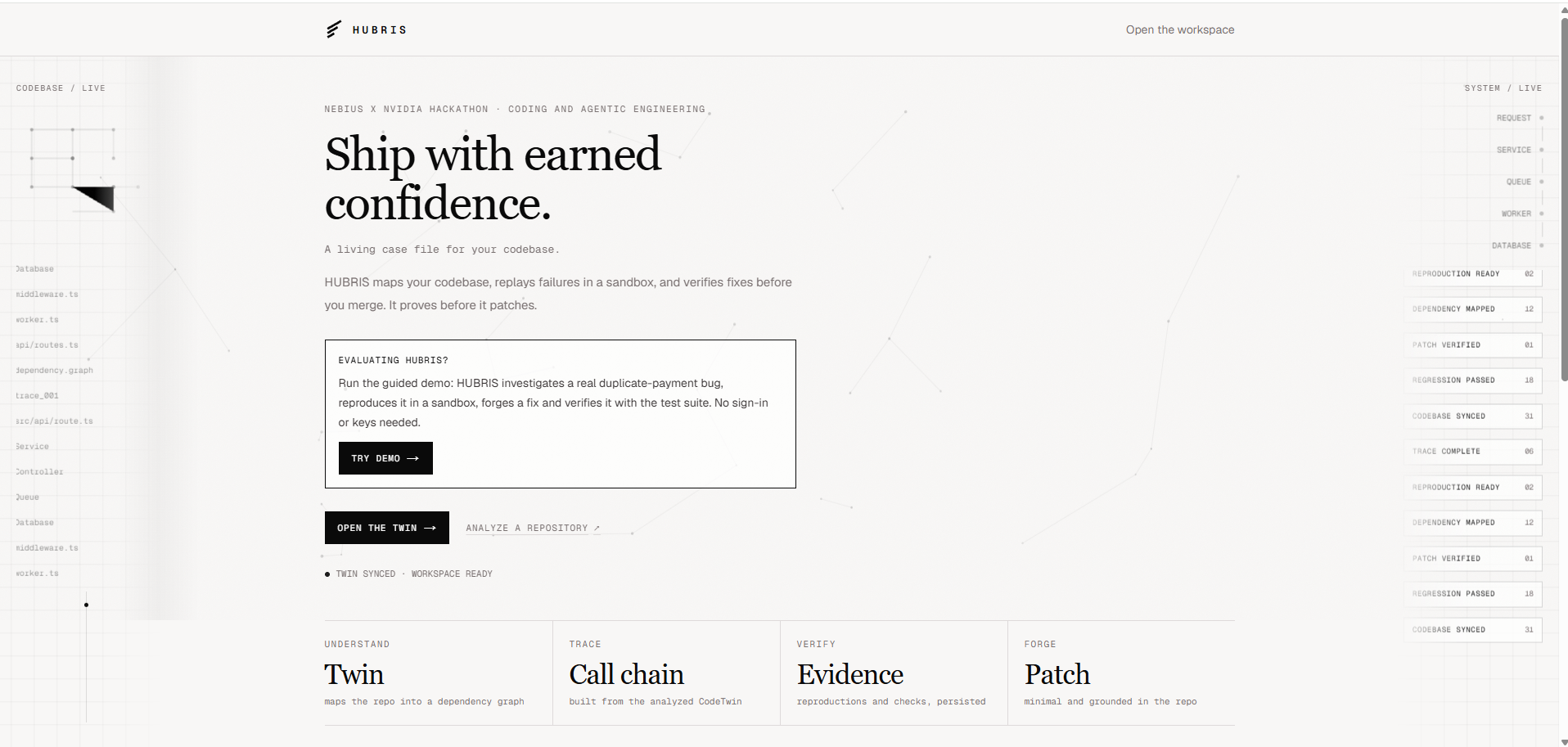
I built HUBRIS around a question: What if AI could do more than suggest a code fix? What if it could prove that the fix actually works before you ship it?
AI coding tools can generate code quickly, but debugging is rarely just a matter of writing a few lines. The difficult part is understanding the failure, tracing it to its root cause, reproducing it reliably, and knowing whether a proposed change truly fixes the problem without breaking something else.
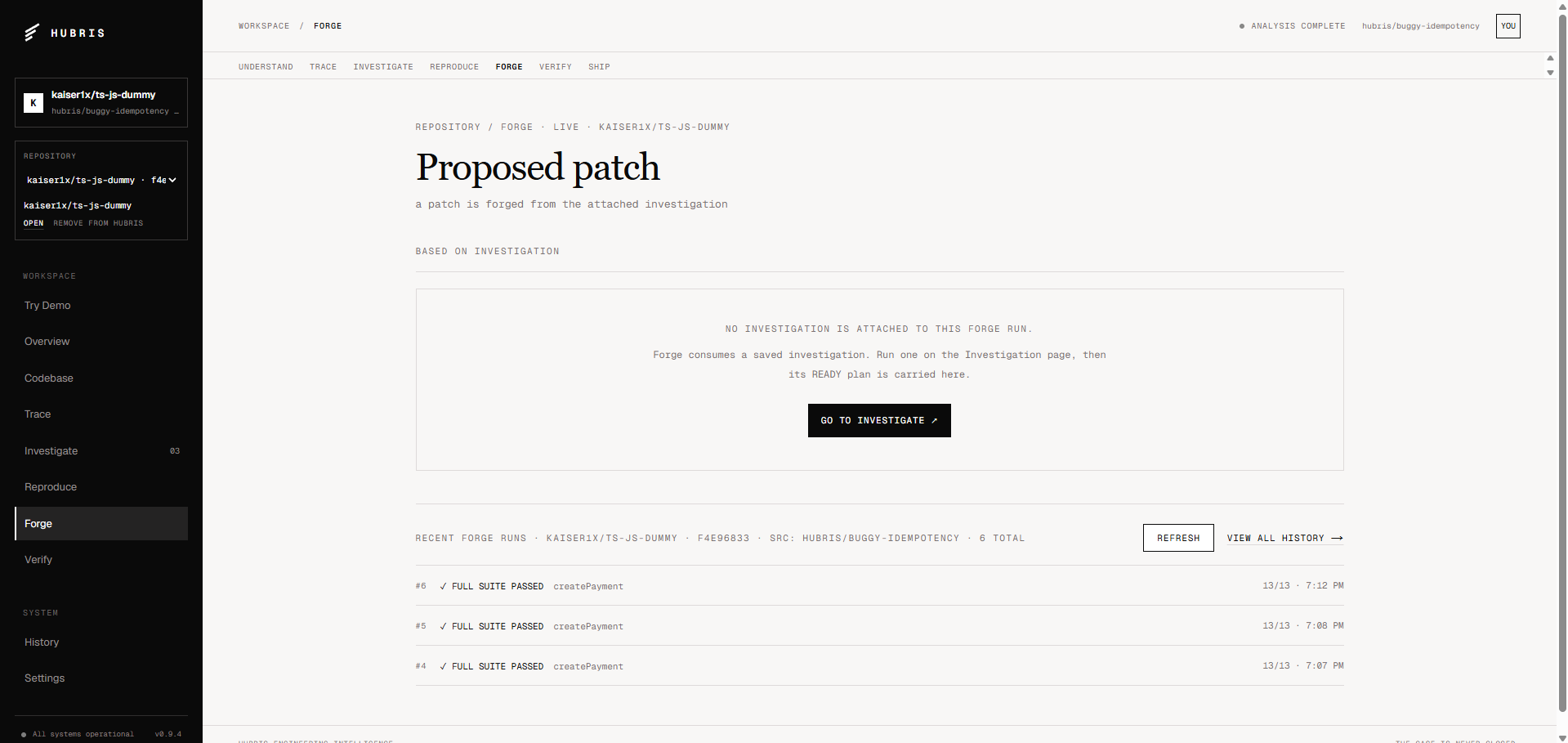
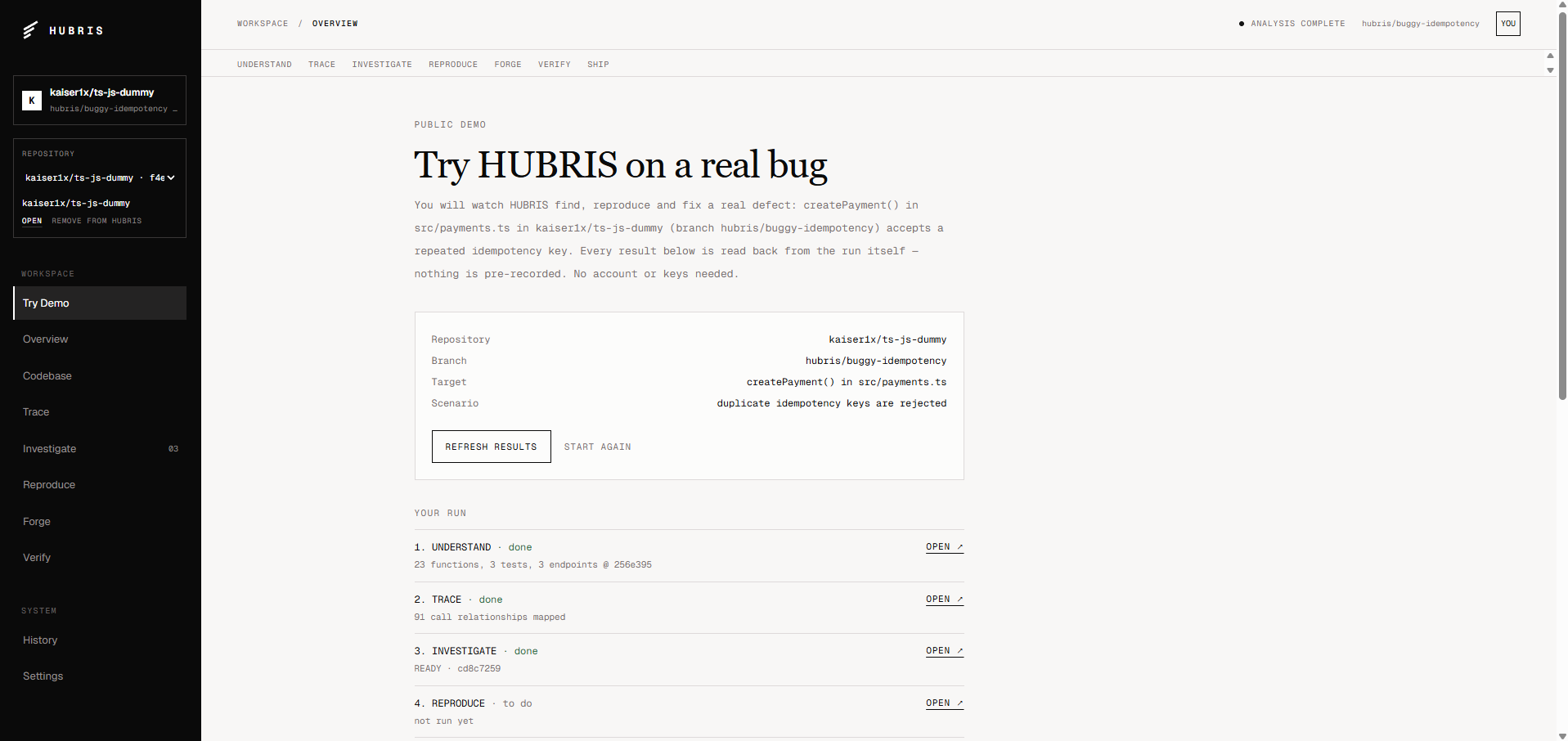
I wanted to build a system that treats software engineering as a chain of evidence rather than a guessing game. Instead of jumping straight from a bug report to a patch, HUBRIS follows a structured workflow: UNDERSTAND → TRACE → INVESTIGATE → REPRODUCE → FORGE → VERIFY → SHIP.
The goal is simple: turn uncertainty into confidence.
How I built it
HUBRIS is a TypeScript-first AI software engineering platform built around repository analysis, evidence-driven investigation, sandboxed code changes, and automated verification.
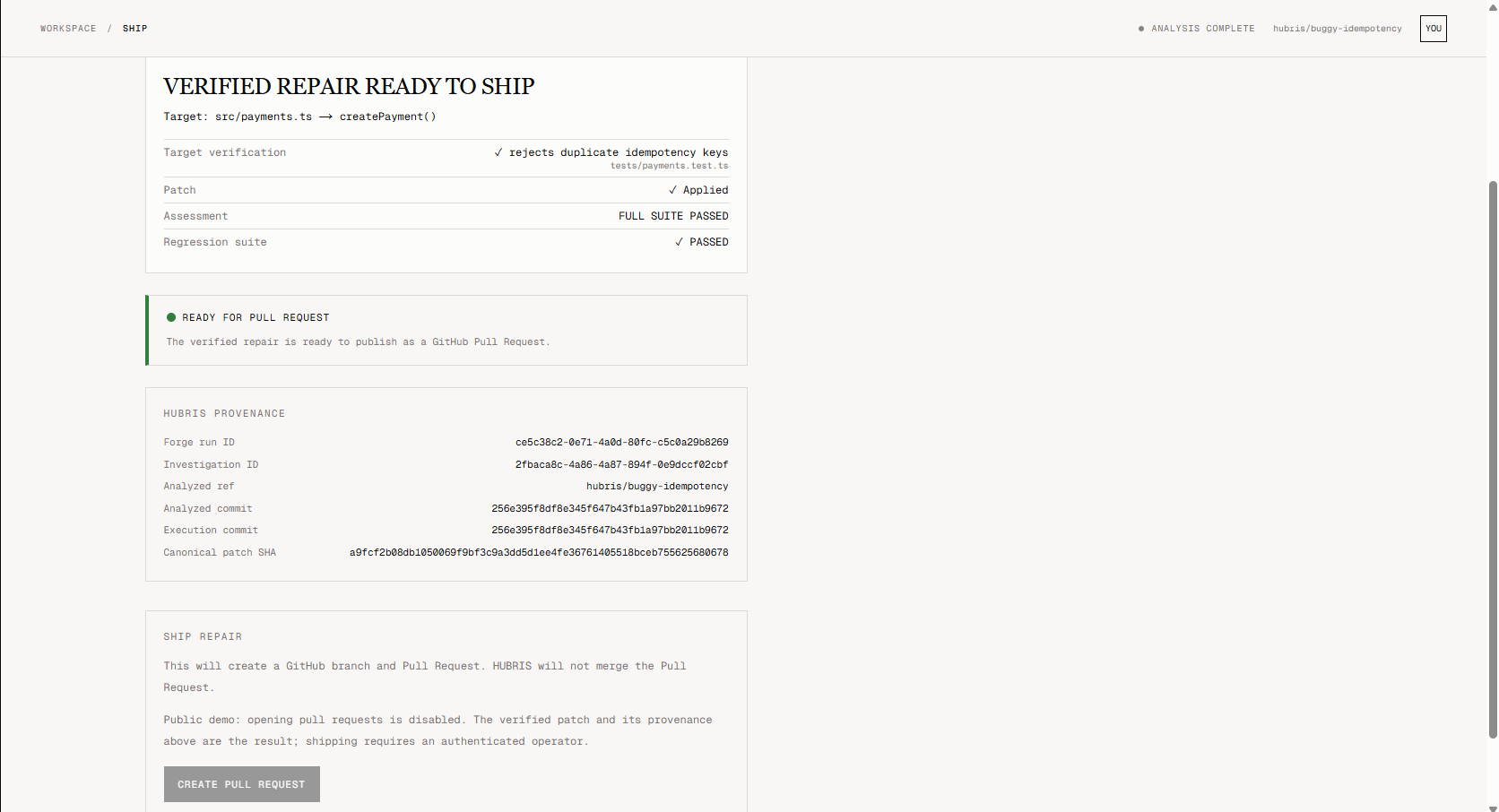
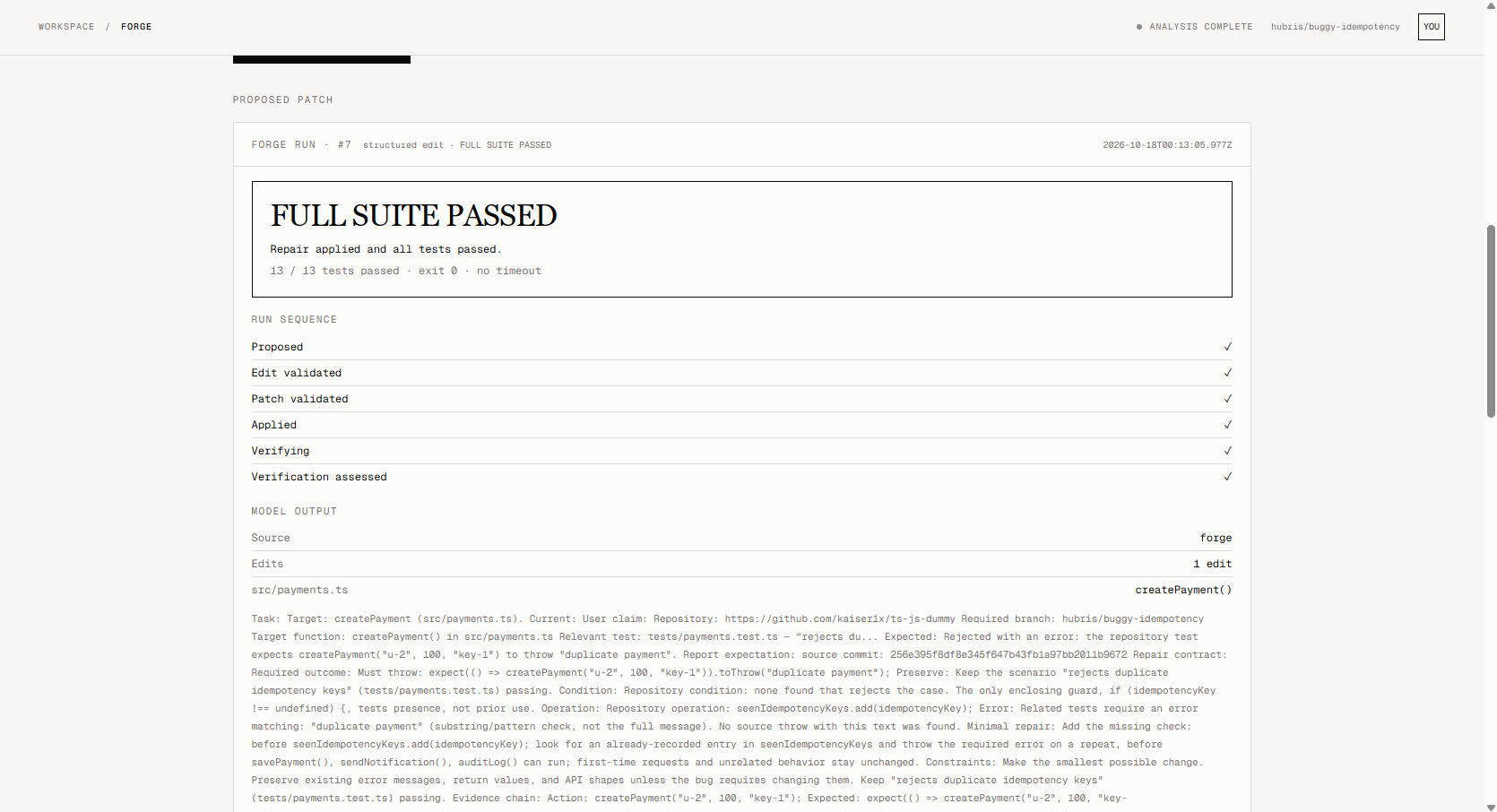
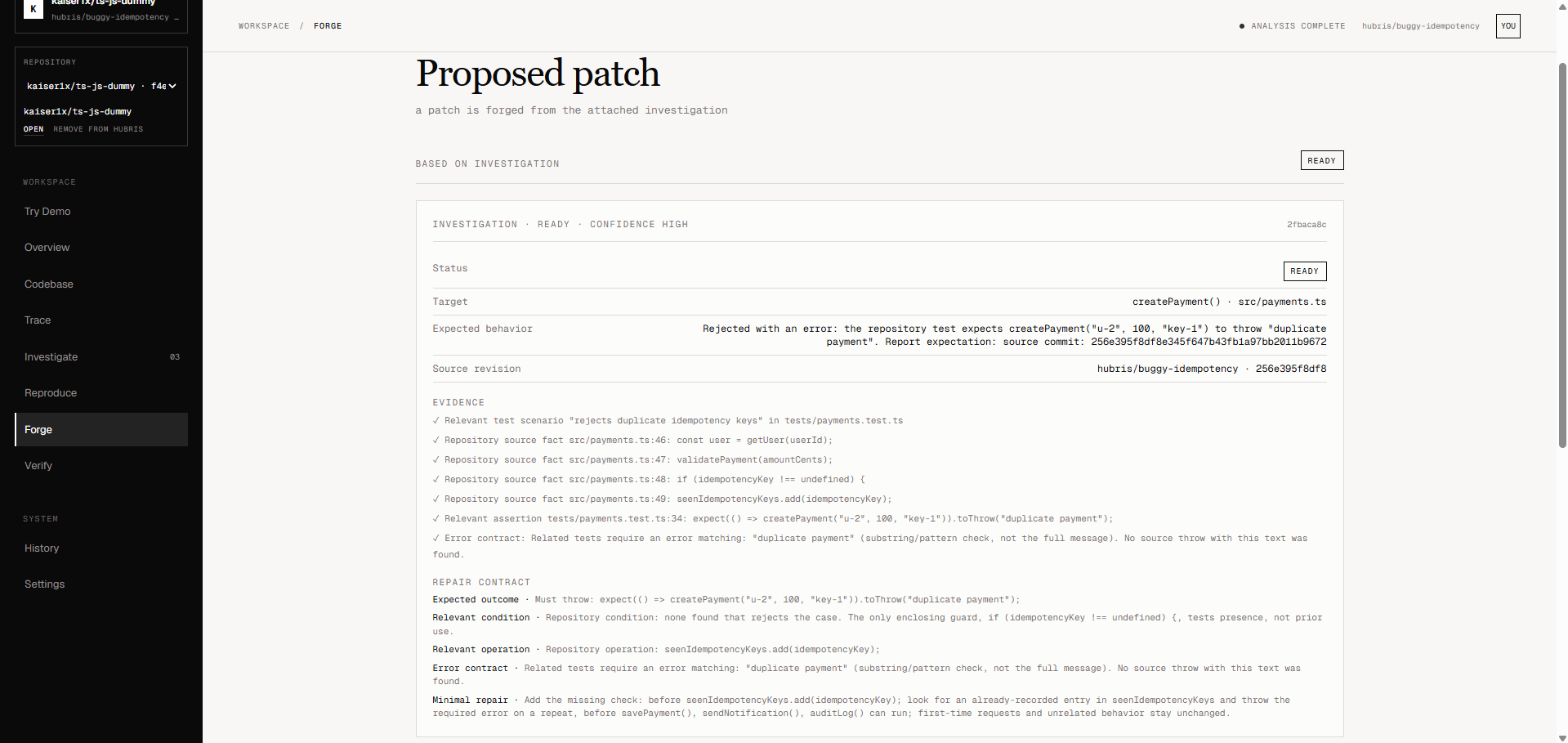
The system begins by analyzing a specific repository revision and identifying the relevant code, conditions, and tests. An investigation establishes an evidence-backed repair contract before FORGE proposes a structured edit. The patch is validated and applied in a disposable sandbox, where the target regression test and full test suite can run. Verification results and source revision information are preserved so that the SHIP stage can make decisions based on what actually happened, not merely what the model claims happened.
I built the application as a monorepo, with a Next.js web interface, a Hono API, shared TypeScript packages, repository analysis services, model integrations, database persistence, and sandbox execution. I also deployed the frontend and API separately so I could test the system under real hosting constraints.
One of my most useful test cases was a deliberately introduced idempotency bug in a TypeScript repository. The duplicate-payment guard was missing, allowing the same idempotency key to be reused. HUBRIS identified the relevant function and test, generated a minimal repair, applied the patch in the sandbox, and verified that all 13 tests passed. The analysis and execution revisions matched, and the run completed without a timeout.
Challenges I faced
Getting the AI workflow right was only part of the challenge. Making the entire system reliable across real infrastructure proved just as important.
One major challenge was preserving correctness across repository revisions. A patch that works against one commit may be unsafe against another, so I worked on binding analysis, execution, and verification to the same source revision and ensuring that SHIP fails closed when the supporting evidence is missing or inconsistent.
I also encountered monorepo build failures that did not reproduce in local development. Turborepo's caching behavior meant generated files could be missing in a clean deployment even when cached build logs appeared successful. Later, Vercel's type checker exposed a separate dependency-resolution issue involving Node's Response types. I reproduced the problems in clean environments and fixed the underlying configuration instead of suppressing the errors.
Runtime behavior introduced another challenge. Repository analysis and sandbox work can be expensive, and a slow operation must not take down the API's health endpoint. I moved the API toward a Docker-based Render deployment, separated liveness checks from dependency readiness, and tested the health endpoint during a real analysis request. The API returned HTTP 200 for the analysis, while all 34 health checks succeeded; the slowest health response was 402 milliseconds.
Authentication and deployment configuration also taught me that a working application on my own machine is not enough. Environment variables must be scoped correctly, secrets must remain server-side, and public demo access needs clear boundaries so anonymous visitors cannot use privileged credentials to perform arbitrary repository operations.
What I learned
The biggest lesson was that a convincing AI-generated patch is not the same as a verified repair.
A trustworthy engineering agent needs to know which source revision it analyzed, what evidence supports its diagnosis, whether the patch applies cleanly, whether the original failure is actually fixed, and whether unrelated tests still pass. It must also be willing to stop when the evidence is insufficient.
I learned how tightly AI reasoning, software testing, version control, sandbox execution, caching, security, and deployment reliability are connected. A failure in any one of those layers can undermine the credibility of the entire result.
I also learned to treat infrastructure failures as part of the product, not as an afterthought. If an investigation hangs, a health check fails, or an API key is missing, the system should report the real problem instead of presenting a misleading success.
What's next
I want to make HUBRIS accessible to anyone evaluating it, without requiring them to configure their own model credentials or understand the infrastructure behind it. That means a guided demo using a known bug, clear evidence at each stage, isolated demo runs, sensible resource limits, and safe restrictions on repository writes.
The long-term vision is to make AI-assisted software engineering more auditable and dependable: an agent that does not merely tell you what it changed, but shows you the evidence that justifies trusting it.
HUBRIS turns uncertainty into confidence. Confidence in the flow.
Built With
- codetwin
- debugging
- git
- hono
- nebius
- nebiustokenfactory
- nemotron
- neon
- pnpm
- postgresql
- render
- testing
- tools
- turborepo
- typescript
- vercel

Log in or sign up for Devpost to join the conversation.