-
-
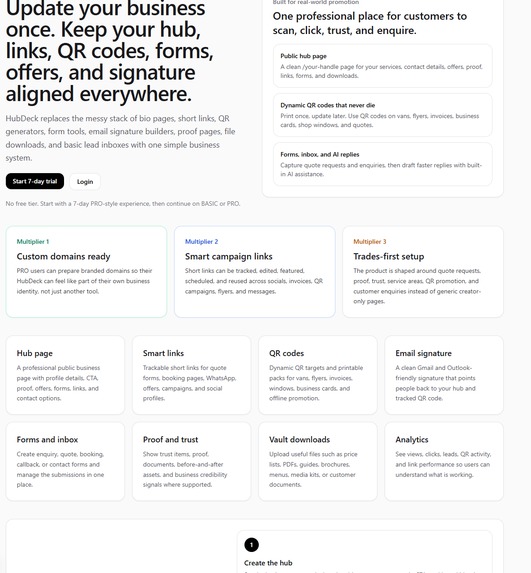
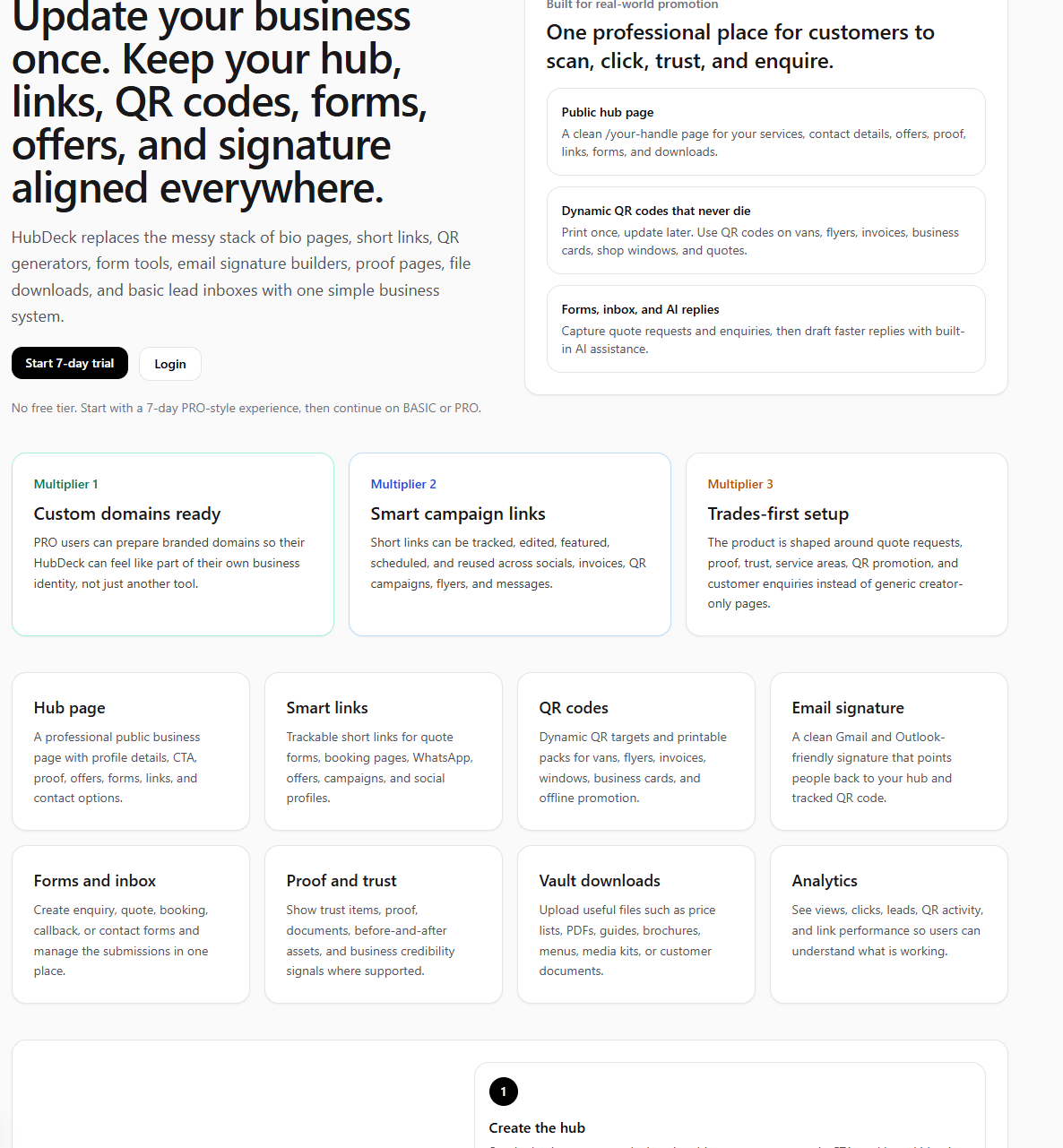
HubDeck’s public homepage and core promise: change it once, use it everywhere.
-
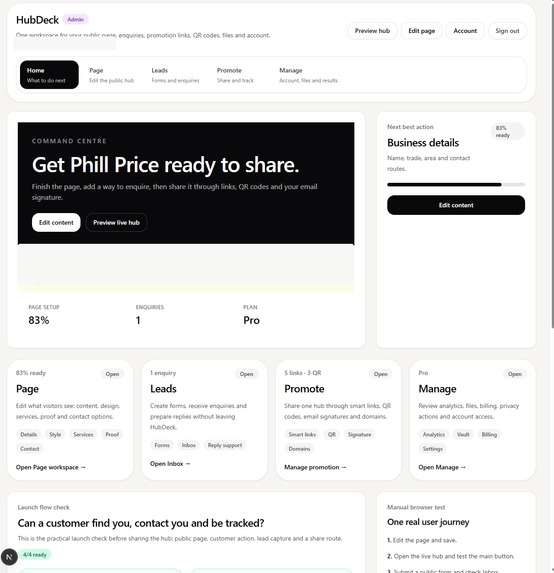
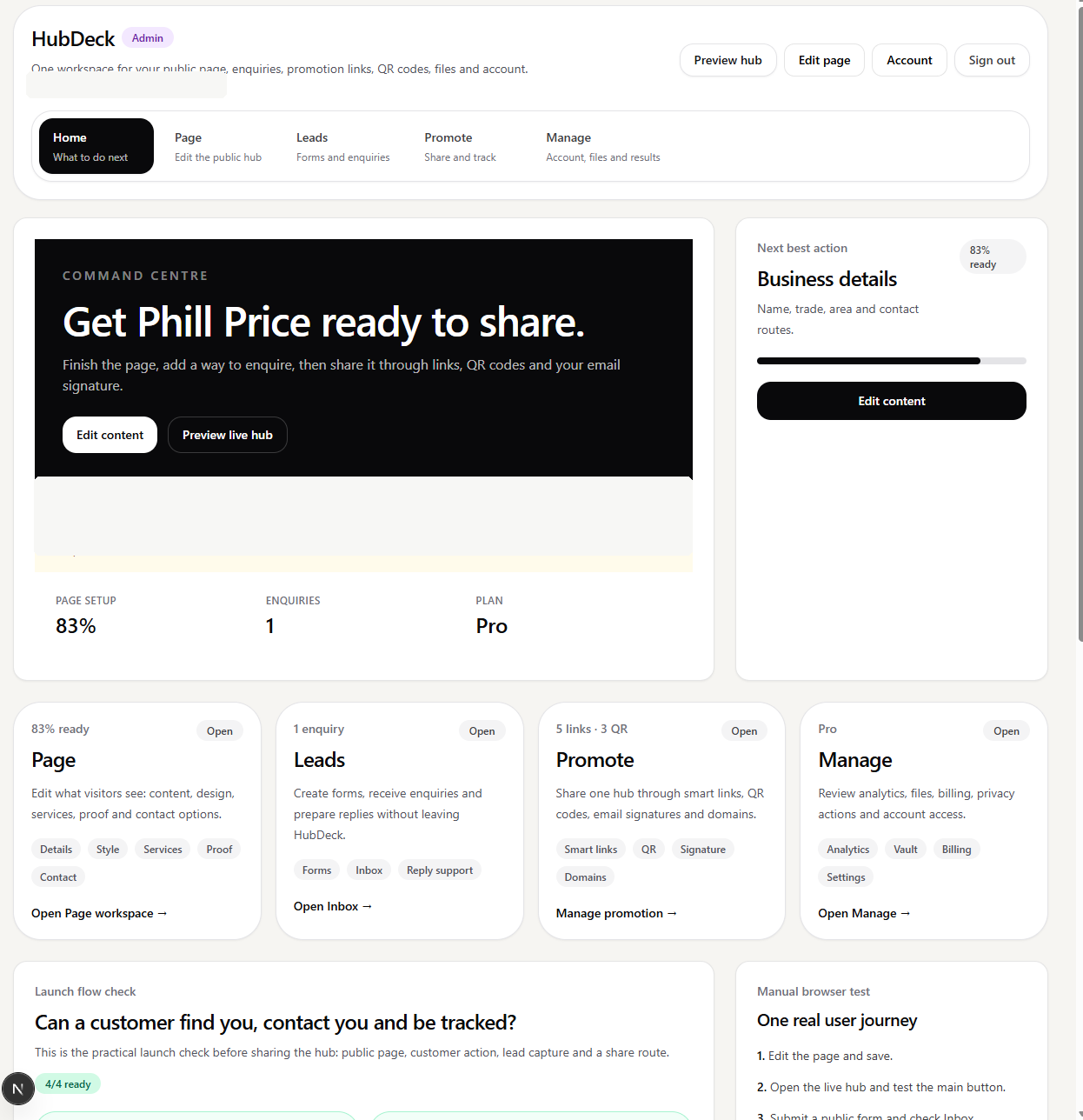
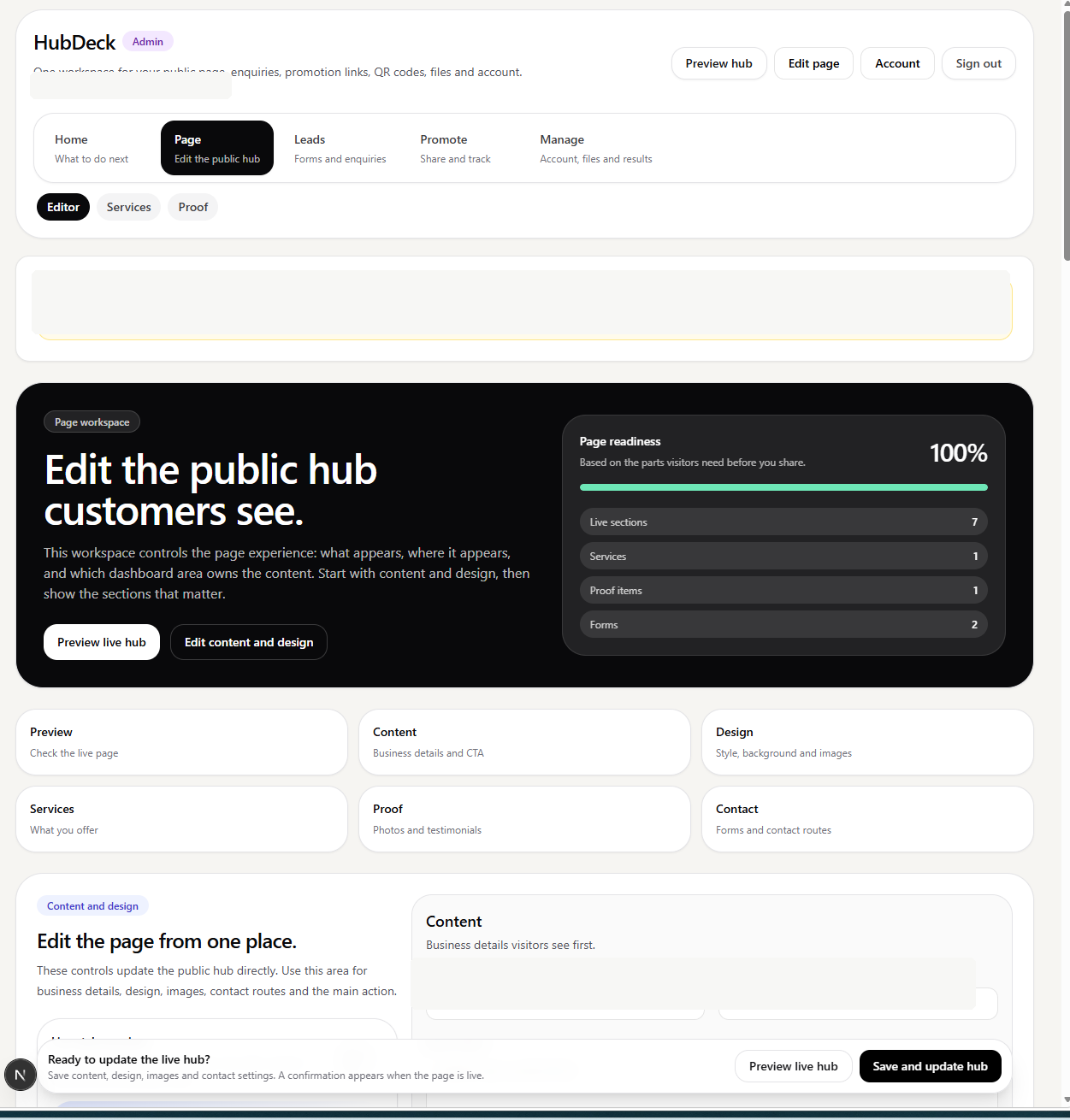
One connected dashboard for Page, Leads, Promote and Manage workflows.
-
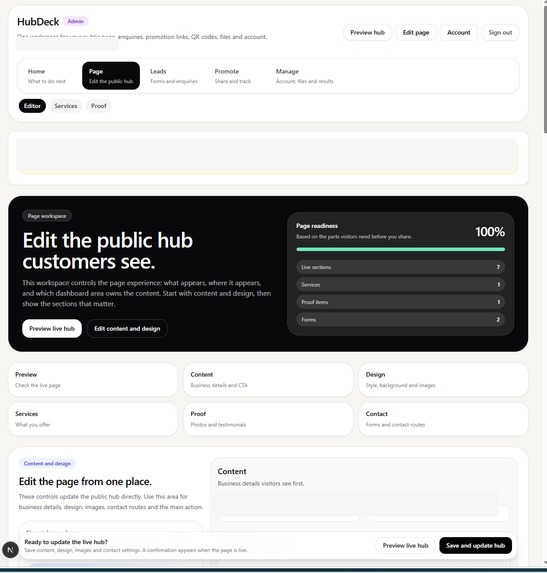
The Page Editor controls business details, branding, services, calls to action and public-page content.
-
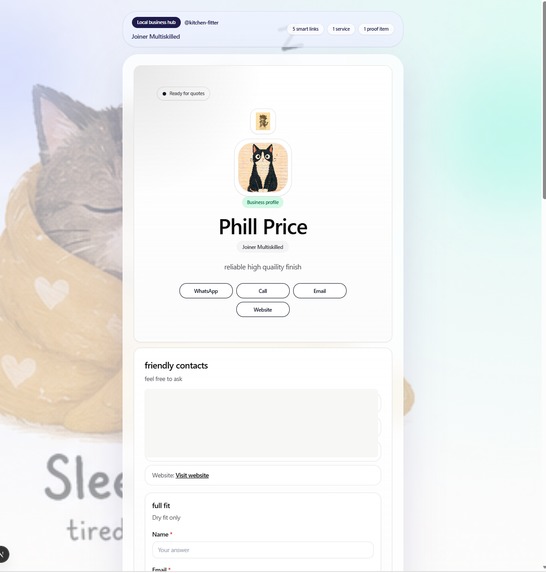
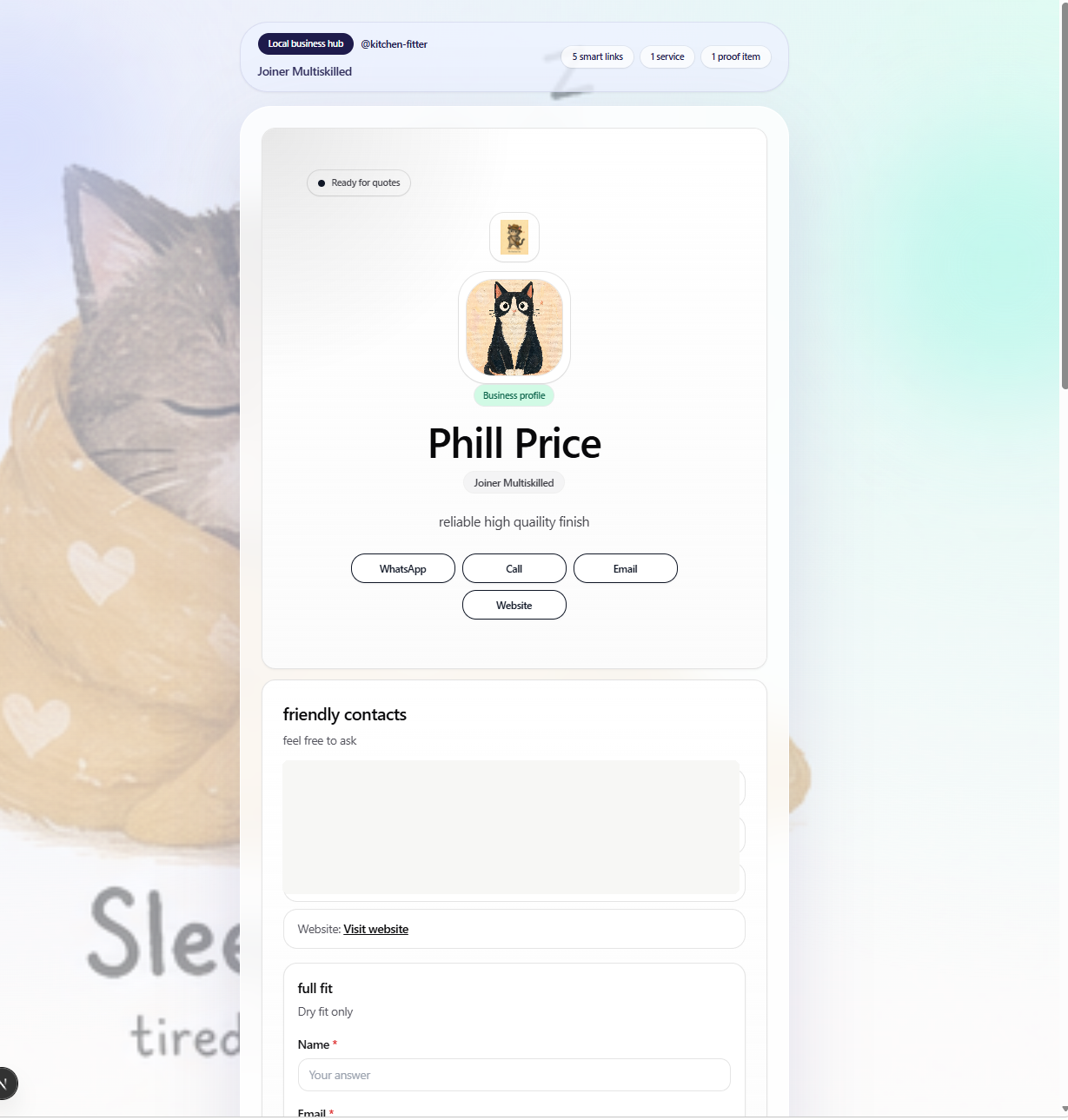
A finished public business hub combining contact routes, services, proof, forms and Smart Links.
-
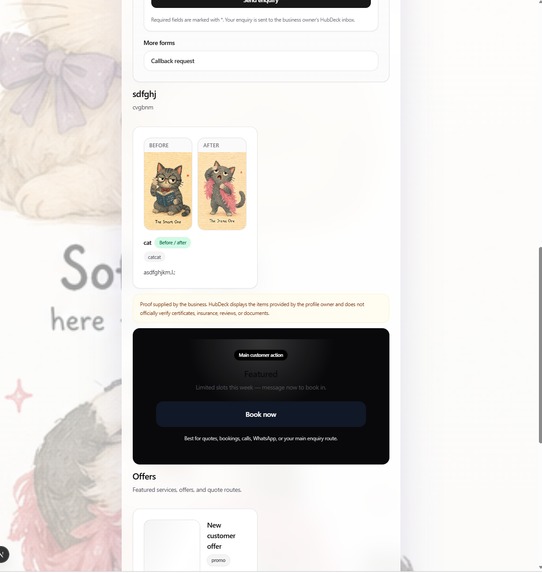
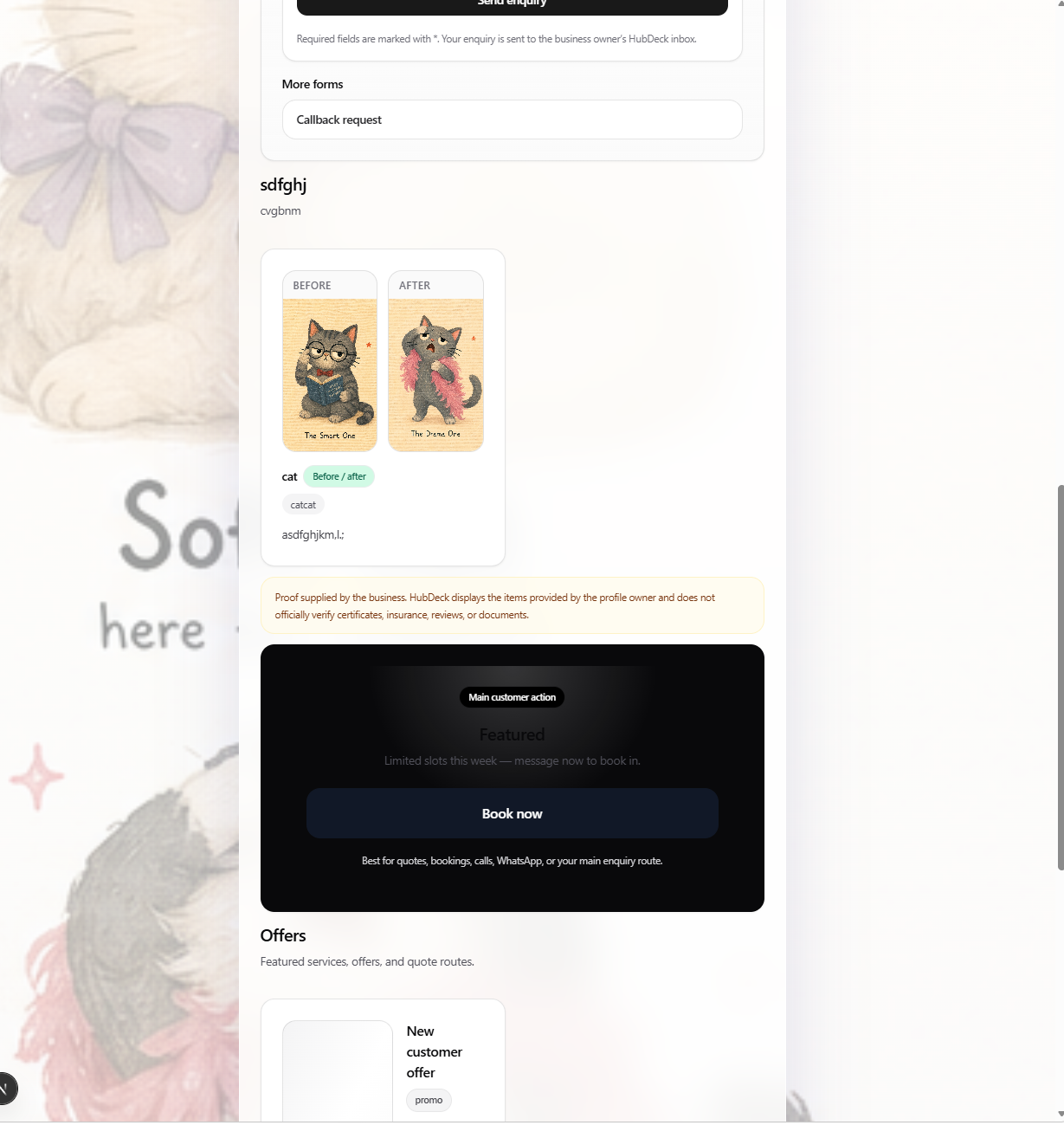
Before-and-after proof helps local businesses demonstrate credibility and completed work.
-
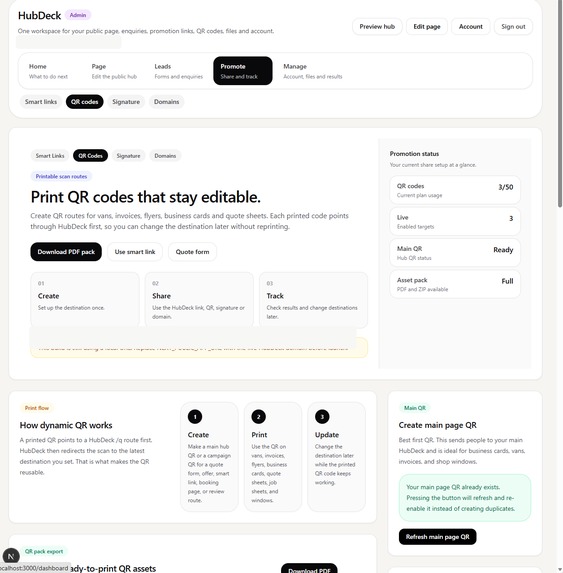
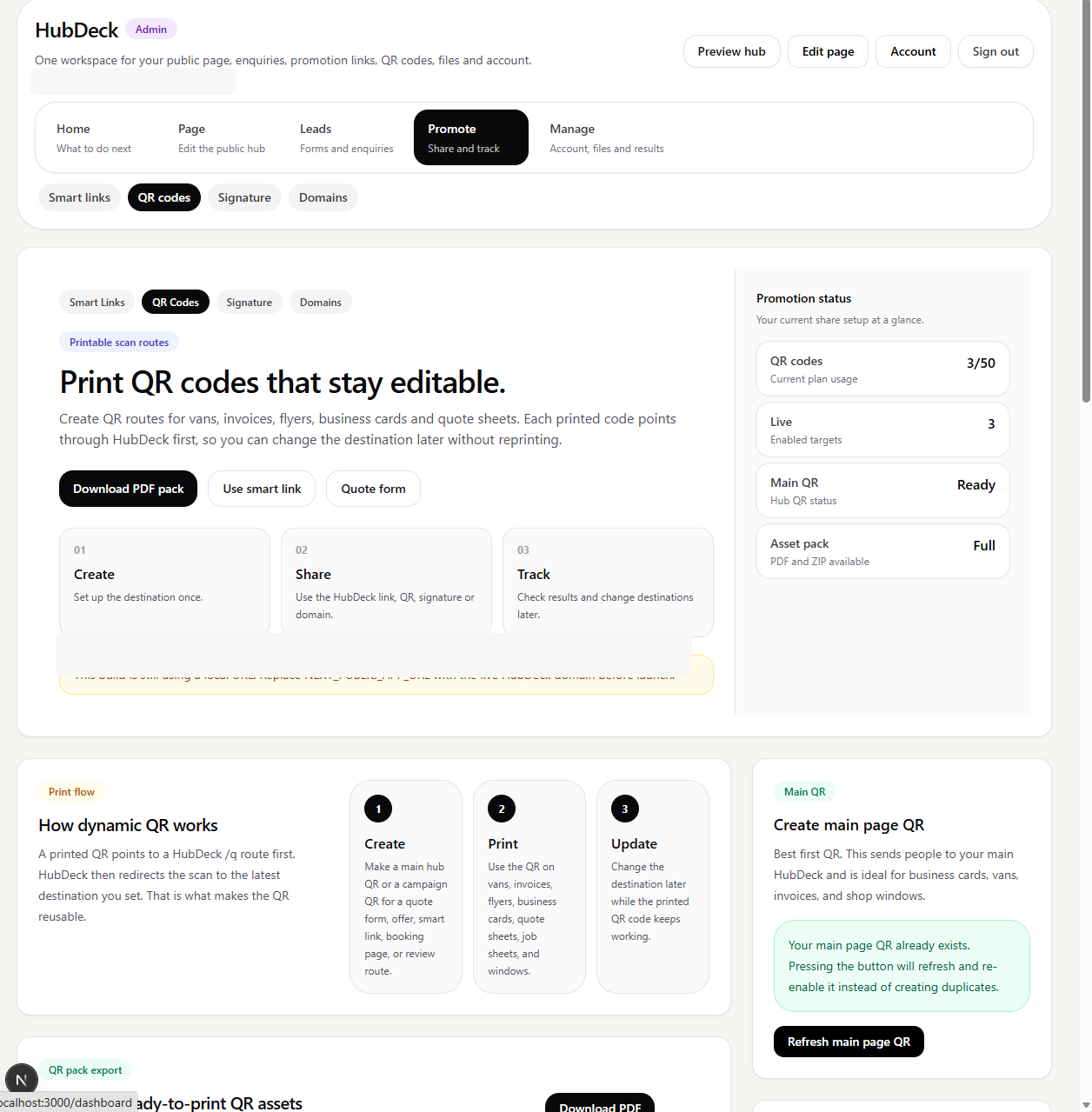
Dynamic QR management with reusable destinations and downloadable campaign packs.
-
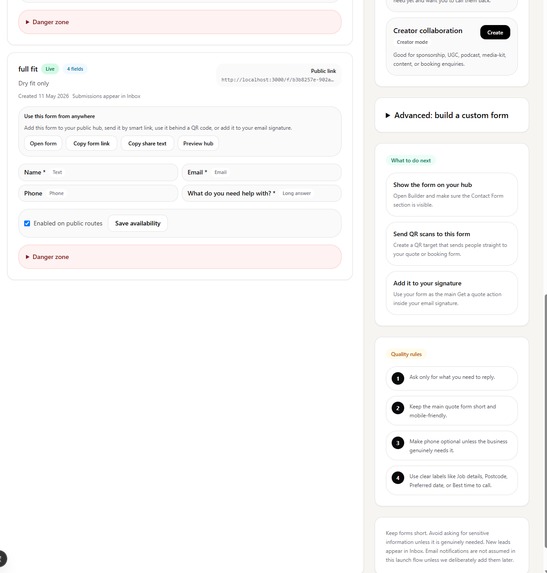
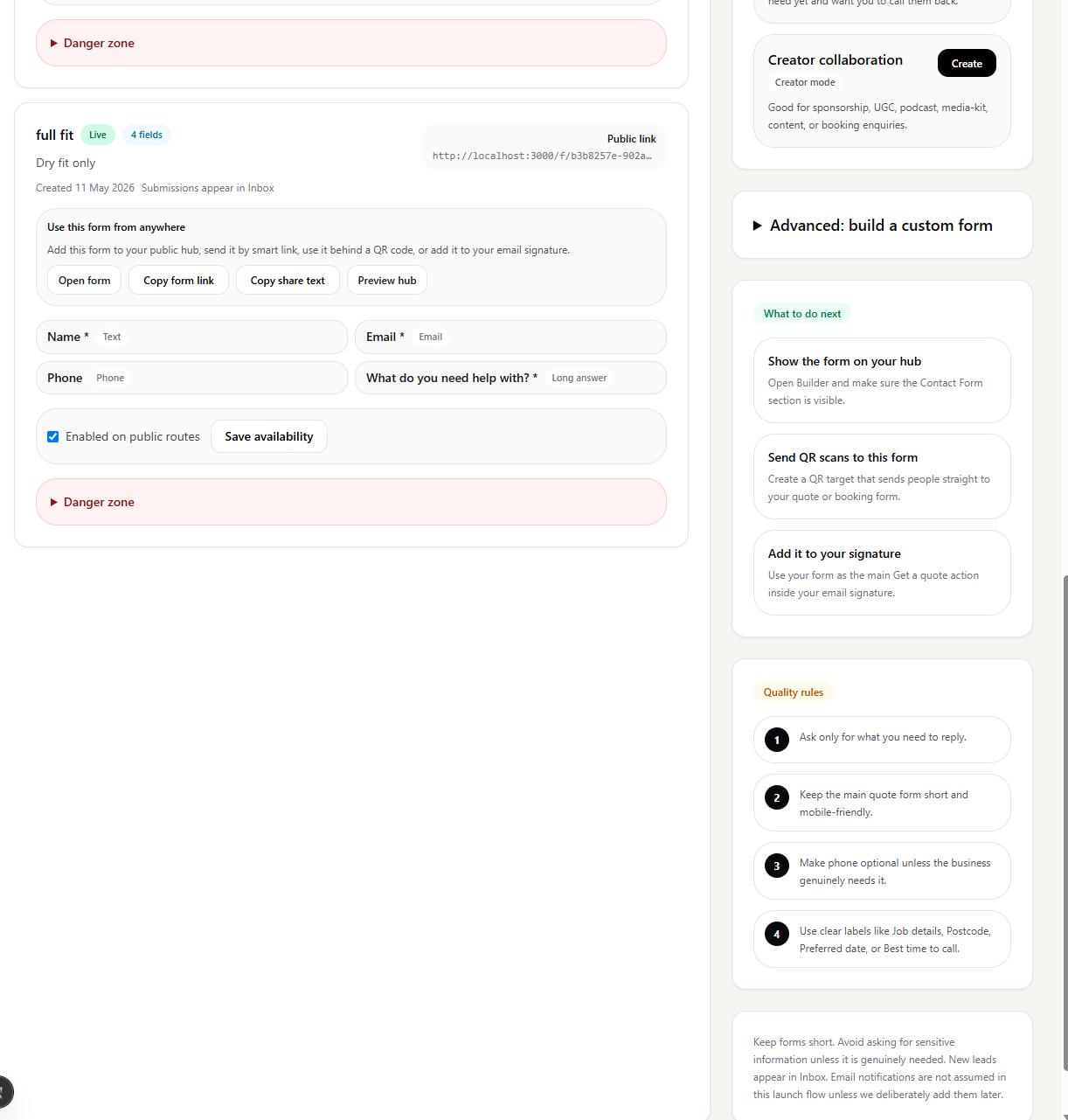
A customer-facing enquiry form that sends leads directly into HubDeck’s Inbox.
-
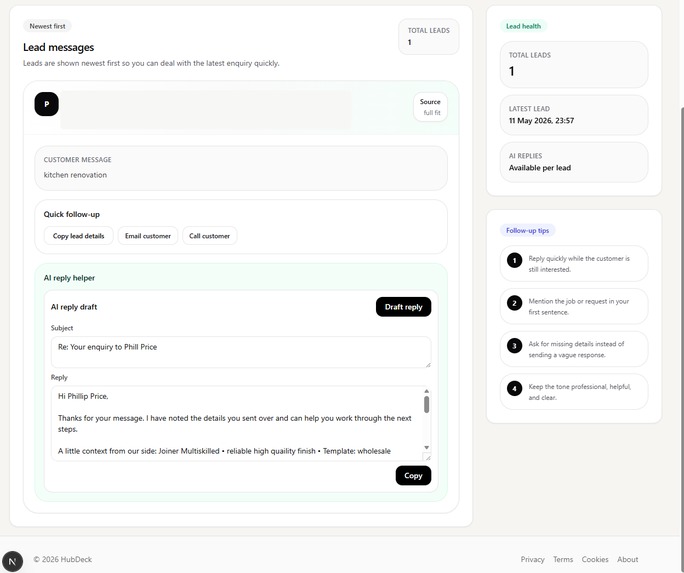
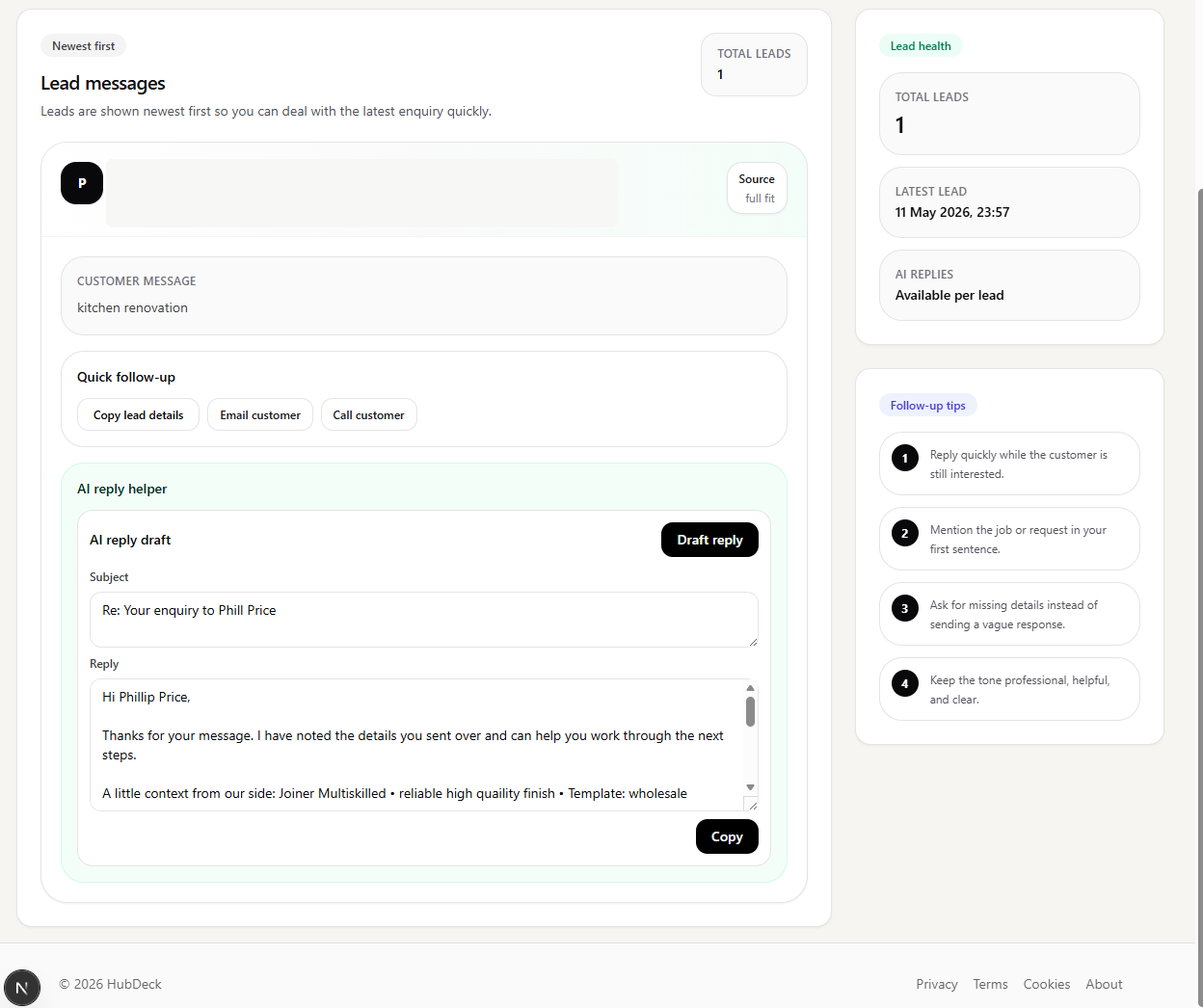
A captured lead with follow-up controls and an AI-generated reply draft.
-
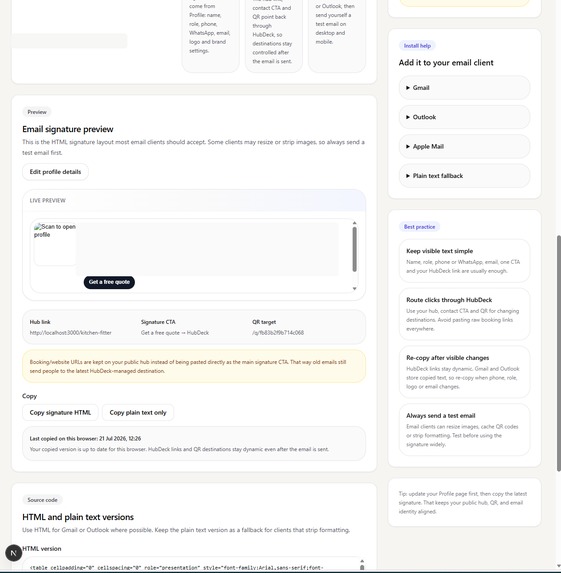
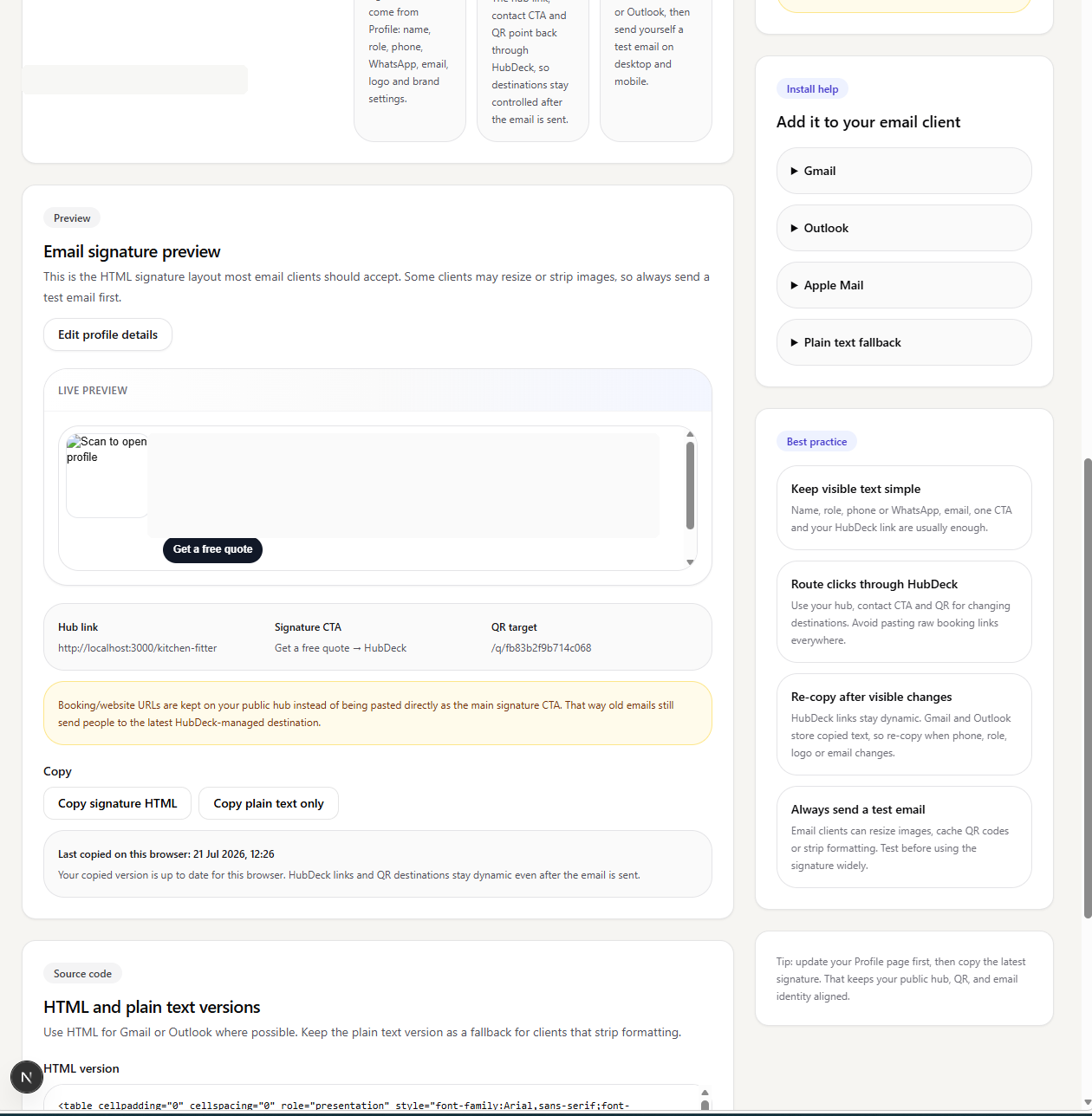
Reusable HTML and plain-text email signatures connected back to the latest HubDeck identity.
-
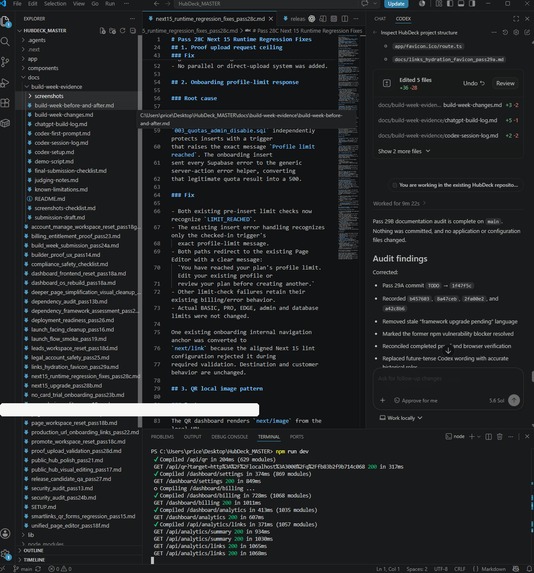
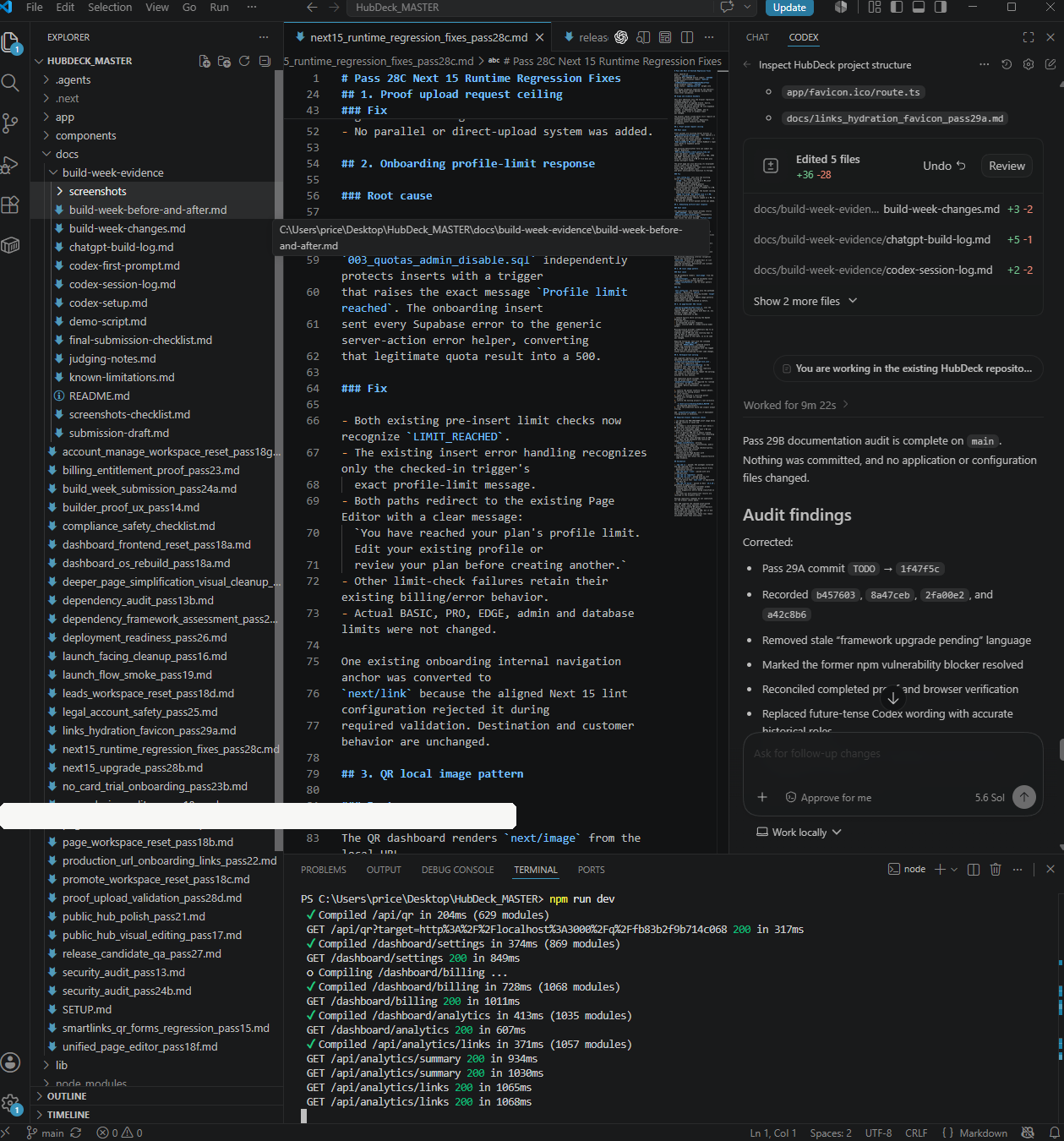
Codex working inside the real HubDeck repository through scoped, reviewable Build Week passes.
Inspiration
I have worked around trades and property improvement for many years, so I know how scattered a small business’s information can become.
A tradesperson might have their phone number, services, latest offer and contact links printed on a van, business cards, flyers, invoices, QR stickers, social profiles and email signatures.
The problem starts when something changes.
An old phone number stays on a flyer. A printed QR code points to the wrong offer. A customer finds an outdated link. The business ends up managing the same information in too many different places.
That is why I built HubDeck around one simple idea:
Update your business once. Keep every link, QR code and customer touchpoint up to date.
What HubDeck does
HubDeck is a connected business identity, promotion and lead-management platform designed mainly for tradespeople and local service businesses.
From one dashboard, a business can manage:
- its public business page;
- services, offers and contact details;
- testimonials and before-and-after work;
- dynamic QR codes;
- Smart Links and campaign links;
- enquiry forms and incoming leads;
- HTML and plain-text email signatures;
- page, click, QR and lead analytics;
- private Vault files;
- billing, account and domain settings.
It is not intended to be just another link-in-bio page.
The aim is to connect the places where a customer discovers a business, checks whether it can be trusted, gets in contact and becomes a lead.
A business can change a destination inside HubDeck without having to replace every printed QR code already on its vans, invoices or flyers.
Build Week scope
HubDeck existed before Build Week as a working SaaS project that I had been developing iteratively.
I did not want to pretend the entire product had been created from nothing during the competition. Instead, I used Build Week to take the real existing product and make it safer, cleaner and much closer to being ready for customers.
During Build Week I worked on:
- Supabase Row Level Security, Storage and privilege hardening;
- account export and deletion safety;
- seven-day trial, billing and entitlement behaviour;
- legal and cookie consistency;
- deployment-readiness checks;
- upgrading to Next.js 15.5.20 and React 19;
- resolving the runtime problems caused by that upgrade;
- reliable single-image and before-and-after proof uploads;
- browser and server file-size enforcement;
- React hydration fixes across copy controls;
- Smart Link, QR, form, Inbox and analytics testing;
- QR PDF and ZIP campaign packs;
- final evidence, screenshots and release validation.
How I built it
HubDeck uses:
- Next.js 15.5.20 App Router;
- React 19;
- TypeScript;
- Supabase Auth, Postgres, Storage and Row Level Security;
- Stripe Billing and Customer Portal;
- OpenAI-powered AI helpers;
- Server Actions and route handlers;
- Tailwind CSS;
- GitHub and VS Code.
The repository includes 53 generated routes covering the public site, dashboard, public hubs, redirects, forms, QR codes, account tools, billing and APIs.
The final validation completed:
- clean dependency installation;
- zero npm audit vulnerabilities;
- TypeScript typechecking;
- lint with no warnings or errors;
- a successful production build.
I also manually tested the main browser workflows rather than relying only on the build result.
AI features
HubDeck currently includes:
- AI Page Builder, which helps create starting page content;
- AI Text Improver, which improves business copy;
- AI Lead Reply Generator, which helps prepare responses to incoming enquiries.
The AI Lead Reply workflow was successfully exercised during runtime testing and generated a follow-up draft from a real Inbox test lead.
Production-equivalent provider testing for every AI Page Builder path is still listed honestly as a remaining limitation.
How I used GPT-5.6, ChatGPT and Codex
I used GPT-5.6 and ChatGPT as planning, review and decision-support tools.
They helped me:
- break a large build into controlled passes;
- review architecture and security decisions;
- analyse errors and test results;
- plan Supabase and billing hardening;
- decide what was safe to change;
- organise the evidence needed for the submission.
Codex worked directly inside the real HubDeck repository through VS Code.
It inspected existing files before making changes, traced problems back to their source, edited the application in focused passes and ran validation after the work.
This included helping with:
- the Next.js and React upgrade;
- runtime regression fixes;
- upload validation;
- hydration problems;
- navigation and lint corrections;
- security and evidence documentation.
I remained responsible for the product decisions and final approval. I carried out the browser testing, Supabase and provider actions, SQL changes, Git commits, screenshots, video and final submission.
Challenges
The biggest challenge was improving a fairly large existing product without damaging systems that were already working.
I did not want to solve problems by creating replacement routes, duplicate engines or disconnected code paths.
One example involved before-and-after uploads. Each image had a 2 MiB limit, but two valid images naturally produced a larger overall request. The browser, Server Action and Supabase Storage rules all had to agree without weakening the individual file limit.
Another challenge was the Next.js 15 upgrade. The application compiled, but some existing behaviour needed to be adjusted for new framework and React runtime expectations.
Copy buttons across Smart Links, signatures, forms and Inbox also produced hydration differences because clipboard support is not identical on the server and in the browser.
These were not glamorous changes, but they were important for turning a feature-rich build into a more dependable product.
What I am proud of
I am proud that Build Week improved the real product rather than producing a separate competition-only demo.
HubDeck now has:
- stronger database and Storage protection;
- cleaner account and billing controls;
- reliable proof-image workflows;
- working dynamic QR campaign packs;
- tested Smart Link, QR, form, Inbox and analytics flows;
- an upgraded application framework;
- zero reported npm audit vulnerabilities;
- a clean typecheck, lint and production build;
- structured evidence showing what changed and what still remains.
What I learned
The most useful lesson was that AI works best for me as part of a disciplined engineering process.
The pattern that produced the best results was:
- inspect the real build;
- understand the existing route or system;
- define one focused change;
- make the smallest safe edit;
- validate it;
- test it in the browser;
- record what happened honestly;
- commit only after reviewing the result.
That approach was much more valuable than asking AI to broadly rewrite large parts of the product.
What is next
HubDeck is being submitted as a substantial working release candidate, not as a fully production-proven public launch.
Before accepting unrestricted public customers, I still need to complete:
- final operator, support and legal details;
- live deployment verification;
- production Stripe webhook and subscription-lifecycle testing;
- DNS, TLS and custom-domain verification;
- broader failure-path and permission testing;
- more automated test coverage;
- final pricing and launch polish.
Basic and Pro are the intended initial plans.
A future Edge tier may add more advanced optimisation and growth features, but it will only be introduced after the main product has been proven with real customers.
Built With
- codex
- github
- next.js
- node.js
- openai
- postgresql
- react
- stripe
- supabase
- typescript
- vercel


Log in or sign up for Devpost to join the conversation.