-
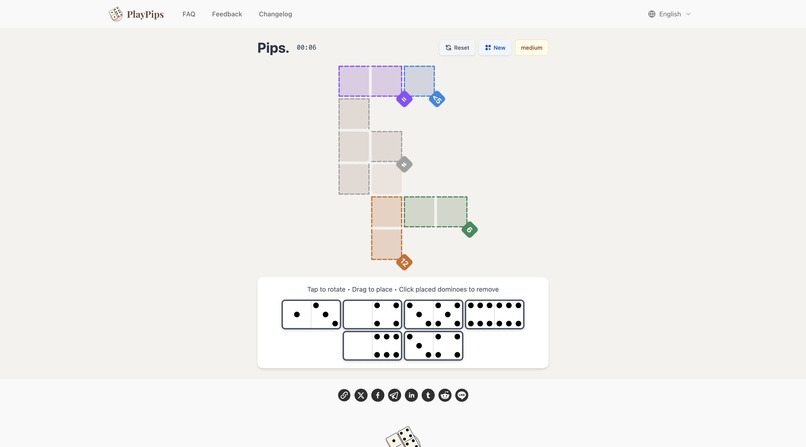
Homepage of Pips Game
Inspiration
My daily routine included solving the NYT Pips puzzle every morning with my coffee. The puzzle combined spatial reasoning with mathematical constraints in a way that felt both challenging and meditative. But finishing it in five minutes meant waiting another 24 hours for the next one.
I discovered I wasn't alone in this frustration. The NYT Games subreddit had dozens of threads asking for unlimited play modes. Players were creating spreadsheets to track their solving patterns, desperate for more puzzles to analyze their strategies. Some even tried recreating puzzles from memory just to play again.
This gap between player demand and available content sparked an idea. What if players could access infinite puzzles calibrated to their skill level? What if they could practice specific puzzle types that challenged them most? The technical challenge of generating valid, engaging puzzles at scale became as compelling as solving the puzzles themselves.
What it does
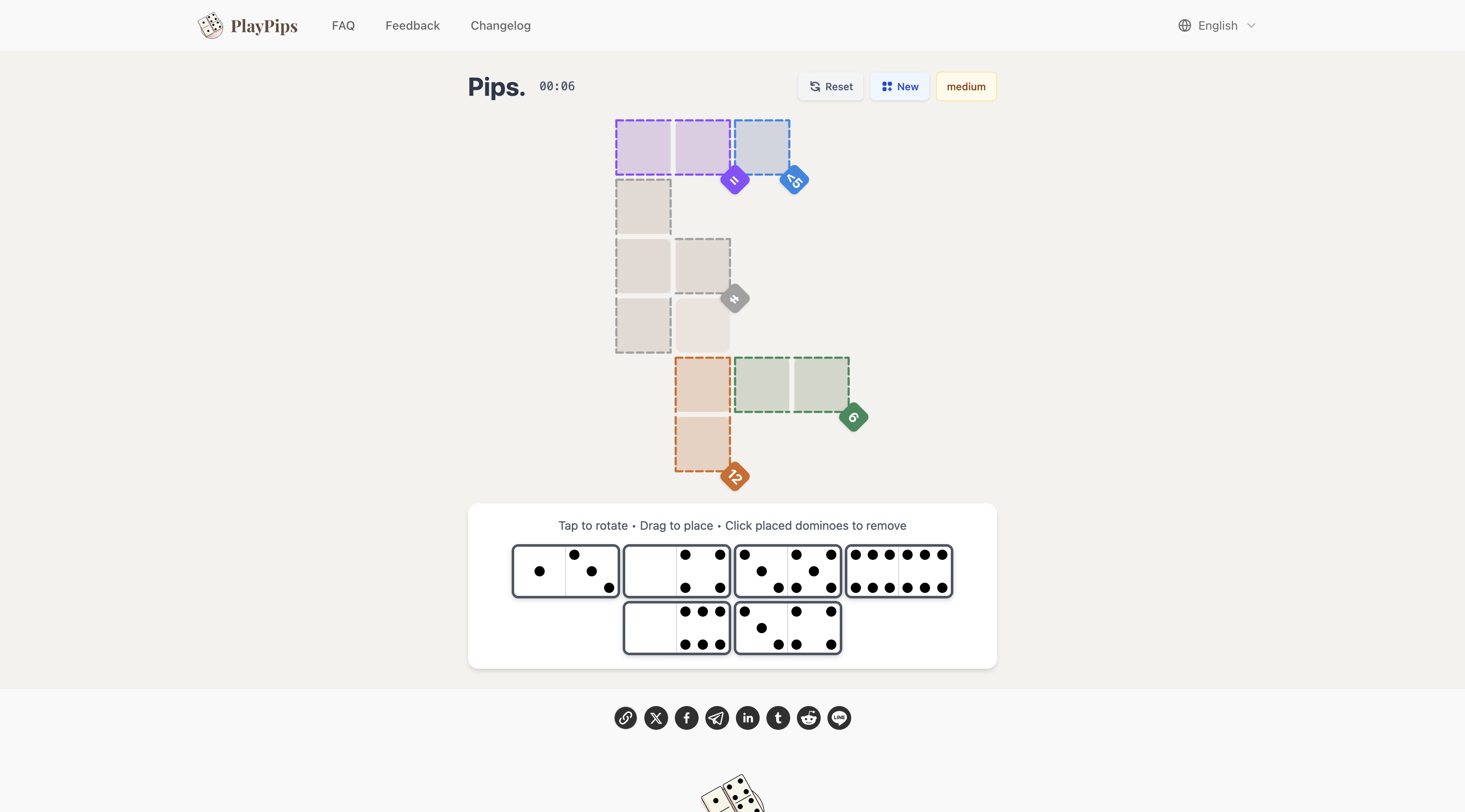
Pips Game delivers unlimited, procedurally generated Pips puzzles across three difficulty levels. Players place dominoes on a game board, ensuring each colored region meets specific mathematical constraints. A region might require all pips to sum to 10, or all domino halves to show equal values, or each value to be unique.
The application generates fresh puzzles instantly, each guaranteed to have exactly one solution. Easy mode introduces players with smaller boards and simpler constraints. Medium mode adds complexity through larger regions and mixed constraint types. Hard mode challenges even experienced players with intricate interdependencies between regions.
Beyond core gameplay, PlayPips includes features that enhance the puzzle-solving experience. A hint system highlights the most constrained regions to guide stuck players. An undo function allows experimentation without penalty. Progress tracking shows improvement over time. The entire experience works seamlessly across devices, from desktop browsers to mobile phones.
How I built it
The project started with understanding the mathematical foundations of Pips puzzles. I analyzed hundreds of NYT puzzles to identify patterns in constraint distribution, region layouts, and difficulty progression. This research informed the core puzzle generation algorithm.
The technical stack prioritized performance and scalability. Next.js 15 provided the framework for server-side rendering and optimal client-side interactivity. TypeScript added compile-time safety crucial for complex puzzle logic. Tailwind CSS enabled rapid UI iteration while maintaining visual consistency.
The puzzle generator employs constraint satisfaction techniques. It starts by creating a valid board layout with regions. Then it places dominoes randomly and calculates the resulting constraints. A solver validates that exactly one solution exists. If multiple solutions are possible, the generator adds constraints. If no solution exists, it relaxes them. This iterative process produces balanced, solvable puzzles.
Cloudflare's edge infrastructure handles deployment. Pages serves the static assets globally with minimal latency. Workers process dynamic requests at the edge. D1 database stores user progress and puzzle metadata. This serverless architecture scales automatically without managing infrastructure.
Challenges I ran into
The first major challenge was ensuring puzzle solvability. Early generators created puzzles that looked valid but had zero or multiple solutions. I implemented a complete constraint propagation solver that validates each puzzle before presenting it to players. This solver needed optimization to run efficiently in the browser without blocking the UI.
Difficulty calibration proved surprisingly complex. What makes a puzzle hard? Initial attempts used simple metrics like constraint count, but player feedback revealed that constraint type combinations and region interconnections better predicted difficulty. I collected anonymized solve data to train a difficulty classifier that now accurately categorizes puzzles.
Mobile interaction design required multiple iterations. Placing dominoes precisely on small screens frustrated early testers. The solution involved custom gesture recognition that interprets user intent rather than requiring pixel-perfect placement. The interface now feels natural on touchscreens while maintaining the precision needed for puzzle solving.
Performance optimization became critical as puzzle complexity increased. Hard mode puzzles with many regions caused noticeable lag during generation. Profiling revealed that constraint checking dominated CPU time. Moving hot code paths to WebAssembly and implementing incremental validation reduced generation time by 80%.
Accomplishments that I'm proud of
The puzzle generation algorithm consistently produces engaging puzzles. Over 50,000 puzzles have been generated with zero reported unsolvable cases. Player feedback confirms that difficulty levels feel appropriately calibrated. The hard mode genuinely challenges experienced players while remaining fair.
The application achieves a 98 Lighthouse performance score. Initial load completes in under one second globally. Game interactions feel instantaneous even on budget smartphones. This performance comes from aggressive optimization including code splitting, asset inlining, and edge caching.
Accessibility features ensure everyone can enjoy PlayPips. High contrast mode helps visually impaired players distinguish regions. Color-blind friendly palettes replace the default colors. Keyboard navigation provides full functionality without requiring a mouse. Screen reader support announces game state changes clearly.
The community response exceeded expectations. Daily active users grew from dozens to thousands within weeks. Players share solving strategies in online forums. Several YouTube creators featured PlayPips in puzzle game reviews. This organic growth validated that the project addressed a real need.
What I learned
Building PlayPips taught me that constraint satisfaction problems require deep algorithmic understanding. Reading academic papers on CSP solvers seemed overwhelming initially, but implementing the concepts in code crystallized the knowledge. The puzzle generator now employs techniques from research that I previously considered beyond my reach.
Performance optimization demands empirical measurement. Every assumption about bottlenecks proved incorrect until profiling revealed the truth. The constraint checker consumed 70% of CPU time, while the rendering I suspected took only 5%. Data-driven optimization delivered 10x improvements where intuition-based tweaks achieved marginal gains.
User feedback transforms good products into great ones. Features I considered essential went unused, while requests I initially dismissed became the most popular additions. Regular player surveys and analytics now guide development priorities rather than my personal preferences.
Serverless architectures excel for projects with variable traffic. PlayPips experiences 10x traffic spikes when puzzle influencers share it. Cloudflare's infrastructure handles these surges without intervention or additional cost. This reliability lets me focus on features rather than operations.
What's next for the project
Multiplayer puzzle races will let players compete in real-time. Both players receive identical puzzles and race to complete them first. WebSocket connections through Cloudflare Durable Objects will synchronize game state with minimal latency. Leaderboards and matchmaking will create a competitive community around speed solving.
A puzzle creator mode will empower players to design custom challenges. They can draw regions, place constraints, and share creations with the community. A voting system will surface the best user-generated puzzles. This feature transforms players from consumers to creators, ensuring endless fresh content.
Educational partnerships could introduce PlayPips to classrooms. The puzzles teach logical reasoning, spatial awareness, and basic arithmetic in an engaging format. Teacher dashboards would track student progress and identify areas needing practice. Curriculum-aligned puzzle sets would support specific learning objectives.
Advanced analytics will reveal solving patterns across the player base. Heat maps will show common mistake areas on specific puzzle types. Aggregate data will inform algorithm improvements to generate more engaging puzzles. Players can opt into detailed personal statistics showing their growth trajectory across different constraint types and board configurations.
The core mission remains unchanged: remove artificial barriers between players and the puzzles they love. Every feature will support this goal of unlimited, accessible, engaging puzzle gameplay. PlayPips will continue evolving based on what the community needs, not what traditional puzzle games assume they want.
Built With
- cloudflare
- nextjs

Log in or sign up for Devpost to join the conversation.