-
-
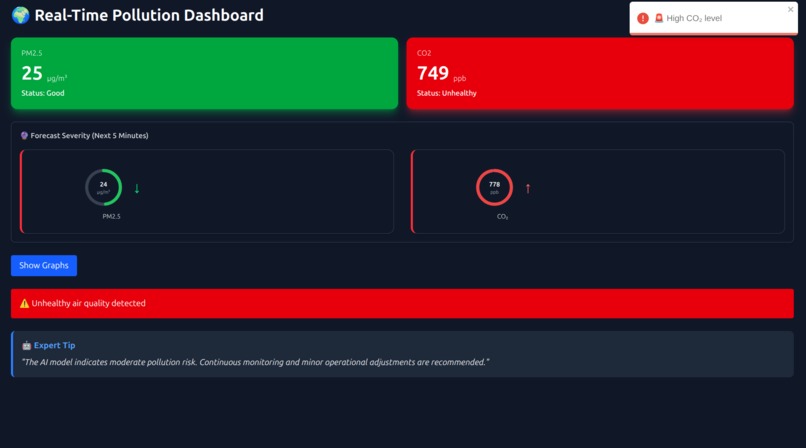
Live pollution monitoring combined with near-term forecasts.
-
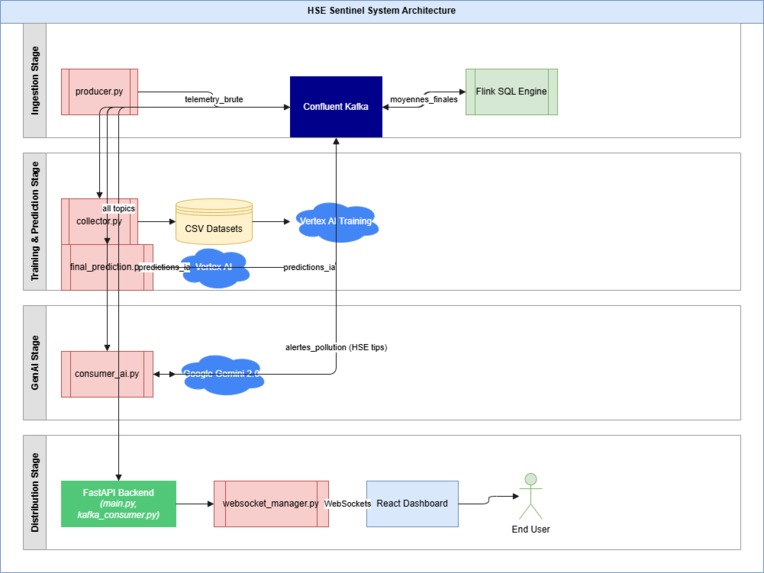
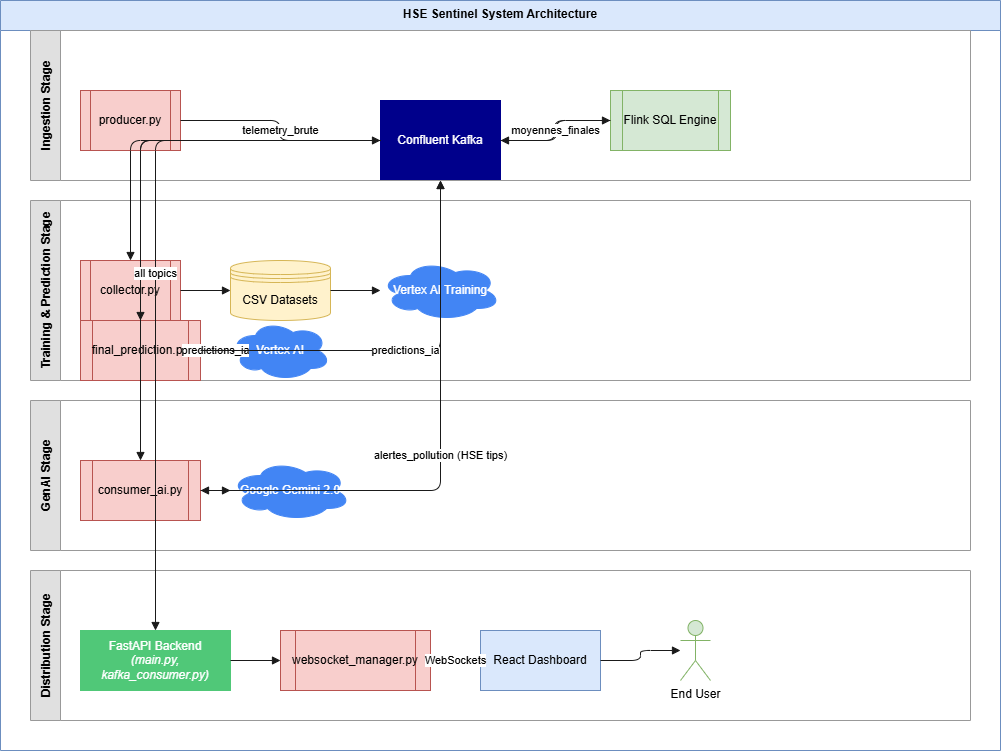
Architecture
-
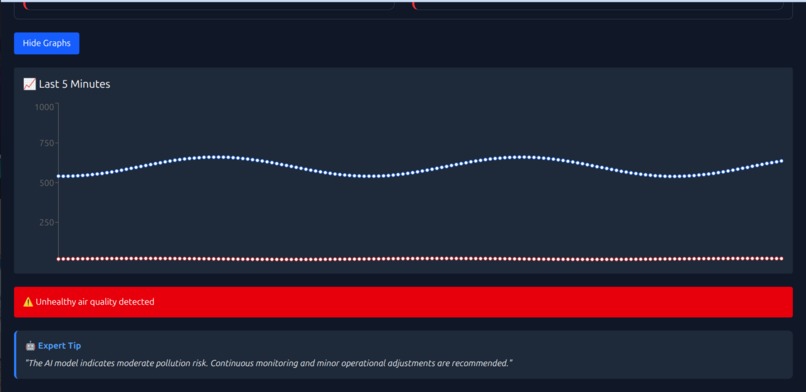
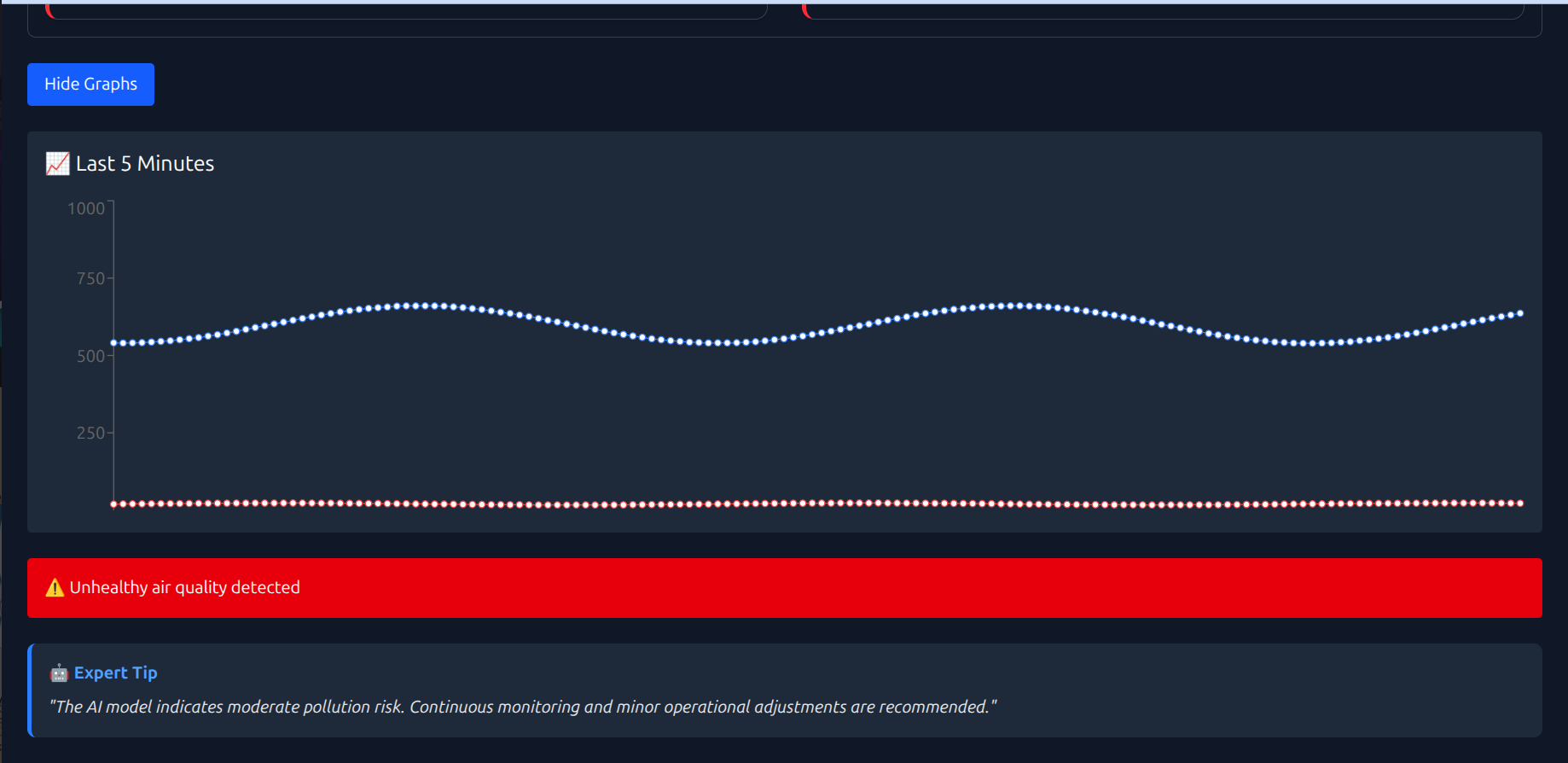
Real-time air quality trends with predictive alerts and AI-generated HSE recommendations displayed on the live dashboard.
Inspiration
Air quality monitoring systems typically rely on reactive alerts, notifying operators only after pollution levels have already crossed unsafe thresholds. We set out to design a more proactive system—one where real-time streaming data, predictive modeling, and AI-driven insights work together to anticipate risks early and enable timely intervention, rather than simply report incidents after they occur.
What it does
HSE Sentinel is a real-time industrial air quality intelligence system that continuously ingests CO₂ and PM2.5 telemetry from IoT sensors and transforms it into predictive safety insights.
The platform:
Streams high-frequency sensor data using Confluent Cloud (Kafka)
Aggregates and stabilizes noisy signals using Flink SQL windowing
Predicts near-future pollution severity using Google Vertex AI
Generates context-aware HSE recommendations using Gemini 2.0
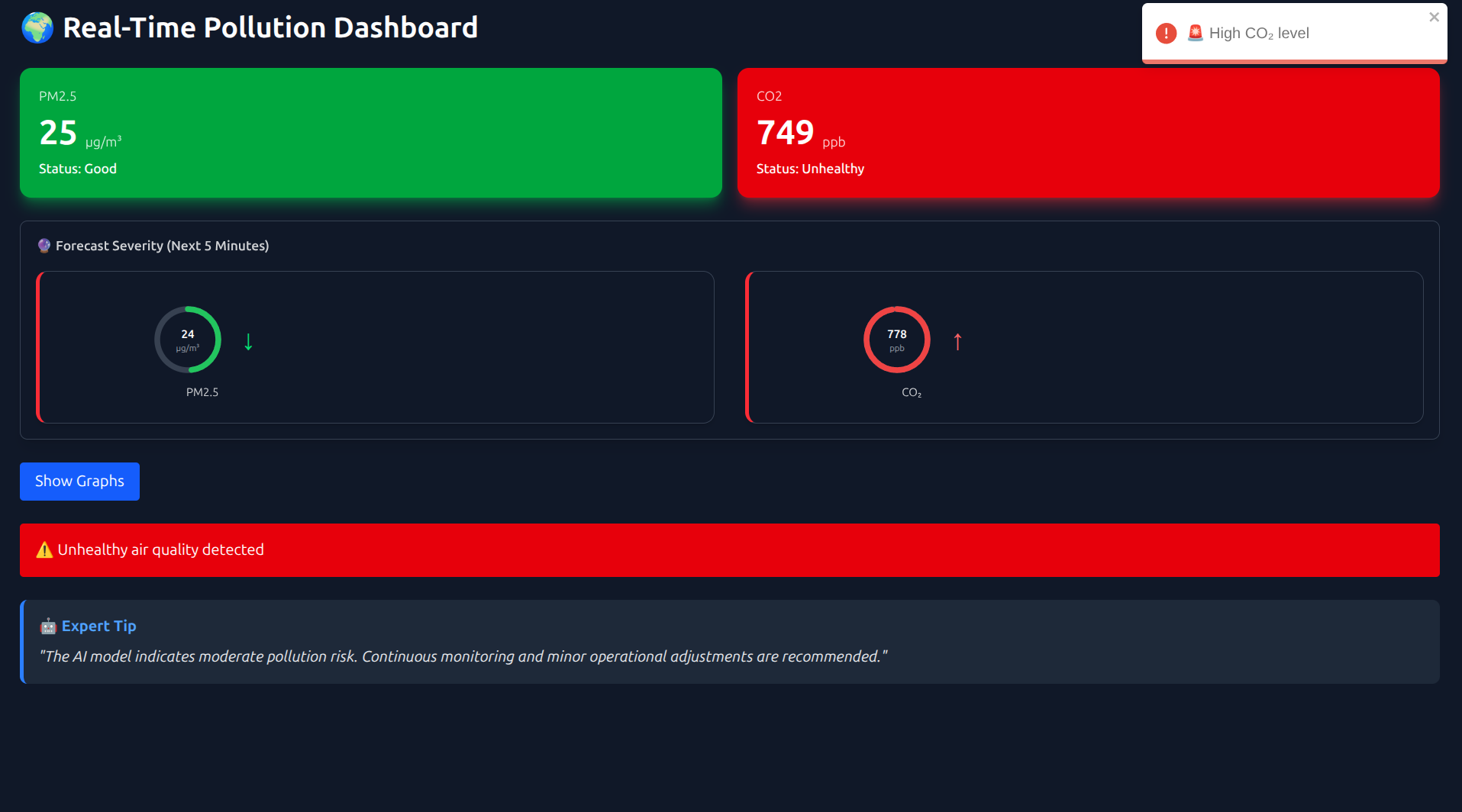
Delivers live metrics, forecasts, alerts, and expert guidance through a real-time dashboard
Instead of reacting after thresholds are breached, HSE Sentinel helps operators anticipate hazards and act early.
How we built it
The system was built as an end-to-end streaming and AI pipeline:
Data Ingestion
A Python-based industrial IoT simulator produces high-frequency CO₂ and PM2.5 readings and streams them into Confluent Cloud using Kafka.
Stream Processing
Flink SQL performs 30-second tumbling window aggregations to smooth sensor noise, compute trends, and prepare stable inputs for AI inference.
Predictive AI
A time-series forecasting model hosted on Vertex AI predicts pollutant severity five minutes into the future.
Generative AI
Gemini 2.0 Flash-Lite analyzes live values, forecasts, and trends to generate real-time, human-readable HSE safety recommendations.
Backend & Delivery
A FastAPI (ASGI) backend consumes Kafka streams asynchronously and pushes live updates to the frontend via WebSockets.
Frontend
A React-based dashboard visualizes real-time data, forecasts, alerts, and AI-generated recommendations with sub-second latency.
The entire stack is containerized using Docker and Nginx for reliability and portability.
Challenges we ran into
Designing a streaming pipeline that balances high-frequency ingestion with stable, noise-resistant analytics
Synchronizing Kafka, Flink, AI inference, and WebSocket delivery without introducing latency
Ensuring AI recommendations felt context-aware, not rule-based or static
Accomplishments that we're proud of
Building a fully integrated streaming + AI system
Successfully combining Kafka, Flink, Vertex AI, and Gemini 2.0 into one pipeline
Delivering predictive insights
Designing a clean separation between data ingestion, processing, inference, and visualization
What we learned
How to design event-driven, real-time architectures using Kafka and Flink
The importance of windowed aggregation before AI inference in streaming systems
How generative AI can enhance observability systems by providing actionable context
Best practices for building AI systems that are modular, secure, and production-ready
How frontend UX strongly influences the perceived intelligence of AI-driven systems
What's next for HSE Sentinel: Predictive Industrial IoT & AI Safety Pipeline
Support for multiple sensors, zones, and industrial sites
Longer-horizon forecasting and anomaly detection
Confidence scoring and explainability for AI recommendations
Integration with automated control systems and alert escalation workflows
Deployment on managed cloud infrastructure for continuous operation

Log in or sign up for Devpost to join the conversation.