-
-
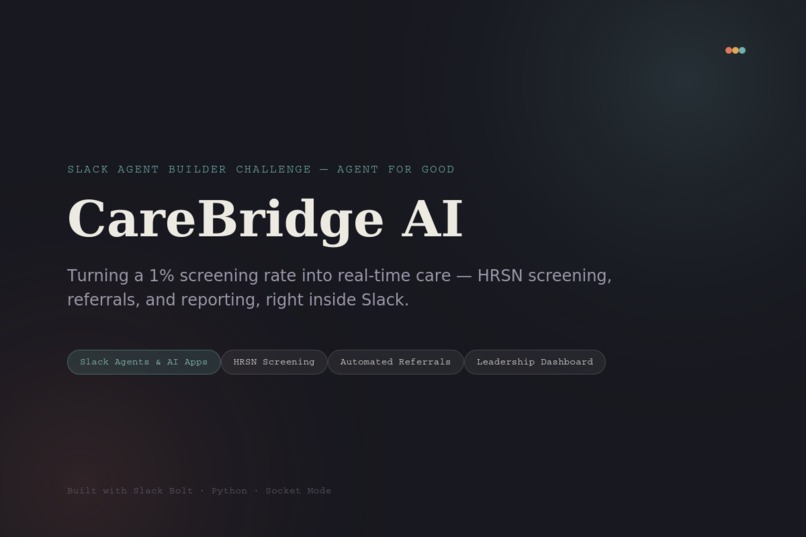
Cover Page
-
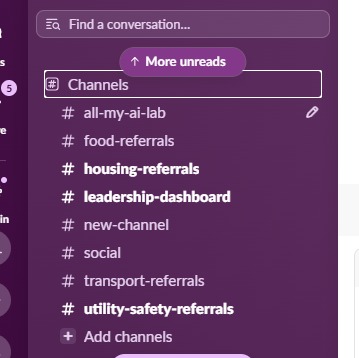
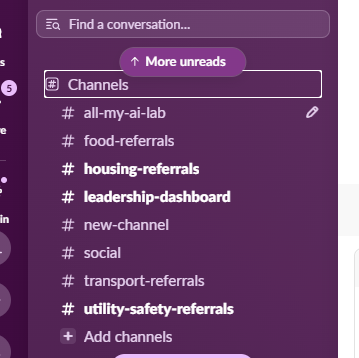
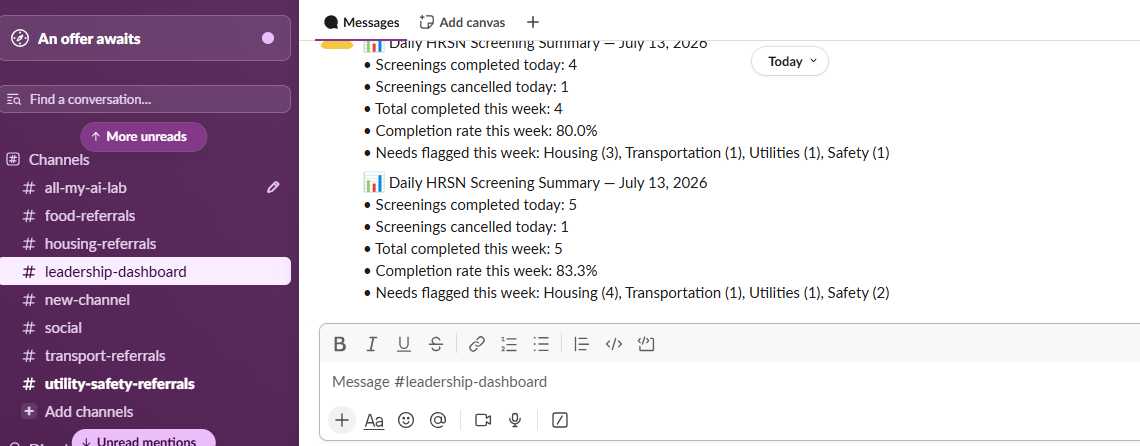
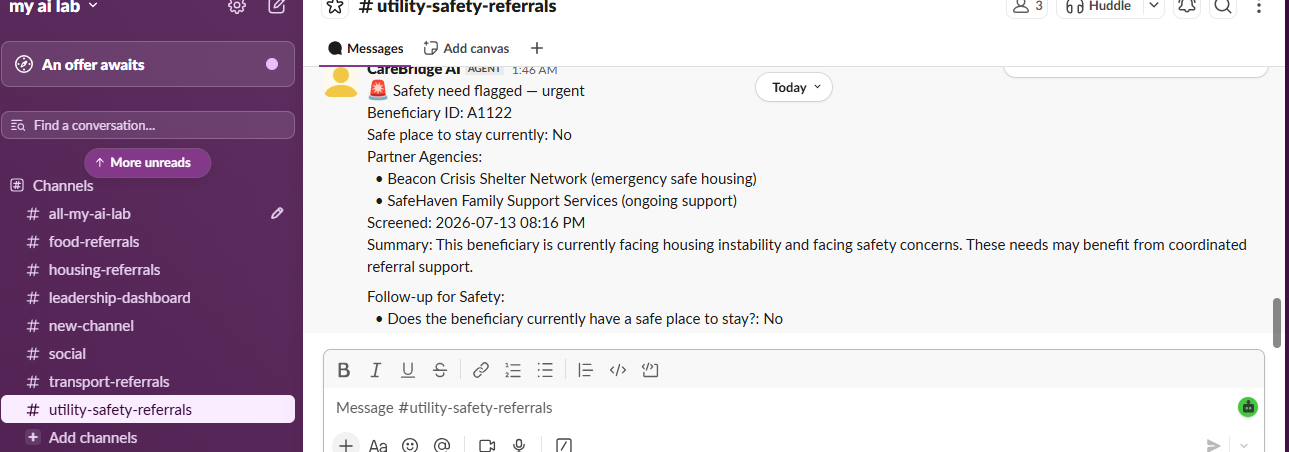
Summary Channel (Leadership) and Referral Channels
-
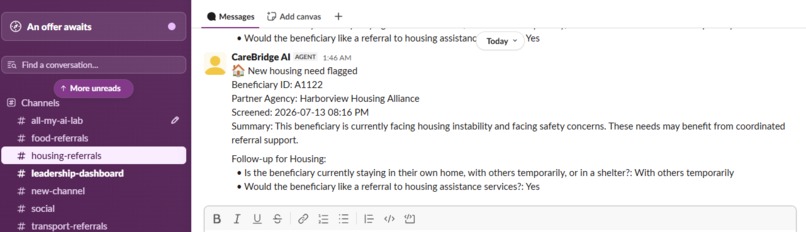
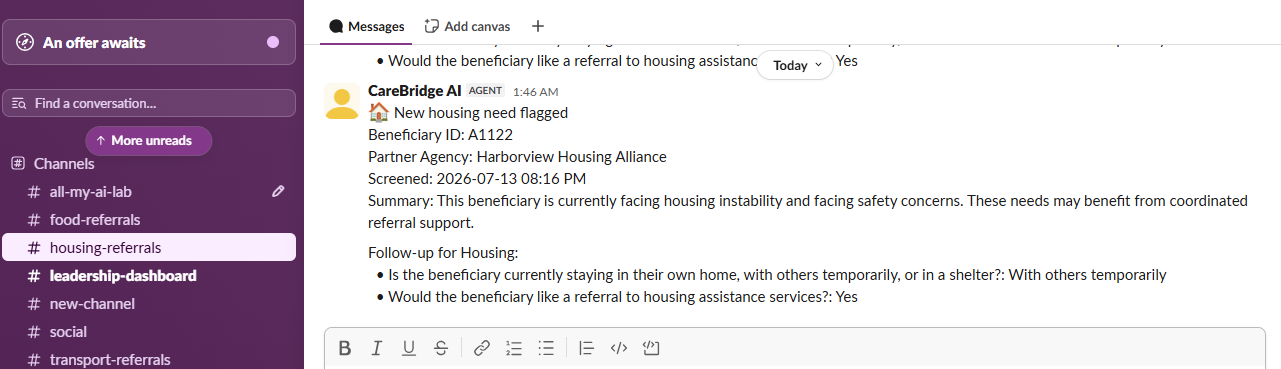
Housing Referral flagged
-
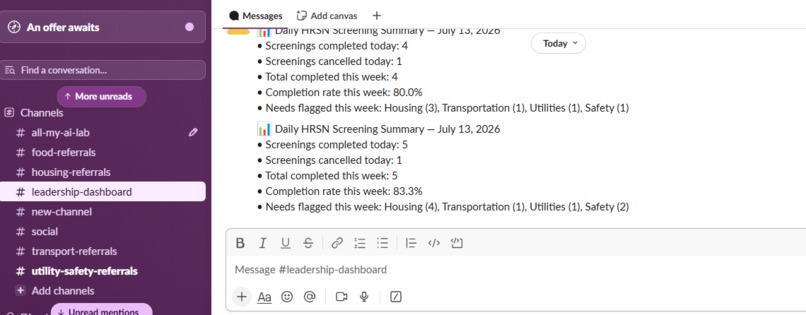
Inside the leadership channel, summary is generated
-
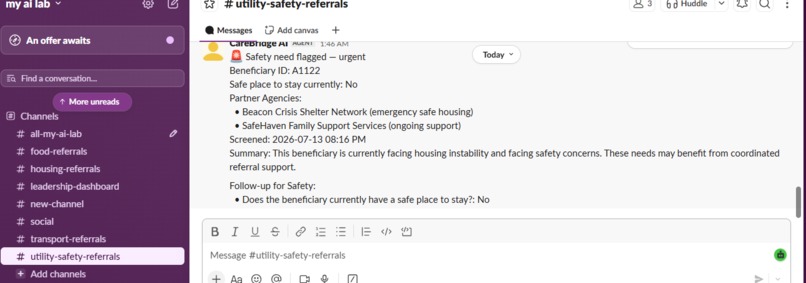
Utility and safety channel, showing the agencies where beneficiary can be referred
CareBridge AI
Track: Slack Agent for Good
Inspiration
During my Health Informatics capstone, I studied a healthcare nonprofit implementing CMS's Accountable Health Communities (AHC) Model — a program built on the premise that up to 80% of health outcomes are driven by social factors, not medical ones. Six months after mandating Health-Related Social Needs (HRSN) screening across its clinics, completion rates were as low as 1%, and in the best case only 16%. The root causes were structural: screening was done on paper, burdened only physicians (who had no time and often avoided it), and results were manually re-typed into Excel and emailed to leadership every two months.
That gap between a well-intentioned policy and its real-world execution stuck with me. Rather than creating another standalone healthcare application, I wanted to bring HRSN screening into a collaboration platform staff already use.
Slack is already where healthcare teams communicate throughout the day. Instead of asking clinicians to learn another application, CareBridge AI brings screening, referral coordination, and leadership reporting into an existing workflow, reducing friction while improving adoption.
What it does
CareBridge AI runs a conversational Health-Related Social Needs (HRSN) screening directly inside Slack using a guided AI assistant. Specifically, it:
- Runs a conversational HRSN screening (Housing, Food, Transportation, Utilities, Safety) directly inside Slack, usable by any staff member, not just physicians
- Instantly flags which domains represent a need, using a transparent rule engine
- Asks targeted follow-up questions immediately after any flagged domain — for example, a flagged Housing need triggers a question about current living situation; a flagged Safety need checks whether the person currently has a safe place to stay
- Generates a plain-language summary of each screening using Slack's native AI Agent framework
- Automatically routes each flagged need to the right internal referral channel, along with a named partner agency — including a dedicated emergency shelter referral path when someone reports having no safe place to stay
- Gives leadership an on-demand, real-time summary dashboard (
/hrs-dashboard) — replacing what used to be a manually compiled spreadsheet emailed every two months
How we built it
CareBridge AI is built with Slack Bolt for Python using Socket Mode, allowing the
application to run without exposing a public server. It uses Slack's native Agents &
AI Apps framework (assistant:write, Assistant thread lifecycle) to deliver the
conversational screening experience and AI-generated summaries natively inside Slack,
satisfying the hackathon's Slack AI capabilities requirement — clinic staff never have to
leave their normal Slack workflow to complete a screening.
The application is organized into modular components:
- Conversation engine for HRSN screening
- Rule engine for deterministic, transparent need detection
- AI summarization module using Slack's Agents & AI Apps framework
- Referral routing engine, including named partner agencies and an emergency shelter path for safety-critical cases
- Leadership analytics dashboard
This separation made the project easier to debug and allows additional screening domains or referral providers to be added without changing the core workflow.
Challenges we ran into
- A silent hang bug: partway through development, the conversation flow would advance its internal state but never send the next message — with no error logged anywhere. Root-causing this required adding explicit logging around every message-send call to find where execution was actually stopping.
- Assistant thread misconfiguration: enabling Slack's Agents & AI Apps feature
initially left the live "Chat" tab non-functional, because messages were being posted
outside the proper Assistant thread context. Fixing this required refactoring message
delivery to use the
channel_id/thread_tsfrom theassistant_thread_startedevent rather than posting to a freshly opened conversation each time. - Keeping referral routing and the leadership dashboard cleanly separated, so per-screening detail never leaks into the aggregate leadership view.
- Designing a healthcare workflow that balanced privacy with collaboration. Referral channels needed enough information for follow-up while avoiding unnecessary exposure of beneficiary details.
Accomplishments that we're proud of
- A complete workflow that takes a beneficiary from screening through referral and organizational reporting without leaving Slack
- Native use of Slack's Agents & AI Apps framework, not a workaround
- A referral system that distinguishes urgency — someone with no safe place to stay gets an emergency shelter referral, not just a generic support contact
- Grounded, real-world impact framing backed by actual data from CMS's Accountable Health Communities Model
What's next for CareBridge AI
- Replace the current placeholder partner agency names with a real, live community resource directory via MCP server integration (e.g. a 2-1-1-style API)
- Add a gentle reminder system for staff who start but don't complete a screening
- Multi-clinic support, so a single hub organization can see aggregated data across several clinical delivery sites, matching the original AHC Model's hub-and-spoke structure
- Persist longitudinal screening history to identify recurring social needs over time
CareBridge AI demonstrates how conversational AI can help healthcare organizations identify social needs earlier, coordinate referrals more efficiently, and replace delayed manual reporting with real-time operational insight — all within the collaboration platform care teams already use.
Note: Partner agency names (e.g. Harborview Housing Alliance, Beacon Crisis Shelter Network) are illustrative placeholders for this hackathon build, representing where a real community resource directory integration would connect in production.
Built With
- chatbot
- conversational-ai
- dotenv
- gemini
- github
- google-gemini
- health-informatics
- healthcare
- logging
- natural-language-processing
- oauth
- pytest
- python
- railway
- rest-api
- slack
- slack-agents
- slack-api
- slack-bolt
- socket-mode
- websockets

Log in or sign up for Devpost to join the conversation.