Inspiration
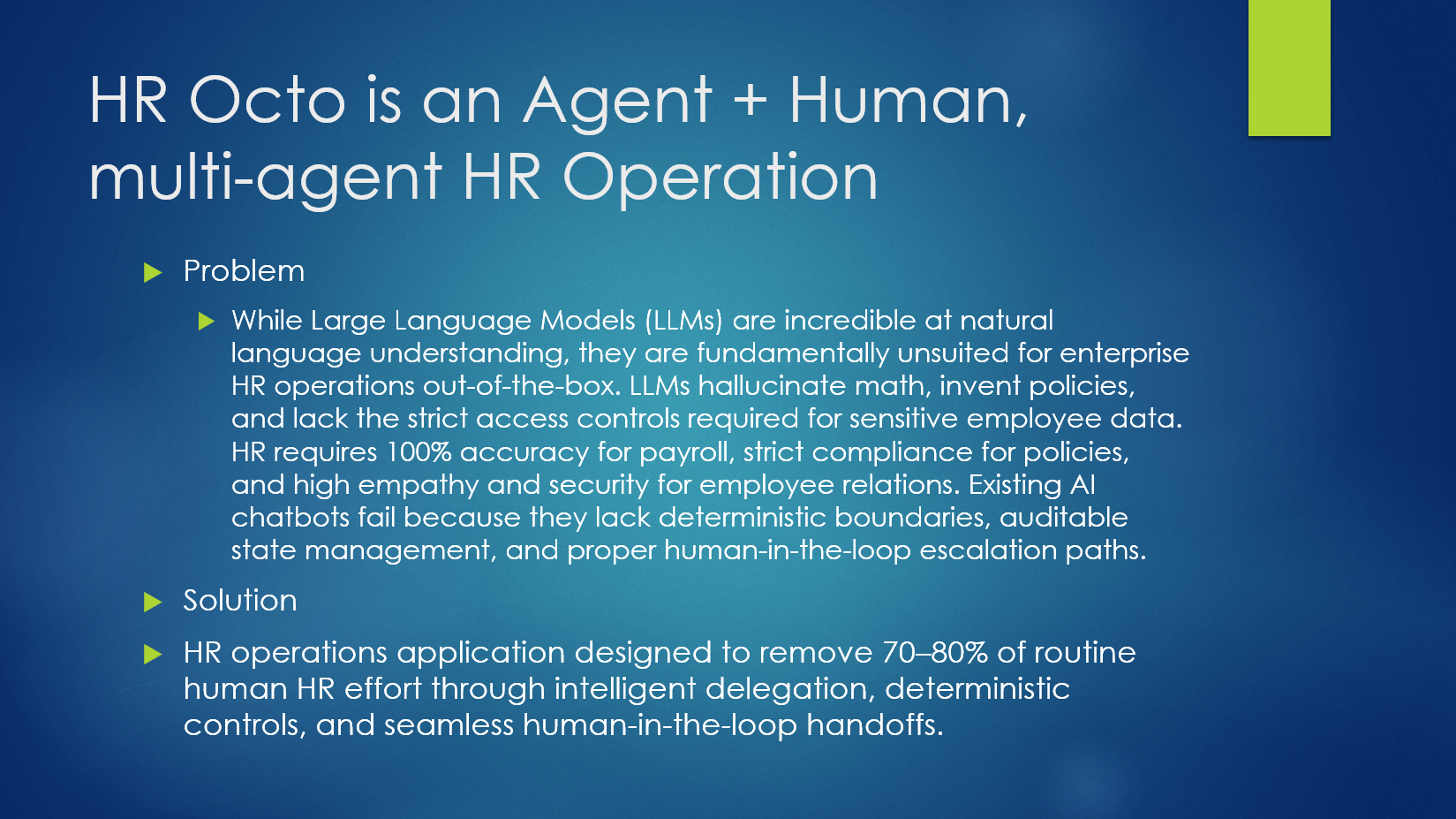
HR teams often resolve payroll questions by checking employee data, approved time entries, payroll results, cutoff schedules, and company policies across separate systems.
HR Octo Agent turns that investigation into one coordinated workflow.
What it does
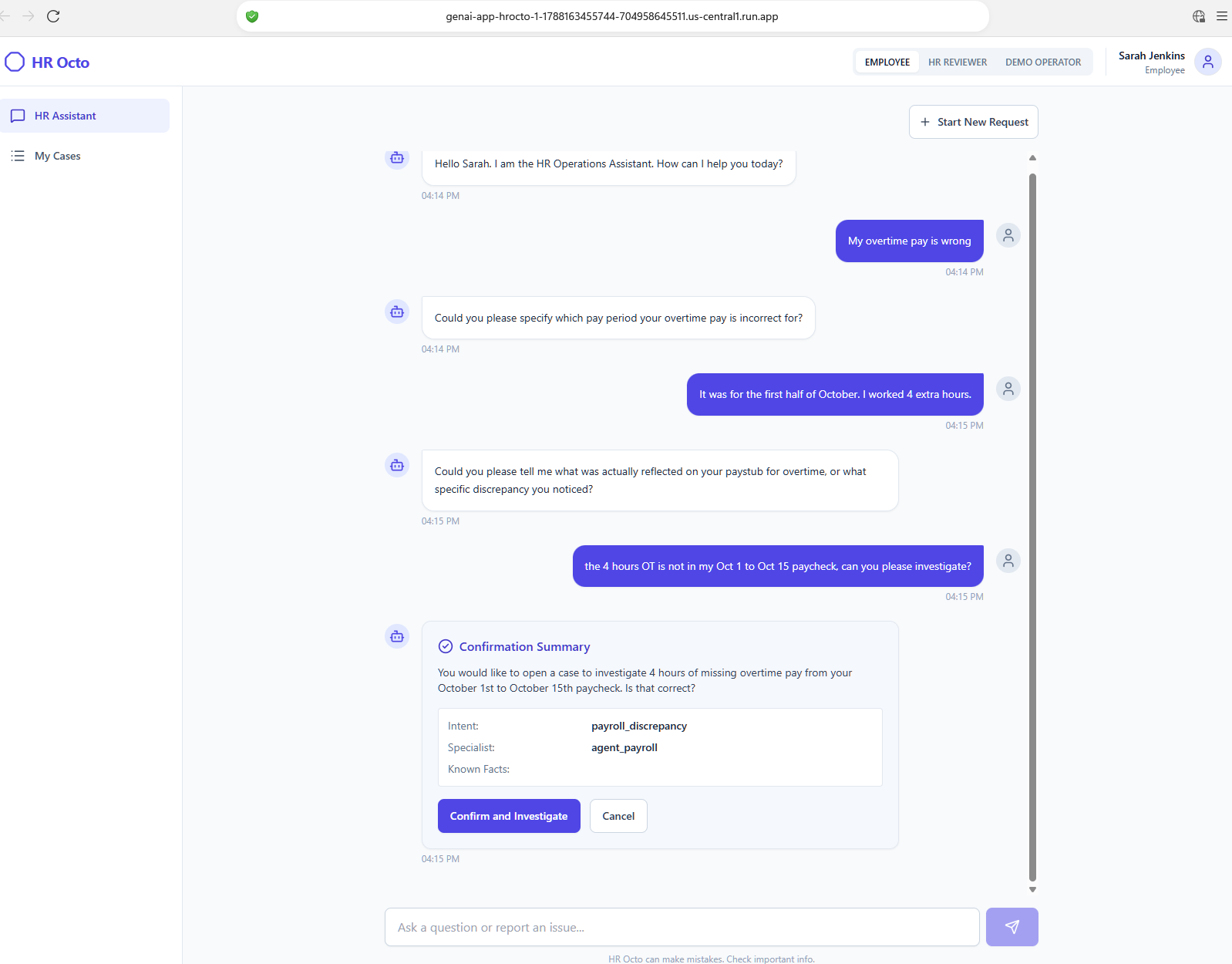
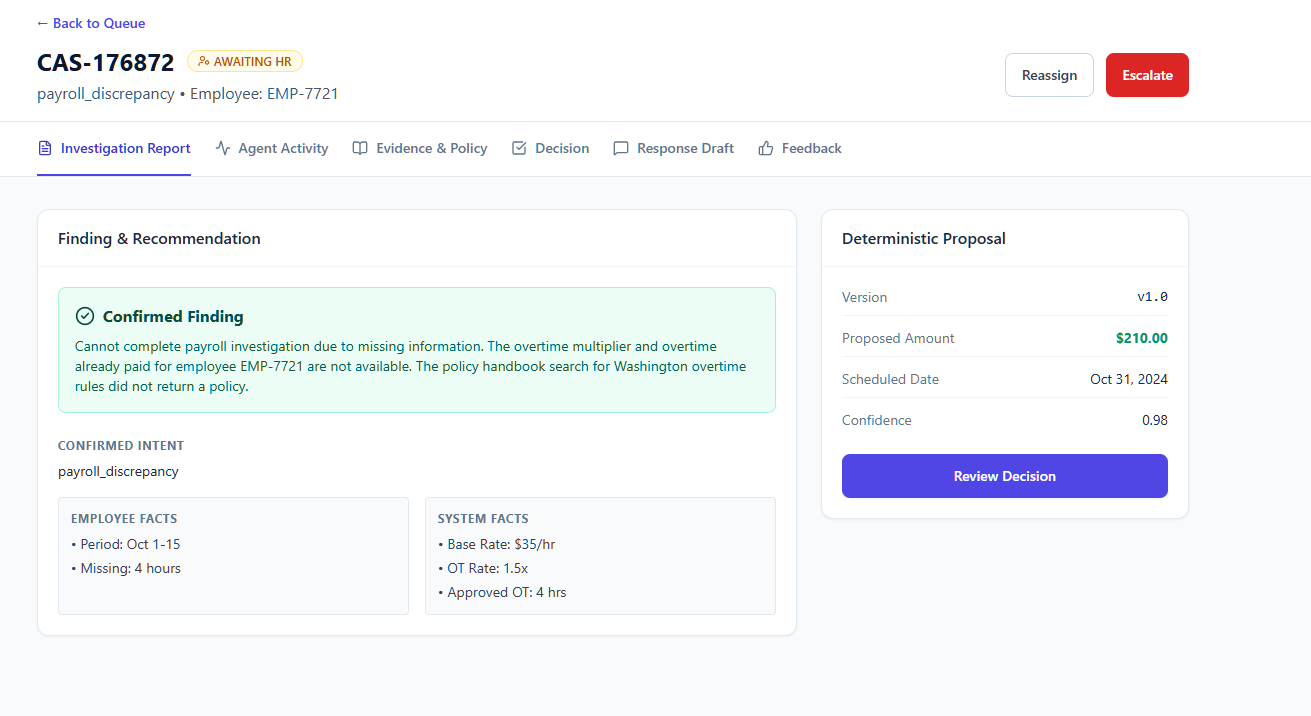
An employee submits a request stating that their latest overtime pay appears lower than expected. The HR Operations Agent creates a case and delegates the investigation to the Payroll Agent. The Payroll Agent retrieves synthetic employee, time-entry, payroll, and pay-schedule records from Firestore. The HR Policy Agent retrieves the effective weekly overtime and payroll-cutoff rules.
A deterministic calculation tool confirms that six approved overtime hours at a $40 hourly rate and a 1.5 overtime multiplier produce a $360 balance. The workflow also confirms that the manager approved the overtime after the payroll cutoff. The case is classified as a normal timing correction rather than a payroll processing error.
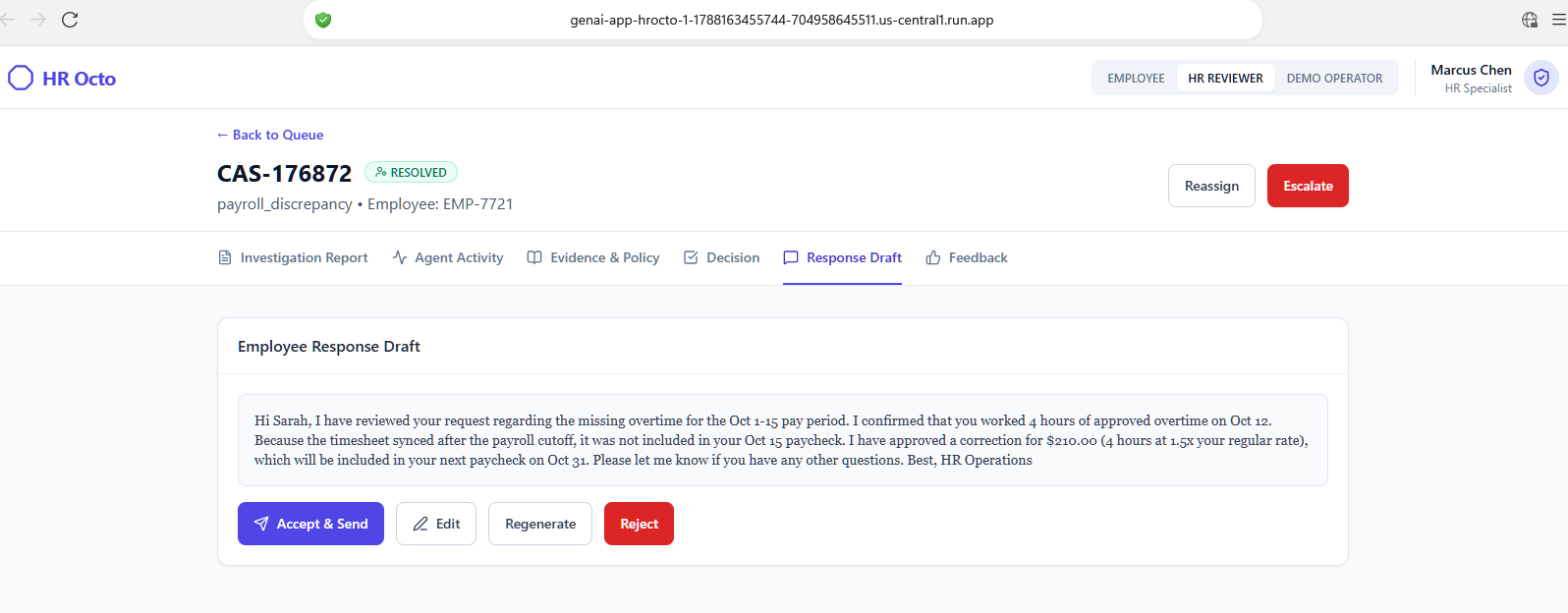
The workflow then pauses for HR approval. After the HR reviewer approves the current proposal version, processing resumes immediately. The HRIS Integration Agent checks for duplicate transactions, creates a simulated ADP integration record, and changes the transaction status to ACCEPTED_FOR_NEXT_PAYROLL.
The case is closed only after the employee receives a resolution stating the exact balance and the next scheduled pay date.
All employee, payroll, records in the demonstration are synthetic.
How we built it
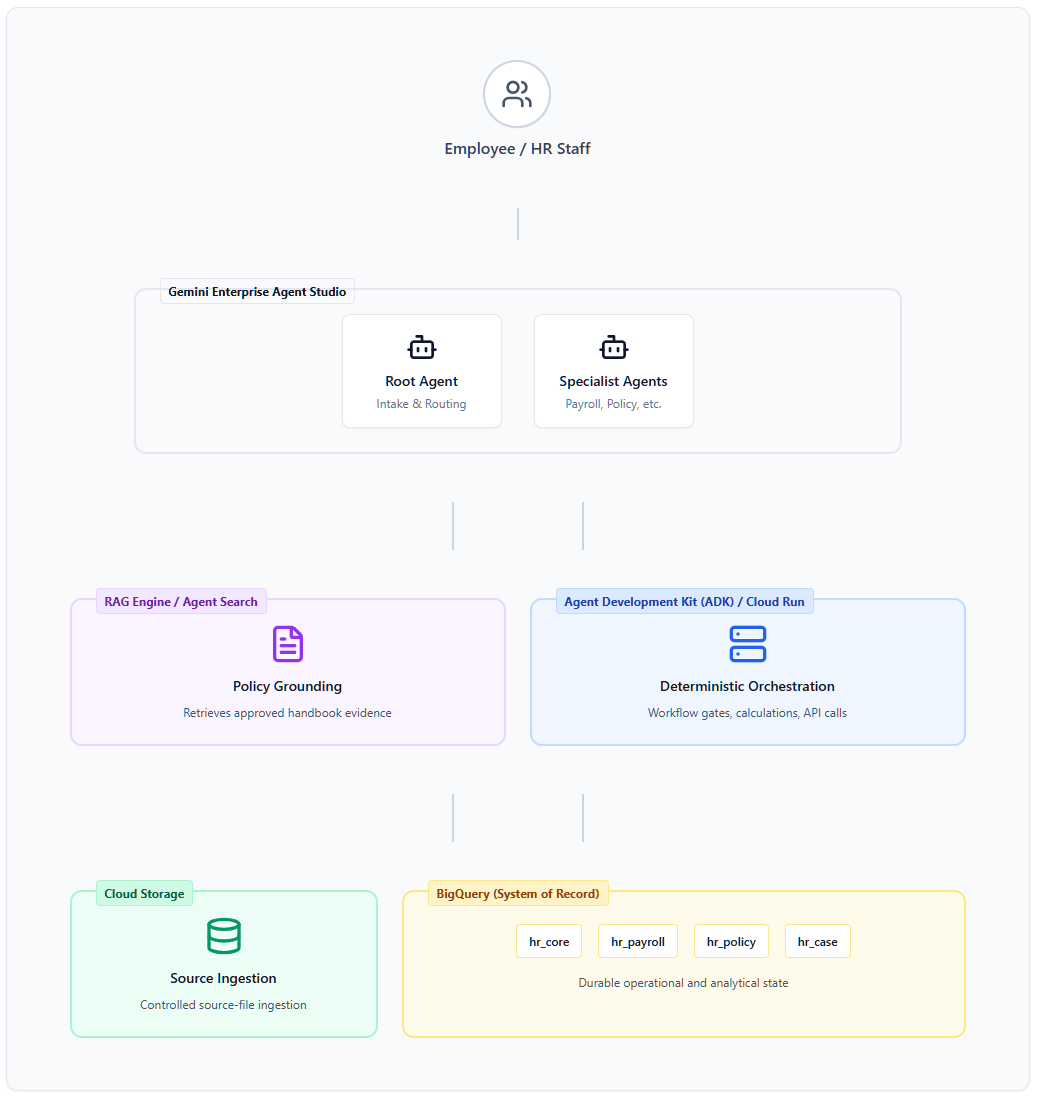
Start with 4 prompts to Agent Studio. Architect, Agent build, UI, test. At last deploy.
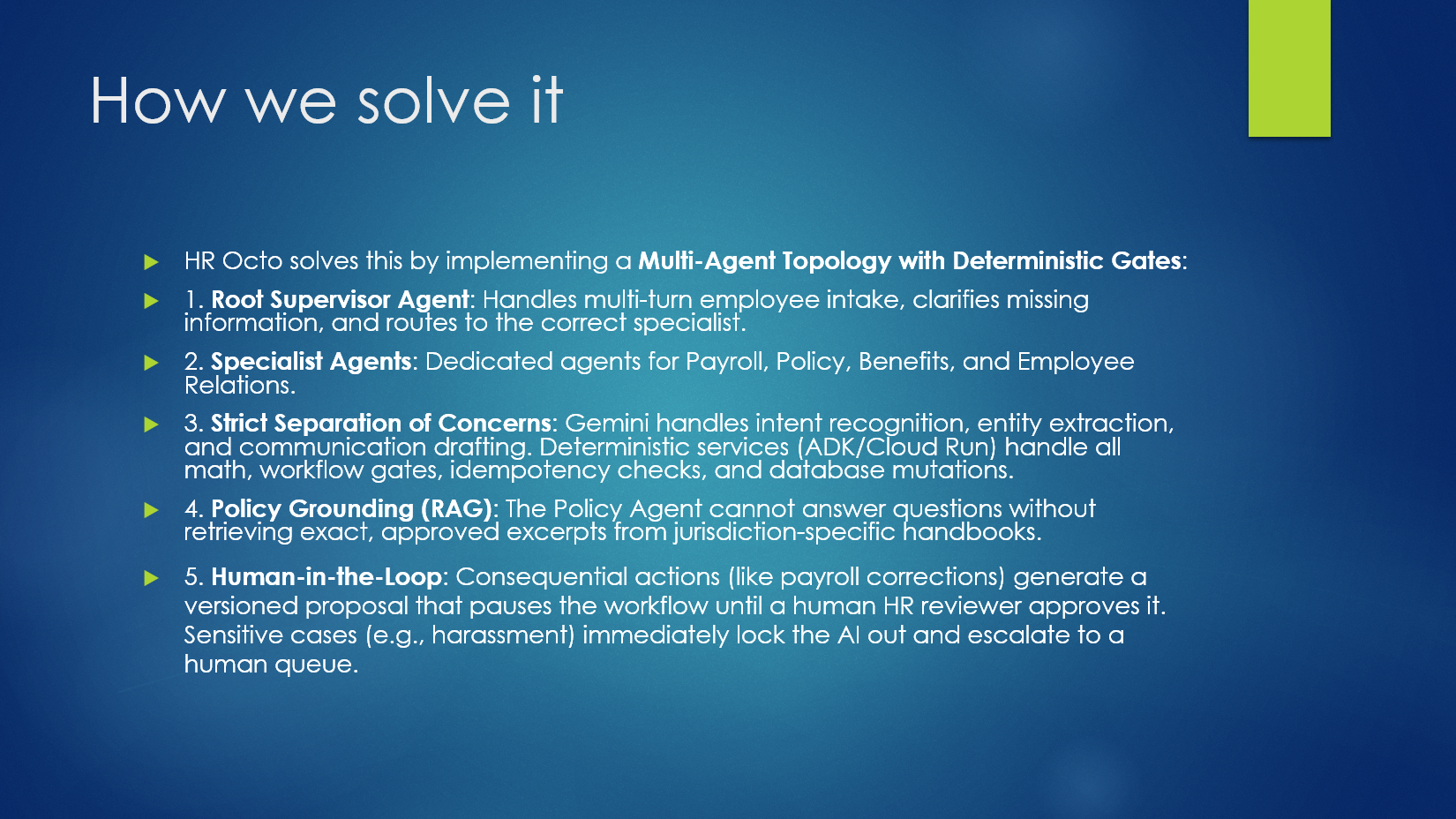
- The root agent interprets the request and chooses the workflow.
- Specialist agents retrieve payroll and policy evidence.
- The workflow selects and invokes deterministic tools.
- The system identifies the applicable pay period and next pay date.
- Execution pauses at a human approval gate.
- Processing resumes after approval without the employee supplying further instructions.
- The integration agent executes the approved transaction.
- The system prevents duplicate corrections.
- The workflow communicates the final resolution to the employee.
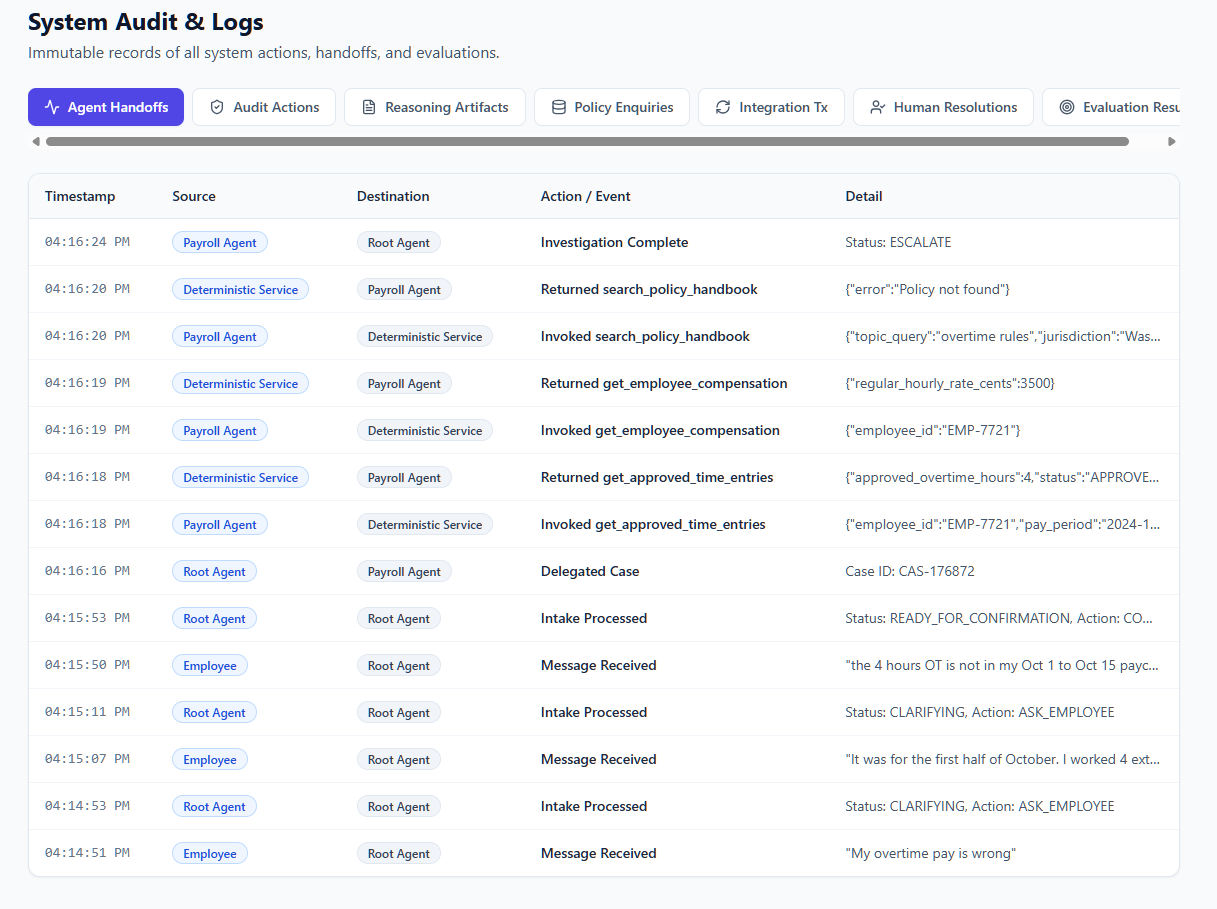
- Every material action is written to an audit record.
Technology Stack
- Frontend: React 18, TypeScript, Tailwind CSS, Lucide React, Recharts
- AI & Orchestration: Google Gemini 3.5 Flash,
@google/genaiSDK, Agent Development Kit (ADK) architecture - Data & State (Architecture): BigQuery (System of Record), Cloud Storage (Ingestion), Cloud Run (Deterministic Services)
- Design: Modern SaaS aesthetic, calm professional interface, strict accessibility and contrast standards
Challenges we ran into
- Preventing LLM Math: LLMs naturally want to solve math problems presented to them. We had to design strict system instructions and tool contracts to force the Payroll Agent to delegate all calculations to a deterministic Python/SQL service.
- Context Preservation: Ensuring that facts gathered by the Root Agent were perfectly preserved and passed down to Specialist Agents without requiring the employee to repeat themselves.
- Sensitive Escalations: Training the model to immediately stop autonomous fact-finding and trigger a restricted escalation when detecting keywords related to legal threats, harassment, or union activity.
Accomplishments that we're proud of
- The Deterministic Payroll Workflow: Successfully building a graph where an LLM investigates a discrepancy, retrieves timecards, fetches policy multipliers, passes them to a deterministic calculator, and drafts a human-readable approval brief.
- Comprehensive Audit Logging: Every single agent handoff, tool invocation, and human decision is logged immutably, providing complete transparency into the AI's reasoning.
- Value Dashboard: A real-time dashboard that tracks actual human minutes saved versus a v1.0 manual baseline, proving the ROI of the multi-agent system.
What we learned
- Contracts are everything: In a multi-agent system, strict JSON schemas for handoffs (e.g.,
ConversationalIntakeOutput,SpecialistOutput) are the only way to ensure reliable orchestration. - AI needs boundaries: The most effective AI systems in enterprise environments are those that are heavily constrained by deterministic rules. AI should synthesize and orchestrate, but traditional code must execute and calculate.
What's next for HR-Octo Agent: Autonomous HR Operation
- Live HRIS Integration: Connecting the deterministic integration tools to live sandbox environments of Workday, BambooHR, and ADP.
- Expanded Specialist Roster: Fully building out the Immigration & Global HR Agent and the Talent Acquisition Agent with their respective deterministic tools.
- Advanced RAG Pipelines: Implementing OCR and semantic chunking for legacy PDF employee handbooks and complex benefits matrices.
- Voice Intake: Integrating the Gemini Live API to allow employees to report issues or ask policy questions via natural voice conversations.
Built With
- cloud-run
- firestore
- gemini
- gemini-3.5flash
- gemini-3.7
- google-adk
- google-cloud


Log in or sign up for Devpost to join the conversation.