-
-
HR Analytics Dashboard
Inspiration
Employee attrition poses a significant challenge to organizations, impacting productivity, morale, and profitability. I wanted to use data science and visualization to uncover what really causes employees to leave and how companies can proactively address it.
What it does
This project uses IBM's HR Analytics dataset to identify key drivers of employee attrition. I performed end-to-end analysis including data preprocessing, modeling, explainability, and business visualization using Tableau/Power BI.
How we built it
Data Cleaning & EDA: Explored attrition by demographics, department, job role, and income.
Modeling: Used Logistic Regression to predict attrition likelihood.
Interpretability: Integrated SHAP values to explain feature importance.
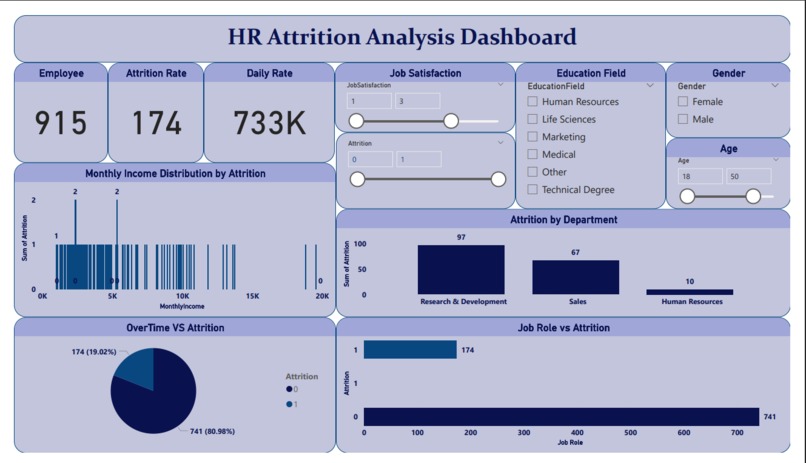
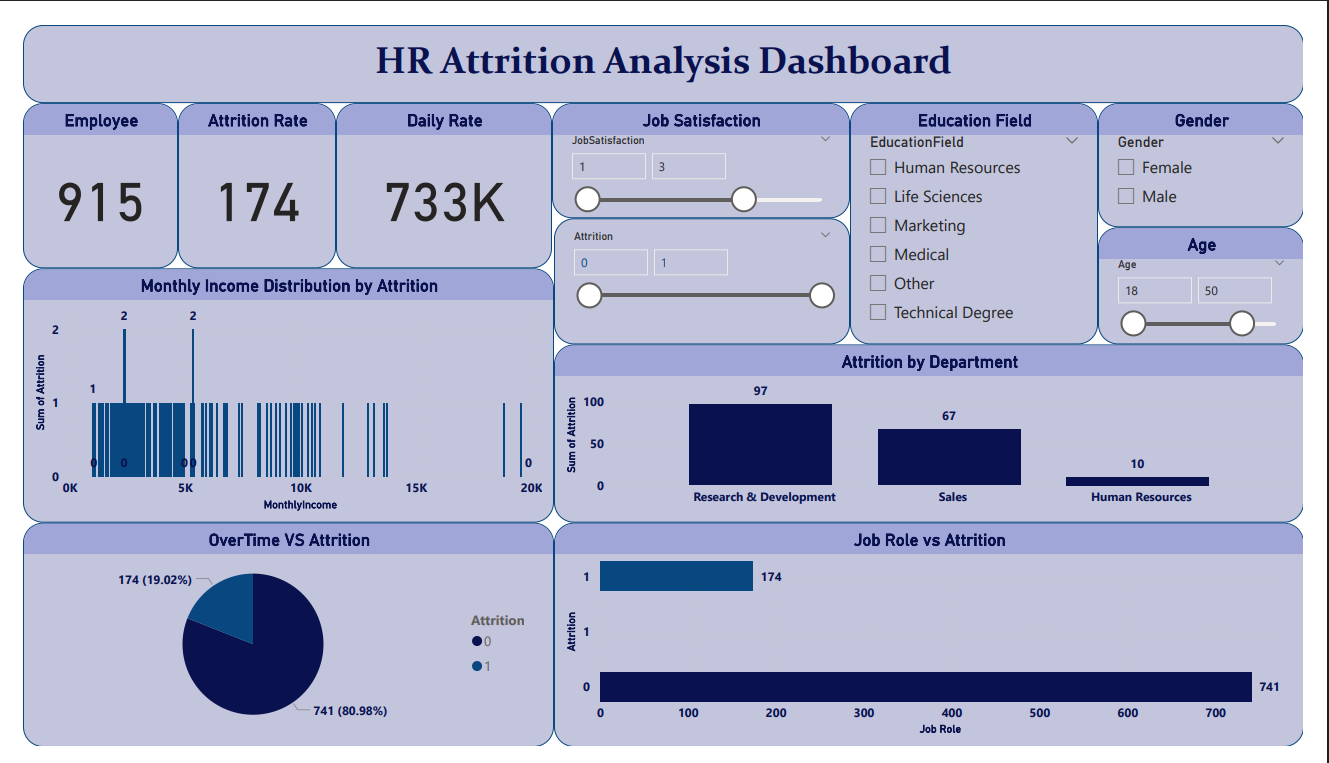
Dashboard: Built an interactive dashboard to communicate insights to HR teams.
Challenges we ran into
Balancing model accuracy with explainability.
Mapping technical insights into clear visual formats.
Ensuring dashboard interactivity across different HR filters (Job Role, Age Group, etc.)
Accomplishments that we're proud of
OverTime was the strongest predictor of attrition.
Employees with low job satisfaction and low income were more likely to leave.
Younger employees (<30) and those in Sales & HR showed higher attrition rates.
Attrition decreased with increased monthly income.
What we learned
Practical application of machine learning in real business problems.
Visual storytelling with dashboards that drive strategic decisions.
Importance of model interpretability in HR analytics.
How to combine technical and non-technical tools (Python + Tableau/Power BI) for business impact.
What's next for HR Analytics – Predicting Employee Attrition
Deploying a web-based HR analytics dashboard using Tableau Public or Streamlit to make insights accessible to non-technical HR teams.
Enhancing model accuracy with advanced algorithms like Random Forest or XGBoost, and evaluating model performance with cross-validation.
Incorporating real-time data (e.g., employee feedback, engagement surveys) to enable dynamic, continuous monitoring of attrition risk.
Automating alerts for HR managers when high-risk attrition profiles are detected.
Extending the solution to support employee retention strategies by simulating the impact of policy changes (e.g., increased salary, flexible hours).
Adding NLP analysis from exit interviews or employee reviews to uncover qualitative attrition signals.
Built With
- csv
- powerbi
- python-(pandas
- scikit-learn
- shap
- tableau

Log in or sign up for Devpost to join the conversation.