-
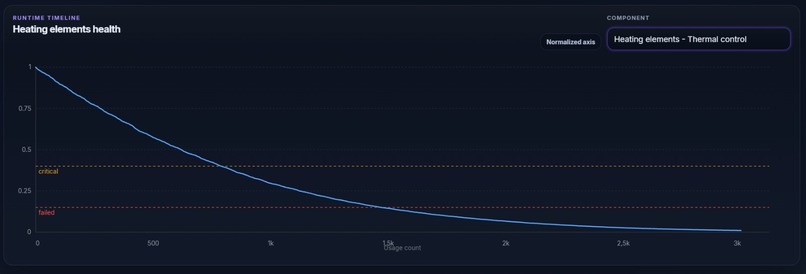
Function: exponential
-
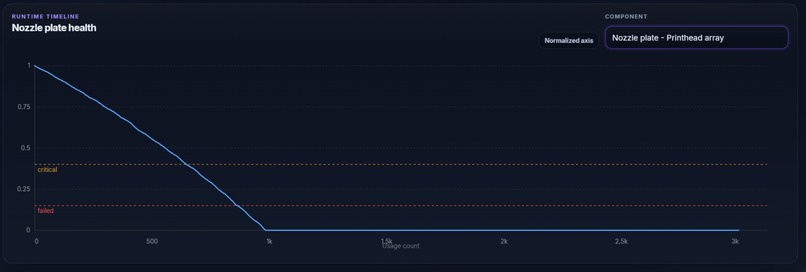
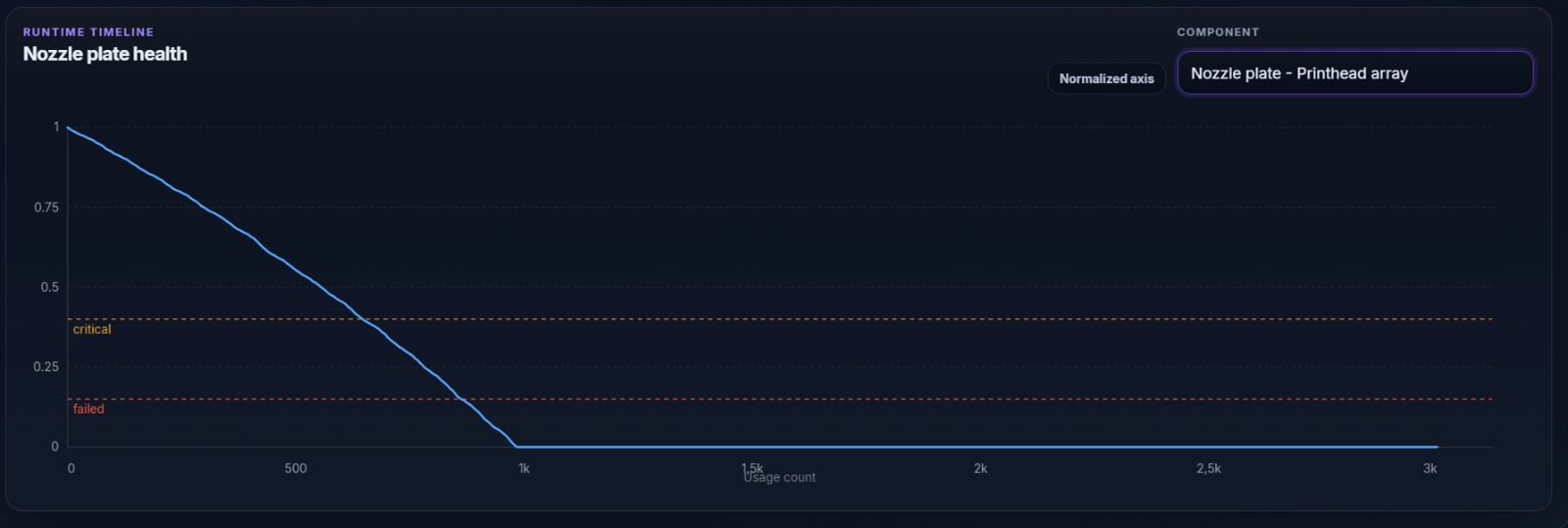
Function: lineal
-
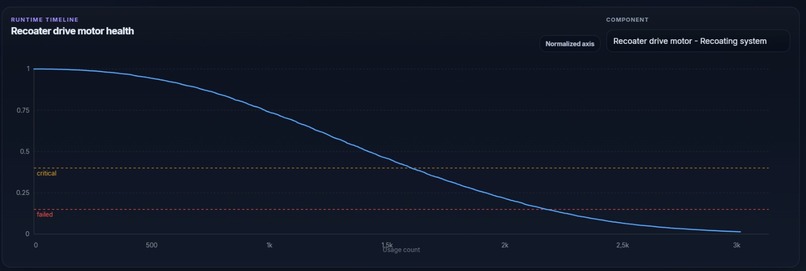
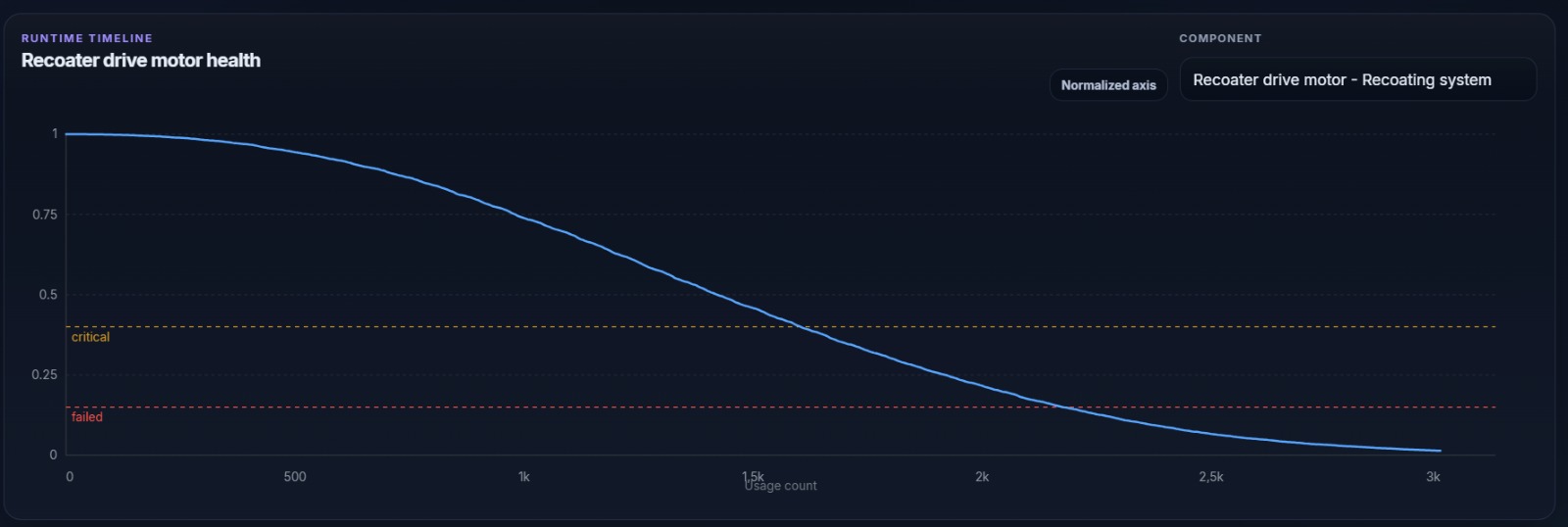
Function: weibull
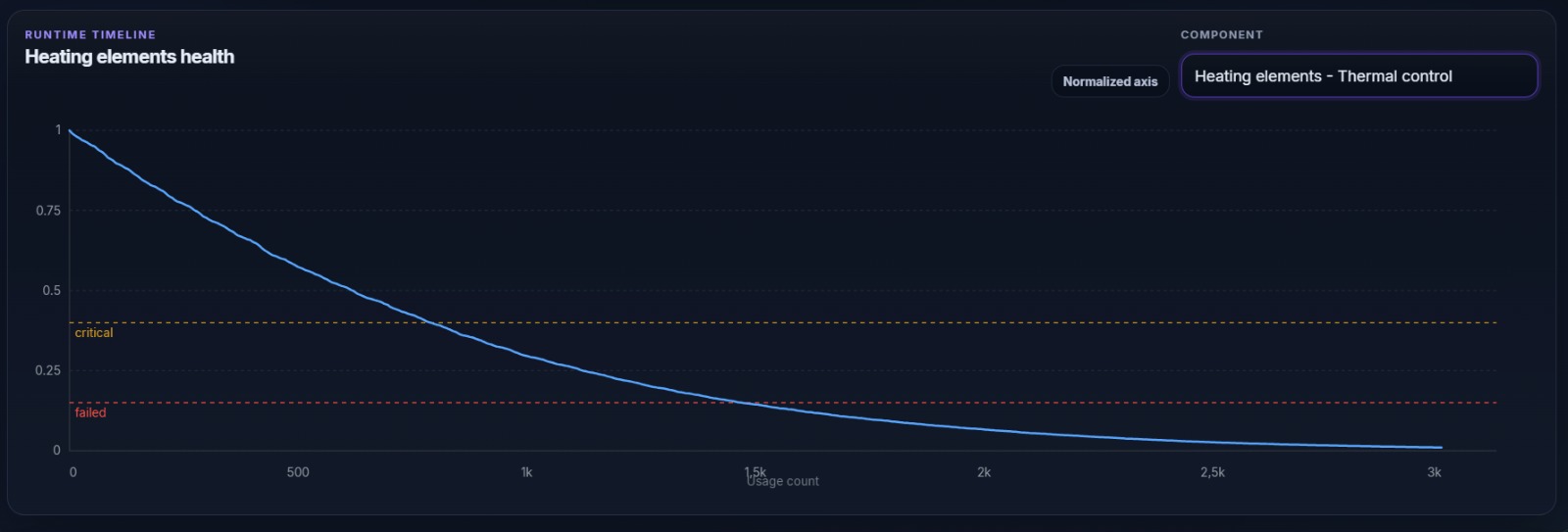
Hackaton-UPC-2026
This repository contains a predictive maintenance and digital twin platform for the HP Metal Jet S100. It models how key printer components degrade under operational and environmental stress, simulates their evolution over time, and stores that telemetry so it can be queried through dashboards and grounded maintenance-oriented interfaces. In practice, the repository combines mathematical degradation models, a simulation backend with historian persistence, and interaction layers for diagnosis and decision support.
Architecture
The solution is organized as a modular system with a clear separation between simulation, prediction, orchestration, and visualization:
frontend/: React + Vite dashboard for visualizing component health, alerts, dependencies, and simulation timelines.backend/: application layer exposing the core prediction, simulation, storage, and chatbot/agent-facing services.agent/: agent logic and scripts used to support interaction, orchestration, and scenario handling.model_mathematic/: mathematical models for each subsystem and component degradation behavior.data/: synthetic histories, example contexts, and agent scenarios used to test the system.docs/,config/,tests/, and3d-models/: supporting material, configuration, validation, and visualization assets.
At a high level, the repository follows the three hackathon phases: model_mathematic/ implements the Phase 1 degradation models, backend/ executes the Phase 2 simulation and historian workflow, and agent/ plus frontend/ provide the Phase 3 interaction and decision-support layers. The mathematical models generate the health and degradation behavior of each subsystem, the backend coordinates predictions and storage, and the frontend presents the results through dashboards and timelines.
Prerequisites
Install the following tools before running the project:
- Python 3.10 or newer.
- Node.js 18 or newer, with npm.
- Git, if you are cloning the repository.
- Optional: Ollama, if you want to use the local LLM explanation flow instead of the mock LLM provider.
The backend reads environment variables from the repository root .env file. For the local Ollama-backed flows, use:
OLLAMA_BASE_URL=http://localhost:11434
AGENT_LLM_PROVIDER=ollama
AGENT_LLM_MODEL=llama3.2:3b
OLLAMA_MODEL=llama3.2:3b
OLLAMA_BASE_URL is shared by the Ollama-backed integrations. AGENT_LLM_PROVIDER and AGENT_LLM_MODEL configure the agent explanation flow, while OLLAMA_MODEL is used by the backend chatbot path.
If Ollama is not installed or running, use the mock provider for the frontend agent panel by creating frontend/.env.local with:
VITE_AGENT_LLM_PROVIDER=mock
Installation
Clone the repository and enter the project directory:
git clone https://github.com/arnaumunozbarrera/Hackaton-UPC-2026.git
cd Hackaton-UPC-2026
Create and activate a Python virtual environment for the backend:
cd backend
python -m venv .venv
On Windows PowerShell:
.\.venv\Scripts\Activate.ps1
On macOS or Linux:
source .venv/bin/activate
Install the backend dependencies:
python -m pip install --upgrade pip
python -m pip install -r requirements.txt
Install the frontend dependencies from a second terminal:
cd frontend
npm install
Usage
Start the backend API:
cd backend
python -m uvicorn app.main:app --reload --host 0.0.0.0 --port 8000
The backend will be available at:
- API health check:
http://localhost:8000/api/health - Interactive API documentation:
http://localhost:8000/docs
Start the frontend dashboard from another terminal:
cd frontend
npm run dev
Open the dashboard at http://localhost:5173.
By default, the frontend calls the backend at http://localhost:8000. To use a different backend URL, create frontend/.env.local and set:
VITE_API_BASE_URL=http://localhost:8000
To use the Ollama-backed agent explanation flow, make sure Ollama is running and that the configured model is available. If you are not using the Ollama desktop application, start the Ollama server first:
ollama serve
Then pull the configured model from another terminal:
ollama pull llama3.2:3b
Run the automated tests from the repository root:
python -m pip install pytest
python -m pytest
The backend creates its local SQLite historian database automatically under backend/storage/ when the API starts.
Typical Flow
A typical end-to-end run through the project looks like this:
- Open the frontend to inspect the current component snapshot exposed by the backend model endpoints.
- Launch a simulation run so the backend advances component degradation over time and persists each step in the SQLite historian.
- Review the generated timeline, component health trends, alerts, and dependency effects in the dashboard.
- Query the resulting run through the chat and agent-backed analysis paths to obtain grounded maintenance explanations based on stored telemetry.
Elements
The main implemented elements of the project are:
- Subsystem-level mathematical models for components such as cleaning interface, heating elements, insulation panels, linear guide, nozzle plate, recoater blade, recoater drive motor, temperature sensors, and thermal firing resistors.
- A logic engine to combine subsystem behavior into machine-level health interpretation.
- A backend structure for prediction, simulation, schema definition, storage, and agent/chatbot integration.
- A frontend dashboard with component selection, health visualization, alerts, dependency impact display, and timeline-based monitoring.
- Synthetic data and agent scenarios to validate the behavior of the platform under different maintenance situations.
Results & Conclusion
The implemented prediction layer combines several degradation functions depending on the physical behavior of each component family:
- Linear degradation for components whose wear grows approximately in proportion to use and environmental stress.
- Exponential decay for thermal and electrical components whose degradation accelerates with accumulated operating stress.
- Weibull-based degradation for components with fatigue behavior and increasing failure risk over time.
Linear Prediction Function
The linear formulation is used for components such as the recoater blade, linear guide, cleaning interface, temperature sensors, and insulation panels.

Exponential Prediction Function
The exponential formulation is used for components such as heating elements and thermal firing resistors, where damage compounds under repeated thermal and electrical cycles.

Weibull Prediction Function
The Weibull formulation is used for the recoater drive motor to represent fatigue accumulation and a non-linear increase in failure probability as effective age grows.

Conclusion
The current prototype delivers a coherent set of prediction functions that are traceable, deterministic, and aligned with the physical interpretation of each subsystem. The main value of the model is not a single universal degradation curve, but the use of the most suitable mathematical behavior for each component type so the digital twin can explain why degradation happens, how it evolves, and when maintenance risk starts to become relevant.
Future Improvements
Two complementary improvement approaches are considered:
- Add more data to the model. This includes incorporating more constant and component-specific parameters such as humidity, degradation rate, temperature exposure, contamination patterns, maintenance history, and other operational variables that affect wear and failure behavior.
The utility of this improvement is that the model would stop relying on a relatively compact synthetic description of machine usage and would start representing a richer operational context. In practice, this would allow the digital twin to:
- Distinguish better between components that fail for similar reasons but under different operating regimes.
- Capture slower effects such as cumulative environmental exposure, seasonal conditions, or long-term maintenance quality.
- Reduce oversimplified assumptions in the degradation curves by conditioning them on more realistic combinations of stress factors.
- Improve the quality of both simulation and prediction outputs, because the backend could generate more nuanced health trajectories instead of a limited number of standard patterns.
In a more advanced version, this could also support better calibration with real telemetry if production data becomes available, making the model progressively less synthetic and more representative of machine behavior in the field.
- Focus the solution on warning generation and maintenance date estimation. The goal is to implement a system more centered on early warnings and on estimating the date when maintenance should be performed.
The utility of this improvement is mainly operational. Instead of using the model only to observe degradation, the platform would become a more actionable decision-support tool. This would make it possible to:
- Trigger interpretable alerts before a component reaches a critical state, giving operators time to react.
- Estimate when a maintenance intervention should ideally be scheduled, balancing failure risk against unnecessary early replacement.
- Coordinate maintenance windows with production demand, reducing disruption to machine availability.
- Prioritize interventions across components and subsystems according to risk, urgency, and expected operational impact.
- Support cost reduction by avoiding both unplanned downtime and excessive preventive maintenance.
In business terms, this would make the system more useful for planning, not only for monitoring. The final value would come from converting health predictions into concrete recommendations: when to intervene, why that intervention is needed, and what operational risk is avoided by acting at that moment.

Log in or sign up for Devpost to join the conversation.