-
-
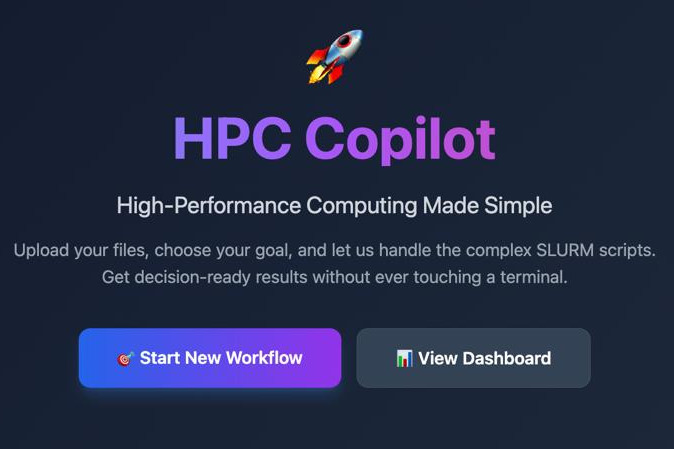
home page
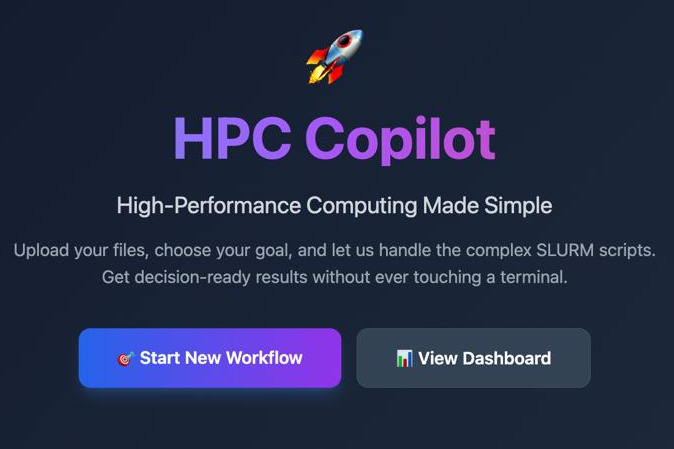
We were inspired by the challenge of democratizing high-performance computing (HPC) making it more accessible to non-technical folks without requiring deep knowledge of cluster systems. While HPC clusters are extremely powerful, they come with steep learning curves around SLURM job submission, resource allocation, and result interpretation. Our goal was to remove these barriers by creating an intuitive web application that preserves the power of HPC while abstracting its complexity.
We built a full stack solution that simulates a real HPC environment, including realistic job queuing, resource constraints, and processing metrics. Our system uses a Next.js frontend along with a FastAPI backend to manage the full job lifecycle. Users upload their input files (such as videos and 3D model files), select from simple resource tiers (small to massive) with automatic CPU, memory, and GPU assignment, and optionally schedule jobs for later execution.
The dashboard visualizes an HPC queue in real time, showing multiple jobs progressing sequentially with individual progress bars, runtime statistics, and output artifacts. Instead of exposing users to SLURM syntax, we translate complex concepts into familiar UI patterns: resource tiers act like service plans, job queues resemble streaming playlists, and SLURM scripts are presented as structured metrics panels.
The result is a system where someone with zero HPC experience can submit a batch job, watch it move through a realistic queue, and view processed results without ever touching the command line or understanding scheduler internals.
Built With
- ai
- nextjs
- node.js
- python
- tailwind
- typescript


Log in or sign up for Devpost to join the conversation.