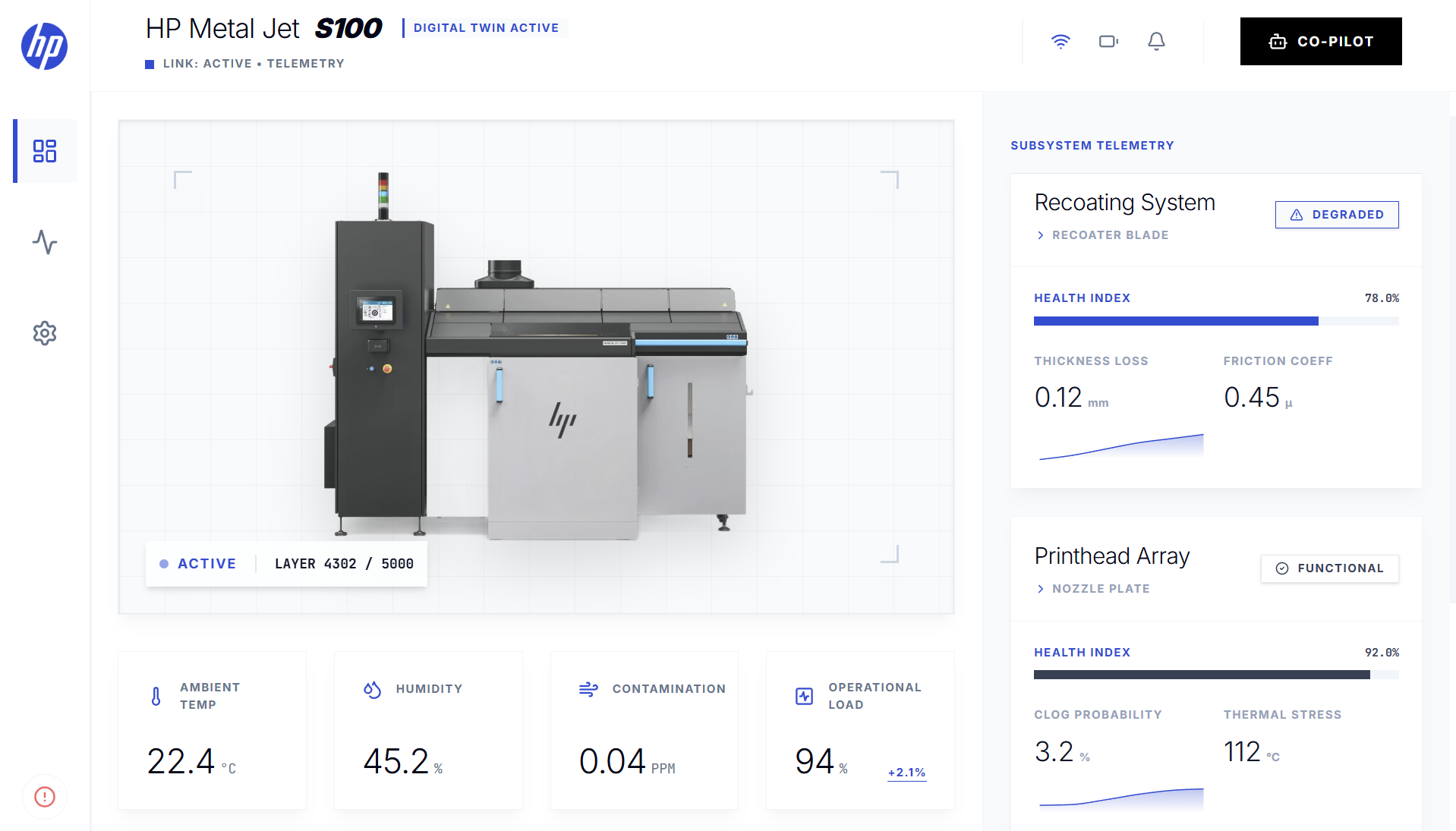
HP Digital Twin Co-Pilot for HP Metal Jet S100
Overview
We built a digital twin and AI assistant for predictive maintenance on the HP Metal Jet S100.
The system simulates component degradation over time, stores telemetry/history, and explains maintenance decisions using grounded operational data instead of generic AI output.
System
The project has three layers:
- Physics-inspired degradation models for thermal, recoating, and printhead subsystems
- A simulation engine with SQLite telemetry storage
- A conversational AI layer that retrieves historian context and explains failures with evidence
Modeling
Each component is represented by a normalized health score:
$$ H_{t+1} = \text{clip}(H_t - \Delta D_t + \epsilon_t, 0, 1) $$
We used several degradation models depending on the subsystem.
Weibull fatigue (drive motor)
$$ H(t) = \exp\left(-\left(\frac{t}{\eta}\right)^\beta\right) $$
Arrhenius thermal acceleration (thermal fatigue)
$$ AF = \exp(k \cdot \Delta T) $$
Resistance drift (thermal firing resistors)
$$ R = R_0 \cdot \exp(\gamma \cdot AF \cdot f_T \cdot N) $$
Failure detection:
$$ \text{drift_ratio} = \frac{R}{R_0} $$
Archard-inspired wear (recoater blade)
$$ V \propto \frac{K \cdot P \cdot s \cdot A}{H_m} $$
AI Co-Pilot / RAG Layer
The AI assistant is connected directly to the simulation historian through a retrieval pipeline.
Instead of generating answers from model memory, it retrieves telemetry, component states, and event traces from SQLite before responding. Every answer is grounded in simulation data and includes timestamps, run IDs, and evidence references.
The system supports:
- component history lookups
- timestamp/range queries
- trend analysis
- root-cause style diagnostics
Control Logic
We implemented a DecisionAgent that reacts to degradation trends instead of isolated spikes.
To avoid unstable maintenance behavior, we added hysteresis, cooldown windows, trend confirmation, and deadband regions near nominal health.
Challenges
The main challenge was realism. Since we did not have access to real S100 telemetry, parameters had to be calibrated through approximations and sensitivity testing.
Another challenge was preventing the controller from overreacting to noisy telemetry while still keeping the AI explanations grounded and traceable.
Takeaways
This project showed that a useful digital twin is more than simulation. It also needs persistence, explainability, and control logic.
It also reinforced that retrieval quality matters more than prompt size when building AI systems around operational data.

Log in or sign up for Devpost to join the conversation.