-
-
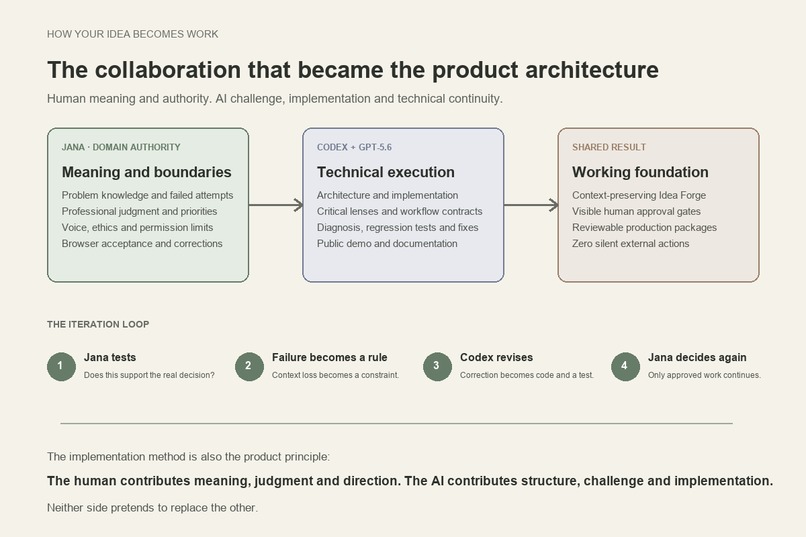
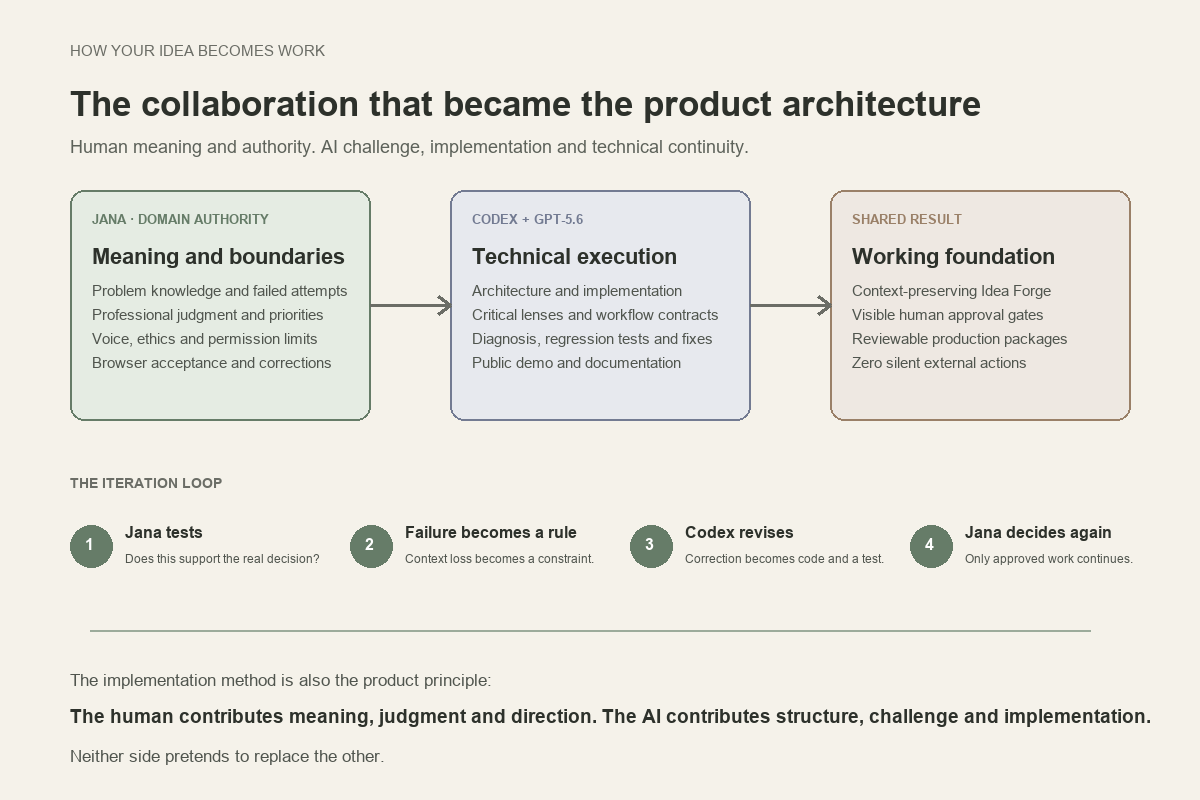
Human judgment stays in control: AI structures, challenges and prepares the work, while every consequential action requires approval.
-
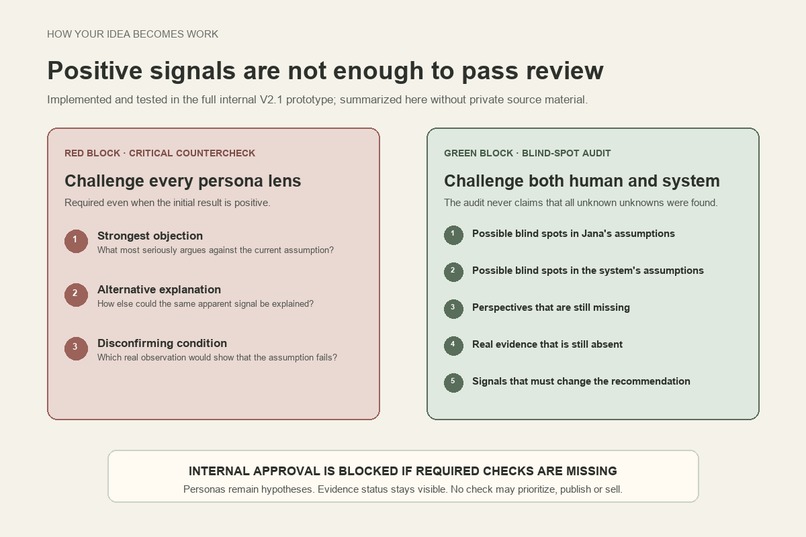
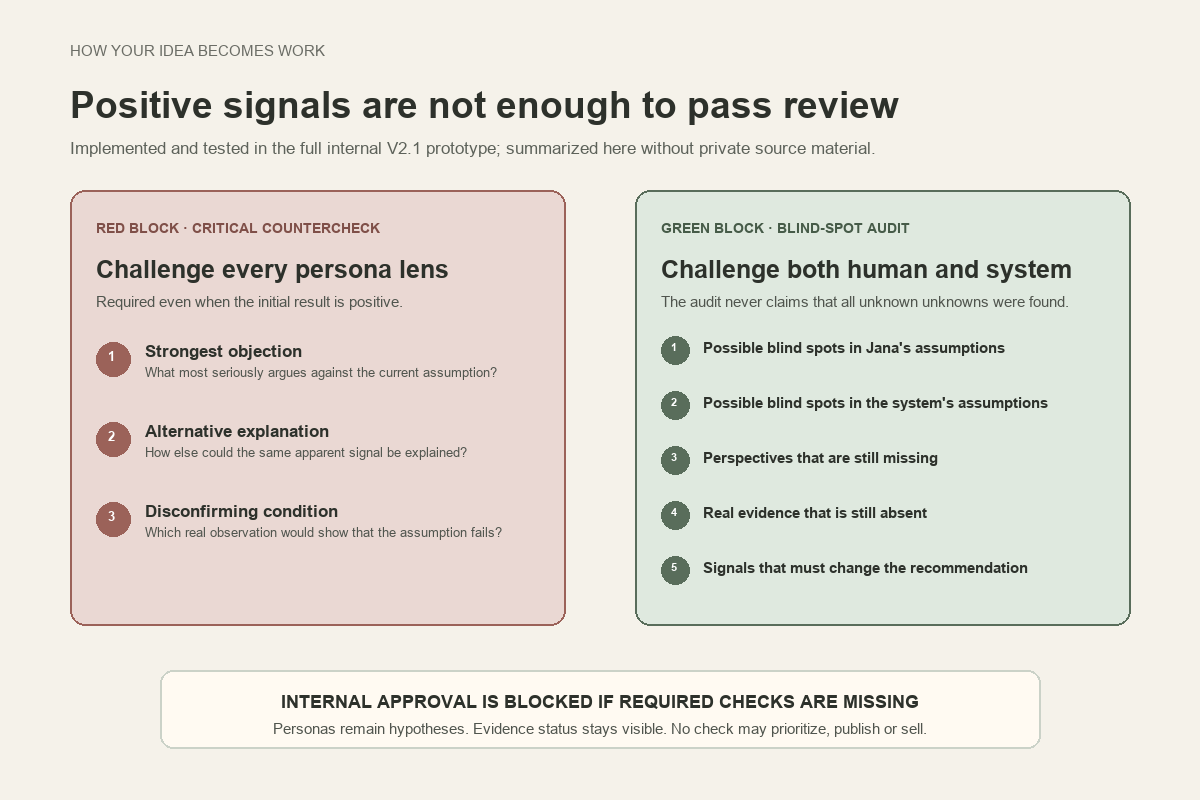
The full prototype tests ideas through red and green gates: evidence, ethics, trust, usefulness and readiness before production.
-
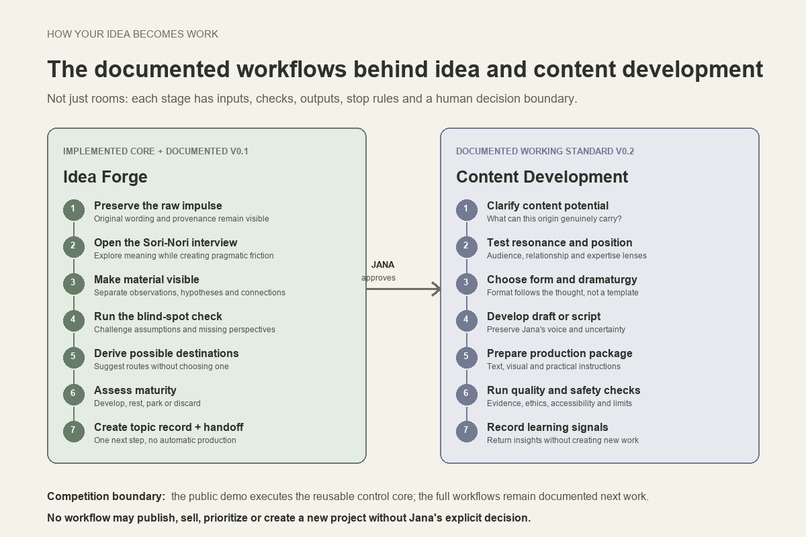
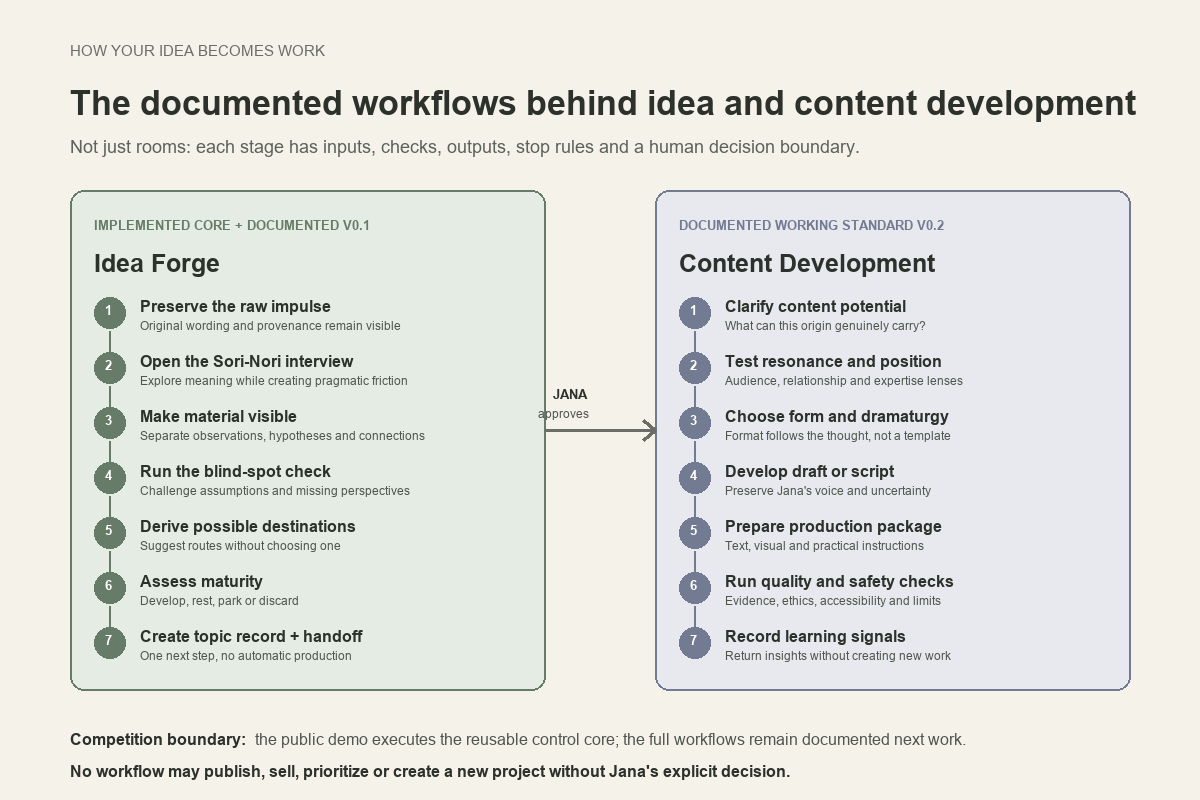
Beyond the public demo, designed workflows turn one thought into tested ideas, articles, social content and digital products.
-
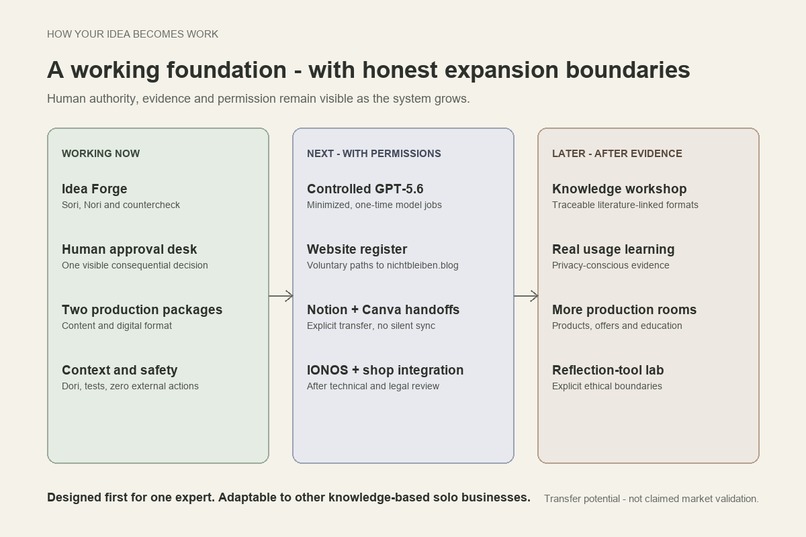
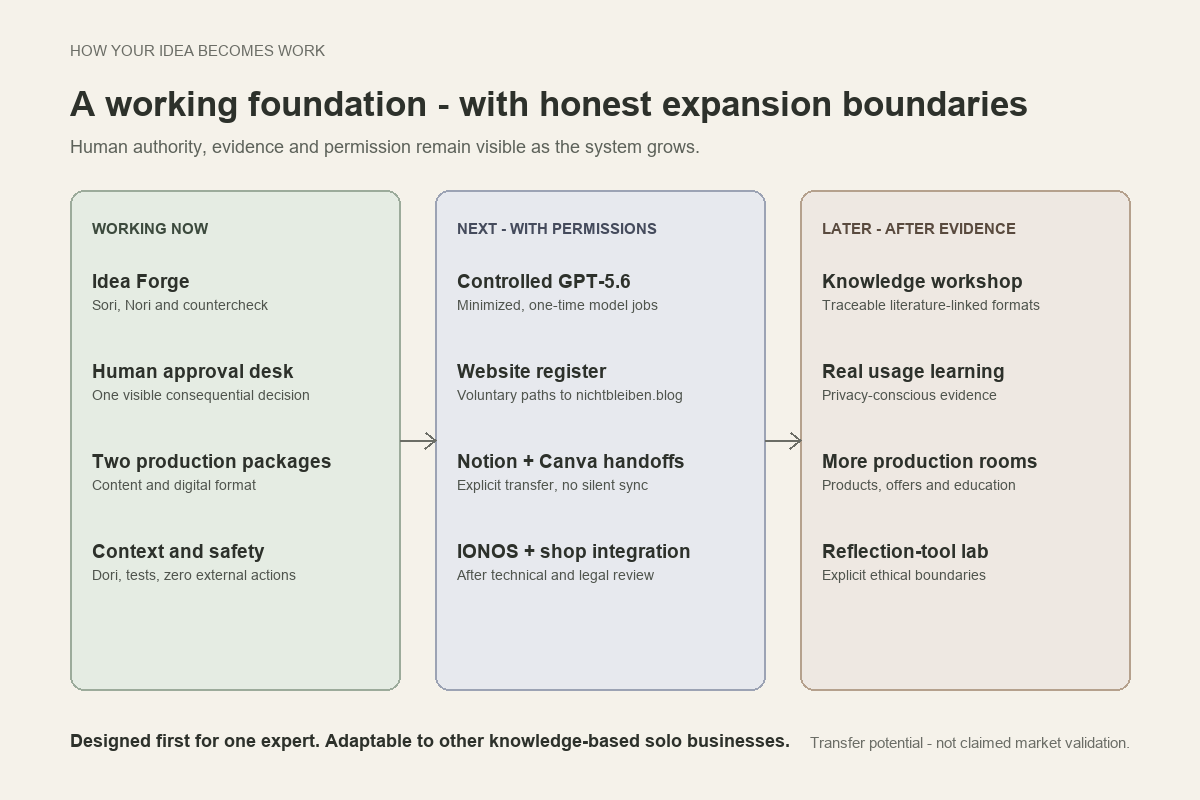
The current prototype is the foundation: external integrations, real audience data and further production rooms come next.
Inspiration
I am building nichtbleiben.blog, a German perspective platform and future one-woman business for people who need clarity, dignity and practical next steps in difficult work and life situations.
My problem was never a lack of ideas. It was the opposite: observations, notes, drafts and possible offers were scattered across chats and documents. I needed a way to decide what deserves to become work without creating an endless pile of content, losing the original context or allowing an AI system to decide what is relevant, true or publishable.
One real example began with a two-hour nap. The first question was whether the nap had been “productive.” Through structured human-AI brainstorming, the more interesting question emerged: Why does rest need to prove a return on investment before we allow it to have value? That observation became a topic record, a finished blog text, a LinkedIn series and further product hypotheses.
What it does
How Your Idea Becomes Work is a local, human-led AI production system for solo experts.
It turns an initial thought into a structured, reviewable path:
- Capture an idea without asking the user for technical metadata.
- Detect duplicates and near-duplicates.
- Let two deliberately different critical roles challenge the idea instead of simply agreeing with it.
- Require a human decision before an idea becomes an active production case.
- Create separate, reviewable content and digital-product draft packages.
- Prepare a minimized GPT-5.6 job only after a specific human authorization.
The system is designed around a simple principle: AI may help generate, organize and challenge—but the expert retains authority over meaning, voice, evidence, priorities and every consequential action.
How I built it
I entered Build Week as a 51-year-old solo domain expert with no prior programming experience and no prior Codex experience. I supplied the professional knowledge, original ideas, source material, ethical boundaries, product decisions and browser acceptance testing.
Using Codex Desktop with GPT-5.6 and high reasoning effort, I turned months of prior experiments, documented failures and workflow ideas into a functioning local browser prototype. Codex helped design the architecture, implement the JavaScript/HTML/CSS application, build workflow contracts and regression tests, diagnose cross-file failures, and revise the system after my testing.
The public demo is intentionally lightweight: no framework, account, API key or network connection is needed to run it locally. It demonstrates the real workflow and its state changes rather than a static mock-up.
What I learned
The most important lesson was that useful human-AI collaboration is not achieved by giving AI more autonomy. It is achieved by making boundaries, uncertainty, dissent and handoffs visible.
Earlier models often lost important context, remembered only one priority, or confidently continued with a wrong assumption. I named this recurring failure pattern “Dori”—after the character in Finding Nemo who remembers either nothing or exactly the wrong single thing. That became a practical design requirement: the system must preserve decisions, show what is still uncertain, and require review instead of silently treating drafts as truth.
I also learned that a critical AI role is more useful than an agreeable one. The system therefore includes counterarguments, missing-evidence checks, buyer and relationship lenses, and explicit warnings against confirmation bias.
Challenges overcome
The central technical challenge was building a coherent system rather than a collection of prompts. The prototype needed stable state management, duplicate checks, role-based reviews, explicit approvals, separate production packages and safe model boundaries.
A second challenge was data protection and trust. My source material can contain personal context, private competence records and sensitive professional observations. The public prototype therefore keeps model transmission disabled by default. Before any possible GPT-5.6 run, it shows what would be included, what is explicitly excluded, and that a separate one-time authorization is still required.
The result is not a claim that every future integration is already complete. It is a working, tested foundation for a system in which a solo expert can turn ideas into meaningful work—without becoming a content factory and without giving away responsibility.
The Build Week deadline and available token budget created a real implementation boundary. Within that boundary, I prioritized the hardest reusable foundation: human decision authority, context preservation, critical counterchecks, controlled model-job contracts and reviewable production outputs.
External connections, additional production rooms and real usage learning are documented but not presented as implemented. They require more build capacity, explicit permissions, platform-specific validation or real user evidence. This is therefore a working foundation with an honest boundary — not a mock-up of an all-in-one platform.
Built With
- codex-desktop
- css
- gpt-5.6
- html
- javascript

Log in or sign up for Devpost to join the conversation.