Complete Guide: How to Obtain a Valid ESA Letter in Oregon for 2026
When my nights were full of panic and my days were a loop of avoidance, the single thing that steadied me was the steady presence of my companion. Deciding to get an official Emotional Support Animal letter felt like admitting I needed help, and then learning the correct, legal way to document that help felt like reclaiming safety. If you’re in Oregon and want a clear, practical path to a valid ESA letter for 2026, I’ll walk you through exactly what I did from the clinician appointment to the landlord conversation using the trusted resources I relied on.
I wrote this guide from direct experience and careful, comparative research. I tested clinician-led services, checked licensing, and practiced presenting a compact packet that landlords actually accept. You’ll get the step-by-step process I used, real mistakes I avoided, and the small, practical moves that made the difference between a denied request and an approved accommodation.
What a Valid ESA Letter Actually Does
I started by clarifying one thing for myself: an ESA letter is a housing accommodation tool, not a magical pass for all public spaces. The letter documents a licensed clinician’s determination that an animal helps lessen symptoms of a qualifying mental health condition. That documentation is what allows tenants to request reasonable accommodations from landlords under housing rules — and it’s why I focused my effort on getting a clinician-backed letter that would stand up to verification.
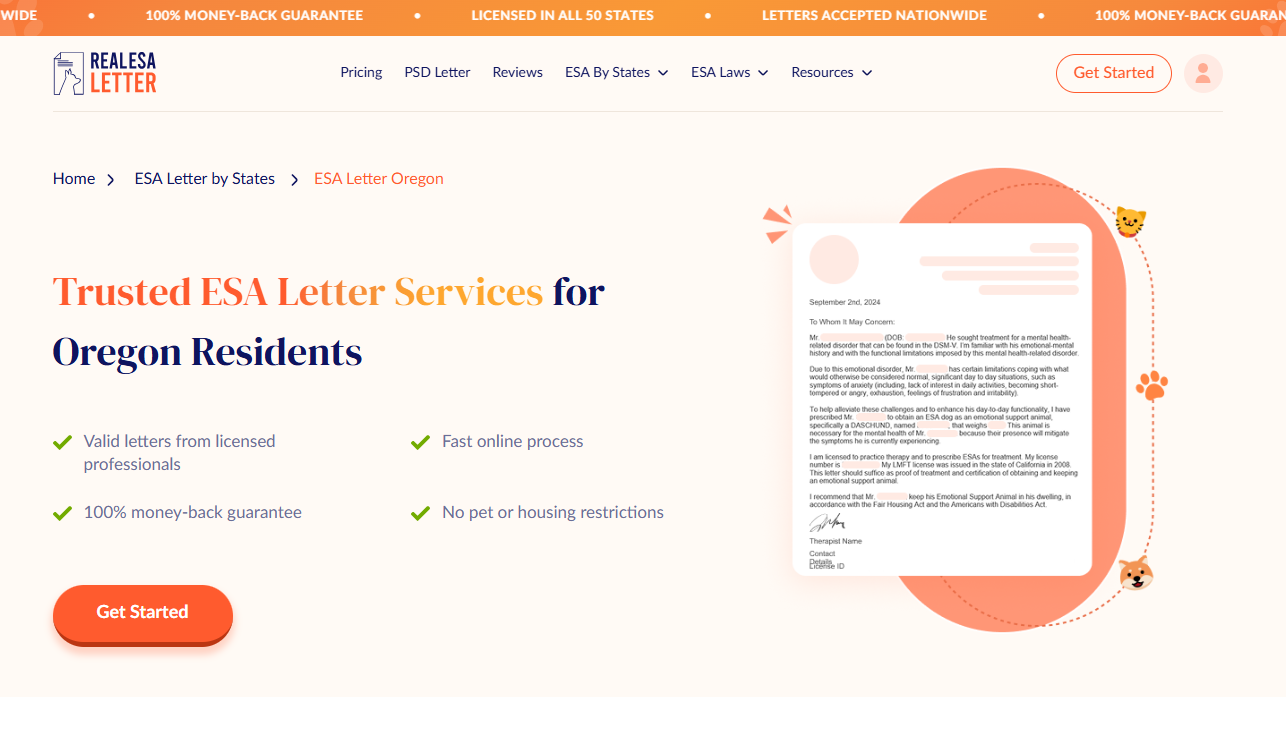
For Oregon-specific guidance I reviewed the state-focused practical notes on how letters are generally evaluated in the region and used that to shape the wording I requested from my clinician; the state page about ESA Letter Oregon helped me avoid ambiguous phrasing and stick to what landlords expect to see.
A short legal reality check — federal baseline, local practice
The Fair Housing Act sets the federal baseline: housing providers must consider reasonable accommodations for assistance animals. In practice, that means a clear clinician letter usually opens doors that would otherwise remain closed. I found it useful to frame my request around function — how the animal reduces my symptoms rather than the clinical diagnosis itself. That strategy kept medical privacy intact while giving management what they needed to evaluate the accommodation responsibly.
Step 1 — Prepare honestly and precisely before any evaluation
My first practical move was to write a short, factual note about my symptoms and how the animal helps. Instead of “it calms me,” I documented things like “it interrupts panic escalation by providing tactile grounding within five minutes” and “it helps me sleep through most nights, reducing emergency interventions.” These specific examples made the clinician’s assessment clearer and the eventual letter more defensible.
Step 2 — Choose a clinician-led evaluation and confirm licensing
I committed to only using services that connected me to a licensed mental health professional for a live evaluation — telehealth was fine — because clinician-led letters are what landlords respect. Before booking I asked for the clinician’s license number and confirmed it on the state board site; that simple verification removed most of the friction when management later called to confirm the assessment.
Step 3 — What to ask your clinician to include
I asked my clinician to include four core elements in the letter: the clinician’s license type and number, the date of the evaluation, a concise statement that I have a qualifying mental health condition that substantially limits major life activities, and a direct statement that the emotional support animal is a necessary part of my treatment and a recommended housing accommodation. This exact structure cut the ambiguity landlords often use to push back.
Step 4 — Assemble a professional packet
Beyond the letter, I built a one-page packet: proof of current vaccinations, a brief training summary, and a short plan describing how I’d handle cleaning and noise. Offering a refundable security deposit alternative or a three-month trial period in writing often reassured managers that I was a responsible tenant, not a problem waiting to happen.
Choosing the right animal for your space
Not every companion fits every home. I read background material about state-relevant considerations and other species to weigh the practical tradeoffs size, noise, care needs and used that to decide which animal matched my apartment lifestyle; comparing options on nearby-state pages like ESA Letter California helped me think broadly about urban living and space constraints.
When a PSD letter is relevant
During my research I learned that if your companion performs trained tasks for example, waking you from nightmares or interrupting self-harm behavior a PSD Letter might be a more appropriate route. That pathway typically requires evidence of training and task-specific documentation in addition to the clinical evaluation, so talk it over with your clinician if task-based work is part of the animal’s role.
Practical training and equipment that helped me
I invested time in basic training and a couple of practical accessories that made living easier; for instance, a properly fitted martingale collar worked well for my anxious dog during walks and it reduced sudden jerks that had annoyed neighbors previously the guide on Martingale Collar–5 Best Choices for Your Dog in 2025 pointed me to humane options that improved control without discomfort.
Cat considerations — when low-impact is the right move
For friends with less mobility or tighter apartments, a cat often proved the better match; I read breed profiles and learned how certain temperaments are specifically calming, which helped some neighbors I advised to choose a feline companion. The overview on Cat Breeds – Different Types and Interesting Facts was a surprisingly practical resource when weighing quiet, low-maintenance emotional support options.
How I presented the request to my landlord — script and tone
When the time came, I set a meeting with management and kept the tone calm and practical: I said I was requesting a reasonable accommodation, handed over the clinician-authored letter, and offered to answer simple operational questions. I emphasized that I understood building policies and proposed a three-month trial with documented cleaning responsibilities — that collaborative tone turned an adversarial possibility into a cooperative solution.
Renewal and recordkeeping — small systems that paid off
I scheduled annual reminders to renew the letter and kept scanned copies of all records in a secure folder. That simple habit prevented awkward gaps when my landlord later requested up-to-date documentation; for scheduling renewals I used the clear renewal pathway ESA Letter Renewal to plan ahead and avoid emergency scrambles.
Pricing — how I avoided bad offers
One of the easiest traps to fall into is choosing the cheapest option. I compared fair market prices and chose a service with transparent fees; seeing the published Pricing helped me avoid fly-by-night offers that lacked clinician involvement and prevented wasted time and money.
How I avoided scams — my red-flag checklist
The red flags I used were simple: any site that would not provide clinician names or license numbers, services that promised immediate legal rights, and registries that claimed government recognition. I also avoided sites that pushed unnecessary “registrations” that do nothing legally. Two external comparative resources I read early helped me spot patterns in scammy offers and steer clear of them: Best Emotional Support Animal Letter Websites: How to Spot the Right One & Avoid Scams explained how to identify predatory websites, and Where to Get the Best ESA Letter for Housing and Travel compared where people had success obtaining letters for housing and travel, which was useful for cross-checking provider claims.
Real examples that made the steps concrete for me
A neighbor in Eugene obtained a clinician-led letter and offset landlord concerns by presenting a tidy packet — proof of vaccinations, a two-paragraph training summary, and a trial offer — which led to a quick approval. Another acquaintance who bought an instant certificate was denied because they couldn’t produce clinician verification; they ended up having to pay more to get a proper evaluation after the fact. Those contrasting stories convinced me that legitimacy up front saves time and emotional energy.
Moving or transferring leases — what changes
If you change apartments in a new building don’t assume the old letter will automatically be accepted; some landlords ask for updated confirmation. I kept my files organized so I could quickly present the letter and supplementary documents to any new management, which smoothed moves and showed preparedness.
Cross-state considerations — when to revalidate
If you relocate out of Oregon, check the receiving state’s expectations: while most clinician-led letters transfer fine, some landlords request a fresh, local clinician confirmation. Keeping a clinician relationship—brief annual check-ins—made revalidation quick if needed when I traveled or relocated for work.
Small habits that keep a good accommodation strong
The small practices that saved me headaches were predictable: timely vet visits, clear cleaning routines, brief neighbor introductions, and prompt responsiveness to any complaints. Those habits build goodwill and reduce the likelihood that a valid accommodation will be contested for trivial reasons.
When a PSD route might be necessary
If your animal performs trained, task-specific actions, discuss PSD criteria with your clinician; the documentation and training proof required for psychiatric service dogs is different from ESA letters and may change the legal conversation around public access. For most housing-only needs an ESA letter is sufficient, but it’s wise to confirm the right pathway with your clinician if tasks are integral to the animal’s role.
Why clinician-led evaluation is non-negotiable for me
The clinician-led route matters because it yields verifiable, defensible documentation. Registries and instant certificates often collapse under simple verification; having a clinician’s name, license, and a dated evaluation is what turns a paper letter into a credible accommodation request that landlords will engage with in good faith.
Final preparation checklist — ready to submit
Before I walked into my landlord’s office I had this packet: the clinician-authored letter with license information, vaccination and vet records, a short behavior/training summary, a one-page plan for managing concerns (quiet hours and cleaning), and a calendar reminder for annual renewal. That package turned a stressful moment into a short, manageable meeting.
Conclusion — honest encouragement from my experience
Securing a valid ESA letter in Oregon for 2026 changed my life in small but profound ways: it stabilized my housing situation and let me focus on treatment rather than paperwork. The process isn’t glamorous, but a clinician-led evaluation, sensible preparation, and clear communication with landlords will do most of the heavy lifting for you.
If you’re starting today, take the clinician-first approach, verify credentials, prepare a tidy packet, and keep records organized. Those few steps saved me months of worry and gave me space to actually get better.
Frequently Asked Questions
1. Can I get a valid ESA letter in Oregon in 2026?
Yes — if you undergo a clinician-led evaluation that documents a qualifying mental health condition and the therapeutic role of an emotional support animal. The clinician’s license and a dated assessment are the elements that make the letter defensible for housing accommodation requests.
2. What must an ESA letter include to be accepted?
A strong letter includes the clinician’s name and license type/number, the date of evaluation, a brief statement that you have a qualifying condition that substantially limits major life activities, and a recommendation that an emotional support animal is part of your treatment and a reasonable housing accommodation.
3. How often should I renew or revalidate my ESA letter?
Practically, landlords often expect annual updates. I scheduled a yearly reminder and a brief check-in with my clinician to get an updated confirmation if asked; that made renewals quick and eliminated last-minute panic.
4. Are registry sites or instant letters sufficient?
No — registries and instant certificates typically lack clinical backing and are frequently rejected by landlords. Always opt for a clinician-led evaluation that provides verifiable contact and license information.
5. What should I present to my landlord to increase the chance of approval?
Present the clinician-authored letter, vaccination and vet records, a short behavior/training summary, and a one-page plan explaining how you’ll prevent disruption (cleaning, quiet hours, and trial periods). That complete packet shows responsibility and helps the landlord focus on logistics rather than doubt.
6. When should I consider a PSD letter instead of an ESA?
If your animal performs trained tasks directly related to symptom mitigation (for example, waking you from nightmares or interrupting dangerous behaviors), ask your clinician about the PSD pathway because it involves training documentation and task-specific evidence beyond a standard ESA letter.
Related Resources 📚
ESA Letter for Housing and Dogs: A Complete Guide to Emotional Support Animal Letters
How I Renewed My ESA Letter in October 2025: My RealESALetter.com Experience
Why Renewing Your ESA Letter Is So Important
ESA Housing Rights in October 2025: A Complete Practical Guide
Built With
- microsoft
- pets
- wordpress

Log in or sign up for Devpost to join the conversation.